
Wooden Pallets
Wooden pallets - acacia, rubberwood, pine + EPAL. In-house ISPM-15 treatment, certificate in 24-72h.
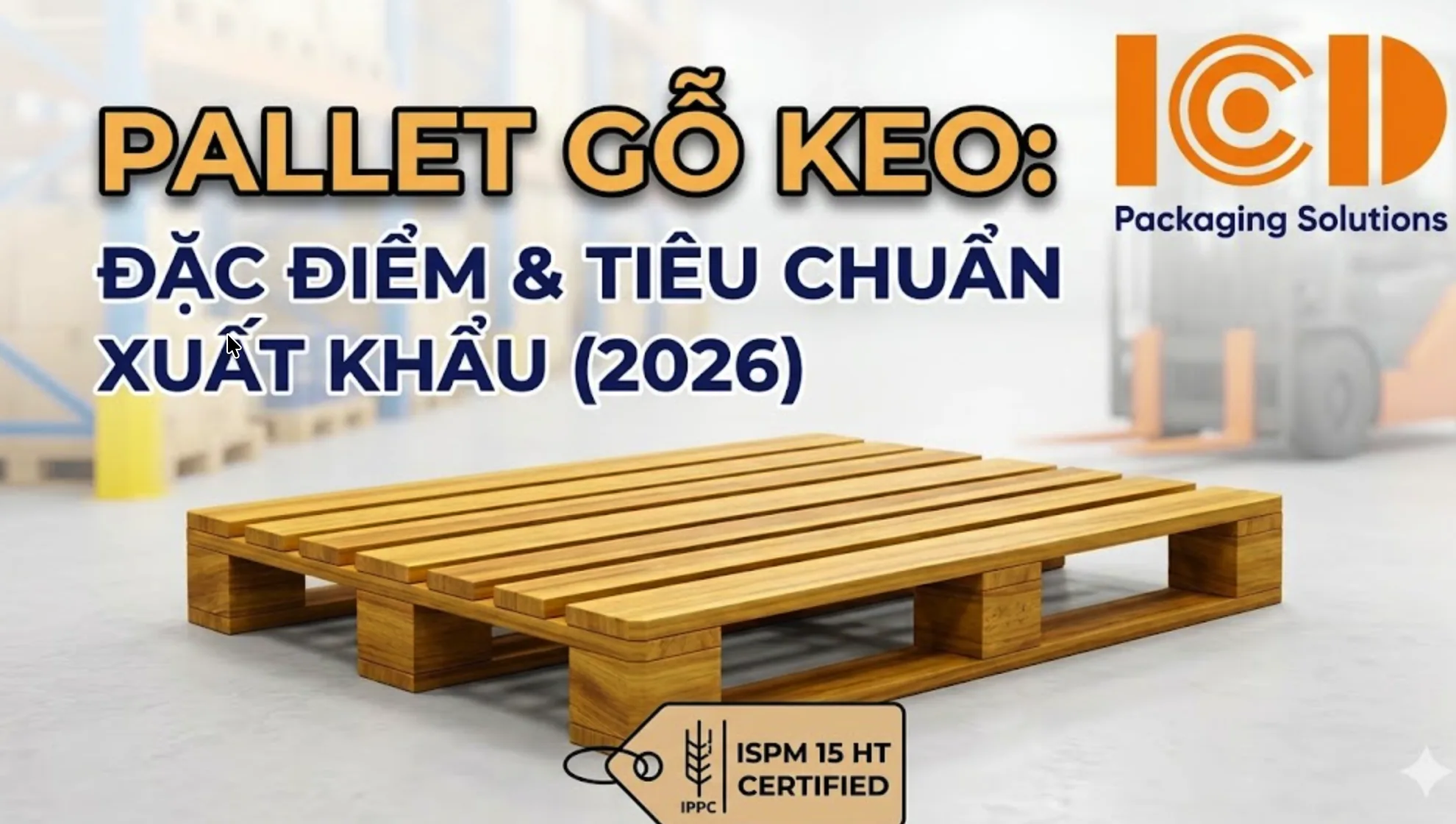

ICD Vietnam Wooden Pallets - Price List, EPAL, ISPM-15 (2026)
ICD manufactures acacia, rubberwood, pine, melaleuca and MDF pallets plus 9 EPAL/EU codes - prices from VND 130,000 to VND 580,000/unit, with in-house ISPM-15 processing and certificates issued in 24-72h.
- In-house HT drying + in-house MB fumigation - no third-party dependence, IPPC stamp applied directly onto finished pallets.
- MOQ 50 units - 5-8% discount from 500 units, project pricing for orders ≥2,000 units.
- Two-region delivery: Hanoi warehouse (Thien Loc) and HCMC warehouse (District 12) - 24-48h dispatch for stock items.
- Made to custom drawings from MOQ 200 units - special sizes, board count, deck thickness to order.
ICD Wooden Pallet Range
Click each code to see detailed dimensions, load capacity, real photos and to order online.
By wood type
| Acacia Wooden Pallet | Rubberwood Pallet | Pine Wooden Pallet |
| Melaleuca Wooden Pallet | Pressed Wood Pallet (MDF/Plywood) |
By EPAL/EU standard
| EPAL CP1 Pallet (1000x1200x138) | EPAL CP2 Pallet (800x1200x138) | EPAL CP3 Pallet (1140x1140x138) |
| EPAL CP4 Pallet (1100x1300x138) | EPAL 6 EU Pallet (800x600x144) | Used EPAL EU Pallet (800x1200x144) |
ICD Wooden Pallet Price List 2026
Reference prices for single orders of 50 units, including HT drying and ISPM-15 fumigation (if needed). Contact us for better pricing on large orders.
Standard wooden pallets (by wood type - size 1100x1100mm)
| Wood type | Dynamic load | Warehouse lifespan | Price/unit |
|---|---|---|---|
| Acacia pallet | 1,500-2,000kg | 4-6 years | VND 230,000 |
| Rubberwood pallet | 800-1,200kg | 3-5 years | VND 200,000 |
| Pine pallet | 1,000-1,500kg | 3-4 years | VND 300,000 |
| Melaleuca pallet | 1,200-1,800kg | 3-5 years | VND 185,000 |
| Pressed wood/MDF pallet | 800-1,000kg | 1-2 years | VND 130,000 |
EPAL/EU European-standard pallets
| Pallet code | Size (mm) | Dynamic/static load | Price/unit |
|---|---|---|---|
| EPAL CP4 | 1100x1300x138 | 1,500/4,500kg | VND 150,000 |
| Used EPAL EU | 800x1200x144 | 1,200/3,500kg | VND 215,000 |
| EPAL 6 EU (1/2 size) | 800x600x144 | 800/2,500kg | VND 280,000 |
| EPAL EU (standard Euro) | 800x1200x144 | 1,500/4,500kg | VND 420,000 |
| EPAL CP3 | 1140x1140x138 | 1,500/4,500kg | VND 420,000 |
| EPAL 2 EU | 1200x1000x162 | 2,000/5,000kg | VND 450,000 |
| EPAL CP2 | 800x1200x138 | 1,500/4,500kg | VND 450,000 |
| EPAL CP1 | 1000x1200x138 | 1,500/4,500kg | VND 480,000 |
| EPAL 3 EU (heavy duty) | 1000x1200x144 | 2,000/5,500kg | VND 580,000 |
Surcharges: HT treatment +VND 8,000-15,000/pallet | MB fumigation +VND 5,000-10,000/pallet | ISPM-15 certificate VND 50,000-200,000/batch | door delivery: free inner-city HN/HCM for orders ≥200 units.
Wholesale price by quantity (discount on base price)
| Quantity | Discount | Example: Acacia 1100×1100 | Note |
|---|---|---|---|
| 50-99 units | Base price | VND 230,000/unit | Minimum MOQ |
| 100-499 units | -3% | ~VND 223,000/unit | No deposit required |
| 500-999 units | -5 to -8% | VND 212,000-219,000/unit | Free inner-city HN/HCM shipping |
| 1,000-1,999 units | -8 to -12% | VND 202,000-212,000/unit | Provincial shipping support |
| ≥2,000 units | Project price | Contact for a quote | Interbank payment, long-term contract |
Comparison of 5 Pallet Wood Types
Quick selection rule: acacia = heavy load + most durable, rubberwood = natural mold resistance + F&B, pine = light + attractive for EU/US export, melaleuca = cheapest, pressed MDF = one-way indoor.
| Criteria | Acacia | Rubberwood | Pine | Melaleuca | Pressed MDF |
|---|---|---|---|---|---|
| Density (g/cm3) | 0.65-0.75 | 0.55-0.65 | 0.40-0.50 | 0.60-0.70 | 0.70-0.80 |
| Mechanical strength | Very good | Medium-fair | Fair | Fair | Medium |
| Natural mold resistance | Fair | Very good | Medium | Fair | Poor |
| Moisture tolerance | Fairly good after drying | Good | Medium | Fair | Very poor |
| Weight (1100×1100) | 20-25 kg | 17-22 kg | 12-17 kg | 18-23 kg | 22-28 kg |
| Warehouse lifespan | 4-6 years | 3-5 years | 3-4 years | 3-5 years | 1-2 years |
| Outdoor lifespan | 2-3 years | 1.5-2.5 years | 1-2 years | 1.5-2 years | Not advised |
| Price (1100×1100) | VND 230,000 | VND 200,000 | VND 300,000 | VND 185,000 | VND 130,000 |
| Best for | Steel, cement, heavy goods | Pharma, F&B, long-term storage | EU/US export, light goods | Low-cost domestic logistics | One-way, internal floor lining |
Read more: Rubberwood vs pine comparison | Rubberwood vs xoan dao wood | Guide to choosing pallet wood
Choosing a Wooden Pallet by Industry
Each industry has different size, load, moisture and certification requirements. A quick reference to choose the right type:
| Industry | Recommended size | Wood type | Special note |
|---|---|---|---|
| Export to Europe (EU) | EUR1/EPAL 800x1200x144 | Pine (light, attractive) or Acacia | HT mandatory - MB banned; EPAL stamp needed if entering the pool |
| Export to US/Canada | GMA 48″x40″ (1219×1016) | Southern Yellow Pine | HT or MB; Walmart/Costco use GMA spec |
| Export to Japan | JIS Z 0601 - 1100×1100 | Acacia or Pine | Wood moisture <18%; Toyota/Sony/Panasonic use JIS |
| Export to Korea | KS A 2155 - 1100×1100 | Acacia (Samsung/LG supplier) | Hyundai, Kia often require custom drawings |
| Food, F&B (non-frozen) | 1200×1000 or 1100×1100 | Rubberwood (mold-resistant, hygienic) | Wood moisture <20%; indirect contact, no touching fresh food |
| Frozen goods (-18 to -25°C) | 1200×1000 4-way | Acacia (well-dried, moisture <15%) | Wood must be dried below 15% before cold storage to avoid shrinkage |
| Chemicals (CEFIC/EPAL CP) | EPAL CP1-CP9 by type | Acacia or Pine (per CP spec) | Do not use MDF/glued boards - chemicals seep through glued ends |
| Steel, cement, building materials | 1200×1000 or 1000×1000 | Acacia (highest load) | Needs 4-way for forklift access from all sides; static load >3,000kg |
| Domestic logistics (rotating) | 1100×1100 or 1200×1000 | Melaleuca (cheap) or Acacia | No ISPM-15 needed; prioritize low cost, manage handover rotation |
Guide to Choosing Pallet Load Capacity
The most common mistake: choosing a pallet by price instead of actual load. The calculation rule:
Required load = Shipment weight (kg) / Number of pallets in the shipment
Example: a 20-ton shipment on 40 pallets = 500kg/pallet, so choose a pallet with dynamic load ≥600kg (a 1.2x safety factor).
| Load requirement | Suitable pallet type | Wood material | Price range |
|---|---|---|---|
| ≤500kg (light goods) | 2-way or thin 4-way | Melaleuca, MDF, small Acacia | VND 130-185k |
| 500kg - 1 ton | 4-way with thick stringers | Rubberwood or Melaleuca | VND 185-210k |
| 1 - 1.5 ton | 4-way double stringers, Acacia/Rubberwood | Acacia or Rubberwood | VND 200-230k |
| 1.5 - 2 ton | Acacia 4-way heavy, EPAL 2 EU | Acacia (required) | VND 230-450k |
| >2 ton / multi-tier stacking | EPAL 3 EU or Acacia heavy duty | Acacia (required) | VND 450-580k |
Stacking note: each stacked pallet tier reduces the actual usable load. Stacking 3 tiers means the bottom pallet bears the weight of the tiers above. Calculate for the actual number of stack tiers in your warehouse.
Wooden Pallet vs Plastic Pallet - ICD’s Objective Analysis
ICD supplies both wooden and plastic pallets. The analysis below is objective - not biased either way - so you can choose the right type for each use case.
| Criteria | Wooden Pallet | Plastic Pallet | Conclusion |
|---|---|---|---|
| Initial purchase price | VND 130-300k/unit | VND 400-900k/unit | Wood wins |
| Number of uses (average) | 10-25 cycles | 30-60 cycles | Plastic wins |
| 5-year TCO (see table below) | Cheaper at <20 cycles | Cheaper at >35 cycles | Depends on cycle count |
| Maximum load | 1,500-5,500kg | 1,000-3,000kg | Wood wins for ultra-heavy goods |
| Export - ISPM-15 | Must be treated + fee | Exempt (no organisms) | Plastic wins (many batches/year) |
| GMP/Pharma hygiene | Hard to clean, can mold | Easy to clean, non-absorbent, no mold | Plastic wins |
| Repair when damaged | Easy - nail + replacement board | Hard - needs specialized plastic welding | Wood wins |
| Size customization | Very easy - to drawing | Needs a custom mold = high cost | Wood wins (special sizes) |
| End of life | Biodegradable, biomass | Hard to recycle, emits when burned | Wood wins (environmental sustainability) |
| Self weight | 12-28 kg | 9-18 kg | Plastic is lighter (saves shipping) |
Quick selection rule: <20 use cycles = choose wood; >35 cycles = choose plastic; 20-35 cycles = calculate actual TCO. Many export trips/year = prefer plastic (no ISPM-15 cost). Pharma/GMP warehouse = plastic required.
See the full range: ICD Vietnam Plastic Pallets - 12 product lines, from VND 320,000.
TCO Analysis - Single-Use vs Reusable (5 years)
TCO (Total Cost of Ownership) is the total cost per transport trip across the pallet’s whole lifecycle. The table compares two common scenarios:
| Item | Acacia Pallet (reusable) | Plastic Pallet (reusable) | Pressed Wood Pallet (single-use) |
|---|---|---|---|
| Purchase price | VND 230,000 | VND 600,000 | VND 130,000 |
| Average cycles | 20 cycles | 50 cycles | 1 time |
| Repair cost (5 years) | 3 x VND 30,000 = VND 90,000 | VND 0 (no repair) | VND 0 |
| Total cost | VND 320,000 | VND 600,000 | VND 130,000/trip |
| Cost/cycle | VND 16,000/trip | VND 12,000/trip | VND 130,000/trip |
Conclusion: Plastic pallets are 25% cheaper when used a full 50 cycles (12k vs 16k/trip). Acacia wood pallets are cheaper at <30 cycles. One-way pressed wood pallets only suit cases where a total cost of VND 130k for one trip is acceptable (final-leg export, sample goods, seasonal).
ISPM-15 Standard - Requirements by Market
Summary: all export wooden pallets must undergo HT (heat treatment 56°C/30 min core) or MB (Methyl Bromide fumigation), with an FAO-standard IPPC stamp. See ISPM-15 standard details.
| Market | Treatment requirement | Common size | Note |
|---|---|---|---|
| EU (Germany, France, Netherlands…) | HT mandatory, MB banned since 2010 | EUR1/EPAL 800×1200 | Carrefour, Tesco, Aldi require a valid EPAL stamp. |
| US (USA, Canada) | HT recommended, MB accepted | GMA 48″x40″ (1219×1016) | Walmart, Costco, Target use GMA. |
| Japan | HT or MB | JIS Z 0601 - 1100×1100 | Toyota, Sony, Panasonic use JIS. |
| Korea | HT or MB | KS A 2155 - 1100×1100 | Hyundai, Kia, Samsung often require custom drawings. |
| Australia, New Zealand | HT mandatory, strict quarantine | 1165×1165 (AS 4068) | Australian customs inspect strictly; the stamp must be clear. |
| China | HT or MB | Loscam/CHEP 1100×1100 | Loscam pool pallets are often used at distribution warehouses. |
| Middle East, Africa | Some markets do not require it | 1200×1000 or per buyer | Still advisable to fumigate to avoid mold on long shipments. |
| Domestic Vietnam | Not mandatory | 1100×1100 or 1200×1000 | HT drying recommended for humid warehouses or long-stored goods. |
ICD process: receive order, choose HT or MB by market, assemble pallet, dry/fumigate, apply IPPC stamp (code VN-XXX, HT or MB symbol, production year), issue certificate + customs documents. The full cycle is 24-72h depending on quantity.
EPAL Standard - The European Wooden Pallet System
EPAL (European Pallet Association) manages 11 wooden pallet codes under DIN EN 13698. Each pallet is stamped with EPAL plus the factory code and production year - no stamp means no entry into the Euro pool. See EPAL and the Euro stamp in detail.
| Code | Size (mm) | Dynamic load | Static load | Main application |
|---|---|---|---|---|
| EPAL EU (Euro) | 800x1200x144 | 1,500kg | 4,500kg | Standard Euro pallet - 90% of EU logistics |
| EPAL 2 EU | 1200x1000x162 | 2,000kg | 5,000kg | Industrial size for Asia-Europe import/export |
| EPAL 3 EU | 1000x1200x144 | 2,000kg | 5,500kg | Heavy duty - chemicals, pharma, machinery |
| EPAL 6 EU | 800x600x144 | 800kg | 2,500kg | Half-pallet - retail, supermarket display |
| EPAL CP1 | 1000x1200x138 | 1,500kg | 4,500kg | Chemical Pallet - CEFIC |
| EPAL CP2 | 800x1200x138 | 1,500kg | 4,500kg | Chemical size Euro |
| EPAL CP3 | 1140x1140x138 | 1,500kg | 4,500kg | Square - paint, solvents |
| EPAL CP4 | 1100x1300x138 | 1,500kg | 4,500kg | Special-size chemical pallet |
| EPAL CP5-CP9 | Other sizes | 1,000-2,000kg | 3,000-5,000kg | To order, ICD accepts |
A valid EPAL must have: the EPAL stamp hot-pressed onto the 4 corner blocks, the factory code (license), the production year, and the ISPM-15 code. A pallet missing any of the 4 marks is rejected at the EU border.
Wooden Pallet Storage - Technical Specs
Proper storage can extend a wooden pallet’s lifespan by 30-50%. Mandatory parameters for warehouse management:
Humidity and temperature
- Warehouse humidity: <75% RH (mold and fungus start >75%)
- Wood moisture on delivery: <20% (measured with a handheld meter)
- Wood moisture for cold storage (<5°C): mandatory <15%
- Normal warehouse temperature: 10-35°C (avoid large fluctuations)
Placement and stacking
- Do not place directly on the ground (moisture rises) - rest on wooden racks or plastic pallets
- Stack a maximum of 6-8 empty pallets (unloaded)
- Loaded: stack a maximum of 3-4 tiers (account for cumulative load)
- Pallets warped >5mm must be separated, not stacked further
Inspection cycle
- Periodic inspection: once every 3 months
- Lengthwise board crack >1/3 of length: replace the board immediately
- Nails protruding 1mm+ above the board: hammer back in
- Cracked corner blocks (EPAL): remove, do not circulate
- Faded or covered ISPM-15 stamp: re-issue the certificate before export
Repair and reuse
- Replace a broken board: 60-80mm nails, same wood type, equivalent thickness
- Replace a bottom stringer: do not part-replace, replace the whole cluster (3 stringers per row)
- After replacing <30% of boards: still usable at the original load
- After replacing >30% of boards: downgrade the load, use for lighter goods
Wooden Pallet Receiving Checklist
7 mandatory check points when receiving a wooden pallet batch from a supplier:
- Count the quantity: the actual count must match the delivery note (detect shortages before signing the record).
- Check the IPPC stamp: if ISPM-15 fumigation was ordered, the stamp must have the IPPC logo + country code VN-XXX + treatment method HT or MB + production year. The stamp must be hot-pressed into the wood, not ink-printed.
- Measure wood moisture: use a handheld moisture meter, result <20% (or <15% if for cold storage). Request ICD’s measurement result before delivery for special orders.
- Check the top deck: no board cracked more than 30% of its length, no snapping, no lifting >2mm.
- Check the bottom stringers: the 3 bottom stringers (2 edges + 1 middle) must be straight, not warped more than 5mm, no glue separation or lengthwise cracks.
- Check the corner blocks (for EPAL): all 9 blocks present, firm, with a clear EPAL stamp embossed on the corner blocks. Cracked corner blocks = the pallet is below standard.
- Sign the record promptly: sign the receiving record within 24h. Report any issues with photos + email to ICD the same day.
When to USE and NOT USE Wooden Pallets
USE wooden pallets when
- You need a heavy load >1,500kg at a lower cost than plastic.
- Exporting to EU/US - EPAL or GMA is required.
- Heavy goods: steel, cement, building materials.
- One-way pallets - not rotating many times.
- You need a special size to a custom drawing.
- Limited budget, prioritizing low investment cost.
- Frozen goods in cold storage (well-dried wood <15% moisture).
Do NOT use wooden pallets when
- GMP cleanroom pharmaceutical warehouse - must use plastic.
- You need to rotate >35 cycles (plastic is cheaper on TCO).
- Strongly corrosive chemical warehouse (concentrated acid, base).
- Fresh food in direct contact (fish, meat).
- Frequently humid warehouse without mold protection.
- You need an ultra-light pallet <10kg for air freight.
- ESD anti-static cleanroom electronics.
Torn between wooden and plastic pallets? See the plastic pallet range to compare prices and full specs.
Related Articles About Wooden Pallets
Frequently Asked Questions (FAQ)
1. How much is an ICD wooden pallet per unit?
Prices range from VND 130,000 (small pressed MDF pallet) to VND 580,000 (EPAL 3 EU heavy duty). The most common acacia pallet 1100×1100 is VND 230,000/unit. Orders ≥500 units get a 5-8% discount.
2. Which wood is best for making pallets?
It depends on the purpose. Acacia is the most durable for heavy loads. Rubberwood has the best natural mold resistance for long-term storage. Pine is attractive and light for EU/US export. Melaleuca is the cheapest of the natural woods. Avoid pressed MDF for outdoors or humid warehouses.
3. What standards must export wooden pallets meet?
ISPM-15 treatment (HT or MB) and an IPPC stamp are mandatory. The EU specifically requires HT (MB banned). EU export also needs an EPAL stamp if entering the pool. ICD issues full certificates in 24-72h.
4. Does ICD make wooden pallets to custom drawings?
Yes. ICD produces to custom drawings from MOQ 200 units - dimensions, board thickness, bottom stringer count, with or without a block base, all to order. Free quote after receiving a CAD file or sketch.
5. How long do ICD wooden pallets last?
In a dry warehouse: acacia 4-6 years, rubberwood 3-5 years, pine 3-4 years. Outdoors: an average of 1.5-3 years depending on wood type and rainfall. Pressed MDF pallets only 1-2 years and not for outdoor use.
6. How does an EPAL pallet differ from an ordinary wooden pallet?
EPAL has dimensions, board count, block count, board thickness and load to the DIN EN 13698 standard - no deviation allowed. Each pallet has the EPAL stamp hot-pressed on the 4 corner blocks plus the factory code. Ordinary pallets are freely designed, with no certification stamp.
7. Does ICD buy back used wooden pallets?
Yes. ICD buys used EPAL EU pallets with an intact stamp and 80%+ sound condition at VND 100,000-180,000/unit depending on condition. Ordinary pallets are bought at VND 50,000-120,000/unit. Contact us directly for a batch quote.
8. What is the wooden pallet delivery time?
Stock items (acacia, rubberwood, melaleuca in 1100×1100 or 1200×1000): 24-48h. Custom-drawing production: 5-10 days depending on quantity. Stamped EPAL orders: 7-14 days including ISPM-15 fumigation.
9. Can pressed wood pallets be used for export?
Yes - and an interesting point: pressed pallets (MDF, OSB, plywood) do NOT need ISPM-15 because they have already undergone heat-glue processing at the factory. However, durability is low, they hate moisture and cannot be used for many cycles - they only suit one-way pallets.
10. What wood moisture meets the ISPM-15 standard?
ISPM-15 does not specify a maximum moisture - it only requires HT heat treatment reaching 56°C/30 min core. However, ICD recommends delivering pallets at <20% moisture (handheld meter) to limit warping and mold during transport. Goods entering cold storage (<5°C) should reach <15%.
11. Do you ship wooden pallets to far provinces?
Yes. ICD has 2 warehouses (Hanoi and HCMC) delivering nationwide. Orders ≥200 units get free inner-city HN/HCM shipping. Inter-provincial orders are charged by truck (VND 200-1,500k depending on distance). For orders ≥500 units to far provinces, ICD supports part of the cost.
12. Are ICD wooden pallets FSC certified?
ICD uses domestic plantation wood (acacia, rubberwood, melaleuca - FSC group II), not natural-forest logging. Imported pine (for EPAL EU/US export) can comply by origin (Australia, New Zealand, US supply FSC-certified SYP). For a specific FSC certificate: contact us for a per-batch answer.
Contact ICD Vietnam
ICD Vietnam Manufacturing & Industrial Co., Ltd
Wooden pallet quotes per project - response within 2-4 business hours. Technicians advise on the right type + spec for free.
| North | 0983 797 186 / 090 345 9186 / 090 5859 186 |
| South | 098 6784 186 |
| sales@icdvietnam.com.vn | |
| Hanoi warehouse | 3rd Floor, Thang Long A1 Building, Bau Hamlet, Thien Loc Commune, Hanoi |
| HCMC warehouse | 551/212 Le Van Khuong, Tan Thoi Hiep, District 12, HCMC |