
Mục lục
Acacia wood and rubberwood represent two entirely different segments of the timber market. While acacia (especially the Gia Lai variety) offers high hardness and a luxurious appearance suited to premium furniture such as altar cabinets, daybeds, and doors, rubberwood is the go-to solution in industrial pallet production and modern furniture manufacturing. At roughly one-third the price of acacia, with abundant supply and strong environmental credentials, rubberwood is the optimal choice for logistics and packaging businesses.
1. Two completely different market segments
In Vietnam’s natural timber market, acacia wood and rubberwood are frequently compared, yet in practice they serve very different purposes.
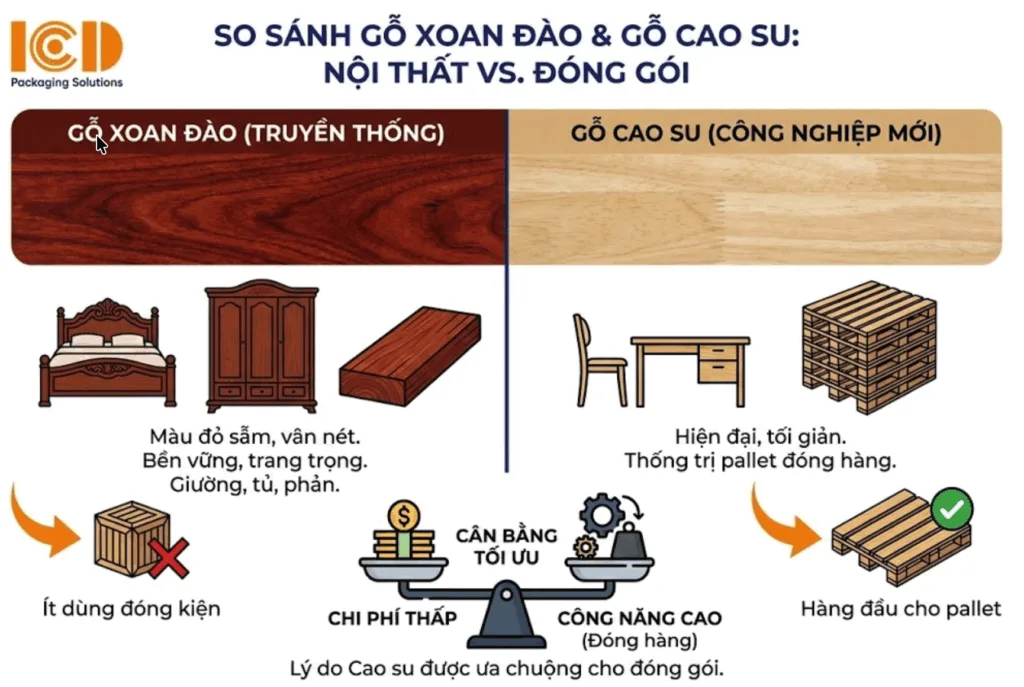
Acacia is a traditional hardwood deeply rooted in Vietnamese culture. Its characteristic dark-red colour and pronounced grain make it the wood of choice for durable, prestigious household furniture - bed frames, wardrobes, and large daybeds.
Rubberwood, by contrast, is a new-generation engineered timber. It has captured the minimalist modern furniture market and, above all, dominates export pallet manufacturing. The reason so few pallets are made from acacia while rubberwood leads that segment comes down to the balance between cost and functional performance.
2. Side-by-side comparison of technical and economic criteria
The table below gives a quick overview of the key differences between the two species.
| Criterion | Rubberwood (Hevea brasiliensis) | Acacia (Gia Lai / South Africa) |
|---|---|---|
| Price | Low (approx. 4.5 - 6 million VND per cubic metre) | High (approx. 12 - 16 million VND per cubic metre) |
| Colour | Pale yellow; accepts stains and paints easily | Deep reddish-brown; prominent, elegant grain |
| Hardness | Medium; good flexibility and resilience | Hard, dense, and heavy (especially old-growth timber) |
| Pest resistance | Requires thorough heat treatment to meet ISPM 15 | Naturally resistant to borers due to bitter extractives |
| Primary applications | Pallets, wooden crates, modern dining furniture | Daybeds, altar cabinets, premium doors, staircases |
3. Types of acacia wood available on the market
For a more complete picture, it is important to understand that not all acacia wood is the same. Quality and price vary considerably by origin.
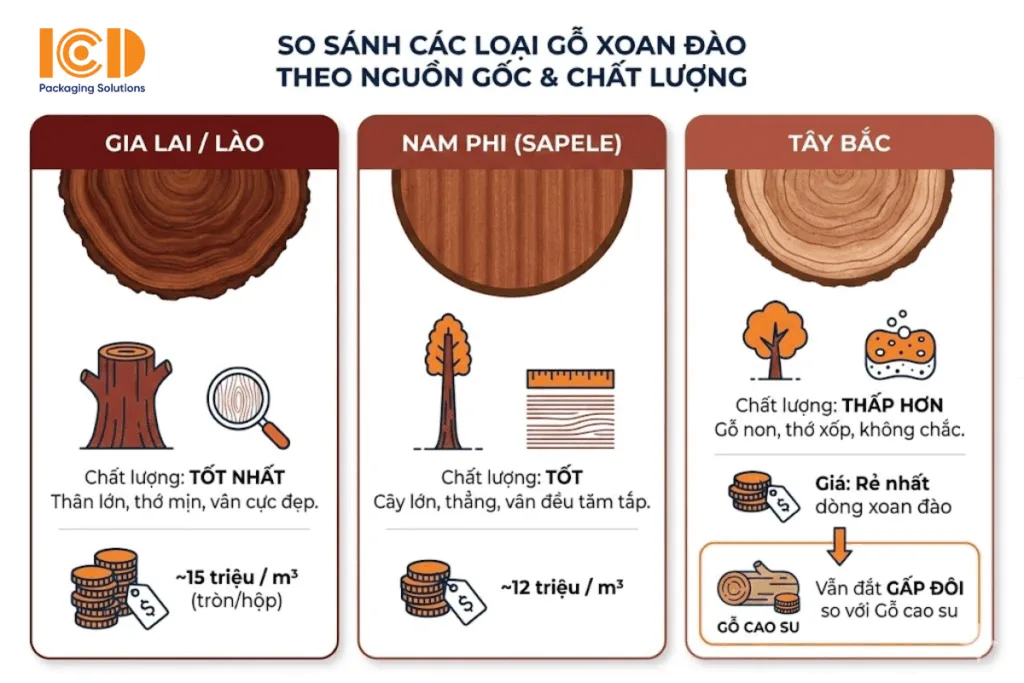
- Gia Lai or Laos acacia: The highest-quality variety, with large trunks, fine grain, and exceptionally beautiful figure. This commands the highest price, around 15 million VND per cubic metre of round or sawn timber.
- South African acacia (Sapele): Large, straight trunks with very even grain. Quality is excellent but the price is slightly lower than the Gia Lai variety, typically around 12 million VND per cubic metre.
- Northwestern Vietnam acacia: Generally younger trees with a more open, less dense grain. The cheapest of the acacia types, yet still roughly twice the price of rubberwood by market value.
4. Why rubberwood leads industrial pallet production
If acacia is the choice for prestige, rubberwood is the answer to cost efficiency in logistics and warehousing. At ICD Vietnam, rubberwood is our material of choice for export pallets for the following key reasons.
4.1. Cost is the decisive factor
To build a pallet capable of carrying 1 tonne, using acacia would bring raw material and labour costs to roughly 1.5 - 2 million VND per unit - far too expensive for a packaging material whose purpose is simply to support goods in transit. A rubberwood pallet of equivalent load capacity costs approximately 250,000 - 300,000 VND. Choosing rubberwood allows businesses to cut operating costs by up to 80% while still guaranteeing cargo safety.
4.2. Abundant and stable supply
Acacia is largely dependent on imports or harvesting from natural forests that are increasingly scarce. This creates serious difficulties when fulfilling large-volume pallet orders of tens of thousands of units per month. Rubberwood is different: it is sourced from Vietnam’s extensive rubber plantations. Supply is always available to meet large-scale industrial park orders without risk of supply-chain disruption.
4.3. Environmental responsibility
Using rubberwood is a genuinely sustainable choice. It is harvested from trees that have completed their latex-producing cycle - instead of being burned, they are converted into a useful material. Prioritising rubberwood reduces pressure on natural forests where precious hardwoods like acacia grow. International markets, particularly in Europe, consistently favour products sourced from clean, sustainable timber.
5. Conclusion
The right wood depends entirely on the intended use. If you need prestige and elegance for a living space, Gia Lai or South African acacia is irreplaceable.
However, if your goal is to optimise costs for logistics, export crating, or pallet production, rubberwood from ICD Vietnam is the leading solution. Choose the right wood for the right purpose and achieve the highest possible return on investment.
Related articles
| What is rubberwood? Price table and applications | Rubberwood vs oak: which performs better? | Is rubberwood good? An honest assessment |
1. What is the main difference between rubberwood and acacia wood?
They serve different markets. Acacia is a premium hardwood used for high-end furniture - dark colour, hard, heavy, and expensive at 12 - 16 million VND per cubic metre. Rubberwood is an industrial timber suited to pallet manufacturing and modern furniture, priced at 4.5 - 6 million VND per cubic metre.
2. Why is rubberwood used for pallets rather than acacia?
Cost is the decisive factor. A rubberwood pallet costs 250,000 - 300,000 VND, while the same pallet in acacia would cost 1.5 - 2 million VND. Rubberwood also has stable, abundant supply from Vietnam’s rubber plantations, making it practical for large-volume orders.
3. Is rubberwood durable enough for heavy pallet loads?
Yes. Properly heat-treated rubberwood meets ISPM 15 standards and withstands loads of 1 tonne or more per pallet. Its medium hardness and good flexibility actually reduce the risk of splitting under dynamic warehouse loads.
4. Which type of acacia wood is best quality?
Gia Lai (Vietnam) and Laos acacia rank highest, with large trunks, fine grain, and excellent figure, priced around 15 million VND per cubic metre. South African acacia (Sapele) is similarly high quality at about 12 million VND. Northwestern Vietnam acacia is the most affordable variety but still costs roughly twice as much as rubberwood.
5. Does rubberwood resist termites and borers?
Untreated rubberwood is susceptible to borers because it retains residual latex sugars. However, after proper kiln-drying and heat treatment to ISPM 15 standards, the risk is eliminated and the timber is safe for export pallets and furniture.
6. Is rubberwood environmentally friendly?
Yes. Rubberwood comes from trees that have finished their latex-producing life cycle - timber that would otherwise be burned. Using it reduces pressure on natural forests and meets the sustainability requirements of European and other international markets.
Contact ICD Vietnam
Hotline: 0983 797 186 / 090 345 9186 / 090 5859 186
Email: sales@icdvietnam.com.vn | Zalo: Chat Zalo