
Table of Contents
- What is a used wooden pallet?
- What should you check before buying used wooden pallets?
- Tips for storing used wooden pallets
- Price and quality compared: used wooden pallets
- Frequently asked questions about used wooden pallets
- Are used wooden pallets reliable?
- What are the cost benefits of used wooden pallets?
- What are the environmental benefits of used wooden pallets?
- Can used wooden pallets be used for export?
- What should I check when buying used wooden pallets?
- What does the price of used wooden pallets depend on?
- Should I use a used pallet with an MB mark to make furniture?
- Contact us for wooden pallet advice
- References
| Product type | Main application | Reference price |
|---|---|---|
| Used wooden pallet 1100×1100 | Storage, domestic | 40,000 - 90,000 |
| Used wooden pallet 1200×1000 | Logistics | 65,000 - 100,000 |
| Used pallet for one-way export | Export | 90,000 - 150,000 |
Market survey 14/09/2026. Reference price; contact hotline 0983 797 186 for exact quote. Call 0983 797 186 or Zalo ICD for the most accurate quote.
A used wooden pallet is a pallet that has been through at least one shipping cycle, then collected, sorted, repaired and resold at a lower price than a new one. Used pallets suit warehouse storage and domestic transport. For export cargo, the pallet must still carry a valid ISPM 15 mark, and if more than about one third of its parts have been replaced, it must be treated again and re-stamped.
With cost control and environmental protection now top priorities for many businesses, reusing pallets makes practical sense.
A used wooden pallet is a sensible choice when a business needs many pallets for warehouse storage and domestic transport and wants to cut packaging costs. The trade-off is that the buyer has to inspect every lot: sizes are uneven, the remaining service life is hard to predict, and for export cargo the ISPM 15 mark has to be read correctly. This article explains where used pallets come from, how they are graded, when they can be used for export, what to check on delivery, and how to store them so they last.
What is a used wooden pallet?
A used wooden pallet is one that has already served in transport and storage, and has then been collected, inspected and reused, repaired, or dismantled for its timber. Even after use, many are still structurally sound and carry loads well enough for everyday storage needs.
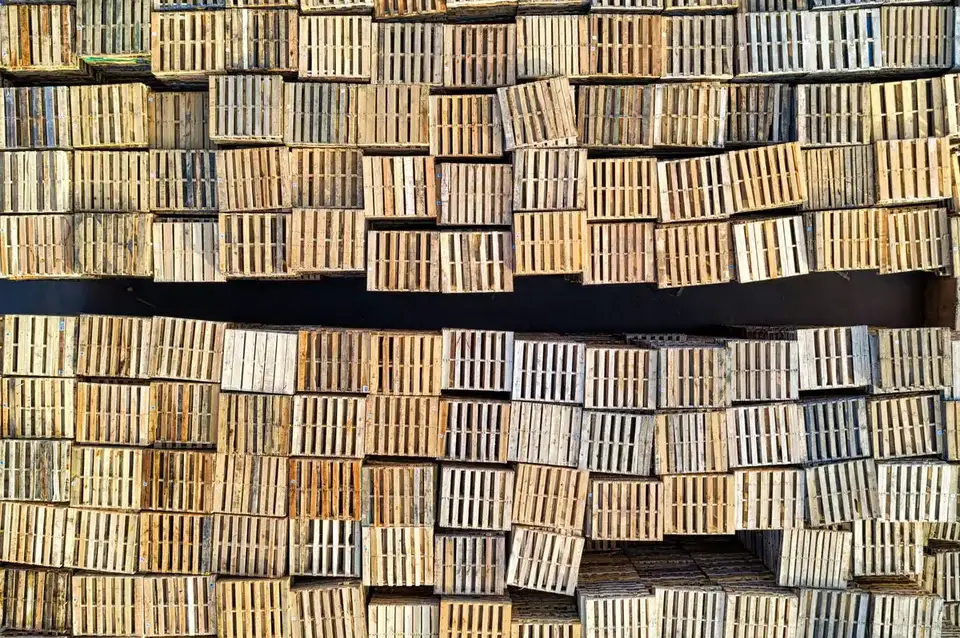
Drive along the major roads on the edge of any big city and you will see tall stacks of used pallets beside the road. These are collection yards that gather pallets from factories, warehouses and ports, sort them, and resell them by the lot to businesses that need them. Used pallets usually reach the market by three routes:
Pallets too damaged to resell whole are taken apart, and the usable boards are used to repair other pallets or made into other products.
How are used wooden pallets graded?
In Vietnam, used wooden pallets are usually split into three groups by condition: almost new, repaired, and good only for salvaging timber. Vietnam has no official standard for this grading, so buyers need to agree the criteria with the seller before confirming a lot.
| Grade | Typical condition | Best used for |
|---|---|---|
| Grade A (almost new) | Few trips behind it, boards and blocks intact, few cracks, no warping | Warehouse storage, domestic transport, stacking, and racking if the dimensions suit |
| Grade B (repaired) | A few boards or blocks replaced, some scratches, uneven wood colour | Floor storage, internal transport, medium-load goods |
| Grade C (salvage) | Many boards broken, split, rotten or warped | Dismantled for timber to repair other pallets, for crafts, or crushed for fuel |
Beyond condition, used pallets are also sorted by size (commonly 1000 x 1200 mm, 1100 x 1100 mm and 800 x 1200 mm), by two-way or four-way entry, and by wood species (pine, acacia, rubberwood). Because the supply comes from many factories, a lot of used pallets is rarely as uniform as new pallets built to order.
Because each seller sets its own A, B and C grades, the same label “Grade A” at two suppliers can mean two different quality levels. The safe approach is to write the acceptance criteria into the order: how many boards may be replaced, how much cracking is acceptable, whether an ISPM 15 mark is required, and limits on moisture and smell. Then check each lot on delivery against the inspection list further down.
Benefits of using used wooden pallets
The biggest benefit of a used wooden pallet is a lower purchase cost than a new one. Next come less timber harvested and less wood sent to landfill.
On cost, a used wooden pallet is clearly cheaper to buy than a new pallet of the same size, which reduces spending on pallets for storage and transport, especially for small and medium businesses that need many pallets for a warehouse. That saving only holds if the pallet lasts long enough: a cheap lot that loses boards after a few handling cycles brings replacement and repair costs and a risk of damaged goods.
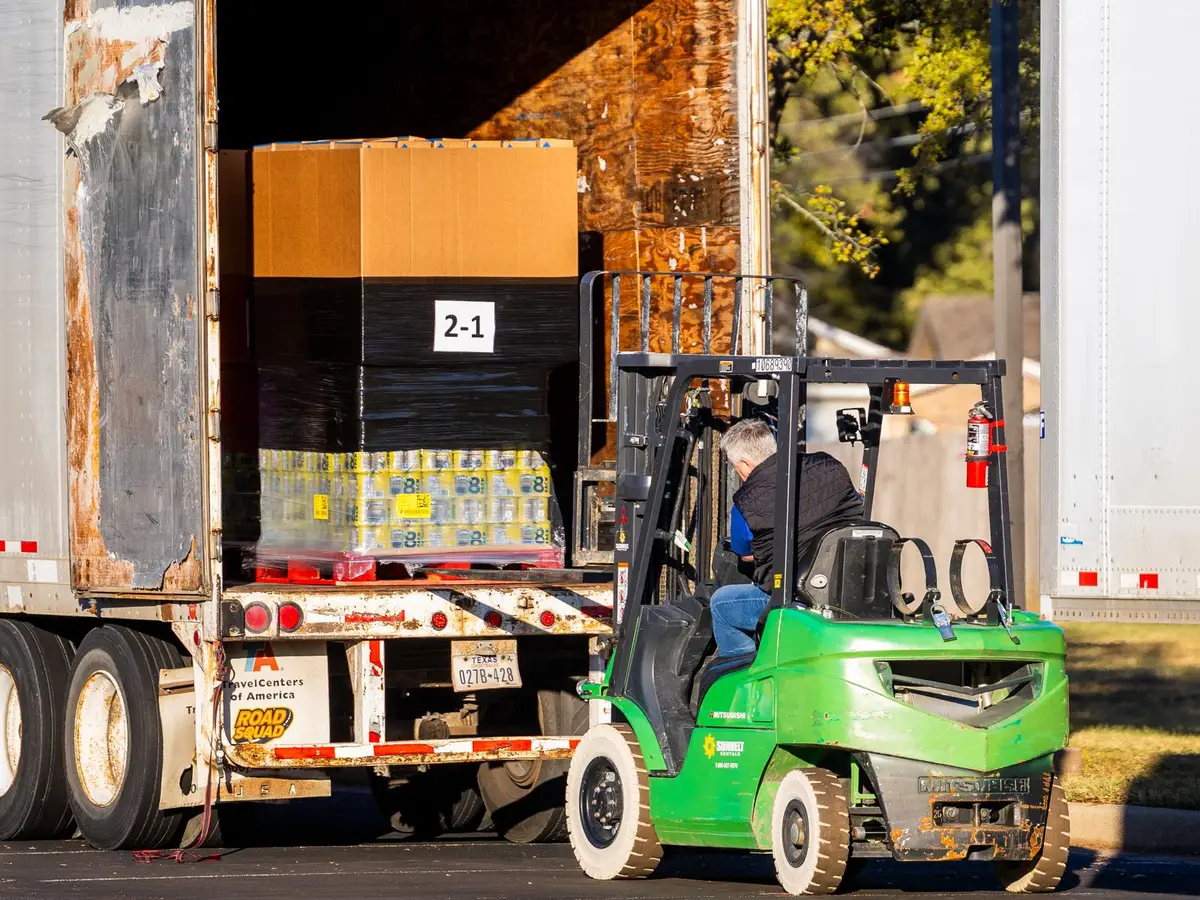
On the environmental side, every reuse is a pallet that does not have to be built from newly harvested timber, and less waste wood to dispose of. Used pallets are also flexible in use, from supporting goods in logistics to furniture and decoration. Used for a long time and passed through many cycles, a used wooden pallet becomes a link in the circular economy, where harvested material stays in use for as long as possible.
The environmental benefit has measurable figures in markets that run organised pallet recovery. According to a survey by Virginia Tech and the US Forest Service, the number of wooden pallets landfilled in the United States fell from about 138 million in 1998 to about 13.1 million in 2016, because most damaged pallets were repaired, dismantled for parts or ground into raw material.
Uses of used wooden pallets
Used wooden pallets are mostly used to support and move goods domestically. The rest are reused for furniture, decoration and outdoor structures.
In logistics, used pallets support and move goods inside warehouses and on domestic routes. They can also travel with export cargo, but only if the ISPM 15 mark is still valid and any repairs followed the rules, which the standards section below explains in detail.
Outside the warehouse, used wooden pallets are a familiar material for do-it-yourself projects: tables, chairs, bookshelves and rustic bed frames, or decoration for cafes and restaurants that want a natural-wood feel. Outdoors, pallets are assembled into fences, planters, garden play areas, stage floors or exhibition booths. For anything used close to people, choose clean pallets, sand them smooth and hammer down every protruding nail.

The used wooden pallet market worldwide
Reusing wooden pallets is common in many countries, not just Vietnam. The need to reuse and the pressure to cut waste are making this market larger in more and more countries.
The United States has the most complete data. According to a survey by the US Forest Service and Virginia Tech, in 2016 the US pallet industry produced about 513 million new wooden pallets and also recovered and resold about 326 million pallets as repaired or remanufactured units. The 48 x 40 inch size (about 1219 x 1016 mm) made up 69% of the recycled pallet market, which shows that standard-size pallets circulate far more easily than custom sizes.
The lesson for buyers in Vietnam: pallets in common sizes such as 1000 x 1200 mm or 1100 x 1100 mm are easy to buy used and easy to resell, while pallets in a custom size built for one product are usually hard to collect in uniform quantities.
How used wooden pallets are recycled
A used wooden pallet goes through three stages: collection and sorting, repair of those still usable, and dismantling or crushing of the badly damaged ones to recover the wood.
- Collection and sorting: pallets are gathered from factories, warehouses, seaports and logistics companies, then divided by size, wood quality and degree of damage.
- Repair: broken boards and blocks are replaced, loose nails are re-driven, splinters are ground off, and pest treatment is applied to the pallets that are still usable.
- Timber recovery: pallets that cannot be repaired are dismantled for parts, or crushed into chips, pellets, and raw material for plywood and the paper industry.
The repair stage decides whether a used pallet can still be used for export cargo. Replacement boards and blocks must be heat-treated wood with their own mark. If too many parts are replaced, the pallet counts as remanufactured and must be fully treated again (see the Standards section below).
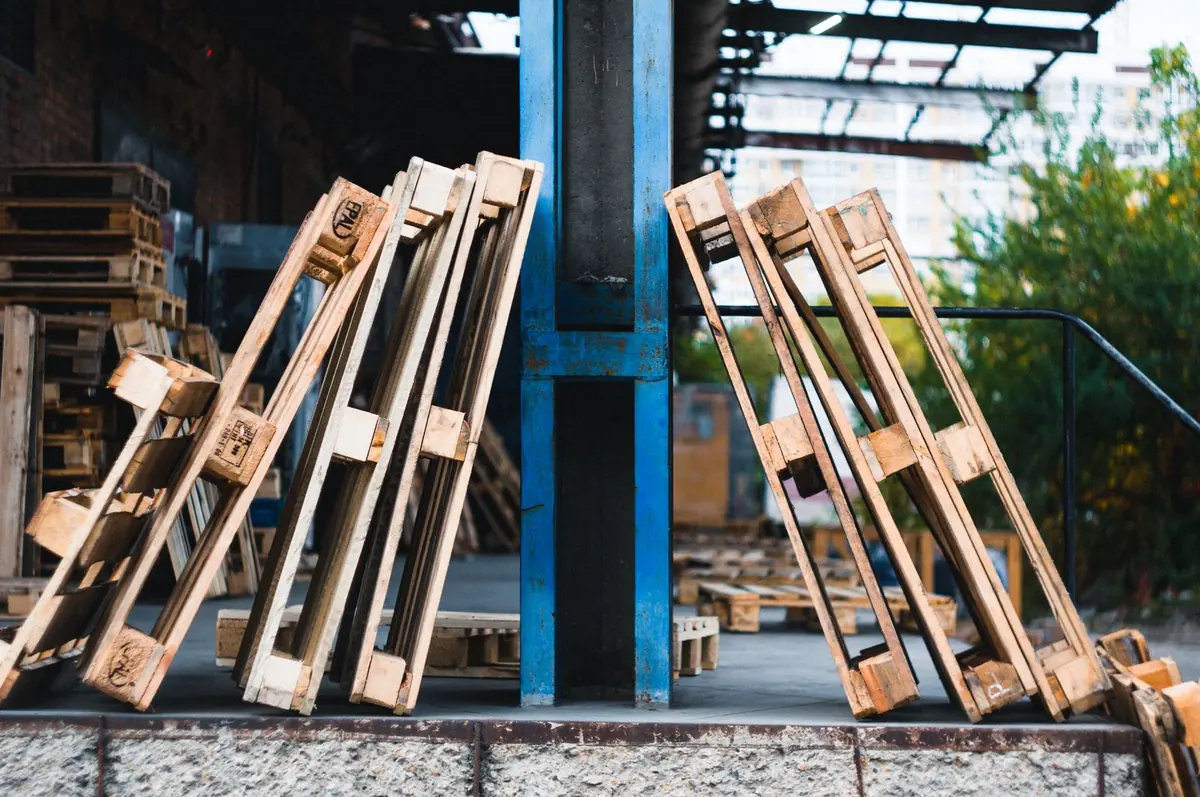
International standards and certification
The international standard that applies to used wooden pallets in export use is ISPM 15: the pallet must have been heat treated (HT) or fumigated with methyl bromide (MB) and carry a legible IPPC mark.
Many buyers call this requirement the “ISPM 15 standard”, but in fact ISPM 15 does not issue a certificate for each pallet. The proof is the IPPC mark stamped on the pallet, which shows it was treated by an approved method to kill wood-boring insects, nematodes and other pests before crossing a border. A compliant pallet carries the HT (heat treatment) or MB (methyl bromide fumigation) code in the mark.
A valid ISPM 15 mark has four elements inside a rectangular frame: the IPPC symbol, the two-letter ISO country code (VN for Vietnam), the treatment facility code issued by the plant protection authority, and the method code HT or MB. Handwritten marks, stick-on labels or faded marks that cannot be read are not accepted.
What buyers of used pallets often overlook is that ISPM 15 separates three cases by the extent of repair. The rule sits in section 4.3 of the standard and is explained in the ISPM 15 guidance published by the International Plant Protection Convention (IPPC):
| Case | Definition under ISPM 15 | Requirement for the IPPC mark |
|---|---|---|
| Reuse | A pallet that has been treated, stamped and not altered in any part | No new treatment needed; the existing mark stays valid for the life of the pallet |
| Repair | Up to about 1/3 of the components replaced | Only treated wood may be used as replacement, and each replacement part must carry its own mark; the plant protection authority may require the whole pallet to be treated again |
| Remanufacture | More than about 1/3 of the components replaced, built from old and new parts | All old marks must be permanently removed (painted over or ground off), the whole pallet treated again and then stamped with a new mark |
For cargo going to Europe, the MB mark needs to be understood correctly. According to the European Commission, the EU bans the use of methyl bromide inside the bloc, and the last exemptions ended on 18 March 2010, yet the EU still accepts imported wood packaging treated by HT or MB in line with ISPM 15. So a used pallet with a valid MB mark is not rejected just because of the MB code; what matters is that the mark is legible and the pallet has not been repaired in breach of the rules.
Sustainability trends
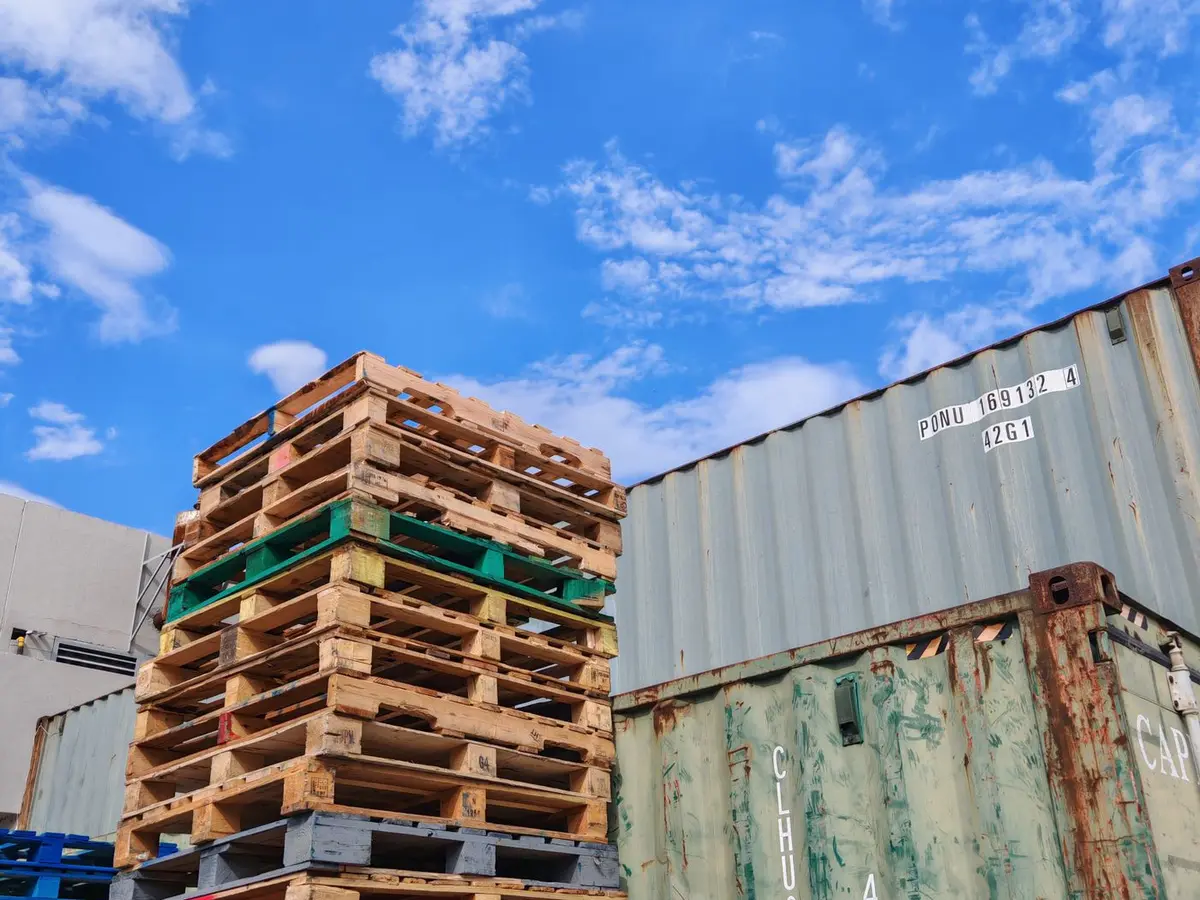
The general trend is to keep wooden pallets in a loop: reuse, repair, remanufacture, and only at the end crush them for fuel or raw material.
Within that loop, every time a pallet is reused or repaired instead of built new, demand for harvested timber falls, so does the energy needed to produce and transport new wood, and emissions fall with them. At business level, working with customers and suppliers on pallet recovery, or learning how countries with organised recovery systems such as the United States run repair and remanufacturing, lets pallets make more trips before they have to be crushed.
What should you check before buying used wooden pallets?
Before buying used wooden pallets, check the structure, the condition of the wood, the quarantine mark, and what the pallet previously carried.
Worker safety comes first: a pallet with a broken board or a loose nail can drop the load when a forklift lifts it or when pallets are stacked. Next is wood quality: pallets must be free of termites, rot and chemical contamination, because pests can travel with the pallet into goods and the warehouse. On the legal side, buy from a seller who issues invoices, states where the lot came from and follows the environmental rules for collecting and disposing of waste wood.

When a lot of used pallets arrives, you can follow this sequence:
- Measure a few pallets at random from the lot to confirm that size, height and entry type match the order.
- Check every pallet against the inspection list below and set aside those that fail.
- For pallets meant for export cargo, look for the ISPM 15 mark on two opposite sides and check that replacement parts carry their own mark.
- Keep the lot in a separate area for a few days before moving it into the main warehouse, and watch for wood dust or mould.
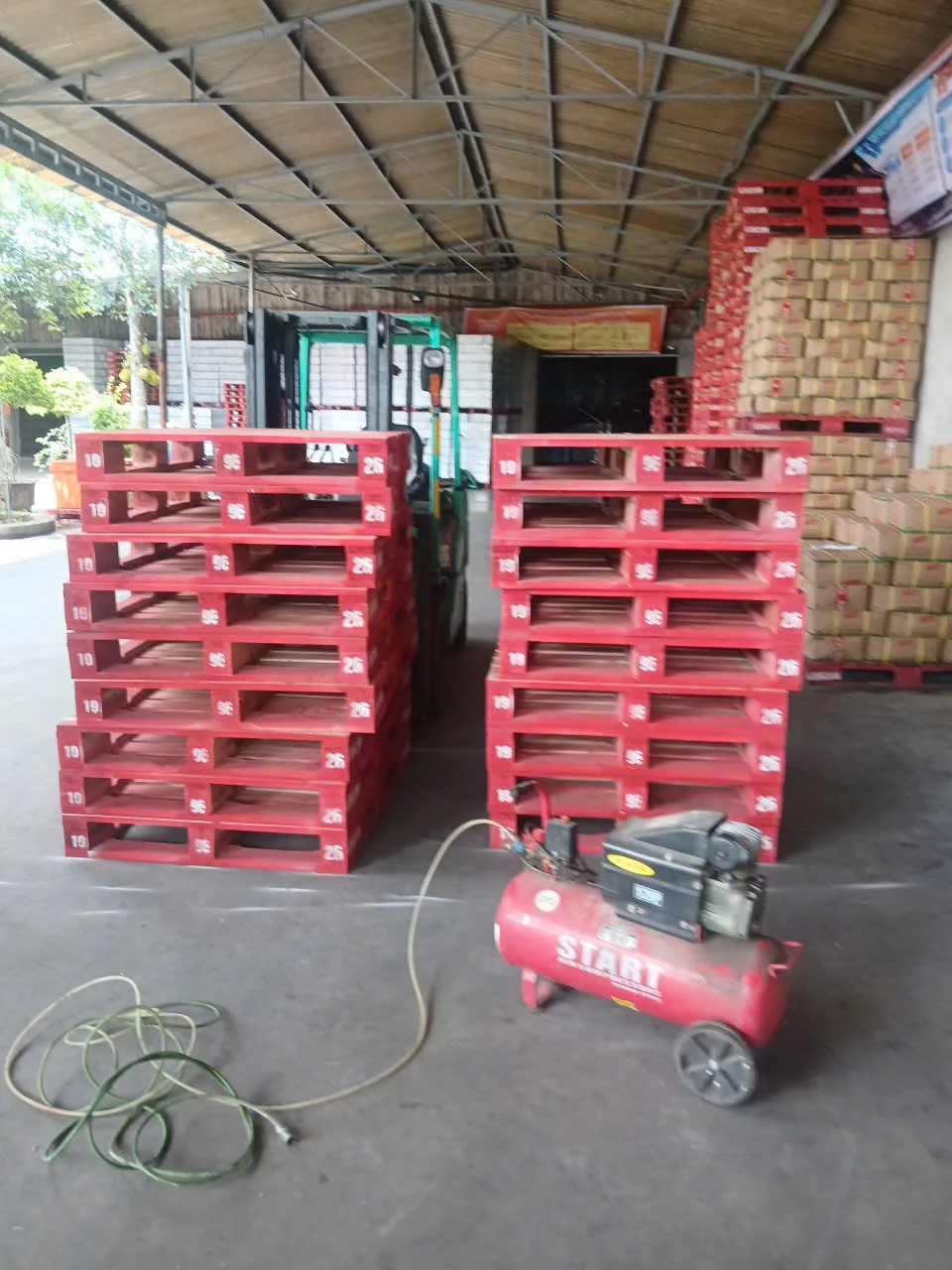
The inspection list below gathers the points to check. Each line is a sign for rejecting a pallet when you receive a lot:
- Top and bottom boards: look at each board and press on it by hand, and reject any pallet with a broken board, a long split along the grain, a missing board or a board that sinks under pressure.
- Blocks and stringers: look from both fork entries, and reject any pallet with a crushed block, a cracked stringer or one that rocks on a flat floor.
- Nails: run a hand over the deck and look at the joints, and reject any pallet with a protruding nail head, a nail working loose or a loose joint.
- Condition of the wood: smell it and look at the cut faces and underside, and reject any pallet with bore holes, wood dust, blue-black mould or soft rotten wood.
- Stains: look over the whole surface, and do not use a pallet that is soiled with oil or chemicals or has an unusual smell for food or pharmaceutical goods.
- ISPM 15 mark: look on two opposite sides, and reject any pallet with a faded mark, with replacement parts that carry no mark, or with an MB mark when the pallet will be used indoors.
Tips for storing used wooden pallets
Used wooden pallets last longest when kept in a dry warehouse, raised off the floor, out of the rain, and inspected and repaired regularly.
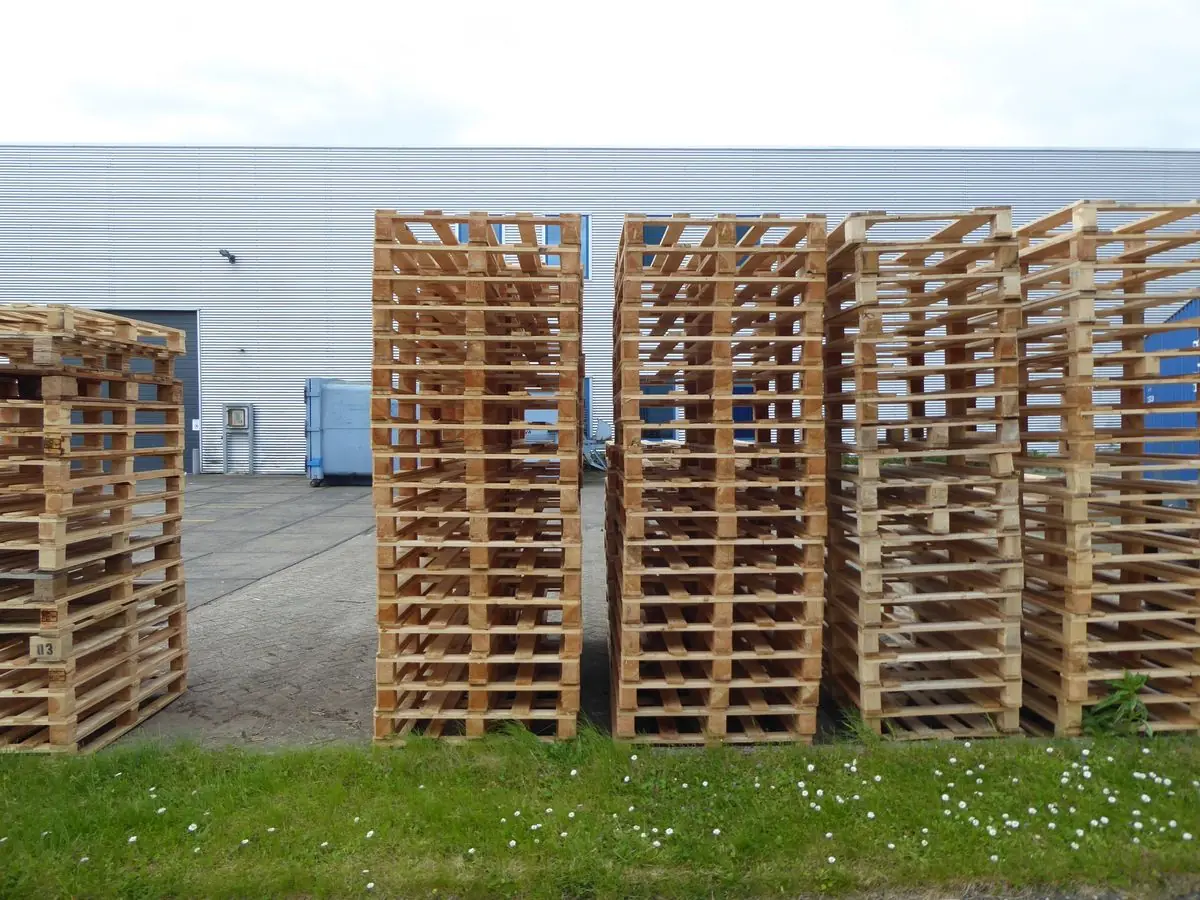
Keep pallets somewhere dry and airy and limit direct contact with rain or damp floors, because wood that absorbs moisture lets mould and rot develop. If pallets will be used for a long time in a warehouse or turned into furniture, you can paint them or apply a protective coat to extend their life and improve their look. Clean them regularly to remove dust and stains, and check and fix any pallet with loose nails or split boards before it is badly damaged. When you need to buy more, look for a supplier with steady stock who lets you see the goods first.
Price and quality compared: used wooden pallets
Used wooden pallets are cheaper than new ones, but in exchange the remaining life is hard to predict, sizes are uneven, and use for export cargo is limited. The actual price depends on grade A, B or C, size, wood species and the quantity in each lot.
| Criterion | Used wooden pallet | New wooden pallet |
|---|---|---|
| Upfront cost | Lower | Higher |
| Dimensions | Uneven from one pallet to the next within a lot | Uniform to the drawing, built to the size you specify |
| Remaining service life | Hard to predict, depends on the number of repairs | Full |
| Export cargo | Only usable if the ISPM 15 mark is still valid and repairs followed the rules | Heat treated and stamped with a new IPPC mark |
| Food and pharmaceutical goods | Risk because the previous cargo is unknown | Better suited |
| Warehouse storage, domestic transport | Very well suited | Suitable |
To pick a reasonably priced lot of used pallets that is still usable, compare several suppliers, inspect the goods in person before buying if you can, and ask previous customers for their feedback. A trustworthy seller grades the goods clearly, has a policy for exchanging pallets that are the wrong size or fail the agreed criteria, and helps when you need to buy more in the same specification.
In short, used wooden pallets are an economical and sustainable solution for warehouse storage and domestic transport, provided you choose the right grade and inspect every lot carefully. Using used pallets in a controlled way lowers costs for the business and keeps harvested timber in use for longer. For export cargo, goods on racking, food or pharmaceuticals, a new pallet built to a drawing is still the safer choice.
Frequently asked questions about used wooden pallets
Are used wooden pallets reliable?
Many used wooden pallets that have been collected and inspected still carry loads well and can be reused safely for many purposes, even after a period of use. Quality does vary between pallets in the same lot, though, so inspect each one on delivery.
What are the cost benefits of used wooden pallets?
A used wooden pallet costs clearly less than a new one, which helps small and medium businesses manage their packaging and transport budget. The saving is only real when the pallet is durable enough for the number of trips you expect.
What are the environmental benefits of used wooden pallets?
Reusing used wooden pallets reduces demand for newly harvested timber, protects forest resources and cuts the amount of waste wood released into the environment. In the US, the number of wooden pallets landfilled fell from about 138 million in 1998 to about 13.1 million in 2016.
Can used wooden pallets be used for export?
Yes, if the pallet still carries a clear ISPM 15 mark and has not been altered, or has been repaired according to the rules (replacement parts are treated wood with their own mark). A pallet with more than about 1/3 of its parts replaced must have its old marks removed, be treated again and be stamped with a new mark.
What should I check when buying used wooden pallets?
Check the top boards, bottom boards and blocks for breaks and splits; nails for protruding heads or loose fit; the wood for bore holes, mould and rot; any oil or chemical stains; and the ISPM 15 mark if the pallets will be used for export cargo.
What does the price of used wooden pallets depend on?
The price of used wooden pallets depends on the condition grade (A, B, C), size, wood species, whether the heat treatment mark is still present, and the quantity in each lot. A standard size such as 1000 x 1200 mm is usually easier to buy and resell than a custom size.
Should I use a used pallet with an MB mark to make furniture?
Not for furniture placed in living spaces. The MB mark shows the pallet was fumigated with methyl bromide; for indoor furniture, choose a pallet with the HT (heat treated) mark that is clean and has never carried chemicals.
Contact us for wooden pallet advice
If your shipment needs pallets in uniform dimensions, or ISPM 15 heat-treated pallets for export, send ICD Vietnam the size, load weight, quantity and destination market to receive advice on wooden pallets built to your requirements.
ICD Vietnam has a production workshop, a Hanoi warehouse and a southern workshop; export pallets are treated and stamped with the IPPC mark under ISPM 15 through a licensed facility. Price: contact us for a quote. Orders are processed within 1-2 days, with delivery in 1-3 days within Hanoi and Ho Chi Minh City, 2-5 days between regions and 3-7 days to other provinces, according to the shipping policy. Wooden pallets carry no warranty and can be exchanged or returned within 7 days under ICD Vietnam policy.
Northern Vietnam: 3rd Floor, Thang Long A1 Building, Bau Hamlet, Thien Loc Commune, Hanoi - 0983 797 186 / 090 345 9186 / 090 5859 186
Southern workshop: 551/212 Le Van Khuong Street, Tan Thoi Hiep Ward, District 12, Ho Chi Minh City - 098 6784 186
Email: sales@icdvietnam.com.vn
Zalo: Chat with ICD Vietnam on Zalo
References
- ISPM 15 - Regulation of wood packaging material in international trade, section 4.3 on reuse, repair and remanufacture; ISPM 15 explanatory document, 2017 edition - International Plant Protection Convention (IPPC/FAO).
- Gerber et al., Investigation of new and recovered wood shipping platforms in the United States - US Forest Service (USDA) and Virginia Tech.
- An investigation of wood pallets landfilled and recovered at US municipal solid waste facilities - US Forest Service (USDA).
- Requirements for wood packaging imported into the EU: European Commission, Requirements for wood packaging and dunnage.
- Regulation (EU) 2024/590 on substances that deplete the ozone layer (replacing Regulation 1005/2009), provisions ending methyl bromide exemptions from 18 March 2010 - European Union.
- Montreal Protocol on Substances that Deplete the Ozone Layer - United Nations Environment Programme (UNEP).