

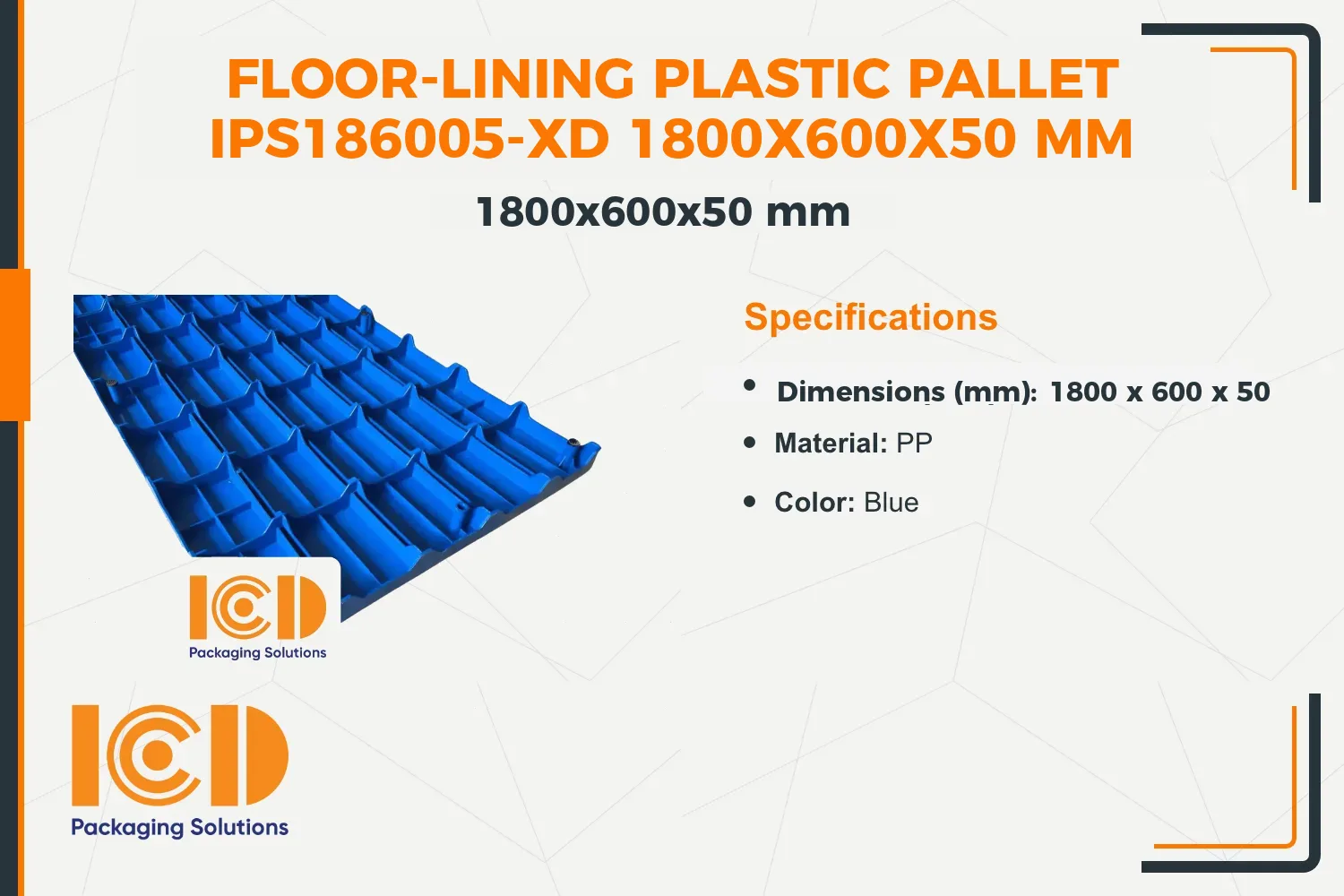


ICD Vietnam supplies new one-piece plastic pallets in virgin HDPE, recycled HDPE and PP, grouped into 14 lines by structure, operating environment and export standard. Sizes run from 600×600 mm to 1960×1960 mm, dynamic load from 500 to 3,200 kg and static load up to 8,000 kg, with new pallets priced from 125,000 VND each on ICD’s English price list. ICD delivers across Vietnam and quotes by model, size and quantity, with a 2-year warranty.

1. When a plastic pallet pays off
A plastic pallet is a one-piece platform moulded from HDPE or PP that lets forklifts and pallet jacks lift and move a whole unit load at once. Unlike a wooden pallet, it does not rot, attract termites or absorb water, and it needs no fumigation for export.
A plastic pallet is worth the investment in three situations. The first is a high-turnover warehouse: one pallet handles 50-100 shipping cycles and lasts 7-10 years in virgin HDPE, so the cost of ownership usually drops below wood from year 2 or 3. The second is cold rooms, humid stores, food and pharmaceuticals, because the surface does not absorb water, can be pressure-washed and, in virgin HDPE, stays tough down to -40°C. The third is cargo bound for the EU, the US or Japan: plastic pallets are exempt from ISPM-15, which saves 1-5 USD per pallet in treatment and avoids goods being held at port. The trade-off is a purchase price roughly 2-4 times that of wood; for regular exports that gap is usually recovered within 12-24 months.
As for weight, a plastic pallet weighs roughly 10 kg to 26 kg depending on its structure. Across ICD models, the 1200×1000×150 size ranges from a 10 kg blow-moulded nine-leg pallet to a 26.5 kg heavy-duty double-faced one; 1200×1200×150 weighs 14-22 kg and 1100×1100×150 weighs 9.5-21 kg. A solid deck, more ribs or a steel core all add weight, but one person can still turn a pallet by hand when no forklift is free. Weights by model are collected in the plastic pallet weight chart.
2. ICD’s 14 plastic pallet lines, chosen by how you use them
Each line below is its own category with full models, sizes and prices. Decide first how the pallet will be used, then compare prices.
Warehouse storage and open deck. These are the two largest lines. Warehouse storage pallets are built for industrial stores and are chosen by three figures: static load 1,000-8,000 kg (38 of 84 models rated 4,000 kg), dynamic load 500-2,400 kg (46 models rated 1,000 kg) and racking load 500-1,500 kg, which only 42 models state. Open-deck plastic pallets (also called grid or vented deck) have drainage holes, which suits produce, seafood and humid stores: 500-1,800 kg dynamic (typically 1,000 kg), typically 4,000 kg static, and they can be hosed down directly.

Closed deck. Closed-deck plastic pallets (also called solid-top or flat-top) have an unbroken surface, so powders and small packs cannot fall through and cleaning is quick. ICD lists 16 closed-deck models in 1200×1200, 1200×1000, 1200×800 and 1100×1100 mm, mostly HDPE; only 3 state virgin HDPE, so food and pharmaceutical plants should ask ICD to confirm the resin in writing. Dynamic load is 1,000-1,500 kg and static load 3,000-6,000 kg depending on the base. The double-faced version has identical top and bottom decks and can be used either way up; the only double-faced model is 1200×1200×150 mm, rated 1,500 kg dynamic and 5,000 kg static, with its weight not yet published.
Three-runner and cross-pattern. Three-runner plastic pallets have three continuous runners along the base; ICD’s full range has 48 models at 500-1,800 kg dynamic (32 rated 1,000 kg) and 2,000-6,000 kg static. Ride-on forklifts enter from four sides on the models that state it, while pallet jacks usually enter from two. Cross-pattern plastic pallets have ribs that cross the deck; ICD’s Vietnamese range has 8 new cross-runner models in 1200×800, 1200×1000 and 1100×1100 mm at 500-1,000 kg dynamic and 2,000-4,000 kg static. When a pallet goes on racking, the racking load is the figure to check, and only 2 of the 48 three-runner models state one (1,000 kg); how to work it out is covered in choosing plastic pallets for racking systems.
Nestable and floor-lining. Nestable plastic pallets (nine-leg, cup-foot) slot into each other when empty, which suits two-way logistics; ICD’s full range has 14 models at 500-2,000 kg dynamic and 1,000-6,000 kg static, and only one states a racking load (800 kg). Floor-lining plastic pallets are low, wide pallets that raise goods off damp concrete, 30-150 mm high and from 550×400 to 1800×600 mm; the 1000×1200×140 nine-leg grid model weighs 12 kg and carries 800 kg dynamic, 2,000 kg static. Where headroom is low there is a 50 mm legless sheet (1800×600×50).
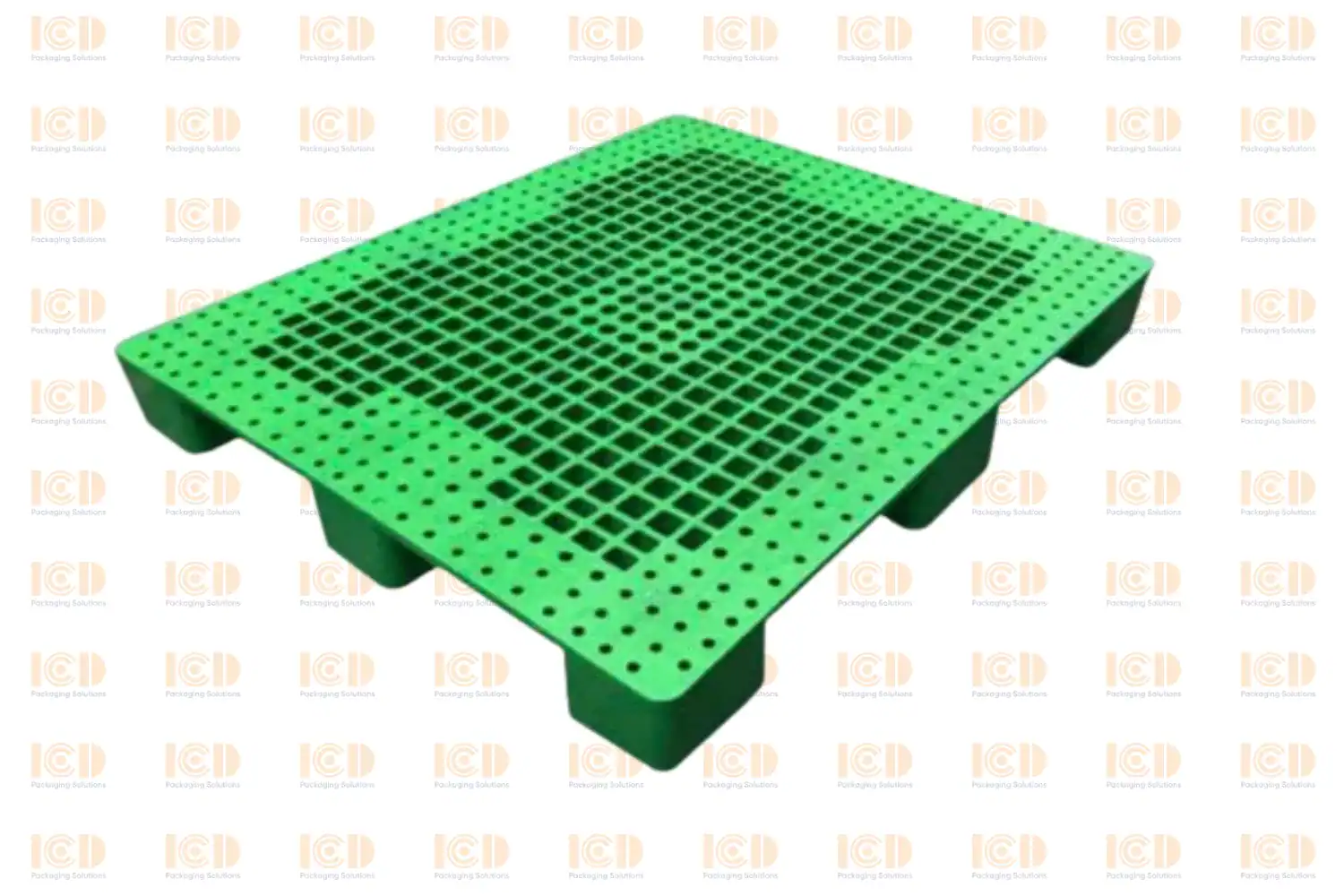
Spill containment. Spill containment pallets are sump trays for 200-litre drums, in a two-drum 1300×660 mm version (150 or 300 mm high) and a four-drum 1300×1300×300 mm version. Rules on size, sump capacity and tray material are summarised in spill containment pallet dimensions and regulations.
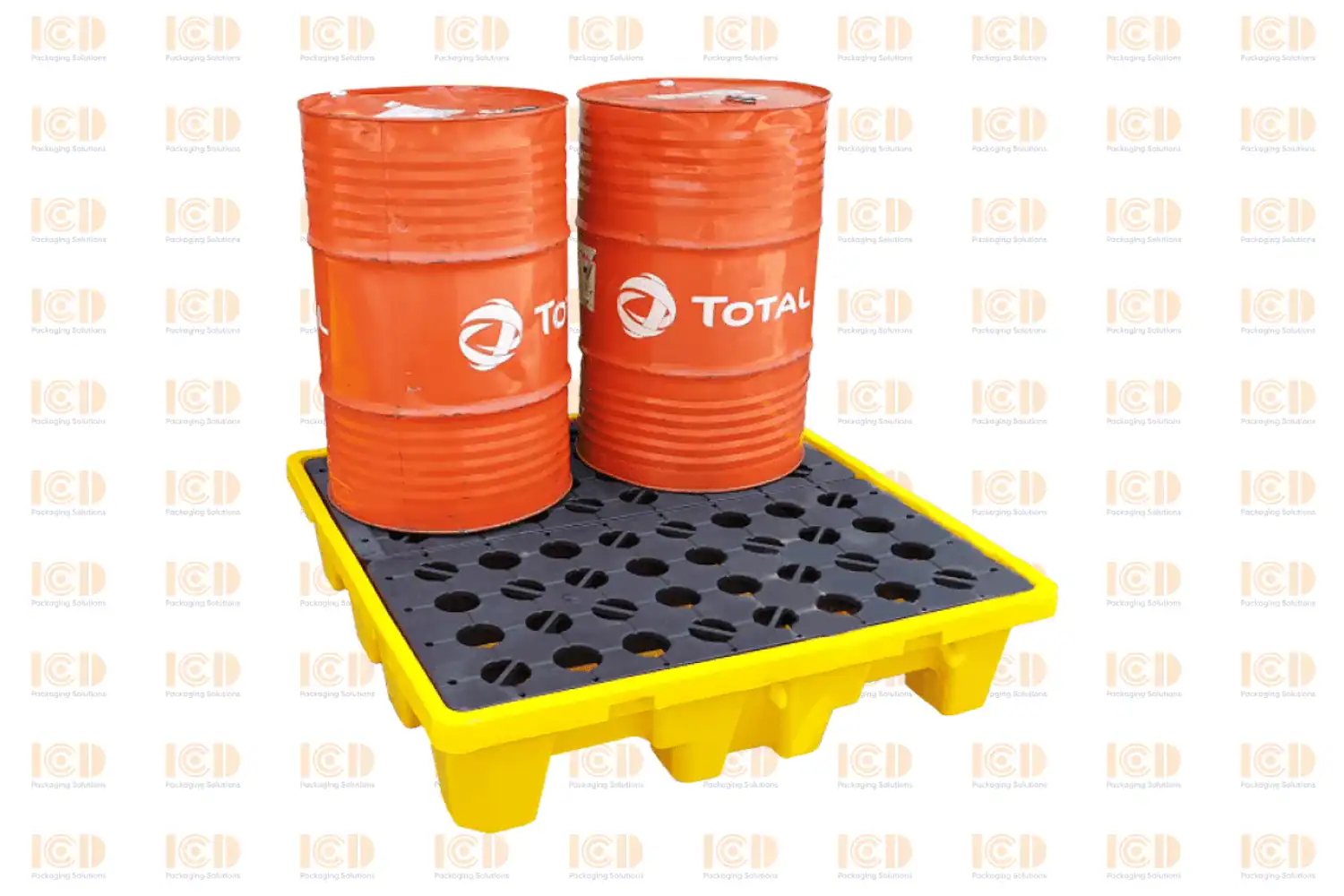
Steel core. The steel-core plastic pallet line has 3 models in 1200×1000×150, with 1,500-3,200 kg dynamic and 4,500-6,500 kg static load, for heavy loads and heavy-duty racking; dimensional tolerance is not published, so for AGVs or automated warehouses ask ICD to confirm in writing. ICD’s PL12 is rated at 6,500 kg static, PL10-LK at 5,000 kg and IPS PL10-2 (blue, recycled) at 4,500 kg. If you are unsure which figure on a spec sheet matters, static load vs dynamic load explains the difference between the two.
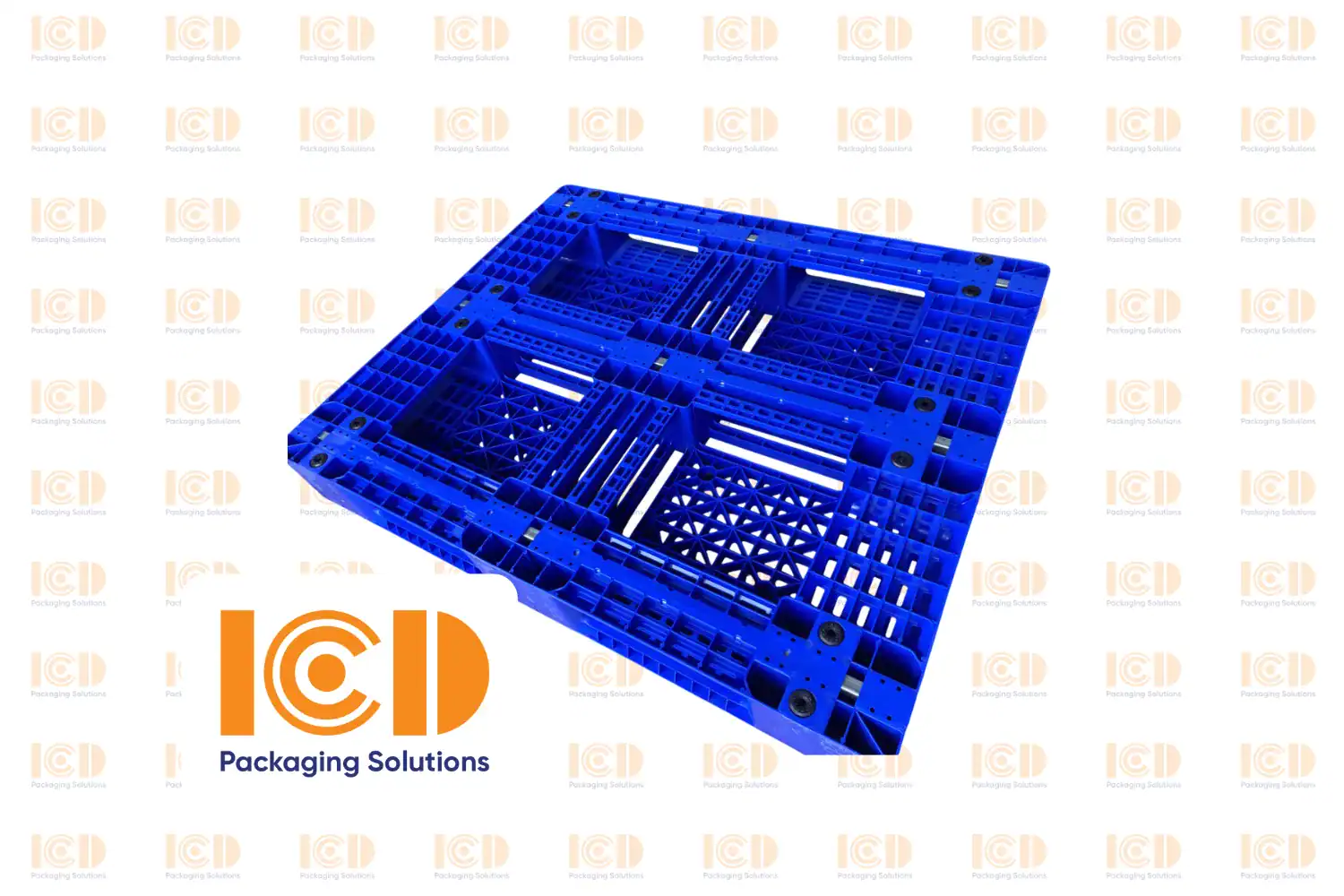
Container pallets and printing industry. Plastic container pallets are sets of base, PP honeycomb or corrugated walls and lid (4 models in Vietnam, from 1200×800×760 to 1470×1140×990 mm) for small, fragile parts such as electronic components; the 1470×1140×990 mm model is rated 1,000 kg dynamic and 2,500 kg static, the 1200×1000×1080 mm model 500 kg dynamic and 1,500 kg static. Printing industry plastic pallets are 102 trays and pallets with decks from 730×630 to 2000×1600 mm (blow-moulded, up to 1.5 t dynamic, up to 3 t static) and 1750×1200×160 mm reinforced with ten steel tubes (4 t static).

Export and Malaysian imports. Export plastic pallets have 16 new models in ICD’s Vietnamese range, from 1000×1000 to 1300×1100 mm and 120-150 mm high, mostly light one-way pallets; the English catalogue lists 8 new models at 185,000-315,000 VND, with dynamic loads of 800-2,000 kg and static loads of 1,500-4,000 kg. Each destination market expects a different footprint; they are compared in ISO standards for export plastic pallets. For imports, imported Malaysian plastic pallets cover 8 lines and more than 150 codes: one-way export, hygienic, heavy-duty, ASRS racking, pharmaceutical, medium-duty, top-frame sheets and solid crates, quoted per code.
Beyond these 14 lines, ICD also carries the XU-2M blow-moulded range (from 1100×1100 to 1600×1400 mm), the ICD-1511 rubber-industry pallet and custom builds such as a company logo moulded or printed on the pallet.
3. Specifications of the 12 main lines
Common sizes, load ratings and best uses side by side, for a quick check before opening each category.
| Pallet line | Common sizes (mm) | Dynamic load | Static load | Best for |
|---|---|---|---|---|
| Warehouse storage | 1200×1000, 1100×1100, 1200×1200 (50 of 84 models) | 500-2,400 kg | 1,000-8,000 kg | Industrial stores, floor and racking |
| Open deck | 1100×1100 / 1200×1000 | 500-1,800 kg | Typically 4,000 kg | Produce, seafood, humid stores |
| Closed deck | 1200×1200, 1200×1000, 1200×800, 1100×1100 | 1,000-1,500 kg | 3,000-6,000 kg | Powders, small packs, easy-clean areas |
| Three-runner | 11 sizes, 1200×800 to 1400×1400 | 500-1,800 kg | 2,000-6,000 kg | Floor and racking loads, ride-on forklifts |
| Nestable | 1000×800 to 1970×1010 | 500-2,000 kg | 1,000-6,000 kg | Two-way logistics, nest when empty |
| Export | 1000×1000 to 1300×1100 | 500-2,000 kg | 1,000-4,000 kg | Overseas shipments, mostly one-way |
| Floor-lining | 550×400 to 1800×600 | 300-1,000 kg (6 models state it) | 100-3,000 kg | Raising goods off damp floors |
| Container | 1200×800 to 1470×1140 (760-1,080 high) | 500-1,000 kg (2 models state it) | 1,500-2,500 kg | Small, fragile parts |
| Spill containment | 1300×660 (2 drums) / 1300×1300 (4 drums) | 500-1,000 kg | 1,000-2,000 kg | Chemicals, oils |
| Cross-pattern | 1200×800, 1200×1000, 1100×1100 | 500-1,000 kg | 2,000-4,000 kg | Ride-on forklifts from four sides |
| Steel core | 1200×1000 | 1,500-3,200 kg | 4,500-6,500 kg | Heavy loads, heavy-duty racking |
| Used | 1000×1000 to 1300×1100 | 1,000-2,000 kg (5 models state it) | 2,500-4,000 kg | In-house storage, tight budgets |
Figures from ICD product pages, October 2026. Racking load applies to racking with two beams and only some models state it: warehouse storage 500-1,500 kg (42 models), three-runner 1,000 kg (2 models), nestable 800 kg (1 model), steel-core PL12 1,200 kg; open deck varies by model.
Of the 244 plastic pallet models ICD sells in Vietnam (counted on 22 October 2026), the most common footprint is 1200×1000 mm (56 models), followed by 1100×1100 mm (29), 1200×1200 mm (24), 1200×800 mm (19) and 1300×1100 mm (12). The most common height is 150 mm (135 models); other heights are 120, 140, 145 and 160 mm, while the floor-lining group includes thin sheets only 30-50 mm high. Small sizes include 600×600, 600×1000 and 800×600 mm for narrow racks, shops and floor lining; large sizes from 1300×1300 to 1960×1960 mm serve bulky goods. These footprints follow the six pallet sizes in ISO 6780: 1200×800, 1200×1000, 1219×1016, 1165×1165, 1100×1100 and 1067×1067 mm.
4. Choosing the material: virgin HDPE, recycled HDPE or PP
The wrong plastic is the most common reason pallets crack or warp early, especially in cold rooms and on racking. The three materials below differ clearly in cold resistance, heat resistance and food-grade compliance.
| Criterion | Virgin HDPE | Recycled HDPE | PP |
|---|---|---|---|
| Cold resistance | Good, down to -40°C | Less consistent below zero | Turns brittle near 0°C (PPC is better) |
| Heat resistance | Up to 80°C | Up to 70°C | Up to 100°C |
| Stiffness | Medium, tough | Lower than virgin | Highest of the three |
| Food-grade, HACCP | Usable, confirm the resin in writing | Not guaranteed | Usable if virgin PP |
| Price vs virgin HDPE | 100% | 65-80% | 90-110% |
For most warehouses virgin HDPE is the safest choice: it has the widest working temperature range (about 120°C) and handles cold storage, food and heavy loads. Recycled HDPE saves 20-35% up front but belongs in in-house stores at room temperature with low turnover. PP is stiffer and more heat-resistant, often paired with a steel core in heavy-duty lines; standard PP turns brittle near 0°C, so it does not suit cold stores, while PP copolymer (PPC) handles cold better. How to tell virgin from recycled stock on delivery is explained in virgin plastic pallets: properties and when to use them.
Colour usually hints at the resin source. Recycled plastic arrives in mixed colours and is blended with carbon black for an even finish, so black plastic pallets are mostly recycled and cheaper; virgin resin takes any colour, so blue, green, grey and white pallets are usually virgin, while red, yellow and orange are often used to mark warehouse zones. In ICD’s range a typical black pallet costs about 325,000 VND against about 485,000 VND for a blue one. This rule holds for most cases, not all: ICD also sells blue pallets made from recycled resin, so when buying for food or cold storage ask for the resin type rather than judging by colour. Colour does not determine load capacity either.
5. Plastic pallet prices by line
Lowest price per model in each line on the English product pages (October 2026), excluding VAT: used pallets from 155,000 VND, floor-lining sheets from 125,000 VND, export from 185,000 VND, nestable from 215,000 VND, warehouse storage from 295,000 VND, three-runner from 385,000 VND, cross-pattern (used models) from 155,000 VND and steel-core from 850,000 VND. These are starting points; real prices rise with size, load rating and material, and volume orders have their own terms. Recycled HDPE runs about 20-35% below virgin.
Across ICD’s full range in Vietnam, a new 1200×1000 mm plastic pallet starts at 185,000 VND, the median is about 585,000 VND and double-faced or heavy-duty versions reach about 1,240,000-1,600,000 VND. The 1100×1100 mm size starts at 145,000 VND with a median of about 465,000 VND; 1200×1200 mm starts at 215,000 VND with a median of about 580,000 VND. Send the model, quantity and delivery point for an exact quote.
6. Five-year cost of plastic vs wooden and presswood pallets
Wooden and presswood pallets are cheaper to buy, but over a five-year total cost of ownership, covering replacement, repairs, cleaning and fumigation, virgin HDPE is usually cheaper from year 2 or 3. Against pine pallets that must be ISPM-15 treated for every export lot, the break-even point falls to 12-24 months.
| Criterion | Pine wooden pallet | Presswood pallet | Virgin HDPE plastic pallet |
|---|---|---|---|
| Average lifespan | 1-2 years (3-5 trips) | 6-18 months (1-3 trips) | 7-10 years (50-100 trips) |
| Repurchases in 5 years | 3-4 times | 4-6 times | None |
| ISPM-15 treatment | 1-5 USD/pallet/lot | Not applicable (pressed under heat) | Not applicable |
| Cleaning | Hard to clean, absorbs water | Cannot be washed | Pressure-washable, can be sanitised |
| Cold storage | Limited, prone to mould | Unsuitable | Good, down to -40°C |
Based on 100 pallets of 1100×1100 mm, 10 trips a year, average load 800 kg, export scenario with fumigation twice a year.
Plastic pallet vs wooden pallet goes deeper into each use case.
7. Plastic pallets by industry
Each industry has its own requirements for material, load and hygiene, so no single line fits all.
Food, beverages, pharmaceuticals. Use closed-deck or warehouse storage pallets in virgin HDPE, which can be used in plants running HACCP and GMP, are odourless and easy to sanitise. Freezer stores add requirements on sub-zero temperatures and stacking, covered in plastic pallets for cold storage.
Seafood, produce, livestock. Use open-deck or warehouse storage pallets that drain fast and cope with damp and cold, meeting the hygiene expectations of VietGAP, GlobalGAP and HACCP when made from virgin resin.
Electronics and FDI plants. These need consistent dimensions for AGVs and robots (ICD has not published a tolerance, so ask for written confirmation) and sometimes static control; selection criteria are in ESD antistatic plastic pallets. Chemicals, paints, oils. Combine spill containment pallets with warehouse storage pallets, as described in section 2. Logistics, distribution, retail. Nestable, three-runner and warehouse storage pallets, because they are light, stack well and take forks from two to four sides. Container export. Light export pallets, exempt from ISPM-15, sized to the destination standard.
8. ICD checklist: 5 questions before you buy
1. Is your real load dynamic or static? Dynamic load, the weight carried while a forklift is moving, is the figure that decides; static load (the pallet resting on a flat floor, including when loaded pallets are stacked) is usually 2-3 times higher. A 4,000 kg static rating does not mean the pallet can be used with a 3-tonne forklift load.
2. What is the storage environment? Stores below 0°C should use virgin HDPE; chemical stores must confirm the specific chemical; outdoor use needs UV-stabilised plastic, because standard PP fades and turns brittle after 6-12 months in the sun.
3. Which forklift, entering from how many sides? Ride-on forklifts enter cross-pattern pallets and the three-runner models that state it from four sides; pallet jacks usually enter three-runner pallets from two sides, while loose-footed nestable pallets take them from all four; for AGVs and robots ask ICD to confirm dimensions in writing. Measure the pallet’s entry height and compare it with the fork thickness (or the lowered height of a pallet jack’s forks).
4. Will the goods be exported? Natural-wood pallets must be treated and stamped under ISPM-15 for the EU, US, Australia and Japan; plastic and presswood pallets fall outside the standard. For regular exports on natural wood, the treatment saved by switching to plastic usually covers the price difference within 12-24 months.
5. One-off budget or lifetime cost? On a tight budget, consider used plastic pallets or recycled HDPE; on a lifetime basis, virgin HDPE usually has the lower total cost from year 2 or 3.
9. Five common mistakes when buying plastic pallets
Using PP or recycled HDPE in a freezer. Standard PP turns brittle near 0°C and recycled HDPE varies in quality, so their legs crack easily at -18°C. Choose only virgin HDPE with a stated sub-zero rating.
Reading the static load instead of the dynamic load. Uneven floors and ramps raise the impact on a pallet considerably, so choose a dynamic rating at least 20% above the actual load.
Buying recycled pallets for food or pharma. Recycled resin varies from batch to batch and may contain impurities; such pallets are not accepted in production and packing areas during HACCP or GMP audits.
Smooth pallets on glossy epoxy floors. Friction between the two surfaces is close to zero, so a sharp forklift turn can send the pallet sliding; choose an anti-slip or ribbed deck.
Using pallets with AGVs or automated stores without confirmed dimensions. Automated systems need consistent dimensions from lot to lot, while ICD has not published a tolerance for its plastic pallets; ask ICD to confirm dimensions in writing before ordering.
10. Used plastic pallets: when they make sense
Used plastic pallets are second-hand pallets; ICD’s English price list shows 6 used models at 155,000-380,000 VND, and the Vietnamese catalogue 11 models from 120,000 to 485,000 VND. In the 120 mm group and at 1200×1100×150 mm a used model costs 25-58% less than a new one of the same size; at a few 150 mm sizes a new virgin-HDPE model is cheaper, so compare prices at the exact size. They suit in-house storage that does not need food-grade pallets; where loads are stated they are 1,000-2,000 kg dynamic and 2,500-4,000 kg static. Before ordering, check the legs, deck and weld lines using this used pallet quality checklist.

ICD also buys back used and damaged plastic pallets for recycling.
11. Related plastic pallet articles
- What is a plastic pallet? Types and buyer guide
- HDPE plastic pallets: pros, cons, types and applications
- Standard plastic pallet dimensions: ISO 6780 lookup table
- Wooden and plastic pallet rental: pricing and how to choose
12. Frequently asked questions about plastic pallets
1. How long do plastic pallets last?
Under normal conditions, within the rated load and at room temperature, virgin HDPE lasts about 7-10 years, PP 5-7 years and recycled HDPE 3-5 years. That is why virgin pallets cost less to own than wood from year 2 or 3 despite the higher purchase price.
2. How much weight can plastic pallets hold?
It depends on the line: most models are rated 1,000 kg dynamic and 4,000 kg static; light lines carry 500 kg dynamic, heavy-duty lines 2,000-2,400 kg dynamic and 6,000-8,000 kg static; steel-core pallets carry 1,500-3,200 kg dynamic and 4,500-6,500 kg static. Size your load against the dynamic rating, because that applies while the forklift is moving.
3. What are plastic pallets made of, and how do HDPE and PP differ?
HDPE is tough and handles cold well (down to -40°C in virgin grade), so it suits cold stores and food. PP is stiffer and takes heat up to 100°C but turns brittle below zero. Most ordinary warehouses should choose virgin HDPE.
4. Can plastic pallets be used for export without fumigation?
Yes. ISPM-15 is a phytosanitary standard that applies only to wood packaging material, so plastic pallets need no fumigation and no IPPC stamp.
5. How much is a plastic pallet? What does a 1200 x 1000 pallet cost?
On the English price list, new pallets start at 125,000 VND (floor-lining sheet) and 295,000 VND for warehouse storage pallets; used ones from 155,000 VND, excluding VAT. Across ICD’s full range, 1200×1000 mm pallets start at 185,000 VND, most models sit around 600,000 VND and double-faced or heavy-duty versions reach about 1,240,000-1,600,000 VND. Send the model and quantity for an exact quote; volume orders have their own terms.
6. Can plastic pallets be used in a -18°C freezer?
Yes, but only virgin HDPE, which stays tough down to -40°C. Standard PP turns brittle near 0°C and recycled HDPE varies in quality, so both crack more easily in freezers. For freezer stores, ask the supplier to confirm in writing that the pallets are virgin HDPE.
7. How high can plastic pallets be stacked?
Most nestable pallets slot into each other when empty, so they stack many high and save space; the count depends on the model, so ask ICD. Do not stack loaded pallets beyond the static rating, because the weight bears on the bottom pallet.
8. Are plastic pallets better than wood or presswood?
Presswood pallets are cheap and need no ISPM-15 treatment, but last only 6-18 months, cannot be washed and handle damp poorly. Plastic pallets cost more at first but last 7-10 years and can be washed; in high-turnover warehouses their five-year cost is lower.
9. Are plastic pallets food-grade and HACCP compliant?
Virgin HDPE belongs to the olefin polymers that the FDA (21 CFR 177.1520) allows for food contact when they meet its specifications, so it can be used in plants running HACCP and GMP. Recycled HDPE is not guaranteed because its feedstock varies. When buying for a food or pharma plant, ask the supplier to confirm the resin in writing.
10. Which plastic pallet size fits a 40 ft container best?
A 40 ft container is about 2,352 mm wide inside, so 1100×1100 pallets placed two across (2,200 mm, 152 mm spare) fit best. 1200×1000 pallets loaded lengthwise also fit.
11. Can a cracked plastic pallet be repaired?
Small cracks can be heat-welded, but the load rating drops by about 20-30% afterwards. Pallets with cracked legs or main beams should be replaced rather than kept for heavy loads.
12. Are plastic pallets recyclable?
Yes. HDPE and PP pallets can be ground and remoulded into new plastic products, which is where recycled-HDPE pallets come from. ICD buys back used and damaged plastic pallets for recycling; contact us for the current buyback price.
13. How fast does ICD deliver?
Delivery time depends on the model, quantity and destination, and ICD confirms it with the quote. Delivery covers all of Vietnam, and an invoice is issued on delivery.
14. Can I rent plastic pallets in Vietnam?
Yes. ICD rents plastic pallets for short and medium terms; rates depend on model, quantity and rental period. Renting suits short-term, seasonal or project use, while buying is usually better value for continuous use at a stable quantity.
15. How much does a plastic pallet weigh in kg?
About 10-26 kg depending on structure. Across ICD models, 1200×1000×150 pallets weigh from 10 kg (blow-moulded nine-leg) to 26.5 kg (heavy-duty double-faced); 1200×1200×150 weighs 14-22 kg; 1100×1100×150 weighs 9.5-21 kg. The weight of each model is listed on its product page, within about ±5%.
16. What is the standard plastic pallet size and height?
ISO 6780 lists six sizes: 1200×800, 1200×1000, 1219×1016 (48×40 inches), 1165×1165, 1100×1100 and 1067×1067 mm. In Vietnam the most used are 1200×1000 and 1100×1100 mm; Europe-bound cargo uses 1200×800 mm and US-bound cargo 1219×1016 mm. Common heights are 120-160 mm, most often 150 mm; thin floor-lining sheets start at 30 mm.
17. What is the HS code for plastic pallets?
Plastic pallets are declared under HS code 3923.90.90, in heading 39.23 (plastic articles for the conveyance or packing of goods), covering one-piece, nine-leg, three-runner and double-faced pallets. Duty and declaration are explained in HS codes for wooden and plastic pallets.
13. Contact ICD for a plastic pallet quote
ICD Vietnam Industrial Production Co., Ltd
Northern Vietnam: Floor 3, Thang Long A1 Building, Thon Bau, Thien Loc, Hanoi - 0983 797 186 / 090 345 9186 / 090 5859 186
Southern Vietnam: 551/212 Le Van Khuong, Tan Thoi Hiep, District 12, Ho Chi Minh City - 098 6784 186
Email: sales@icdvietnam.com.vn
Zalo: Chat on Zalo
Send the size, load, quantity and delivery point to receive the right model and delivery time.


