
Table of Contents
- How do the three load ratings of a pallet differ?
- Why do plastic pallets sag or crack on pallet racking?
- Rack load of some ICD Vietnam plastic pallet models
- How is racking load measured under ISO 8611?
- When should you choose a steel-core pallet for racking?
- How do the rack type and rack accessories affect pallet requirements?
- Steps to choose a plastic pallet for pallet racking
- Frequently asked questions about plastic pallets on pallet racking
- What is racking load and how does it differ from static load?
- Can a pallet with a 4-tonne static load go on a rack?
- When do you need a steel-core pallet?
- Why does a pallet look fine when loaded but sag after a few weeks?
- Which goes on racking better, open-deck or closed-deck pallets?
- Can you rack pallets without buying steel-core pallets?
- Which plastic pallets suit drive-in racking?
- How much deflection passes under ISO 8611?
- What should you watch for with plastic pallets on racking in a cold store?
- Contact ICD Vietnam
- References
- Related articles
Reviewed and updated by ICD - Week 43/2026
A plastic pallet going onto a pallet rack must be chosen by the rack load, meaning the weight the pallet can carry when supported only at its two ends on the beams, not by the static load on the floor. On ICD Vietnam product pages, models with the same 4,000 kg static load can have a rack load of only 500 kg or of 1,000 kg; the figure to read is therefore the rack load line of the exact model you plan to buy.
Many warehouses buy pallets by a static load of 4,000 to 6,000 kg, put them on racking and find the pallet sagging mid-span after a few weeks. This article explains the three load ratings of a pallet, why a pallet weakens on a rack, how the ISO 8611 standard measures racking load, when to move to a steel-core pallet, and how to check the specifications before ordering.
How do the three load ratings of a pallet differ?
Every pallet has three load figures, matching three different ways of support. Static load is the weight the pallet carries lying still on a flat floor, with the whole underside supported evenly; this is always the largest figure. Dynamic load is the weight the pallet carries when a forklift or pallet truck lifts and moves it, when the force is concentrated on the two forks. Related to this section is the article on static and dynamic load.
Rack load, also called racking load, is the weight the pallet carries when only its two ends rest on beams and the middle hangs free. It is almost always the smallest figure and the deciding one when a warehouse uses racking. A pallet rated at a static load of 6,000 kg does not mean it holds 6,000 kg on a rack: in the ICD Vietnam catalogue, model H1212R4-3A has a static load of 6,000 kg but a rack load of only 700 kg.
Why do plastic pallets sag or crack on pallet racking?
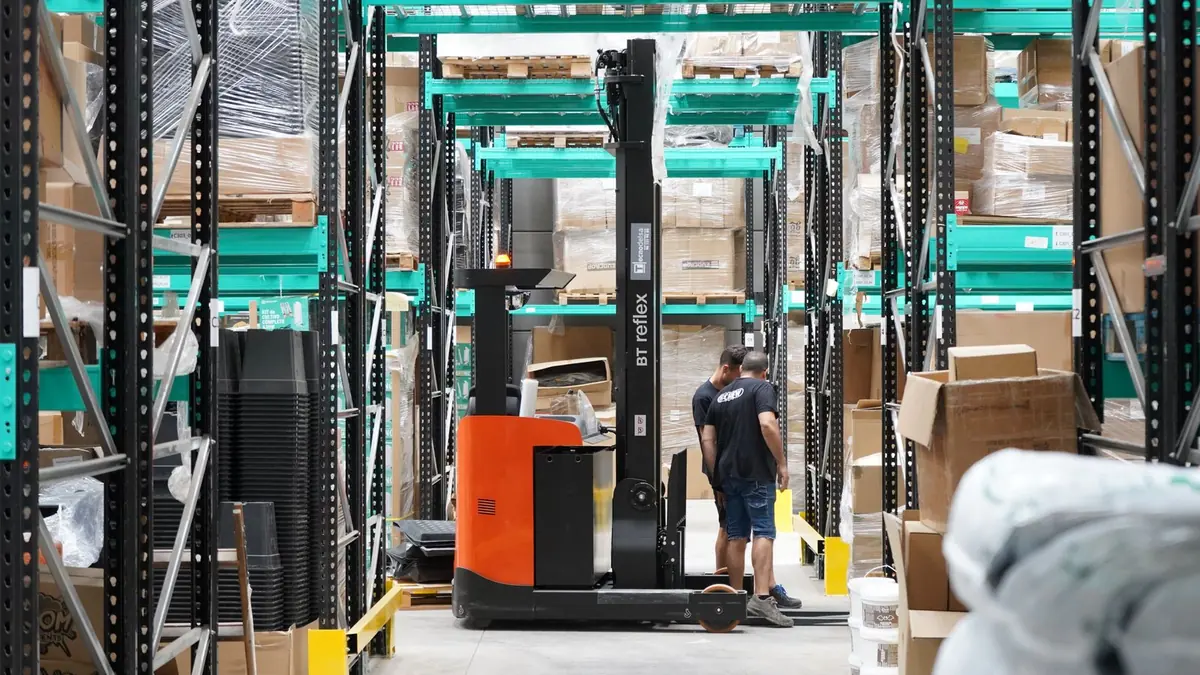
The main cause is the loss of support in the middle. On the floor, the underside of the pallet is supported evenly so force spreads out. On a rack, the pallet rests only at its two ends, the weight of the goods is pushed into the middle of the span, and the greatest bending moment arises exactly where nothing supports it. The further apart the beams, the longer the unsupported section and the more the pallet sags.
Plastic also shows creep: under a load applied for a long time, the material deforms slowly even though the load does not increase. A pallet that looks flat when loaded can sag visibly after a few weeks, especially when goods sit in one rack position for a long time. This is why ISO 8611 measures not only deflection under load but also the residual deflection after a recovery period.
Warehouse temperature makes the problem more pronounced. Plastic is softer when hot and so creeps faster, and more brittle when cold and so cracks easily when a fork hits it. The ISO 8611 series therefore specifies testing plastic pallets at 23 °C, testing the maximum working load at 40 °C and includes a test at -10 °C. Hot or cold stores should ask for load figures at exactly those conditions.
Rack load of some ICD Vietnam plastic pallet models
The table below is taken from the rack load line on the product page of each model at icdvietnam.com.vn, checked on 15 October 2026. We chose models of the same size to show clearly that with the same size and the same static load, the rack load can differ by a factor of two depending on the construction of the feet and base.
| Pallet code | Size (mm) | Static load | Dynamic load | Rack load |
|---|---|---|---|---|
| M1111S4-2A | 1100 x 1100 x 150 | 4,000 kg | 1,000 kg | 500 kg |
| H1111S4-2M | 1100 x 1100 x 150 | 4,000 kg | 1,000 kg | 1,000 kg |
| M1210D4-1A | 1200 x 1000 x 150 | 4,000 kg | 1,000 kg | 500 kg |
| H1210R4-3E | 1200 x 1000 x 160 | 4,000 kg | 1,000 kg | 1,000 kg |
| H1210S4-3L | 1200 x 1000 x 160 | 4,500 kg | 1,500 kg | 1,200 - 1,500 kg |
| H1212R4-3A | 1200 x 1200 x 160 | 6,000 kg | 1,000 kg | 700 kg |
| H1212S4-1A | 1200 x 1200 x 160 | 6,000 kg | 1,000 kg | 1,500 kg |
| PL10 (steel core) | 1200 x 1000 x 150 | 6,000 kg | 2,400 kg | 1,200 kg |
| PL12 (steel core) | 1200 x 1000 x 150 | 6,500 kg | 3,200 kg | 1,200 kg |
Three things stand out in the table. The ratio of rack load to static load varies widely, from about one eighth (500 kg on 4,000 kg) to about one third (1,200 to 1,500 kg on 4,500 kg), so the rack load cannot be inferred from the static load by a fixed ratio. The difference comes from the construction of the feet, the base rails and the load-bearing ribs of each model.
The third point is that steel-core pallets do not always have the highest rack load: models PL10 and PL12 state 1,200 kg, while some non-steel-core 1,200 x 1,200 mm models state 1,500 kg. The steel core is strong in dynamic load and long-term stiffness; for racking, you must still compare the rack load line itself. In addition, many warehouse pallet models in the catalogue show N/A on this line, meaning there is no specification for racking yet.
How is racking load measured under ISO 8611?
Racking load is determined by a bending test: the pallet is placed on two supports simulating the beams, a uniformly distributed load is applied and the deflection at mid-span is measured. This procedure is in the ISO 8611-1 series on test methods for flat pallets, while ISO 8611-2 sets the pass thresholds and ISO 8611-3 gives guidance on determining the maximum working load with specific goods.
| Item | Requirement in ISO 8611 | Meaning when choosing a pallet for racking |
|---|---|---|
| Deflection under load (stiffness test) | No more than 2% of the free span | With a 1,000 mm span, deflection is at most about 20 mm during the test |
| Deflection after recovery | No more than 0.7% of the span | The pallet must spring back to nearly its original shape, with no permanent sag |
| Safety factor | Minimum failure load of 2 times the rated load | The declared load already has a safety margin and must not be exceeded |
| Test temperature for plastic pallets | 23 °C; maximum working load tested at 40 °C; some tests at -10 °C | Hot or cold stores need to ask for figures at the exact temperature |
| Rated load and actual load | The rated load is for comparison, not the real cargo load | Ask additionally for the maximum working load with the exact goods and rack |
One point to note: ISO 8611 itself states that laboratory testing cannot replace real trials with each pallet design. When ordering, send the supplier the weight of the goods, the beam spacing and the store temperature to get advice on the right model, rather than comparing only the load figures in a catalogue.
The bending test has two steps. The first finds the failure load, meaning the load at which the pallet breaks or sags to 6% of the span. The second applies half of the failure load, corresponding to a safety factor of 2, and checks whether deflection exceeds 2% of the span. If the pallet has already sagged 2% before half the failure load is reached, the rated load is taken at that deflection.
An example in ISO 8611-2 itself: a pallet has a failure load in the bending test of 2,840 kg, half of which is 1,420 kg, but the deflection reaches 2% of the span at 1,250 kg, so the rated load for use on racking is 1,250 kg. The standard also states clearly that the rated load is a level for comparing designs and not the real cargo load; the maximum working load for a specific type of goods is determined separately under ISO 8611-3.
When should you choose a steel-core pallet for racking?
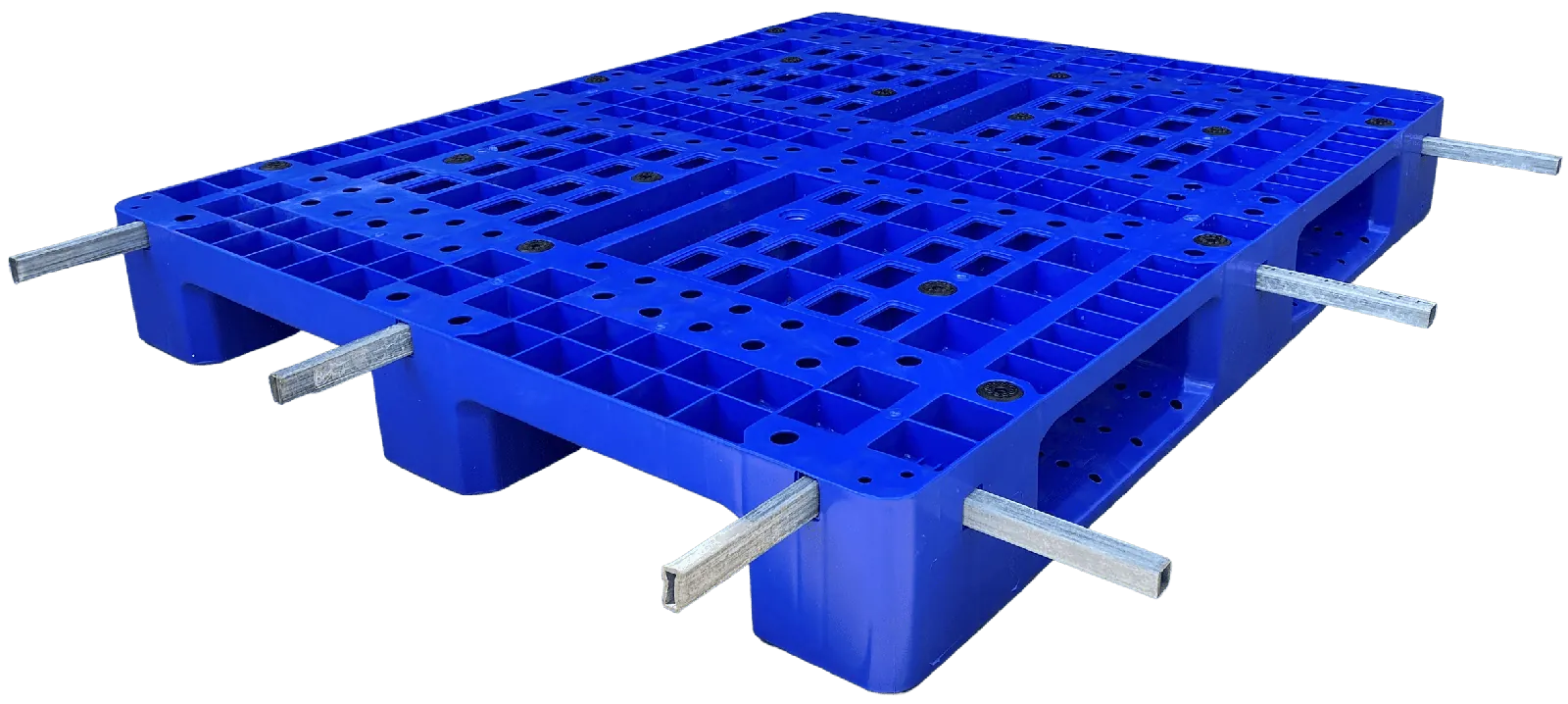
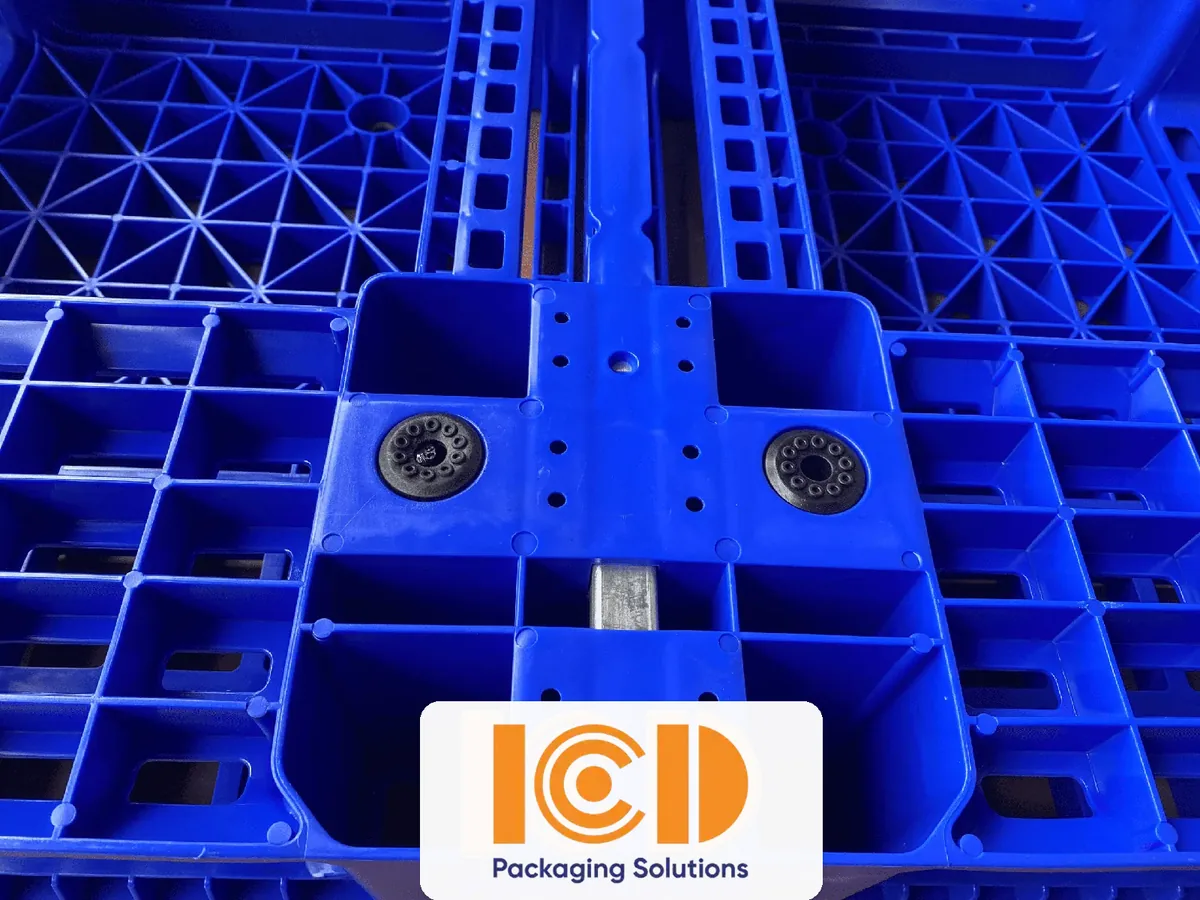
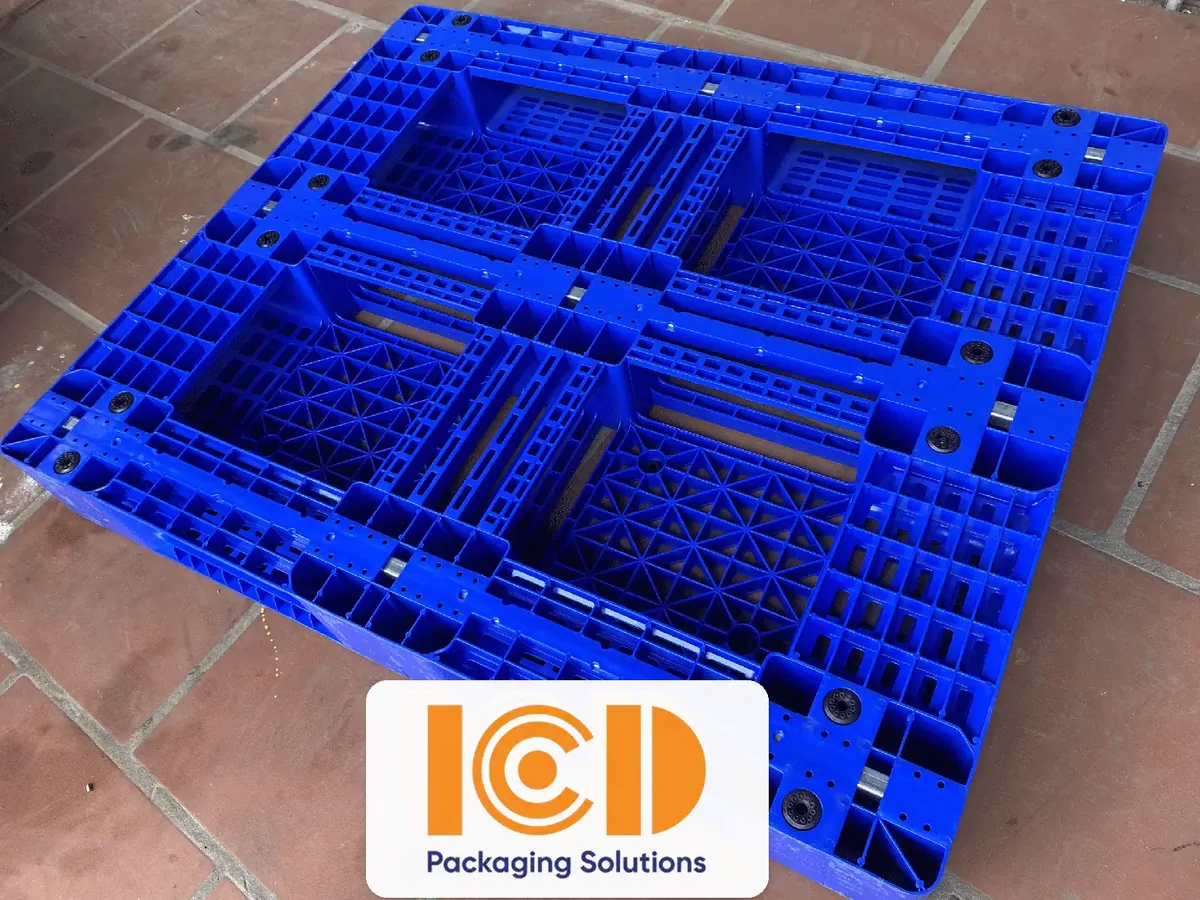
Consider a steel-core pallet when the non-steel-core model of the size you need has a rack load lower than the weight of the goods, when the rack has a wide beam span, or when goods stay on the rack for many months. In these cases the steel bar carries most of the bending moment at mid-span and limits creep over time. A model available for reference: the ICD steel-core plastic pallet, 1200x1000x150 mm (PL12).
A steel-core pallet also suits a warehouse that both racks pallets and handles them continuously: models PL10 and PL12 have dynamic loads of 2,400 kg and 3,200 kg, well above the 1,000 to 1,500 kg of most warehouse models. Conversely, if the goods are light and the rack span is short, a non-steel-core model with a large enough rack load is usually the leaner choice. A concrete example is the ICD steel-core plastic pallet 1200x1000x150 mm.
How do the rack type and rack accessories affect pallet requirements?
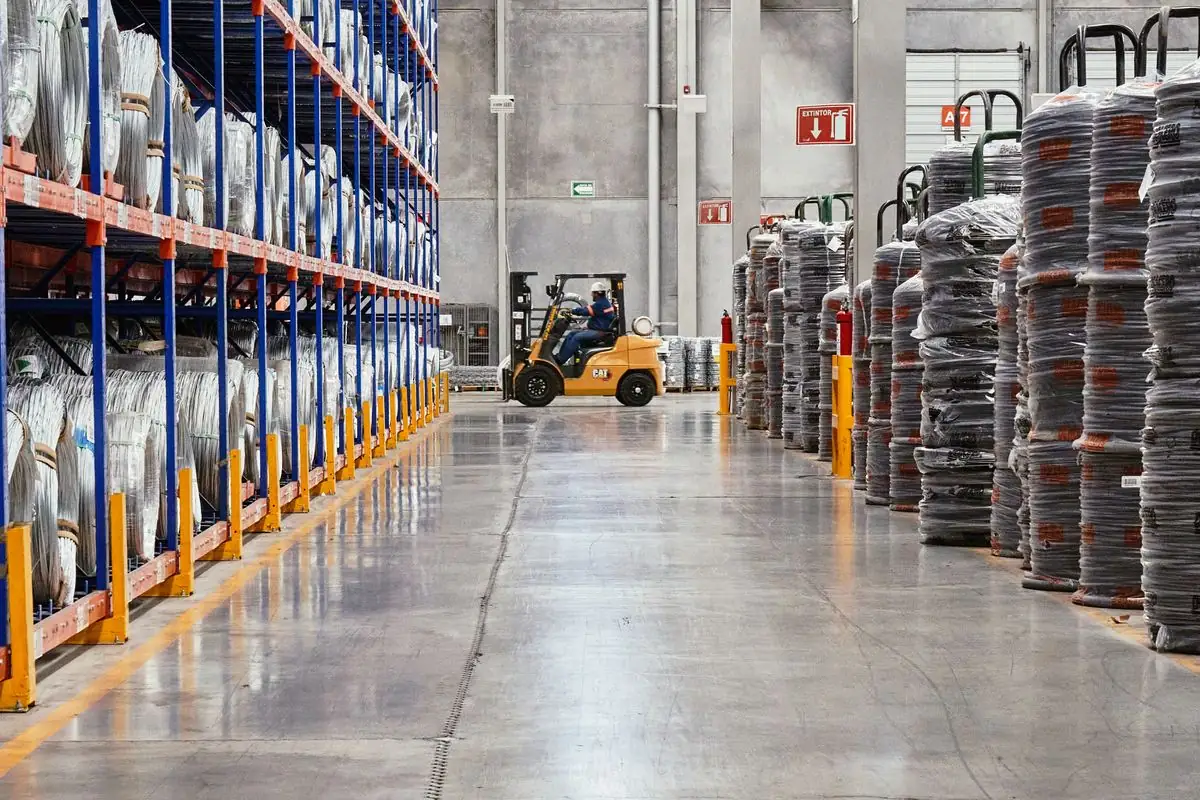
Selective racking, the most common type, supports the pallet on two beams, front and back; the pallet needs only the right rack load and enough length to sit securely on the beams. Drive-in racking supports the pallet on two rails at its edges, with a wider free span and a different bearing direction, so the pallet must be stiff with a solid base, and many warehouses choose steel-core pallets. Double-deep and push-back racking need pallets with durable edges because the forklift reaches in deep and often knocks them.
When existing pallets have a low rack load but you do not want to replace them, you can reinforce the rack with a cross support bar placed perpendicular between two beams, or a steel mesh deck laid over the beams. Both methods shorten the free span under the pallet. Reinforcing the rack needs the rack installer to calculate the load for the rack frame, not just for the pallet.
Steps to choose a plastic pallet for pallet racking
Before sending a quotation request, prepare the information in the order below so the right model is chosen from the start:
- Weigh the real goods on each pallet, including packaging.
- Measure the distance between two beams and the rack depth to know whether the pallet sits securely on both ends.
- Identify the rack type: selective, drive-in, double-deep or push-back.
- Note the store temperature and how long goods stay on the rack.
- Check against the rack load line of the model you plan to buy; skip models showing N/A or lower than the weight of the goods.
Example: goods weigh 850 kg per pallet, selective racking, 1,200 x 1,000 mm pallet. In the table above, model M1210D4-1A (500 kg) fails despite a static load of 4,000 kg; model H1210R4-3E (1,000 kg) or H1210S4-3L (1,200 to 1,500 kg) is going in the right direction.
Frequently asked questions about plastic pallets on pallet racking
What is racking load and how does it differ from static load?
Racking load (rack load) is the weight the pallet carries when only its two ends rest on beams and the middle hangs free. Static load applies when the pallet lies on a flat floor with the whole underside supported. Racking load is always much smaller; for example, model H1212R4-3A has a static load of 6,000 kg but a rack load of 700 kg.
Can a pallet with a 4-tonne static load go on a rack?
Yes, if that model has a rack load greater than the weight of the goods. In the ICD Vietnam catalogue, models with a 4,000 kg static load have rack loads from 500 kg to 1,000 kg, so you must read the rack load line of the model and not rely on the 4-tonne figure.
When do you need a steel-core pallet?
When the non-steel-core model of the right size has a rack load lower than the weight of the goods, when the rack span is wide, when goods stay on the rack for many months, or when the warehouse needs a high dynamic load. The two steel-core models PL10 and PL12 state a rack load of 1,200 kg and dynamic loads of 2,400 kg and 3,200 kg.
Why does a pallet look fine when loaded but sag after a few weeks?
Because of plastic creep: under a load applied for a long time, the material deforms slowly even though the load does not change, and the hotter the store the faster it happens. ISO 8611 therefore also measures residual deflection after a recovery period, limited to 0.7% of the span.
Which goes on racking better, open-deck or closed-deck pallets?
There is no fixed rule by the names open deck or closed deck. The construction of the base is the main factor: in the ICD Vietnam catalogue, two models of the same 1,200 x 1,200 mm size have rack loads of 700 kg and 1,500 kg. Compare the rack load line of the exact model.
Can you rack pallets without buying steel-core pallets?
Yes, by reinforcing the rack: place cross support bars or steel mesh over the beams to shorten the free span under the pallet. This needs the rack installer to recalculate the load for the rack frame.
Which plastic pallets suit drive-in racking?
Drive-in racking supports the pallet on two rails at its edges, so the pallet needs to be stiff with a solid base; many warehouses choose steel-core pallets. When asking for a price, state clearly that the rack type is drive-in and give the distance between the two rails.
How much deflection passes under ISO 8611?
In the racking bending test of ISO 8611-2, deflection under load must not exceed 2% of the free span and must not exceed 0.7% of the span after the recovery period. For example, a 1,000 mm span gives a test limit of 20 mm. This is a test limit, not the amount of sag that should be accepted in operation.
What should you watch for with plastic pallets on racking in a cold store?
Plastic is more brittle when cold and so cracks easily when a fork hits it. ISO 8611 has a test at -10 °C; when ordering for a cold store, ask clearly for the load figures and the plastic type at the real operating temperature.
Contact ICD Vietnam
ICD Vietnam Industrial Manufacturing Co., Ltd
Northern Vietnam: 3rd Floor, Thang Long A1 Building, Bau Hamlet, Thien Loc Commune, Hanoi - 0983 797 186 / 090 345 9186 / 090 5859 186
Southern Vietnam: 551/212 Le Van Khuong, Tan Thoi Hiep Ward, District 12, Ho Chi Minh City - 098 6784 186
Email: sales@icdvietnam.com.vn
Zalo: Chat with ICD Vietnam on Zalo
Send the weight of goods per pallet, the beam spacing, the rack type and the store temperature, and ICD Vietnam will match a pallet model with a suitable rack load and send a quotation. 2-year warranty.
References
- ISO 8611-1, Pallets for materials handling - Flat pallets - Part 1: Test methods (bending test on two supports).
- ISO 8611-2:2025, Part 2: Performance requirements and selection of tests (2% and 0.7% span deflection limits, safety factor 2, test temperatures, rated load example of 1,250 kg).
- Classification, structure and dimensions of pallets: Material Handling Industry (MHI).
- Static load, dynamic load and rack load of each model: ICD Vietnam plastic pallet product pages, checked on 15 October 2026.
Related articles
| ICD industrial plastic pallets | Plastic pallet sizes: a reference table of specifications | ISO standards for export plastic pallets |
For warehouses that need a closed four-sided protective frame, see also container-style plastic pallets.