
Table of Contents
- What is a double-face plastic pallet and how is it built?
- Types of double-face plastic pallets and ICD Vietnam models
- Detailed comparison of double-face and single-face plastic pallets
- Why a double-face pallet spreads load better - the mechanics
- When to choose double-face, and when single-face is enough
- Cost difference and how to assess return on investment
- Conclusion
- Frequently asked questions
- Can a double-face plastic pallet be used with a hand pallet truck?
- Can double-face pallets be stacked on each other when not in use?
- Are double-face plastic pallets and reversible pallets the same?
- How much does a double-face plastic pallet cost?
- Which lasts longer, double closed-deck or double mesh-deck pallets?
- Can a double-face plastic pallet with broken feet be repaired?
- Can a double-face plastic pallet go on racking?
- How does a double-face wooden pallet differ from a double-face plastic pallet?
- Contact us for advice on double-face plastic pallets
- References
Reviewed and updated by ICD - Week 44/2026
A double-face plastic pallet has both a top deck and a bottom deck, and the flat bottom rests evenly on the floor. In the ICD Vietnam catalogue, 10 double-face models state a static load of 4,000 to 6,000 kg; at the same 1200 x 1000 mm size, most single-face models state 3,000 to 4,000 kg. In return, double-face pallets usually cost more, cannot nest when empty and many models cannot be used with a hand pallet truck. Choose one for high stacking, conveyors, racking or when pallets must be washed in batches.
“Should we buy single-face or double-face pallets?” is one of the questions I have been asked most since I started making pallets at ICD Vietnam in 2011, and the answer is not simply which type is better. Some places buy double-face and pay extra for features they never use; others use single-face for heavy stacked goods and keep dealing with wobbly pallets and cracked feet. The first thing I ask customers is always: does the warehouse use hand pallet trucks or electric forklifts, and do the goods go on racking? This article follows that same order.
What is a double-face plastic pallet and how is it built?
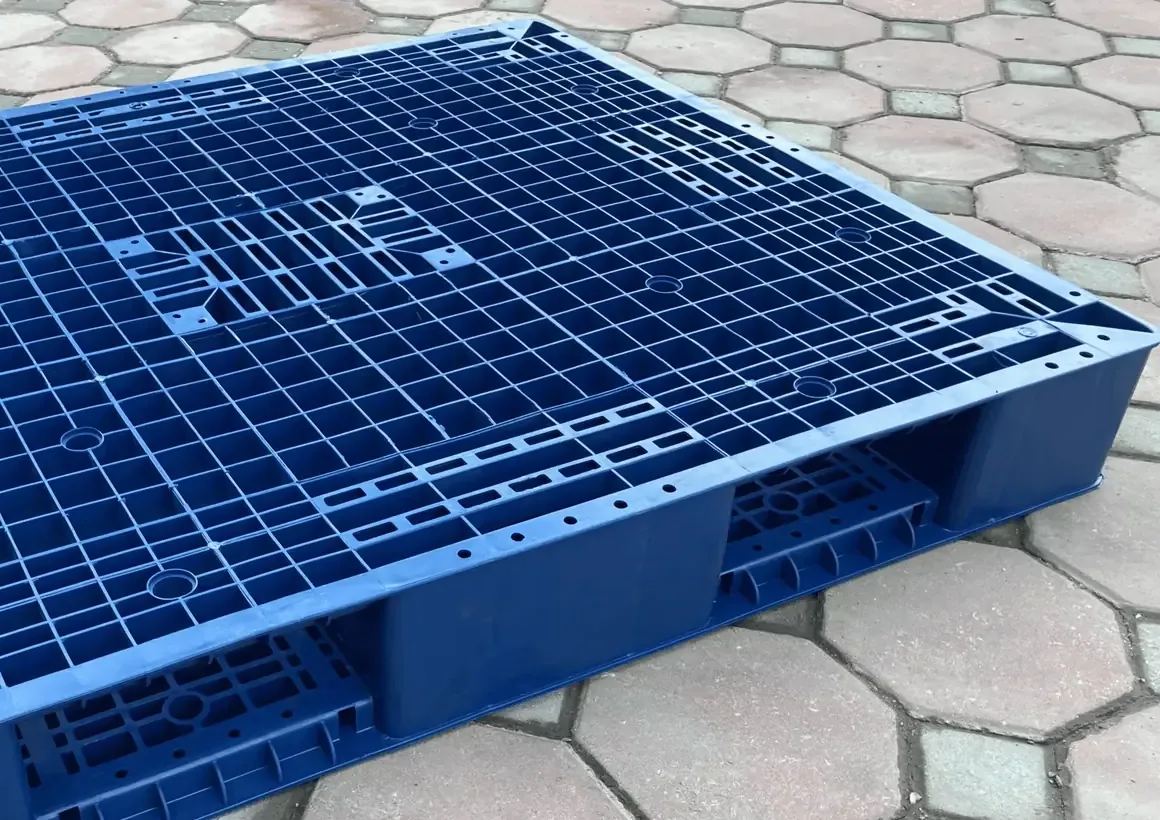
A double-face plastic pallet has two deck boards, one on top and one below, joined through a system of feet or walls in the middle. A single-face pallet has only a top deck; the part that rests on the floor is cup feet or runners. For more background, see what plastic pallets are and their types.
This construction is entirely different from a single-face pallet, which has just one flat surface touching the goods and the other side made of cup or runner feet. On a double-face pallet, both decks have the same structure and size, and either can touch goods or rest on the floor. Most models allow forklift entry from 4 directions (4-way entry) thanks to a gap between the two decks wide enough for the forks; some designs can be lifted from only 2 directions, so check the specification of each model. To go deeper, see what plastic pallets are used for.
The cross-section diagram below shows the core difference between the two designs: a single-face pallet rests on the floor through its feet, while a double-face pallet rests through a whole bottom deck.
Double-face, reversible and non-reversible: three concepts often confused
On the market, “double-face pallet” is often translated as reversible pallet, but in pallet industry terminology these are two different concepts. The standard pallet vocabulary is ISO 445, and industry documents divide the terms as follows. A double-face pallet only needs to have both a top deck and a bottom deck. Within this group, a reversible pallet has two identical decks so either side can carry goods, while a non-reversible pallet has a bottom deck different from the top, usually more open and leaving clearance for the wheels of a hand pallet truck.
Telling them apart correctly helps you order exactly what you need. If you want to flip the pallet and use the other side when one side is dirty or scratched, it must be the reversible type. A warehouse that mainly runs hand pallet trucks is better suited to the non-reversible type, whose bottom deck has openings for the load wheels. As for “2-way” or “4-way”, that is the number of sides a forklift’s forks can enter, unrelated to the number of decks.
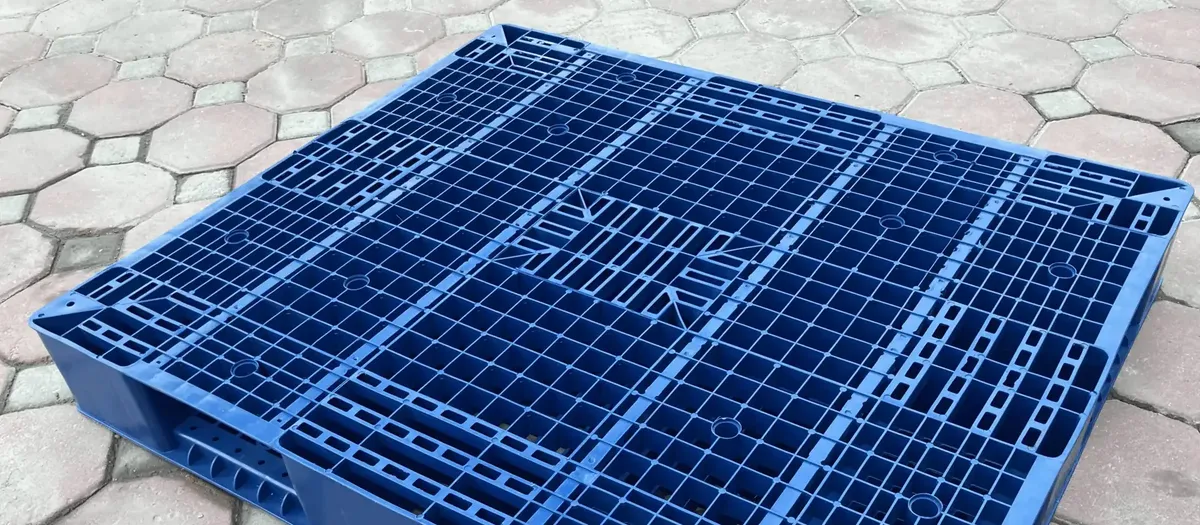
One detail buyers often overlook is the direction of the bars on the bottom deck. When a pallet runs on a roller conveyor or sits on racking, bottom bars arranged in both directions let the pallet sit evenly whichever edge it enters from, so you do not have to turn the pallet to the right direction before it enters the system. This is why double-face pallets with a solid bottom are often chosen for automated warehouses.
Types of double-face plastic pallets and ICD Vietnam models
By deck construction, double-face plastic pallets come in three kinds. The double closed-deck type has both surfaces continuous with no holes, so it spreads force most evenly, is easy to wash and lets no small goods fall through; it suits food, pharmaceuticals and cold stores. The double mesh-deck type has open cells on both sides, is lighter, ventilated and drains fast, and suits farm produce and damp stores. The combination type has one closed deck and one mesh deck, used in warehouses handling many product lines. The models on sale are in the ICD plastic pallet range.
The table below lists the 10 ICD Vietnam double-face models that currently publish specifications; there is also an imported Malaysian double-face line in many specifications from 600 x 400 to 1500 x 1300 mm.
| Product code | Size (mm) | Static load (kg) | Dynamic load (kg) | Technology, material |
|---|---|---|---|---|
| ICD XU 2M 1111 | 1100 x 1100 x 150 | 6,000 | 2,000 | Blow moulded, HDPE |
| ICD XU 2M 1210 | 1200 x 1000 x 150 | 6,000 | 2,000 | Blow moulded, one-piece, HDPE |
| ICD DMV1012B2 | 1200 x 1000 x 150 | 4,000 | 1,500 | HDPE |
| ICD XU 2M 1212 | 1200 x 1200 x 150 | 6,000 | 2,000 | Blow moulded, HDPE |
| ICD XU 2M 1311 | 1300 x 1100 x 150 | 6,000 | 2,000 | Blow moulded, HDPE |
| ICD XU 2M 1412 | 1400 x 1200 x 150 | 6,000 | 2,000 | Blow moulded, HDPE |
| ICD XU 2M 1414 | 1400 x 1400 x 150 | 6,000 | 2,000 | Blow moulded, HDPE |
| ICD XU 2M 1512 | 1500 x 1200 x 150 | 6,000 | 2,000 | Blow moulded, HDPE |
| ICD XU 2M 1513 | 1500 x 1300 x 150 | 6,000 | 2,000 | Blow moulded, HDPE |
| ICD XU 2M 1614 | 1600 x 1400 x 150 | 6,000 | 2,000 | Blow moulded, HDPE |
Source: ICD Vietnam plastic pallet product catalogue, checked on 11 October 2026. Model DMV1012B2 has a self-weight of about 17.5 kg (5% tolerance) according to the manufacturer’s specification.
Detailed comparison of double-face and single-face plastic pallets
The main difference lies in the base of the pallet: a double-face pallet has a flat bottom so it stacks more stably and generally publishes a higher static load, in return for a higher price and no nesting when empty. The table below is not meant to show which type is “better”, but which suits your warehouse conditions.
| Criterion | Double-face plastic pallet | Single-face plastic pallet |
|---|---|---|
| Usable sides | 2 sides (reversible type); the non-reversible type carries goods on the top deck only | 1 side, must be placed the right way up |
| Forklift entry directions | Usually 4-way, some models 2-way | 2-way or 4-way depending on design |
| Stability when stacked | High, flat bottom rests evenly | Medium, cup feet rest at points |
| Hand pallet truck | Only when the bottom deck has openings for the load wheels | Usable with most models |
| Self-weight (1200 x 1000 size) | DMV1012B2 about 17.5 kg | About 6 kg (nesting hump-foot) to 17.5 kg (3-runner), depending on construction |
| Published static load (1200 x 1000 size) | 4,000-6,000 kg | Mostly 3,000-4,000 kg (full range 1,500-6,500 kg, the highest model has a steel core) |
| When empty | Stack straight, no nesting | Cup-foot types nest into each other, saving space |
| Cleaning | Easy, no cup-foot pockets to hold dirt | Cup-foot pockets easily collect dirt and water |
| Price | Contact for a quote, usually higher than a single-face pallet of the same size | Contact for a quote |
Load and weight figures are taken from the ICD Vietnam catalogue, checked on 11 October 2026; the single-face loads are based on 42 models of 1200 x 1000 mm that publish a static load (25 of them at 3,000 or 4,000 kg).
Weight is where the real figures say something different from common perception. The double-face model DMV1012B2 weighs about 17.5 kg, exactly the same as the three-runner single-face model EHV1012B2 of the same 1000 x 1200 x 150 mm size, while the nesting hump-foot pallet NP01-1 at 1200 x 1000 mm weighs only about 6 kg. A pallet is heavy or light according to the amount of plastic in the ribs, feet and decks rather than whether it has one or two decks, so compare the weight of the exact two models you are considering.
Why a double-face pallet spreads load better - the mechanics
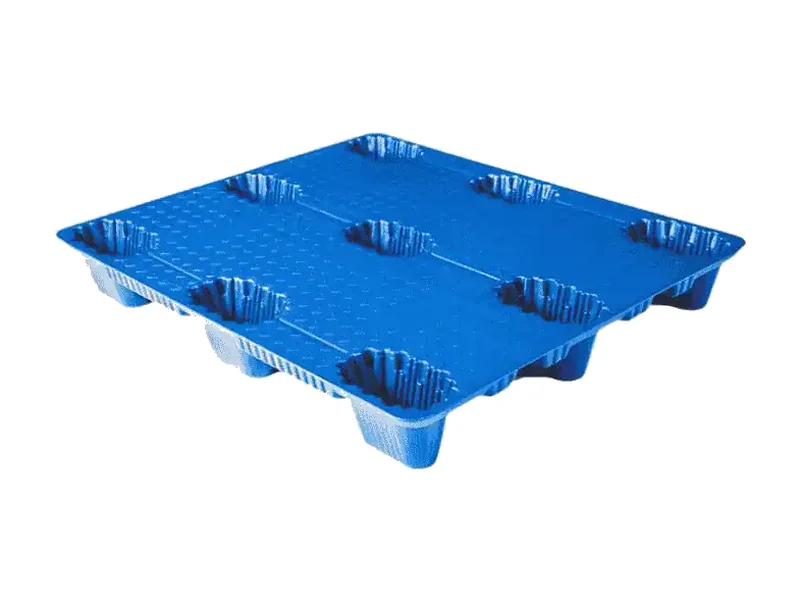
A double-face pallet spreads load better because force passes to the floor through the whole bottom deck, covering most of the 12,000 cm² area of a 1200 x 1000 mm pallet, instead of only through the foot area of 9 cup feet as with a single-face pallet. This is not a subjective remark - there is concrete physics behind it: for the same force, the larger the contact area, the smaller the pressure at each point.
A single-face pallet standing on the floor rests on cup feet or runners, usually 9 feet; the total foot area is only a small fraction of the pallet area. The entire load of goods and pallet is pushed down onto those points. Under normal conditions this is fine, but with heavy loads and a floor that is not truly flat, concentrated force can crack a foot or make the pallet wobble.
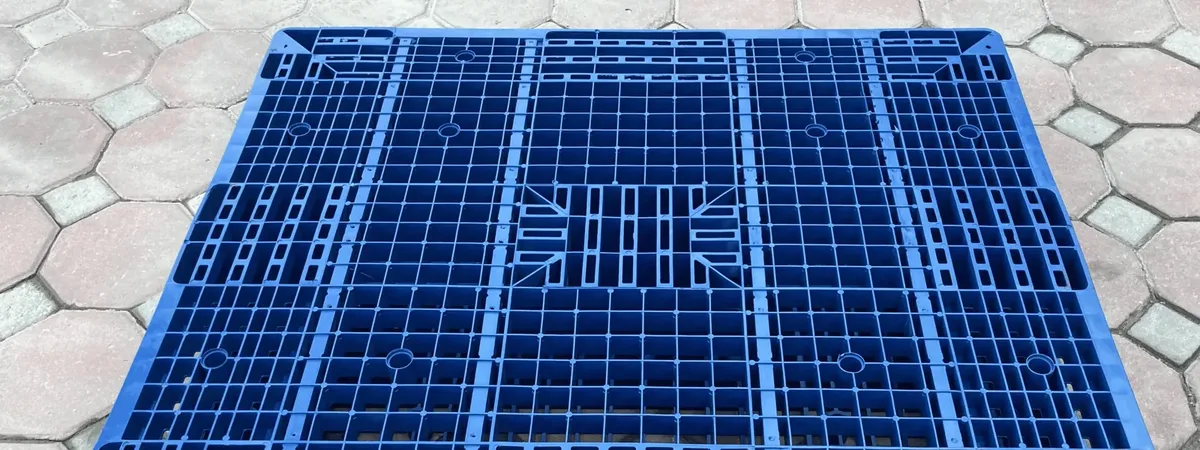
When a double-face pallet is placed with its lower deck on the floor, the contact area is nearly the whole lower deck. The load is spread evenly over this area, reducing the stress at each point several-fold compared with a single-face pallet. The result: the pallet is more stable and wobbles less, especially when stacked many tiers high or placed on a floor that is not fully flat such as an old warehouse floor or a container surface.
Three load figures on a quotation: static, dynamic and rack
Plastic pallets are load-tested under ISO 8611-1, whose latest edition was issued in 2025. The test set includes bending when the pallet lies on a rack, lifting by forklift and hand pallet truck, foot compression, stacking and bending of the bottom deck. A pallet model therefore has several different load levels. Static load applies when the pallet lies on a flat floor; dynamic load applies while it is being lifted and moved; rack load applies when the pallet rests only on two beams, usually the lowest of the three figures.
The 6,000 kg figure in the model table above is the static load, not a level for racking. The ICD Vietnam catalogue currently publishes static and dynamic loads for 10 double-face models; if you plan to put pallets on beam racking, ask for the rack load of the exact model, together with the orientation of the pallet relative to the beams, before you buy.
When to choose double-face, and when single-face is enough
Choose a double-face pallet when goods are stacked 3 tiers or higher, weigh more than 1,500 kg per pallet, run on conveyors or need batch cleaning; in other cases a single-face pallet is enough and more economical. For a quick decision, use this filter: if the answer to any condition below is “yes”, a double-face pallet is the better choice.
- Goods are stacked 3 tiers or higher.
- The warehouse runs conveyors or an automated system.
- Pallets go on beam racking.
- The warehouse must wash pallets in batches.
- You want to flip the pallet and keep using the other side.
- Goods are light, stacked 1-2 tiers.
- The warehouse mainly uses hand pallet trucks.
- Goods ship one way and pallets are not recovered.
- You need to nest empty pallets to save space.
If your warehouse falls into both groups, for example with both a heavy stacking area and a one-way shipping area, the sensible approach is to use both side by side: double-face pallets for the internal storage area that circulates, single-face pallets for goods leaving the factory.
Check the lifting equipment before buying
A double-face pallet works well only when it matches the equipment already in the warehouse. With a hand pallet truck, when the forks are raised the load wheel at the end of the fork must lower to the floor through a gap in the bottom deck; if the bottom deck is closed at that position, the wheel has no room and the truck cannot lift. You therefore need to look at the bottom deck construction of each model, instead of relying only on the name double-face.
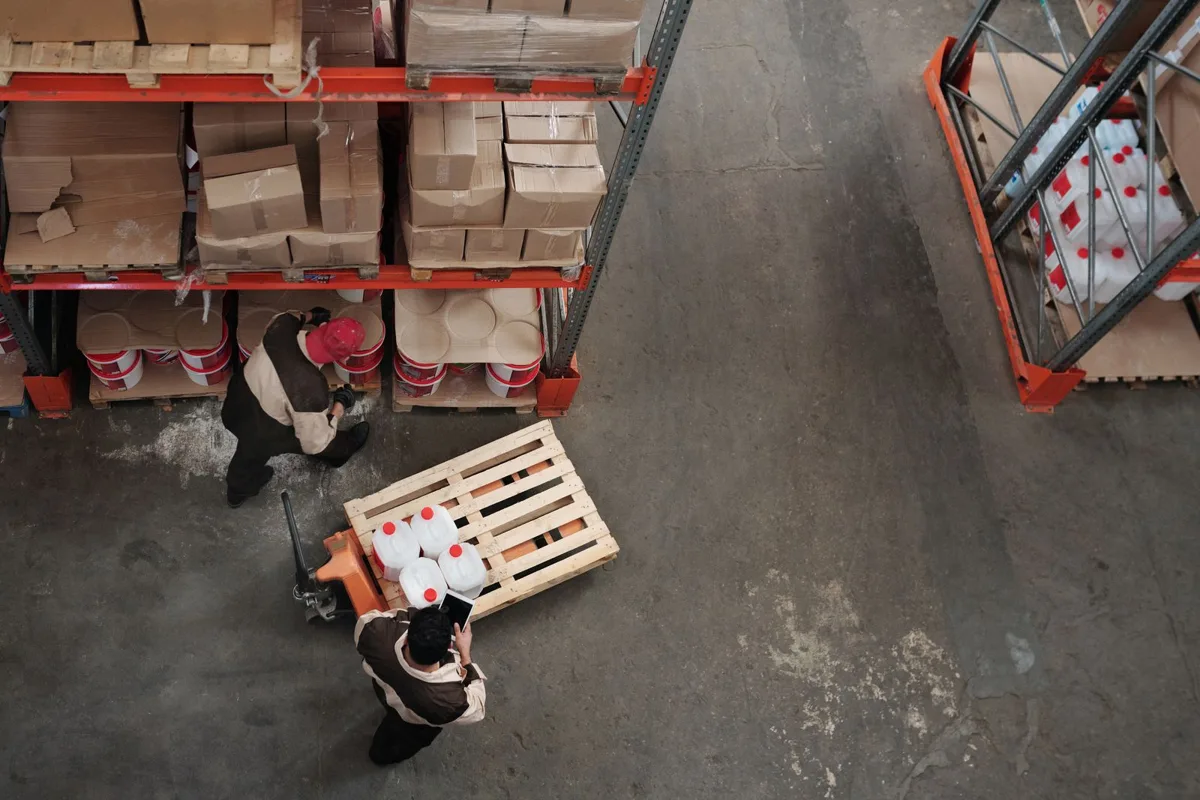
Diesel and electric forklifts use forks only, with no wheel at the fork tip, so they suit any double-face pallet whose fork entry is high enough. A hand pallet truck needs a gap in the bottom deck at the exact position of the load wheel; the surest way is to bring the truck for a trial or send the fork dimensions to the supplier. For conveyors and automated warehouses, prefer a flat bottom with bars in both directions.
Cost difference and how to assess return on investment
A double-face pallet usually costs more than a single-face pallet of the same size because it has an extra deck and a more complex mould. How much more depends on the model, virgin or recycled plastic and the resin price at the time, so I do not give a fixed ratio here. The practical question is whether the difference is recovered in operation.
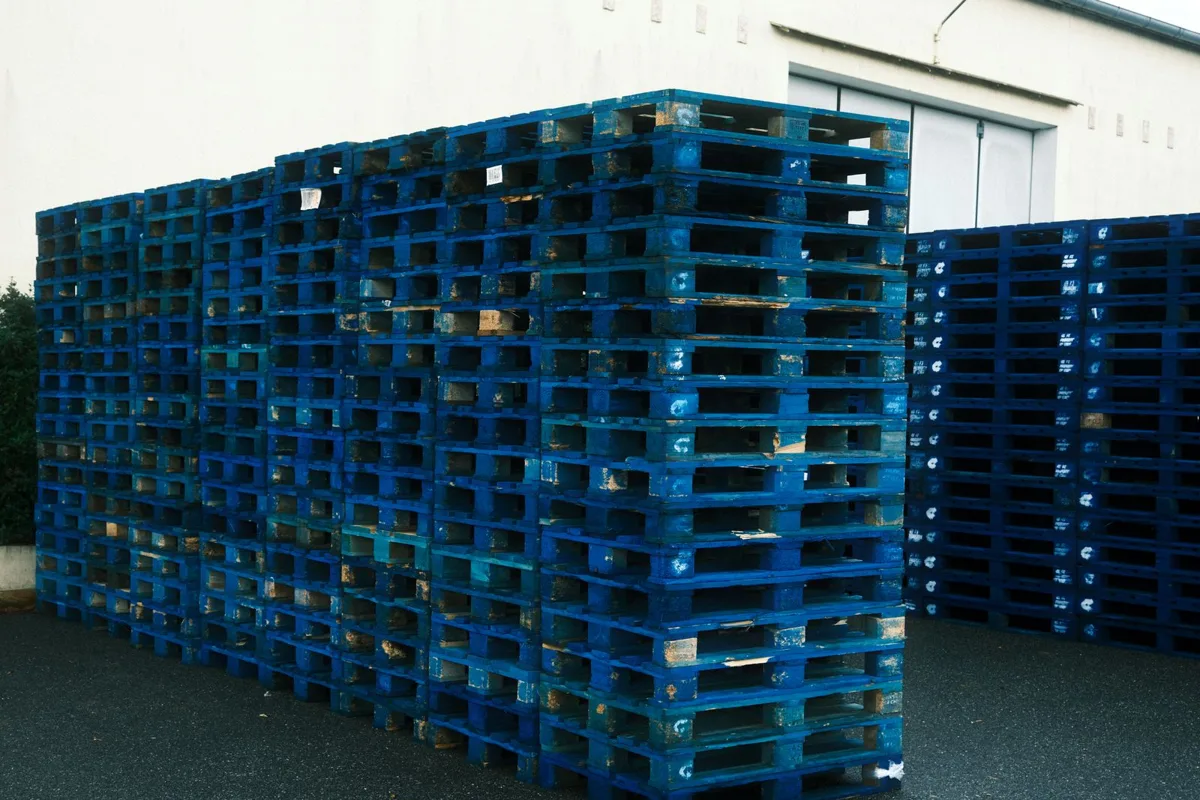
The way I usually work it out with customers is to convert to cost per use cycle: take the purchase price and divide by the expected number of cycles before the pallet must be replaced. A double-face pallet helps in two places. When one side is scratched or dirty beyond cleaning, the reversible type keeps going on the other side. When the warehouse must wash pallets in batches, a solid bottom washes faster than cup-foot pockets. If those two benefits are real in your warehouse, the number of cycles rises and the cost per cycle can be lower even though the purchase price is higher.
Use the real number of cycles and the real damage rate of your own warehouse to calculate. Conversely, if the warehouse does not need to flip pallets, has no high hygiene requirement and the goods are not heavy, the extra cost creates no matching value; in that case a single-face pallet is the more sensible choice.
Conclusion
Frequently asked questions
Can a double-face plastic pallet be used with a hand pallet truck?
Only models with a gap in the bottom deck at the exact position of the truck’s load wheel. When lifting, the wheel at the fork tip must lower to the floor through that gap; a model with a closed bottom deck at the wheel position can only be used with electric and diesel forklifts. The pallet’s fork entry must also be higher than the forks of a hand pallet truck at their lowest; this figure differs between truck brands so you need to measure the truck you actually use.
Can double-face pallets be stacked on each other when not in use?
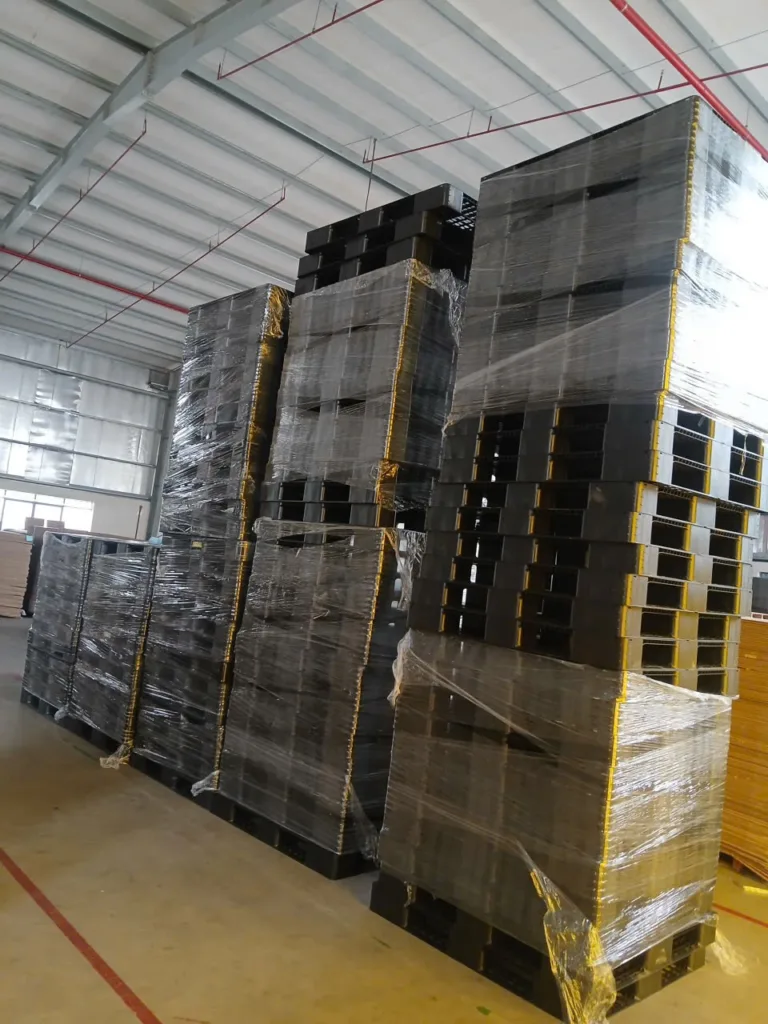
Yes, but not as many as single-face pallets with nesting cup feet. Double-face pallets stack straight, each pallet taking its own full height (usually 140-150 mm). To store them economically, plan warehouse space for empty pallets in advance - you usually need a height of at least 2 to 2.5 m to stack 15-16 in a pile.
Are double-face plastic pallets and reversible pallets the same?
Not exactly. A double-face pallet only needs to have both a top deck and a bottom deck; a reversible pallet is a double-face type with two identical decks, either of which can carry goods. A non-reversible double-face type has a bottom deck different from the top, usually leaving openings for hand pallet truck wheels.
How much does a double-face plastic pallet cost?
The price depends on size, virgin or recycled plastic, injection or blow moulding technology and the quantity ordered. At the same size, a double-face pallet usually costs more than a single-face pallet. Because resin prices change over time, contact ICD Vietnam for a quotation by model and specific quantity.
Which lasts longer, double closed-deck or double mesh-deck pallets?
For mechanical strength, double closed-deck is stronger because a continuous deck forms a better load-bearing frame than a mesh deck with many open cells. A double mesh-deck type is lighter than a closed model of the same construction, drains and ventilates well so it suits damp stores and farm produce. For hard impact or constant heavy loads, double closed-deck is the safer choice.
Can a double-face plastic pallet with broken feet be repaired?
It depends on the position and extent of the damage. A small crack on the deck can be re-welded if it does not affect the load-bearing structure. A broken internal support usually cannot be repaired and the pallet must be replaced. ICD Vietnam can help assess on site whether the pallet can continue to be used safely.
Can a double-face plastic pallet go on racking?
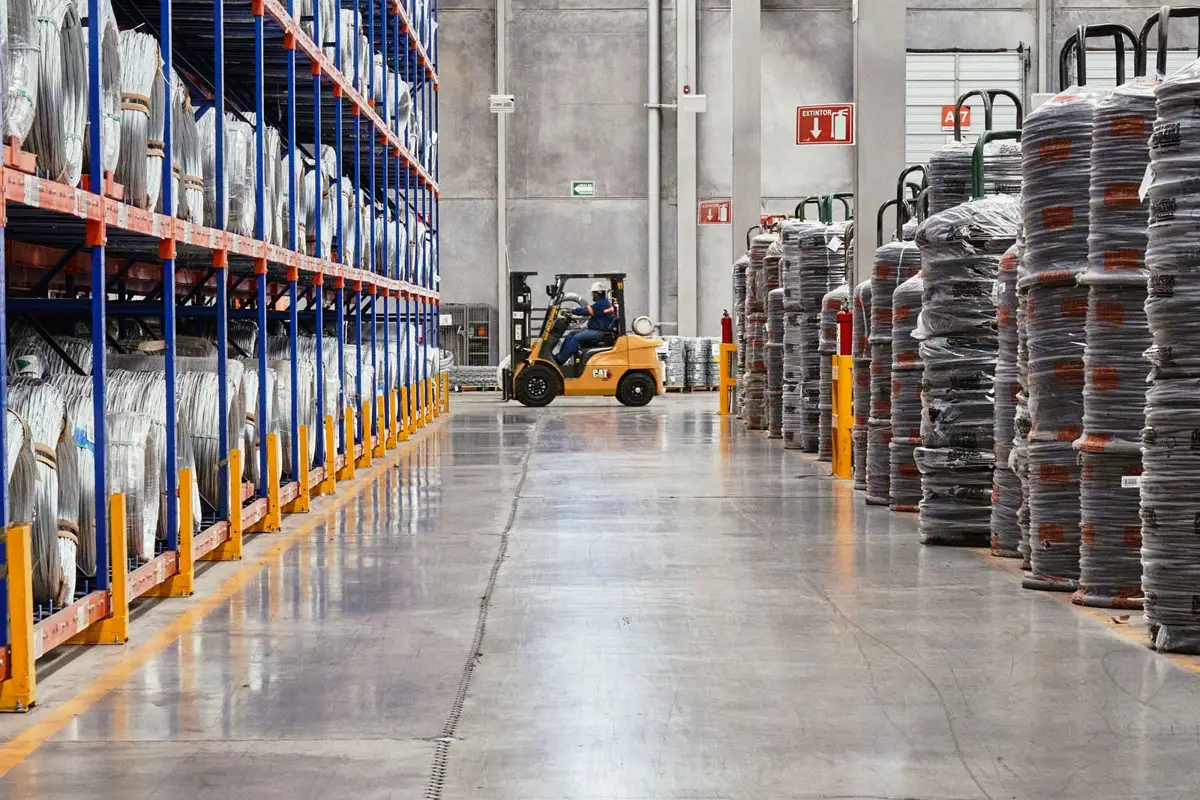
Yes, and this is a common use because the bottom deck sits evenly on the beams. However, rack load differs from static load on the floor, because the pallet rests only on two supports; ISO 8611-1 tests this case separately. Ask for the rack load of the exact model you plan to buy; for heavy goods that stay long, prefer a steel-core model.
How does a double-face wooden pallet differ from a double-face plastic pallet?
A double-face wooden pallet also has boards on both the top and the bottom, is usually cheaper to buy and can be repaired board by board. The biggest difference is in export: raw wooden pallets fall under ISPM 15 and must be treated, for example heat treated until the wood core reaches 56 °C for 30 continuous minutes, and then stamped. Plastic pallets are outside the scope of ISPM 15, absorb no moisture and are easier to wash.
Contact us for advice on double-face plastic pallets
If you need advice on choosing the right pallet for your warehouse conditions and product line, the ICD Vietnam team is ready to help free of charge.
- Northern Vietnam: 0983 797 186
090 345 9186
090 5859 186 - Southern Vietnam: 098 6784 186
- Email: Sales@icdvietnam.com.vn
In stock - VAT invoice - Nationwide delivery - Free consultation
References
- Classification, structure and pallet size standards (ISO 6780, GMA) - Material Handling Industry (MHI) - Pallets.
- Pallet terminology - ISO 445:2013, Pallets for materials handling: Vocabulary.
- Flat pallet load tests - ISO 8611-1:2025, Pallets for materials handling: Flat pallets, Part 1: Test methods.
- Wood packaging material in international trade - ISPM 15, International Plant Protection Convention (IPPC).
- Product specifications - ICD Vietnam plastic pallet catalogue, checked on 11 October 2026.