Table of Contents
- What are virgin plastic pallets
- Virgin HDPE and virgin PP
- How virgin and recycled differ
- How to tell when you receive the goods
- Recycled plastic and food contact regulations
- Lifecycle cost
- When to use virgin and when to use recycled
- Frequently asked questions
- Do virgin plastic pallets meet FDA standards?
- How do you know the supplier delivers genuinely virgin plastic?
- Can virgin plastic pallets be used in deep freezer stores?
- Is virgin plastic toxic?
- Is a recycled plastic pallet the same as a used plastic pallet?
- Can a virgin plastic pallet be recycled at the end of its life?
- Conclusion
- References
Reviewed and updated by ICD - Week 43/2026
Virgin plastic pallets are moulded from new HDPE or PP resin that has never been used or recycled. Compared with pallets moulded from recycled plastic, they are more consistent from batch to batch, stay durable longer under continuous use and suit the food, pharmaceutical and cold storage industries; in return the purchase price is higher. Recycled pallets make sense when the goods have no hygiene requirement, when the pallets travel one way or are only used for temporary storage.
When customers ask me about virgin pallets, they usually start with “which type is better?”. I tend to answer with a question back: what will your pallets carry, at what temperature, and for how long will they circulate? This article helps answer those three questions, along with checks that most other articles skip: laboratory testing, the rules on recycled plastic in contact with food, and why recycled pallets are often “stiff but brittle”.
- Choose virgin when: Food, pharmaceuticals, cold storage; pallets circulating for many years; export customers requiring material records.
- Choose recycled when: Industrial goods, building materials; one-way export with no return; temporary storage or a limited budget.
What are virgin plastic pallets
Virgin plastic is resin synthesised directly from petroleum and natural gas that has never been used or heated before. The polymer chains are intact, so the moulded pallet has even strength across its whole surface. Virgin resin is naturally an opaque white; the blue, red and yellow of a pallet come from colour masterbatch added during moulding. You can see all models in ICD’s range of plastic pallets.
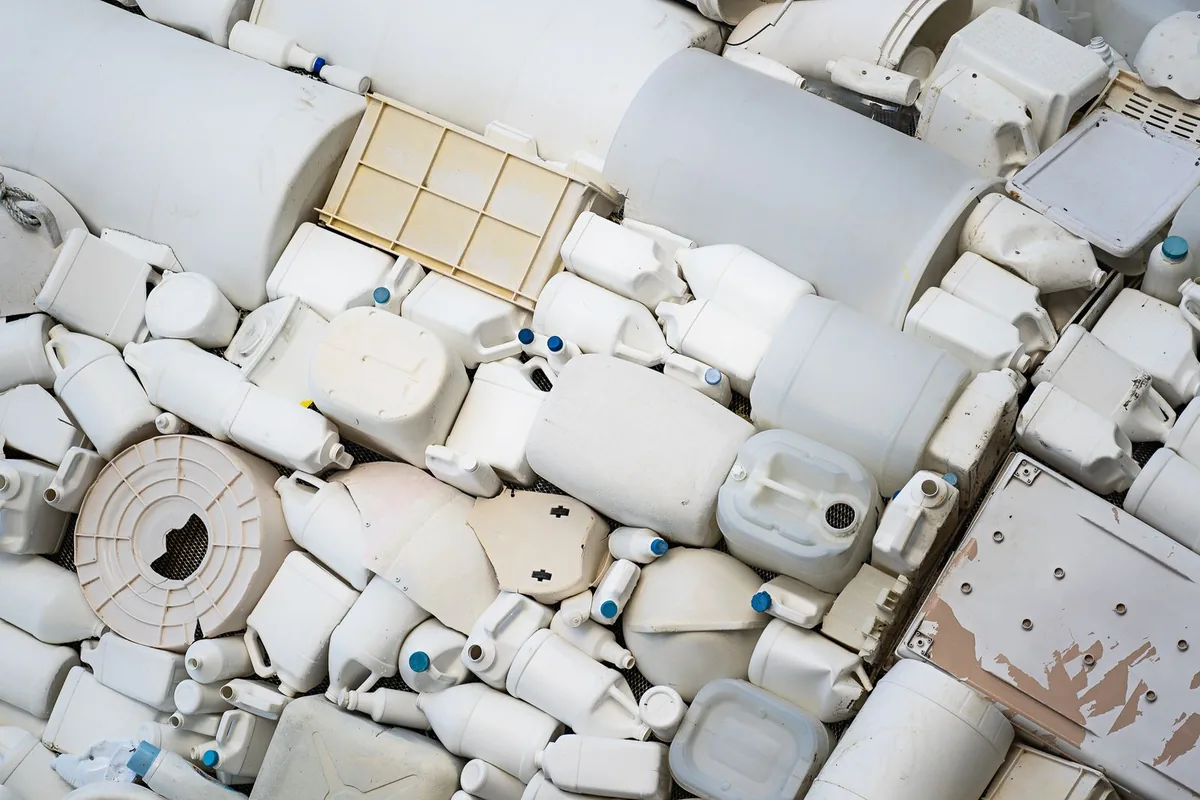
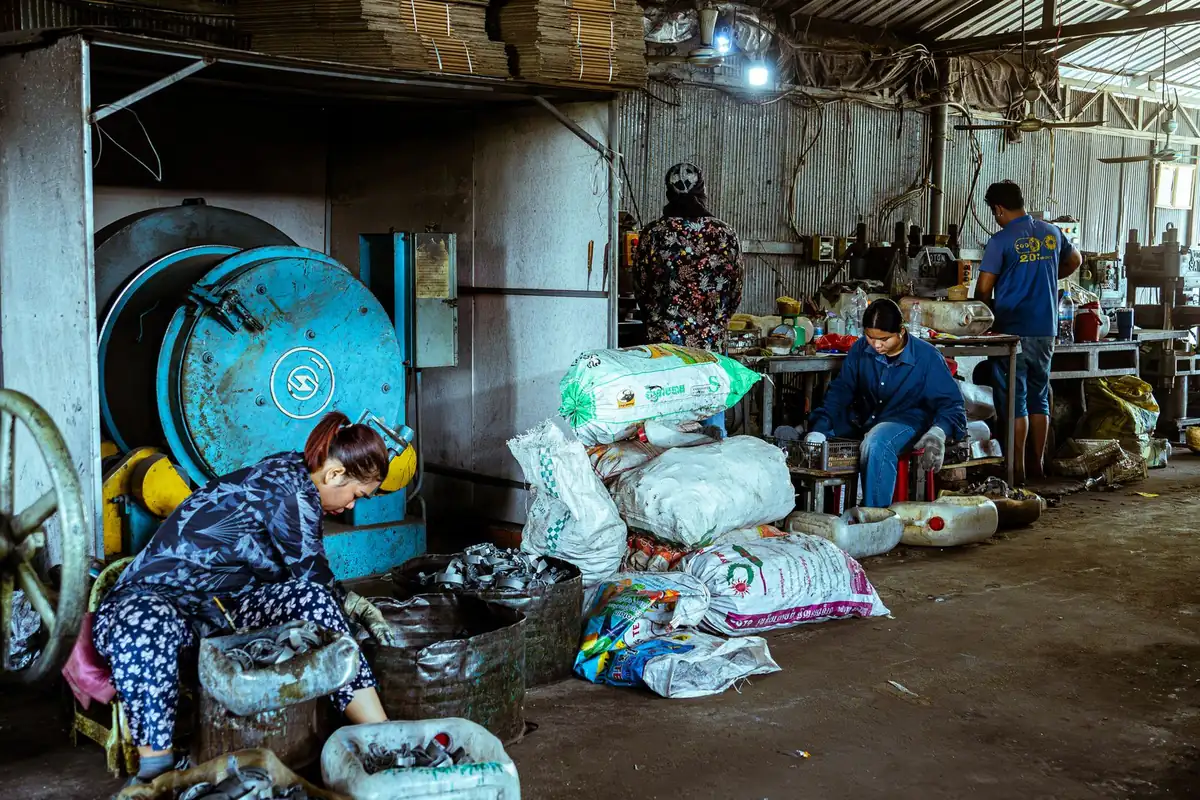
Recycled plastic is collected from used plastic products, ground, melted and moulded again. Each heating breaks some of the polymer chains and can bring impurities into the material, so consistency between batches is lower. Recycled pallets can still carry loads well if the design is suitable.
Three concepts below are often mixed up in quotations. Telling them apart helps you read a quotation correctly and ask for the right goods.
- Virgin plastic pallet: describes the source of the material, new resin that has never been used. For example: a virgin HDPE pallet fresh from the factory.
- Recycled plastic pallet: also describes the material, recovered plastic that has been ground and moulded again. For example: a pallet fresh from the factory but moulded from recycled plastic.
- Used plastic pallet: describes the state of use, a pallet that has been used for some time. For example: a virgin pallet that ran for 3 years in a warehouse and is being sold off.
So a recycled pallet can be brand new, and a virgin pallet becomes a used pallet after a period of use. When buying, ask clearly about both the material and the condition. In the imported range, many virgin plastic pallet models imported from Malaysia by ICD Vietnam state virgin HDPE on the specification.
Virgin HDPE and virgin PP
Most virgin plastic pallets are made of HDPE (High-Density Polyethylene) or PP (Polypropylene). HDPE is tough, takes impact well and stays flexible at low temperatures, so it suits cold stores, logistics and heavy goods. PP is stiffer, handles heat and chemicals better and is lighter, but becomes brittle below 0 °C. Choosing the wrong type can make a pallet crack in a cold store or deform in a hot place. Related to this section is the article comparing Tritan and PP plastic.
- Tough at low temperatures: according to the British Plastics Federation (BPF), HDPE stays tough down to about -60 °C, so it suits freezer stores
- Continuous-use temperature of about 65 to 80 °C depending on grade and data source
- Good stress-crack resistance, withstands repeated impact
- Density of about 0.94 to 0.97 g/cm³
- Suitable for: cold stores, logistics, heavy goods
- Stiffer, with higher tensile strength than HDPE
- Continuous-use temperature of about 80 to 110 °C depending on grade and data source
- Glass transition temperature of about 0 °C, so homopolymer PP is brittle when cold; copolymer PP improves on this point
- Density of about 0.90 g/cm³, lighter than HDPE of the same design
- Suitable for: chemicals, high-heat environments
Many pallets have a triangle symbol with a number printed or moulded on them, called the resin identification code. The symbol tells you the type of plastic, not whether it is virgin or recycled.
- HDPE - number 2: Tough, takes impact well and stays flexible at low temperatures. A common choice for cold stores and logistics in Vietnam.
- PP - number 5: Stiffer, handles heat better and cold less well than HDPE. Its lower density means PP pallets are usually lighter at the same design.
How virgin and recycled differ
There is no general answer on which is better, only which suits the conditions of use better. The table below compares the criteria that businesses often weigh. For the bigger picture, read which pallet material is best.
| Criterion | Virgin plastic pallet | Recycled plastic pallet |
|---|---|---|
| Material | New HDPE or PP resin | Used plastic, ground and moulded again |
| Consistency between batches | High | Lower, depends on the scrap source |
| Durability under continuous use | Lasts longer, fewer micro-cracks from impact | Declines faster under frequent impact |
| Colour | Even, many colours | Usually black or dark blue |
| Food contact | More suitable, still needs migration test results for the lot | Impurities are hard to control, not advised for direct contact |
| Purchase price | Higher | Lower |
Why are recycled pallets often “stiff but brittle”?
Many people think recycled plastic is weak because it has “been used”. Research points to more specific causes. The first is other plastics mixed in: post-consumer PE scrap is often mixed with PP from bottle caps, labels and packaging. The two plastics do not blend well and create weak boundary zones inside. A study in the journal Polymers (Gall et al., 2021) found that recycled PE pellets can contain about 7% PP and are clearly more brittle than virgin plastic; the research group of Karaagac et al. (Waste Management, 2020) also found a similar effect in HDPE recycled from bottles and containers.
The second is the number of heatings. Each remelt cuts or cross-links part of the polymer chain. The effect builds up gradually: a 100-pass repeated extrusion experiment on LDPE (Jin et al., Polymer Degradation and Stability, 2012) showed that processability and long-term creep strength only changed clearly after about the 40th pass. That means the big problem with recycled pallets usually lies not in “how many times it was recycled” but in whether the scrap source is clean and uniform.
On load capacity, the figures in ICD Vietnam’s catalogue show that design decides first, and the material decides durability over time.
| Indicator | Models stating virgin plastic | Models stating recycled plastic |
|---|---|---|
| Number of models stating the material clearly | 14 models | 12 models |
| Published static load | 3,000 to 6,500 kg | 1,500 to 5,000 kg |
| Published dynamic load | 1,000 to 3,200 kg | 800 to 2,000 kg |
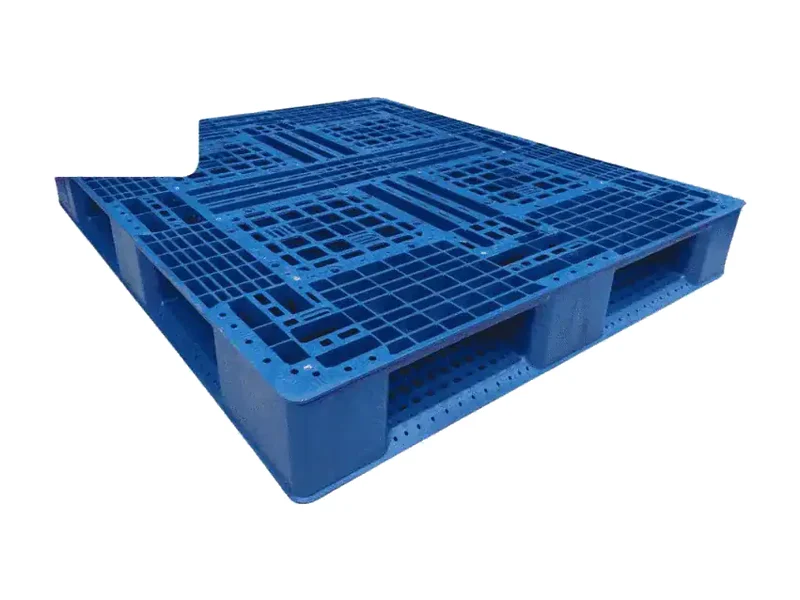
| Same cross-rib structure 1200 x 1000 x 150 mm | Static load 4,000 kg, dynamic load 2,000 kg | Static load 4,000 kg, dynamic load 2,000 kg |
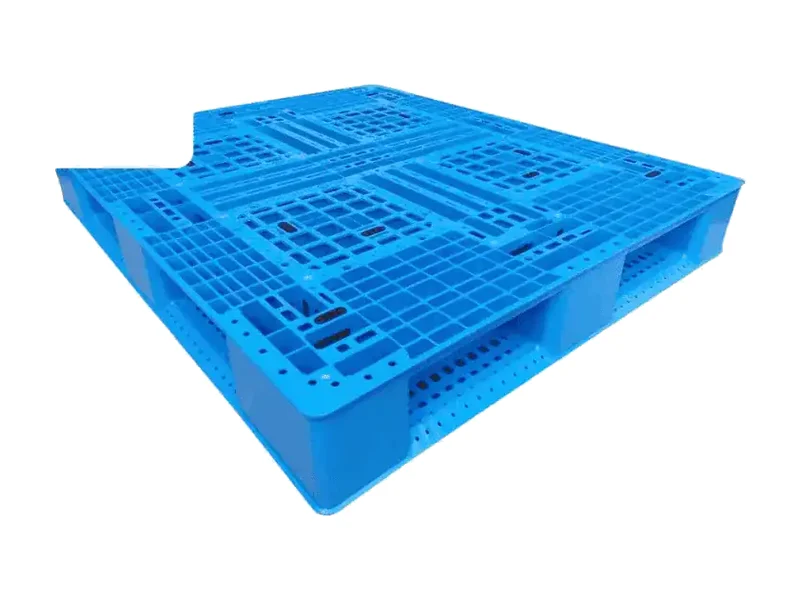
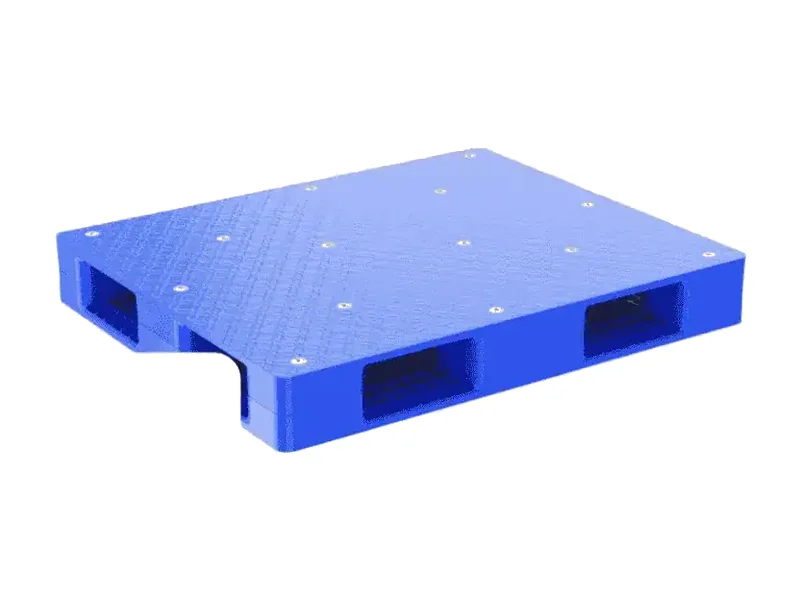
- Cross-rib, virgin plastic: Bright blue, even across the deck and feet of the pallet. (1200 x 1000 x 150 mm; static 4,000 kg; dynamic 2,000 kg)
- Cross-rib, recycled plastic: Same mould, same published specifications; a darker blue because the colour masterbatch masks the recycled plastic base. (1200 x 1000 x 150 mm; static 4,000 kg; dynamic 2,000 kg)
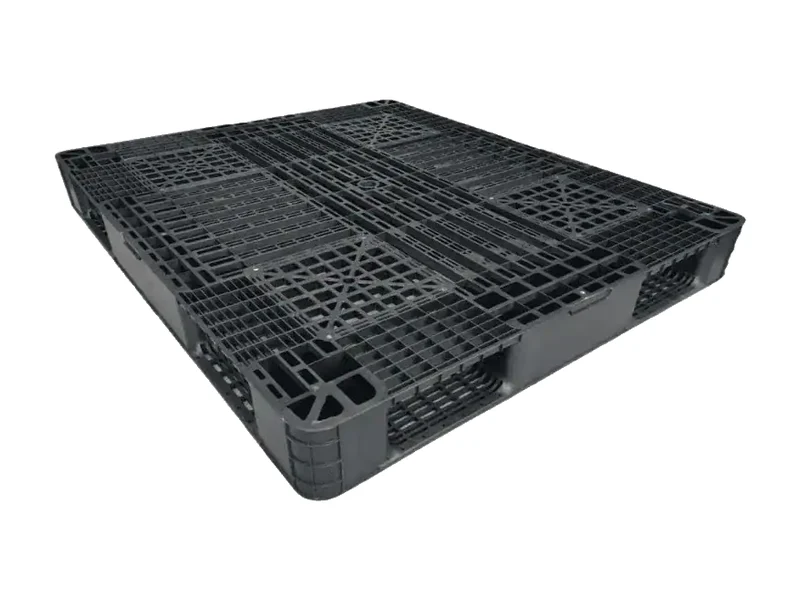
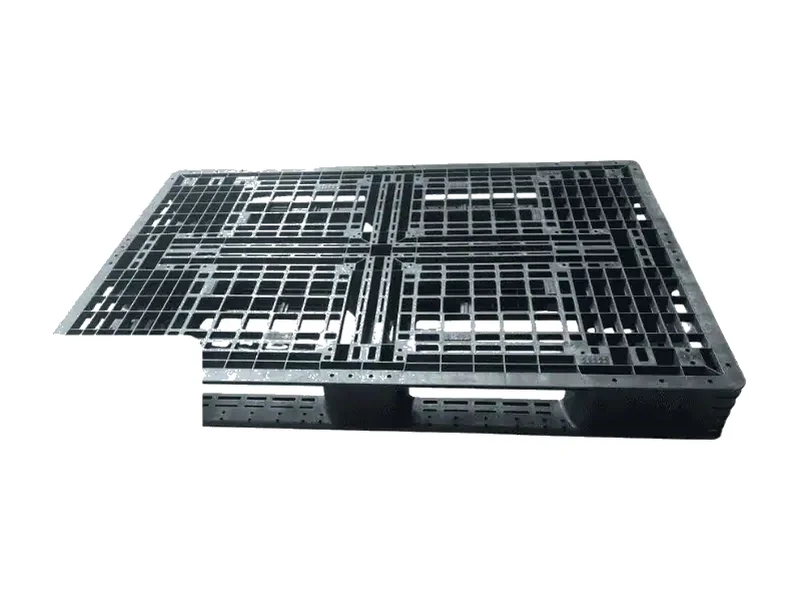
- Black, virgin plastic: 1300 x 1100 x 130 mm export pallet, weighing about 11.5 kg. (Static 3,000 kg; dynamic 1,000 kg)
- Black, recycled plastic: 1200 x 800 x 120 mm one-piece export pallet, recycled HDPE. (Static 3,000 kg; dynamic 1,000 kg)
Figures are from ICD Vietnam’s plastic pallet catalogue, checked on 11 October 2026; only models that state the material clearly and publish a load are counted.
The figures above show something I often explain to customers: with the same mould and the same published load figures, a virgin and a recycled pallet are almost no different when new. The difference lies in durability over time, after thousands of knocks from forklift forks and many hot and cold seasons, which the numbers in a catalogue cannot show.
How to tell when you receive the goods
The four signs below help you screen quickly at the warehouse without equipment. They are reference signs; the sure evidence is still the material record of the lot.
- 1. Colour: Virgin has even colour across the surface and the cross-section. Recycled tends to have lighter and darker patches, especially at the corners and feet of the pallet where the plastic is thicker.
- 2. Surface: Virgin is smooth, glossy and hard to the touch. Recycled is usually rougher and may be speckled with impurities that did not fully melt.
- 3. Sound: Tap lightly with a knuckle; a virgin pallet gives a crisp, sharp sound, while a recycled pallet usually sounds duller.
- 4. Smell: A virgin pallet fresh from the factory has only a light plastic smell. A recycled pallet may still smell burnt or sharp from the remelting process.
Whichever type you choose, ask the supplier to state the material on the quotation and invoice. The three kinds of record below help you check when receiving goods.
- CO, CQ: Certificate of origin and certificate of quality of the lot, stating the type of plastic and the material.
- Incoming material sheet: Information on the resin used for moulding, which helps tell virgin from recycled.
- Migration test results: Needed when the pallet or tray comes into direct contact with food, under QCVN 12-1:2011/BYT.
When you need certainty: laboratory testing
Signs checked by eye, hand and nose are only for screening. For a large order for the food or pharmaceutical industry, you can send a sample cut from the pallet to a plastics laboratory to measure the following:
- Melt flow rate (MFR) under ISO 1133-1: compared with the figure published by the resin producer; recycled or blended plastic usually gives off-target results that vary between samples.
- Ash content under ISO 3451-1: abnormally high ash shows mineral filler or impurities.
- DSC thermal analysis: HDPE melts around 130 °C and PP around 160 to 170 °C. An HDPE sample that also shows a peak in the PP range is a sign of another plastic mixed in, common in recycled plastic.
- Environmental stress cracking under ASTM D1693: assesses crack resistance when the pallet carries a load for a long time.
- Pallet testing under ISO 8611-1: bending, fork lifting, compression and stacking tests on the finished pallet itself.
Recycled plastic and food contact regulations
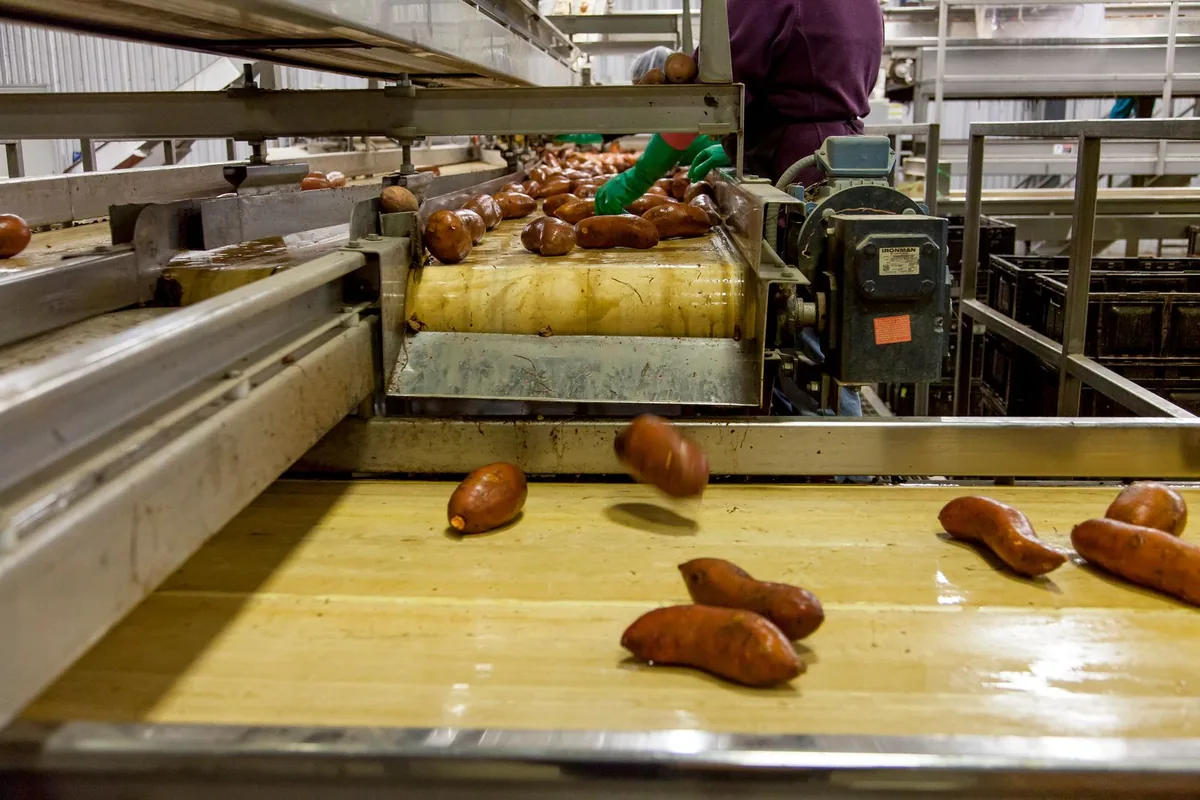
First you need to decide whether the pallet really touches food. A pallet counts as a food contact tool only when it carries unpackaged food directly, for example vegetables, seafood or meat placed straight on the pallet deck. If goods are already boxed or bagged, the rules below do not apply directly to the pallet, although many plants still require virgin plastic under internal standards.
- Vietnam: plastic packaging and utensils in direct contact with food must meet the migration limits of QCVN 12-1:2011/BYT (issued with Circular 34/2011/TT-BYT). The regulation does not ban recycled plastic but requires the product to pass the test indicators.
- United States: polyolefins in food contact fall under 21 CFR 177.1520. For recycled plastic, the FDA evaluates each recycling process (guidance updated in 2021) and does not approve “recycled plastic” in general.
- European Union: Regulation (EU) 2022/1616 only allows recycled plastic in food contact when it is made with a technology recognised as suitable; for polyolefins, the accepted route is closed-loop recycling with controlled sources.
Lifecycle cost
A virgin pallet costs more to buy, but if the pallet is used continuously for many years, it has to be replaced less often. The example below uses assumed numbers to illustrate the calculation and is not a quotation: 100 pallets of 1200 x 1000 mm, with the purchase price of 100 recycled pallets set to an index of 100 and virgin pallets 30 to 50% more expensive.
- Purchase price for 100 pallets (index): virgin 130 to 150, recycled 100.
- Service life (assumed): virgin 10 years, recycled 3 years.
- Number of purchases in 10 years: virgin 1, recycled 3 to 4.
- Total 10-year cost (index): virgin 130 to 150, recycled 300 to 400.
Real results depend on a business’s own purchase price and service life. The harsher the environment (heavy impact, constant forklift use, cold store), the wider the durability gap between the two types; if the pallet only travels one way, the cheaper pallet always wins. The example does not include indirect costs such as goods damaged when a pallet breaks or the time to place a replacement order.
When to use virgin and when to use recycled
The decision rests on three factors: the hygiene requirement of the goods, the intensity of use and how long you plan to keep the pallet.
- Food, beverages, pharmaceuticals: virgin; the material can be controlled and GMP and HACCP requirements are easier to meet.
- Deep cold stores, below -10 °C: virgin HDPE; it stays flexible at low temperatures with less cracking.
- Export with packaging material record requirements: virgin; the origin of the material is easier to prove.
- Continuous handling, heavy forklift impact: virgin; durability lasts longer under repeated impact.
- Building materials, industrial goods: recycled; no hygiene requirement and lower cost.
- One-way export with no return: recycled; the pallet is used only once.
Frequently asked questions
Do virgin plastic pallets meet FDA standards?
In the US, polyolefin plastics such as HDPE and PP used in food contact are regulated under 21 CFR 177.1520. Virgin plastic without banned additives meets this more easily; recycled plastic that is to touch food must go through its own evaluation process. For a specific lot of pallets, ask for test results instead of relying only on the word virgin.
How do you know the supplier delivers genuinely virgin plastic?
Ask for the material to be stated on the quotation and invoice, together with the CO, CQ and incoming material sheet. On receipt, run a quick check with the four signs of colour, surface, sound and smell; when you need certainty, send a sample for melt flow rate, ash and DSC thermal analysis. ICD Vietnam sends the material records along from the time of quotation.
Can virgin plastic pallets be used in deep freezer stores?
Yes, if they are virgin HDPE: according to the British Plastics Federation (BPF), HDPE stays tough at very low temperatures, enough for ordinary freezer stores from -18 to -25 °C. Do not use homopolymer PP, which turns brittle below 0 °C. When buying, state virgin HDPE as the material in the contract.
- Freezer store at -18 to -25 °C: virgin HDPE works well
- Below 0 °C: homopolymer PP starts to turn brittle and crack easily
Is virgin plastic toxic?
Virgin HDPE and PP themselves are materials permitted for packaging and food contact tools. In Vietnam, PE and PP plastic packaging in direct contact with food must meet the migration limits of QCVN 12-1:2011/BYT. The safety of each product also depends on the colour masterbatch and additives that go with it.
Is a recycled plastic pallet the same as a used plastic pallet?
No. Recycled describes the material: a pallet moulded from recovered plastic, which can be brand new. Used describes the condition: a pallet that has been in use, which may originally have been virgin or recycled.
Can a virgin plastic pallet be recycled at the end of its life?
Yes. An HDPE or PP pallet at the end of its life is ground into pellets and used as recycled material for other plastic products, so when it is sold off the business still recovers part of its cost.
Conclusion
Virgin plastic pallets are not always the best choice. For food, pharmaceuticals and cold stores they are the type to prefer; for pallets circulating for many years, the lifecycle cost is usually favourable even though the purchase price is higher. For one-way industrial goods or temporary storage, recycled pallets are more reasonable on budget. If you are not sure which suits you, the ICD Vietnam team gives free advice based on your actual warehouse conditions and goods.
- Northern Vietnam: 0983 797 186
090 345 9186
090 5859 186 - Southern Vietnam: 098 6784 186
- Email: Sales@icdvietnam.com.vn
In stock, VAT invoices, nationwide delivery
References
- Properties of virgin plastic and polypropylene - British Plastics Federation (BPF).
- Regulation on polyolefins in food contact - 21 CFR 177.1520, US Food and Drug Administration (FDA).
- Hygiene and safety of plastic packaging - QCVN 12-1:2011/BYT, Ministry of Health.
- Density and resin identification code - English Wikipedia (High-density polyethylene, Polypropylene, Resin identification code).
- Product specifications - ICD Vietnam plastic pallet catalogue, checked on 11 October 2026.
- PP contamination in recycled polyolefins - Gall et al., Polymers 13(16):2618, 2021; Karaagac et al., Waste Management 119:285-294, 2020.
- Effect of repeated recycling - Jin et al., Polymer Degradation and Stability 97(11):2262-2272, 2012.
- Test methods - ISO 1133-1 (melt flow rate), ISO 3451-1 (ash), ASTM D1693 (stress cracking), ISO 8611-1:2025 (pallet testing).
- Recycled plastic in food contact - FDA; Regulation (EU) 2022/1616.