Table of Contents
- What is a Euro pallet?
- Euro pallet sizes: EUR 1, 2, 3, 6 and 7
- Converting Euro pallet sizes to ISO pallet sizes
- Which standards must a Euro pallet meet?
- Pros and cons of the Euro pallet
- How to choose a Euro pallet for a shipment
- What is EPAL certification, and when do you need it?
- History of the Euro pallet
- Frequently asked questions
- Contact ICD Vietnam
- References
Reviewed and updated by ICD - Week 43/2026
The Euro pallet (EPAL 1, or EUR 1) is the standard European wooden pallet measuring 800 x 1200 x 144 mm, built from 11 boards, 9 blocks and 78 nails, weighing about 25 kg with a safe working load of 1,500 kg. Besides this common code, the Euro pallet family also includes EPAL 2 and EPAL 3 (1200 x 1000 mm) and EPAL 6 and EPAL 7 (800 x 600 mm). Only manufacturers licensed by the European Pallet Association (EPAL) may brand the EPAL logo on a pallet.
This article focuses on what a Euro pallet is, the size codes, the load ratings and how to pick a code for a shipment. How to read each mark on a pallet and how to grade used EPAL pallets are covered in detail in our article on the EPAL system, linked at the end of the certification section.
What is a Euro pallet?
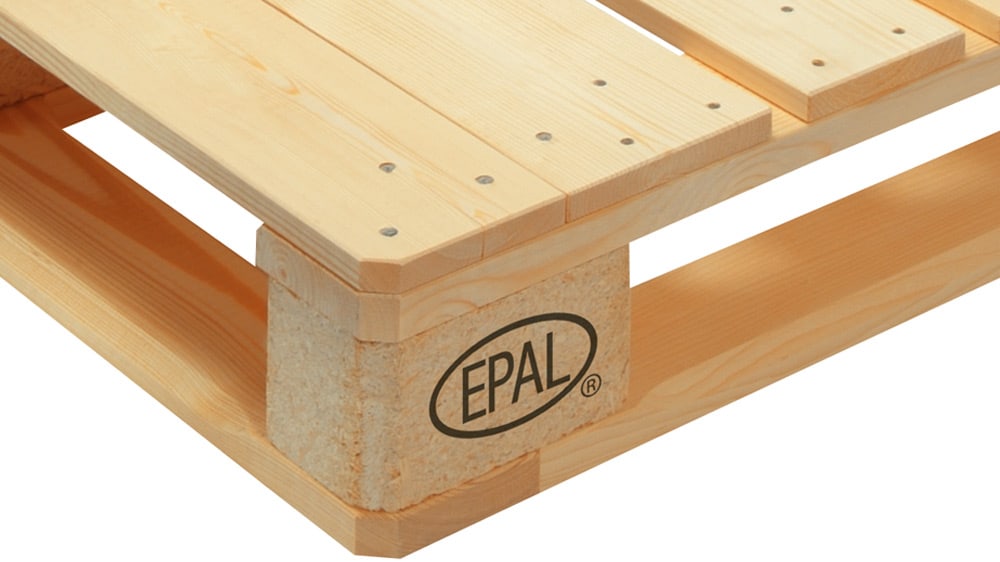
A Euro pallet, also called a Europallet, EUR pallet or EPAL pallet, is a standardised flat wooden pallet for moving and storing goods in European supply chains. What sets it apart is the single standard size of 1200 x 800 x 144 mm: every licensed workshop builds to the same set of specifications, so the pallet fits truck bays and warehouse racking, works with every forklift and can be swapped “pallet for pallet” between parties in the exchange system.
The original specification of the Euro pallet is set out in leaflet UIC 435-2 of the International Union of Railways, the European standard EN 13698-1 (production specification for 800 x 1200 mm flat wooden pallets) and the EPAL technical rules; the floor dimensions fall within ISO 6780. The letters “EUR” are the mark of the UIC railway pallet system, while “EPAL in an oval” is the trademark of the European Pallet Association. Since 1 May 2017, EPAL has recommended no longer treating UIC/EUR pallets as equivalent to EPAL pallets when exchanging.
How does a wooden Euro pallet differ from a “plastic Euro pallet”?
In the original sense, a Euro pallet is a wooden pallet whose specification is set by EPAL; on the market, “Euro plastic pallet” is the name given to a plastic pallet with the same 1200 x 800 mm footprint that does not carry EPAL certification. If you want an overview first, read more about what a plastic pallet is and the main types.
In practice, “Euro pallet” is divided by material into two groups. Each has its own strengths and weaknesses and suits different transport needs. Another angle is covered in the article on column-base plastic pallets.
The wooden Euro pallet is the most common type, made from hardwood or softwood as EPAL specifies. Its biggest advantage is a lower price than a plastic pallet of the same size, and it is easy to repair when damaged; the drawbacks are that wood absorbs moisture, gets mouldy if left outdoors for long and is less durable than plastic. It suits industries without strict hygiene demands and cargo going to Europe that needs to be exchanged within the EPAL system.
The plastic Euro pallet is made of rigid plastic, usually HDPE or PP, with the same 1200 x 800 mm footprint but no EPAL certification. Plastic pallets resist moisture and chemicals and are easy to clean, which makes them a good choice for food and pharmaceuticals, where hygiene and safety demands are very high. A plastic pallet does not need heat treatment for export because ISPM 15 only applies to wood material, but it cannot be exchanged within the EPAL system.
Euro pallet sizes: EUR 1, 2, 3, 6 and 7
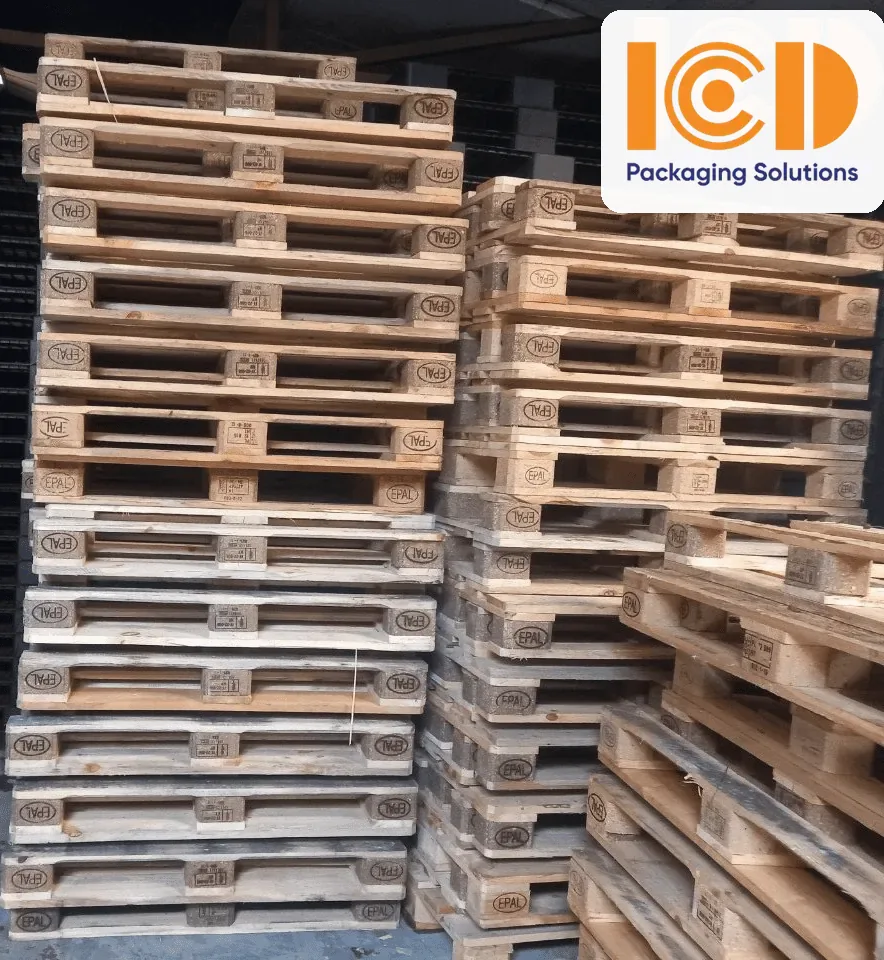
The standard Euro pallet size is 800 x 1200 x 144 mm (EPAL 1). The other codes are EPAL 2 (1200 x 1000 x 162 mm), EPAL 3 (1000 x 1200 x 144 mm), the half pallet EPAL 6 (800 x 600 x 144 mm) and the display pallet EPAL 7 (800 x 600 x 163 mm). The table below puts together the size, weight and load that EPAL publishes for each code, applicable when the goods are evenly distributed and the pallet stands on a flat, hard floor:
| Code | Size (mm) | Weight | Safe working load | Bottom pallet when stacked | Matching ISO 6780 size |
|---|---|---|---|---|---|
| EPAL 1 (EUR 1) | 800 x 1200 x 144 | ~25 kg | 1,500 kg | 5,500 kg | 1200 x 800 |
| EPAL 2 (EUR 2) | 1200 x 1000 x 162 | ~35 kg | 1,250 kg | 4,250 kg | 1200 x 1000 |
| EPAL 3 (EUR 3) | 1000 x 1200 x 144 | ~30 kg | 1,500 kg | 4,500 kg | 1200 x 1000 (placed the other way round) |
| EPAL 6 (EUR 6) | 800 x 600 x 144 | ~9.5 kg | 750 kg | 1,500 kg | Half the size of EUR 1 |
| EPAL 7 | 800 x 600 x 163 | ~9.5 kg | 500 kg | 1,500 kg | Half the size of EUR 1, display type |
EPAL 2 and EPAL 3 share the same footprint but differ in construction: EPAL 2 is taller, heavier and has a lower working load, while EPAL 3 has its boards laid in the opposite direction, so the forklift enters from a different side. So when a request says “Euro pallet 1200 x 1000”, ask which code is meant. The 1200 x 1000 mm footprint of EUR 2 is close to the American 48 x 40 inch pallet (1219 x 1016 mm) but not identical.
Beyond the EPAL codes, the market also uses smaller sizes derived from the Euro pallet: 600 x 400 mm (a quarter of the EUR size) and 400 x 300 mm (an eighth of the EUR size). These two sizes match standard European crates and trays, but have no directly matching ISO 6780 size. The 800 mm width passes through ordinary doorways (the common DIN door is 850 mm wide), an advantage Wikipedia cites when explaining why the Euro pallet became so widespread.
From our own advisory experience, the most frequent mistake is quoting only the footprint and forgetting the height. An 800 x 1200 mm pallet 120 mm high and an 800 x 1200 x 144 mm pallet look alike, but only the latter matches the EPAL 1 height. When ordering, state all three dimensions, the working load you need and the lifting direction.
Converting Euro pallet sizes to ISO pallet sizes
The 1200 x 800 mm size of the Euro pallet is one of 6 pallet sizes recognised by the ISO 6780:2003 standard for intercontinental transport; the other 5 sizes are 1200 x 1000, 1219 x 1016, 1067 x 1067, 1100 x 1100 and 1140 x 1140 mm. While Europe mainly uses 1200 x 800 mm, other regions prefer different sizes, for example 1200 x 1000 mm or 1140 x 1140 mm.
Converting between the two systems needs careful thought so that goods can be loaded and unloaded safely and efficiently, above all for export cargo, where matching the pallet size directly affects freight and storage cost. The first point to watch when packing a container is the width. A standard dry container has an internal width of about 2.35 m, which is not enough for two Euro pallets side by side along their 1200 mm edge; this is why Europe also uses “pallet-wide” containers with an internal width of 2,440 mm. With ordinary containers, exporters often choose 1200 x 1000 mm pallets or alternate the orientation of Euro pallets to fill the gaps.
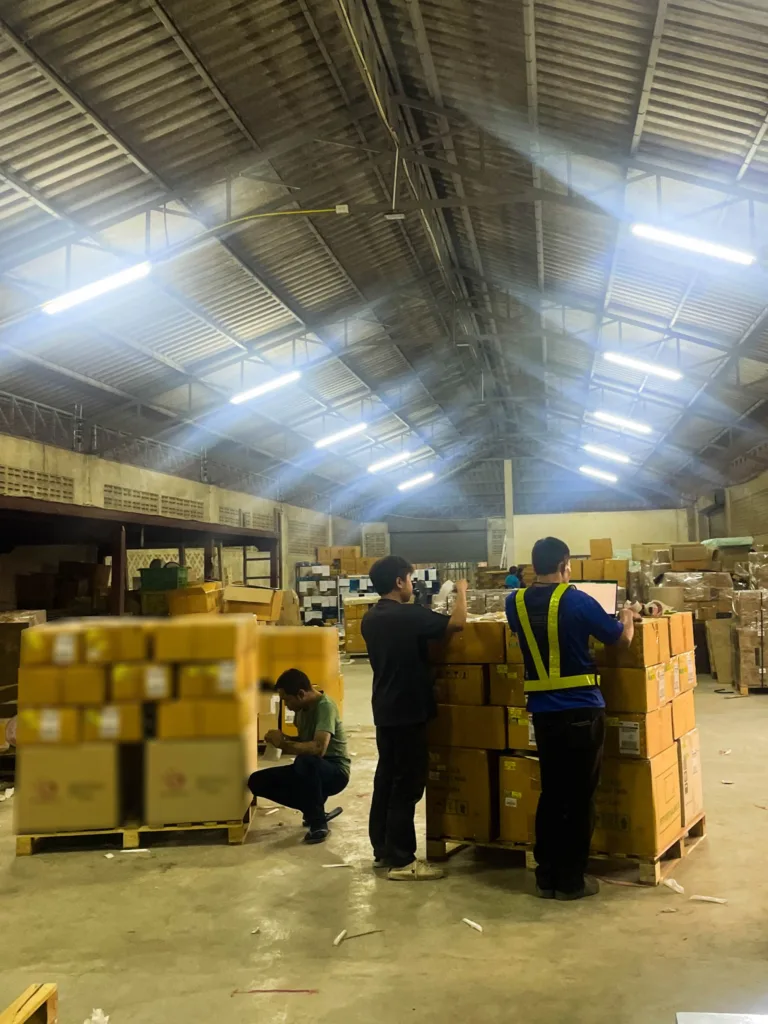
For road transport within Europe it is the other way round: the Euro pallet is the optimal size, since a truck body about 2.4 m wide takes 3 pallets along their 800 mm edge, so a 13.6 m trailer usually carries 33 Euro pallets. That is why European customers often ask for exactly the 1200 x 800 mm size for goods that travel by truck after leaving the port.
Which standards must a Euro pallet meet?
A Euro pallet carrying the EPAL mark must comply with EPAL’s technical rules on wood, board thickness, blocks, nail type and nailing pattern, dimensions and load capacity, backed by independent inspection. The pallet must also meet hygiene and safety requirements for use in food and pharmaceuticals. These standards both guarantee pallet quality and build trust in international freight.
On quarantine, every EPAL pallet produced since 1 January 2010 is heat treated and carries the IPPC mark under ISPM 15, including pallets used within Europe; EPAL prohibits treating EPAL pallets with methyl bromide. For ordinary wooden pallets (without the EPAL mark) going to the EU, the general rule is broader: the EU has banned the use of methyl bromide inside the Union since 18 March 2010, but still accepts imported pallets treated by HT or MB correctly under ISPM 15, with the IPPC mark.
Construction and identification marks of the wooden Euro pallet
A standard EPAL wooden Euro pallet has 11 boards, 9 blocks and 78 nails driven to a fixed pattern, so counting the boards and reading the marks on the blocks is enough to tell a genuine pallet from one simply built to the same size. Under EPAL’s rules, the required marks and details are:
- Corner blocks: the EPAL logo in an oval, showing that the pallet was made by a producer licensed by EPAL.
- Middle block: the IPPC mark with the country code, registration number and the HT symbol, confirming heat treatment under ISPM 15.
- Middle block: the EPAL control nail, confirming that the pallet belongs to a lot that passed quality control.
- Middle block: the licence number, year and month of production, so the manufacturer and the time of production can be traced.
- Repair marking nails: found only on EPAL pallets that have been repaired by a licensed workshop.
Pros and cons of the Euro pallet
The advantages of the Euro pallet are a single size across Europe, high durability, reuse and repairability, exchangeability within the EPAL pallet system and a working load of 1,500 kg. The disadvantages are its weight (about 25 kg per pallet), wood that absorbs moisture if left outdoors for long, the need for heat treatment, and a higher price than an ordinary wooden pallet of the same size because it must meet the specification, heat treatment and EPAL certification.
The Euro pallet suits cargo going to Europe, retail chains that use exchange pallets and warehouses with racking designed for the 800 mm edge best. Every type of Euro pallet, wood or plastic, has its own strengths and weaknesses, so weigh them against the route of the goods and the number of cycles the pallet will make before you choose.

How to choose a Euro pallet for a shipment
Choose a Euro pallet on three factors: material according to how it will be used, size code according to the destination and how the container is packed, and load rating according to the actual weight of the goods.
1. Choose the right material
Choose a wooden EPAL Euro pallet when goods go to Europe or the customer uses the pallet exchange system; choose a 1200 x 800 mm plastic pallet when you need easy cleaning, use in cold storage or many internal cycles. A plastic pallet needs no heat treatment for export, but cannot be exchanged within the EPAL system.
2. Choose the right size
EPAL 1 (800 x 1200 mm) suits retail, food and goods going to Europe in the pallet exchange system. EPAL 2 (1200 x 1000 x 162 mm) suits heavy industrial goods and chain or roller conveyors; EPAL 3 (1000 x 1200 mm) suits industrial goods. The two 1200 x 1000 mm codes also pack more easily into ordinary containers, because two pallets placed side by side along the 1000 mm edge take up only 2,000 mm of width. EPAL 6 (800 x 600 mm) is for small orders and goods going straight to supermarkets, while EPAL 7 is for display areas.
3. Ask the supplier before you order
Before ordering, ask the supplier 3 things: does the pallet carry the EPAL logo and a licence number, has it been heat treated and stamped with the IPPC mark, and which stacking method does the published load rating apply to. The IPPC mark decides whether the pallet clears quarantine at the destination port; the EPAL logo decides whether the pallet can be exchanged within the EPAL system; and the load rating tells you whether the pallet can carry your loading method.
4. Steps for choosing a Euro pallet
Choosing a Euro pallet takes 4 steps, from the market’s requirements down to the pallet specification:
- Identify the destination market and the receiving customer’s requirements (an EPAL pallet, or just the right size).
- Weigh the cargo on each pallet and note the stacking height and the type of racking in the warehouse.
- Choose a model whose working load and stacking load are higher than you need.
- Check the EPAL mark, the IPPC mark and the wood moisture on delivery.
Completing all 4 steps avoids having to swap pallets at the warehouse or at the port.
5. Consider the price
The price of a Euro pallet depends on the wood type, board thickness, heat treatment, EPAL certification and order quantity. When comparing quotations, compare like with like: a pallet with EPAL certification and an IPPC mark is always different from a pallet merely built to 800 x 1200 mm. For ICD Vietnam wooden pallets, price depends on the specification: contact for a quote.
What is EPAL certification, and when do you need it?
EPAL certification is a licence the European Pallet Association issues to production and repair workshops, confirming that pallets are made and inspected to the association’s specification; only licensed workshops may apply the EPAL mark. A business that needs genuine EPAL pallets for exchange within the network should buy from a licensed manufacturer and check the licence number printed on the blocks.
Not every shipment needs a pallet carrying the EPAL mark. When the pallet makes only a one-way trip, is not returned, or the warehouse in the importing country only asks for the right size, a pallet of the same size that meets ISPM 15 and carries the IPPC mark is enough. Using the right type of pallet for your partner’s requirement both protects the goods and shows the business takes compliance with international standards seriously.
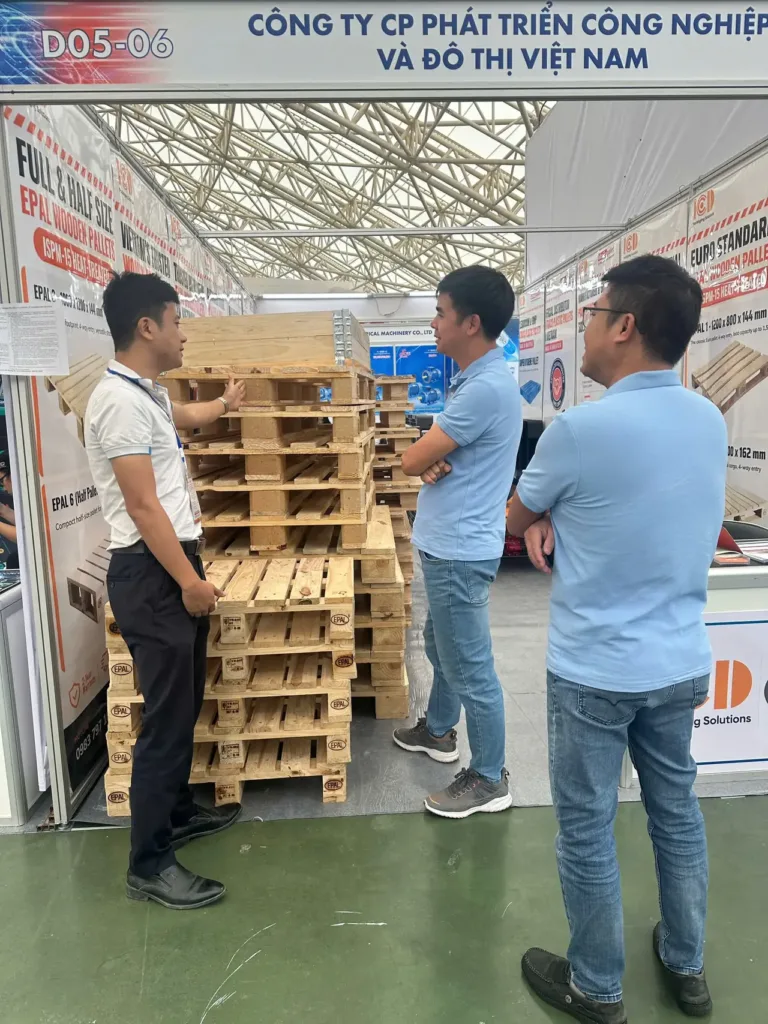
See also: the EPAL pallet system and EUR marks.
See also: Asian-standard pallets
History of the Euro pallet
The Euro pallet was born in 1961, when European railway companies agreed on a common pallet design under the coordination of the International Union of Railways (UIC); in 1991 the European Pallet Association EPAL was founded to manage quality and the trademark.
What is the Euro pallet and what role has it played in the development of the wooden pallet industry?
The Euro pallet came out of the need to standardise transport equipment in the European railway industry of the 1960s. According to Wikipedia, thanks to the Euro pallet, the time to load goods onto a railway wagon fell to about 10% of what it had been. After standardisation, most of European industry moved to the Euro pallet, and trucks, forklifts and high-bay racking were designed around this size; national associations set up “pallet for pallet” exchange agreements.
When poor-quality wooden imitation pallets became common, EPAL was founded in 1991 to control quality. From 1 January 2010, every EPAL pallet must carry the heat-treatment IPPC mark; in 2016, EPAL took responsibility for the safety and quality of all pallets in the exchange system; from 1 May 2017, EPAL recommended ceasing to treat UIC/EUR pallets as equivalent.
Today the Euro pallet is used in road and sea transport, not only on railways. According to Wikipedia, about 450 - 500 million Euro pallets are in circulation and it remains the most common pallet type in the world; EPAL reports more than 650 million EPAL pallets in circulation. Even so, globalisation has reduced the dominance of the Euro pallet system outside Europe, because the 1200 x 800 mm size does not fit ISO container interiors well.
Frequently asked questions
What is a Euro pallet?
Also called a Europallet or EPAL pallet, it is a wooden pallet designed to a European standard for moving and storing goods; the most common code is EPAL 1, measuring 800 x 1200 x 144 mm. Only workshops licensed by EPAL may brand the EPAL logo.
What is the standard size of a Euro pallet?
The EPAL 1 Euro pallet measures 1200 x 800 x 144 mm, fits cargo bays and is easy to use with forklifts. The other codes: EPAL 2 1200 x 1000 x 162 mm, EPAL 3 1000 x 1200 x 144 mm, EPAL 6 800 x 600 x 144 mm, EPAL 7 800 x 600 x 163 mm.
Why does the Euro pallet have a uniform size?
A uniform size saves storage space, fills European truck bodies fully and keeps transport consistent, so that pallets can be swapped between parties in the exchange system.
How many kilograms does a Euro pallet weigh?
An EPAL 1 Euro pallet measuring 800 x 1200 x 144 mm weighs about 25 kg. The EPAL 2 pallet (1200 x 1000 x 162 mm) weighs about 35 kg, EPAL 3 (1000 x 1200 x 144 mm) about 30 kg, and EPAL 6 and EPAL 7 about 9.5 kg. The actual weight varies with the moisture content of the wood.
What is the maximum load a Euro pallet can carry?
According to EPAL, the EPAL 1 Euro pallet has a safe working load of 1,500 kg when the goods are evenly distributed. When loaded pallets are stacked on a flat, hard floor, the bottom pallet can carry up to 5,500 kg.
Is heat treatment mandatory for Euro pallets?
For pallets carrying the EPAL mark, yes: since 1 January 2010, every EPAL pallet must be heat treated and carry the IPPC mark under ISPM 15, including pallets used within Europe. Ordinary wooden pallets of the same size going to the EU are treated by HT or MB correctly under ISPM 15.
Contact ICD Vietnam
If you need Euro-size wooden pallets or 1200 x 800 mm plastic pallets for export cargo, send ICD Vietnam the cargo weight, the destination market and the quantity. We have a production workshop, a Hanoi warehouse and a southern workshop; price: contact for a quote.
- Hotline: 0983 797 186 / 090 345 9186 / 090 5859 186.
- Zalo: Chat Zalo. Email: sales@icdvietnam.com.vn.
- Southern workshop: 551/212 Le Van Khuong Street, Tan Thoi Hiep Ward, District 12, Ho Chi Minh City.
References
- Specification, load rating and marking of the EPAL Euro pallet: European Pallet Association (EPAL); EPAL 2, 3, 6 and 7 pages on the same website.
- EUR-pallet, history and specification: Wikipedia (accessed 17 October 2026).
- ISO 6780:2003 Flat pallets for intercontinental materials handling, Principal dimensions and tolerances - ISO.
- Requirements for wood packaging entering the EU: European Commission, Requirements for wood packaging and dunnage.
- EN 13698-1 Pallet production specification, Part 1: Construction specification for 800 mm x 1200 mm flat wooden pallets - CEN.