
Table of Contents
- What is an ESD antistatic plastic pallet?
- Why does the electronics industry need antistatic pallets?
- How does an antistatic pallet differ from an ordinary plastic pallet?
- What types of antistatic pallet are there?
- Where in an electronics plant are antistatic pallets used?
- How do you check an antistatic pallet on delivery?
- Frequently asked questions
- Contact us for advice on antistatic pallets and supplies
- References
Reviewed and updated by ICD - Week 43/2026
An ESD antistatic plastic pallet is a pallet made of plastic blended with conductive additives, with a surface resistance in the dissipative range from 104 to below 1011 ohm, so that charge drains gradually to ground instead of discharging suddenly into components. This type of pallet is used in the electrostatic protected area (EPA) of electronics plants operating to ANSI/ESD S20.20 or IEC 61340-5-1.
Three figures worth remembering: a dissipative material has a surface resistance from 104 to below 1011 ohm; ordinary HDPE and PP plastic pallets sit in the insulative group, at 1011 ohm or more; and the IEC 61340-5-1 programme is designed to protect components that withstand 100 V or more on the human body model (HBM).
Customers from electronics plants often ask me one question: is a black pallet an antistatic pallet? The short answer is not necessarily. This article explains how an ESD pallet differs from an ordinary pallet, how to read a resistance test sheet, and what to check on delivery so the pallet really does its job in the electrostatic protected area.

What is an ESD antistatic plastic pallet?
An ESD antistatic plastic pallet is a pallet whose surface resistance is controlled in the conductive or dissipative group, so that charge flows to ground in a controlled way instead of building up and discharging into components. ESD stands for Electrostatic Discharge: a sudden transfer of charge between two objects at different potentials. For the general picture, read about plastic pallets for seafood and agriculture.
Ordinary plastic pallets are usually made of HDPE or PP, two insulating plastics, so charge stays on the surface for a very long time. ESD pallets still use HDPE or PP but blend in additives that create conductive paths, such as carbon black or conductive polymers. Thanks to the additive, charge has a path out, provided the pallet sits on a grounded floor, rack or trolley. Reference range: ICD antistatic plastic crates.
What surface resistance makes a pallet count as antistatic?
A pallet counts as antistatic when its surface resistance is below 1011 ohm, meaning it belongs to the dissipative group (104 to below 1011 ohm) or the conductive group (below 104 ohm). This is the material classification in the ESD ADV1.0 glossary and the ANSI/ESD S541 packaging standard of the ESD Association, measured by ANSI/ESD STM11.11 (surface resistance) or STM11.12 (volume resistance).
Read the scale above from left to right. A discharge-shielding material has a resistance of no more than 103 ohm and forms a barrier so charge cannot penetrate inside; this is required for packaging that takes components out of the EPA. The conductive group, below 104 ohm, lets charge escape very quickly on touching ground and can be used for pallets, but contact with live open circuits must be avoided. The dissipative group, from 104 to below 1011 ohm, lets charge flow away gradually and under control, and is the most common group for ESD pallets. From 1011 ohm upward is insulative, including most ordinary plastic pallets, and should not be brought into an EPA.
Low charging ability must be distinguished from resistance. According to the ESD Association, a material’s low-charging property cannot necessarily be inferred from its resistance: a plastic sheet with low resistance can still generate charge when rubbed, so a container placed right next to components needs to meet both requirements.
Why does the electronics industry need antistatic pallets?
The electronics industry needs antistatic pallets because ordinary plastic pallets are insulators that hold thousands of volts of charge on the surface, while many components withstand only about 100 V on the human body model (HBM). Livestock farming has its own pallet requirements, but they differ from those of the electronics industry.
The consequences are not always seen at once. One electrostatic discharge can destroy a chip or board outright, but it can also just weaken an internal joint inside a component: the product still passes end-of-line testing, then fails after reaching the customer. This kind of latent defect brings warranty, return and lot-tracing costs that are usually far larger than the price of the right container.

Humidity is a factor warehouse staff often overlook. Dry air multiplies static voltage several times over, so the dry season or a heavily air-conditioned room is when risk is highest. The table below gives typical figures published by the ESD Association:
| Activity | Humidity 10 - 25% | Humidity 65 - 90% |
|---|---|---|
| Walking across a carpet | 35,000 V | 1,500 V |
| Walking across a vinyl floor | 12,000 V | 250 V |
| Worker seated at a workbench | 6,000 V | 100 V |
| Lifting a PE plastic bag from a bench | 20,000 V | 1,200 V |
| Urethane foam padded chair | 18,000 V | 1,500 V |
Set these figures beside the tolerance of components and the gap shows. IEC 61340-5-1:2024 and ANSI/ESD S20.20, two sets of standards with similar content, build an ESD control programme for components that withstand 100 V HBM and 200 V CDM (charged device model) and also limit the voltage on isolated conductors to below 35 V. Components more sensitive than this need extra measures of their own.
How does an antistatic pallet differ from an ordinary plastic pallet?
The difference lies in the material and the paperwork that comes with it: an ESD pallet has conductive additives and must come with resistance test results, while an ordinary plastic pallet made of HDPE or PP belongs to the insulative group.
| Criterion | Ordinary plastic pallet | ESD antistatic plastic pallet |
|---|---|---|
| Material | HDPE or PP, virgin or recycled | HDPE, PP blended with conductive additives such as carbon black or conductive polymers |
| Surface resistance group | Insulative, 1011 ohm or more | Dissipative or conductive, below 1011 ohm |
| Discharges charge when grounded | Cannot discharge, charge stays on the surface | Discharges through a grounded ESD floor, rack or trolley |
| Documents required | Size, load rating | Size, load rating, resistance test sheet per ANSI/ESD STM11.11 |
| Use in an EPA | Not advised | Yes |
| Typical colour | Many colours | Black or dark grey from carbon black |
The most notable line in the table is the paperwork. For an ordinary pallet, the buyer needs only size and load rating. For an ESD pallet, the surface resistance test sheet per ANSI/ESD STM11.11, stating the humidity at the time of measurement, is the real proof of which group the pallet belongs to; without a test sheet it cannot yet be treated as an antistatic pallet, however identical it looks.
What types of antistatic pallet are there?
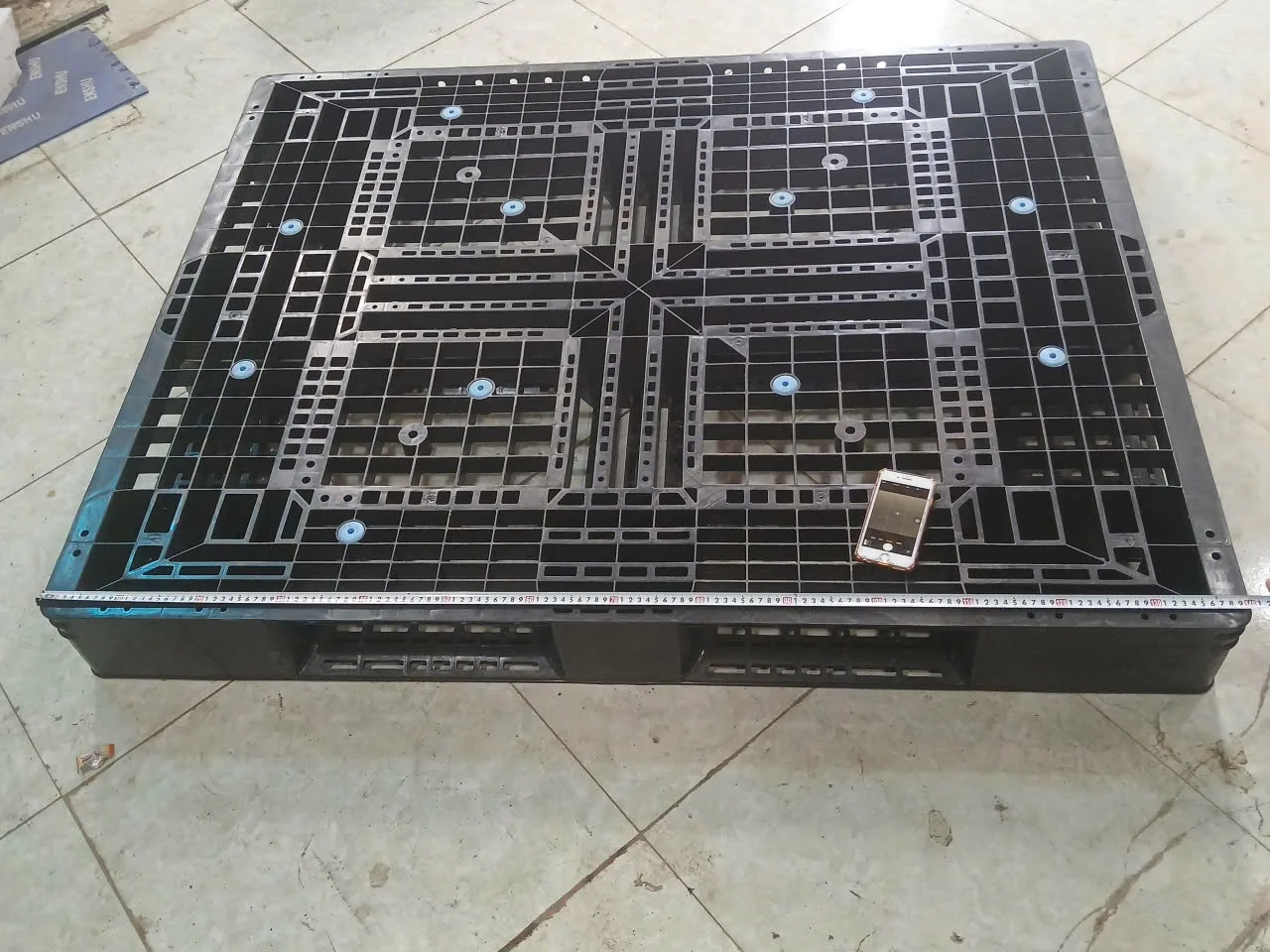
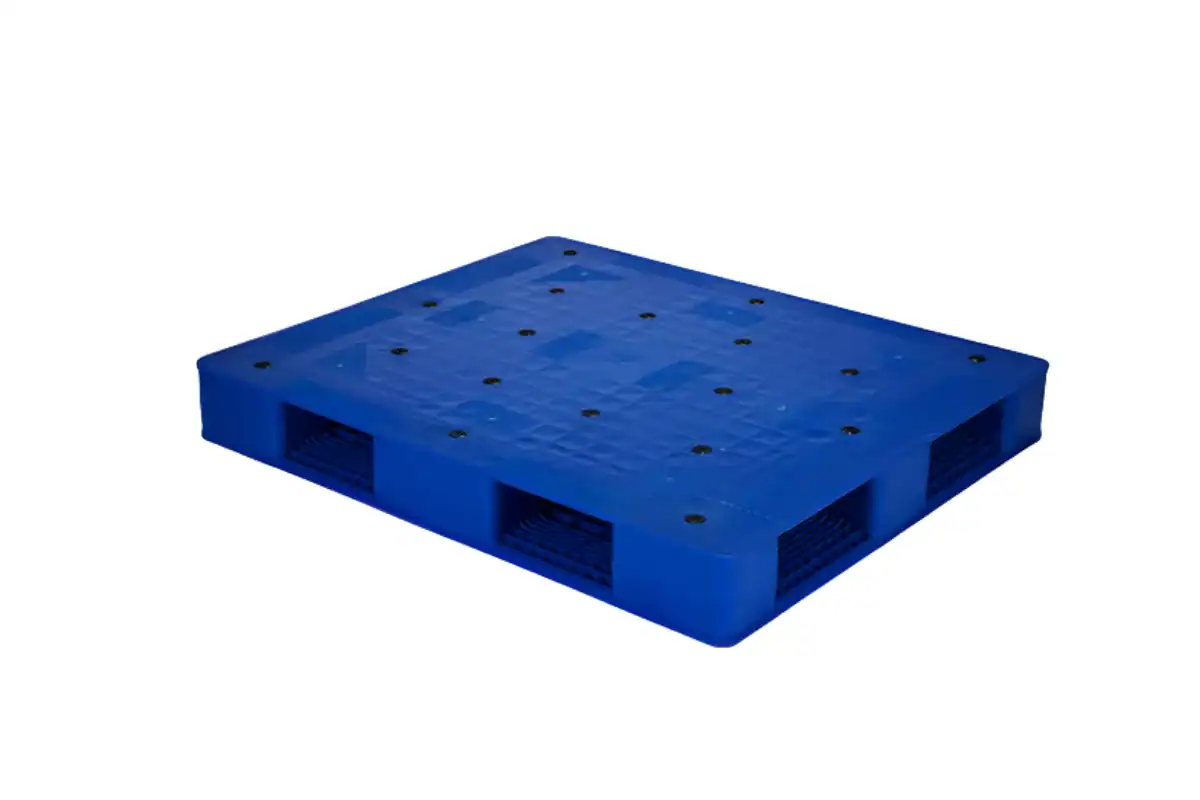
There are four common types of antistatic pallet: closed deck, mesh deck, double-face and rackable; for the same resistance range, which type suits depends on the goods and the warehouse system.
A closed-deck pallet (solid deck) has a continuous surface, takes small goods and footless boxes and is easy to wipe free of dust, so it suits components and circuit boards. The mesh-deck type (open deck) is lighter, with good air and water drainage, and suits goods already in cartons. The double-face type (reversible) can use both sides and carries load more evenly. The rackable type has a stiff structure to sit directly on rack supports without a liner sheet.
How do pallets used inside and outside the EPA differ?
The difference is whether components are left exposed. Inside the EPA, a dissipative or conductive pallet sits on a grounded ESD floor, rack or trolley, and components can lie exposed in ESD crates. Outside the EPA, components must be in discharge-shielding packaging such as shielding bags, and an ESD pallet cannot replace that packaging layer. Finished goods already in shielding boxes in a closed warehouse can use an ordinary pallet, provided the areas are separated and clearly labelled so nobody brings it into the EPA by mistake.
See also: Plastic pallets for the pharmaceutical and food industries
Where in an electronics plant are antistatic pallets used?
Antistatic pallets are used at every stage where electrostatic-sensitive components are left exposed: component manufacturing, assembly, dedicated storage and cleanrooms.
In component manufacturing, the ESD pallet carries crates of printed circuit boards (PCB), chips and microprocessors between stations. In assembly, it follows partly or fully assembled equipment. In a dedicated electronics warehouse, the ESD pallet keeps the area holding exposed components free of insulating objects. At packing, goods go into shielding packaging before leaving the EPA.
In cleanrooms, static does harm a second way: a charged surface attracts and holds dust from the air, raising defects on wafers, according to the ESD Association. An ESD pallet here therefore both protects components and helps keep surfaces clean.
How do you check an antistatic pallet on delivery?
On delivery, check three things: the batch resistance test sheet, how the additive is introduced into the plastic, and the grounding path where the pallet sits. Missing any one of them, a pallet may comply on paper but fail to discharge in practice.
- Ask for the surface resistance test sheet per ANSI/ESD STM11.11 for the exact batch, stating the humidity at the time of measurement.
- Ask whether the additive is blended into the resin or only a surface coating, because a coating can wear off with use and washing.
- Check that the ESD floor, rack or trolley where the pallet sits is grounded.
- Put the pallet into the periodic re-test plan of the ESD programme, because dust, oil and cleaning chemicals reduce performance.
- Check that the crates, trays and boxes placed on the pallet are also ESD type.
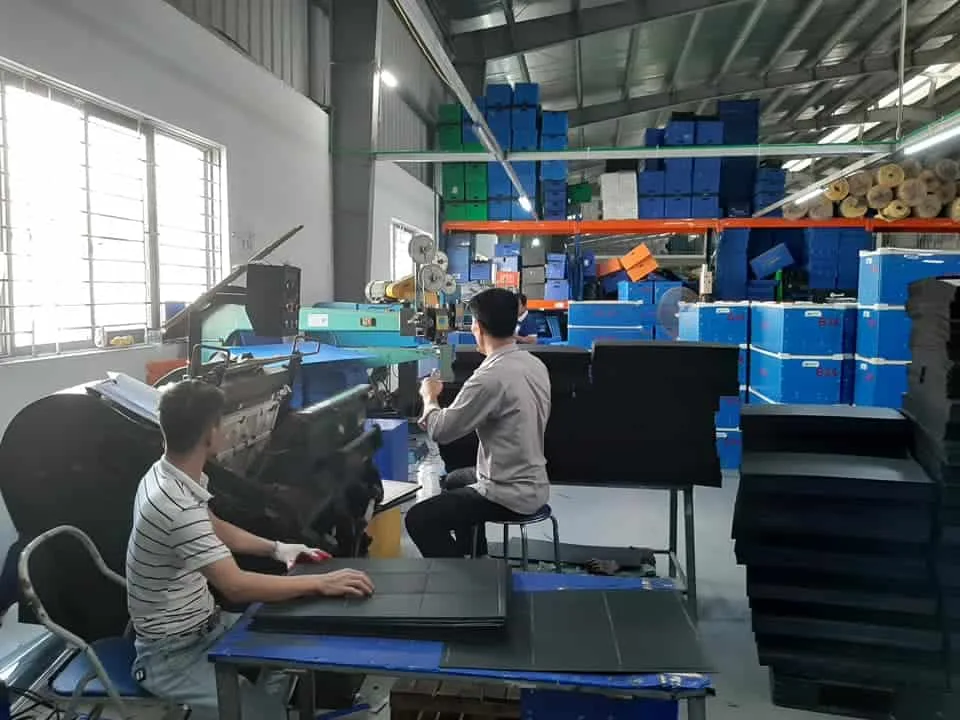
The last point is the one most often forgotten. An insulating crate placed on an ESD pallet still holds charge right beside the components, defeating the whole chain. So when ordering, I advise customers to state clearly in the order the required group, dissipative or conductive, below 1011 ohm, and to buy pallets together with containers.
The pallet is only one link. At ICD Vietnam, ESD antistatic plastic crates come in 12 sizes, from 155 x 105 x 55 mm to 720 x 560 x 380 mm, and ESD antistatic component boxes come in 11 sizes, from 95 x 105 x 50 mm to 450 x 300 x 170 mm, all made of ESD compound plastic, for holding components placed on pallets in an EPA. For pallets that need their own resistance range, send the size, load rating and required resistance range so we can advise. Ordinary plastic pallet models are in the product catalogue.
Frequently asked questions
What does ESD stand for?
ESD stands for Electrostatic Discharge: a sudden transfer of charge between two objects at different potentials, enough to damage sensitive electronic components.
What material are antistatic plastic pallets made of?
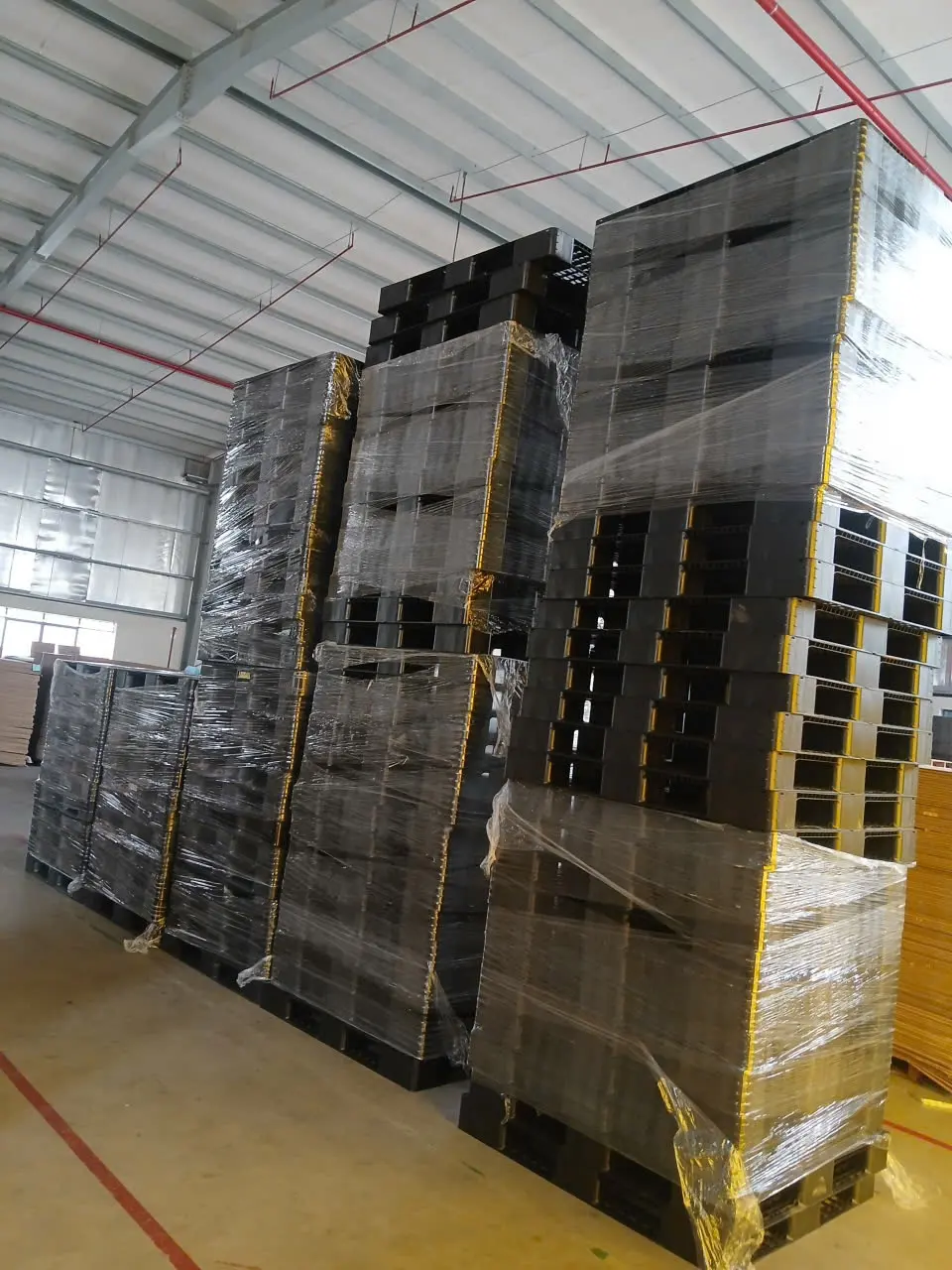
Usually HDPE or PP blended with conductive additives such as carbon black or conductive polymers, bringing the surface resistance into the dissipative or conductive group so charge drains gradually to ground.
What surface resistance makes a pallet meet the antistatic standard?
Below 1011 ohm. The dissipative range from 104 to below 1011 ohm is the most common; below 104 ohm is the conductive group. Both groups can be used for containers in an EPA according to the ESD Association.
Is a black plastic pallet an antistatic pallet?
Not necessarily. ESD pallets are usually black because of carbon black, but ordinary plastic pallets can also be black because of colourants or recycled plastic. Only a surface resistance test sheet or a measurement in the warehouse can confirm it.
Do antistatic pallets need grounding?
Yes. A dissipative material can discharge only when there is a path to ground, for example sitting on an ESD floor or on a grounded rack or trolley. With an ESD floor and footwear system, the resistance from the person to ground must be below 109 ohm according to the ESD Association.
Can antistatic pallets be used to carry components out of the EPA?
They can, but the components must be in discharge-shielding packaging such as shielding bags or boxes. Outside the EPA, the ESD Association requires packaging with the added shielding function, which a dissipative pallet alone does not meet.
Contact us for advice on antistatic pallets and supplies
For advice on pallets for an EPA, send ICD Vietnam the size, load rating, required resistance range and quantity needed.
ICD Vietnam Industrial Manufacturing Co., Ltd
Northern Vietnam: 3rd Floor, Thang Long A1 Building, Bau Hamlet, Thien Loc Commune, Hanoi - 0983 797 186 / 090 345 9186 / 090 5859 186
Southern Vietnam: 551/212 Le Van Khuong, Tan Thoi Hiep Ward, District 12, Ho Chi Minh City - 098 6784 186
Email: sales@icdvietnam.com.vn
Zalo: Chat with ICD Vietnam on Zalo
References
- The concept of electrostatic discharge: TechTarget, Electrostatic discharge (ESD).
- Classification of shielding, conductive, dissipative and insulative materials; container requirements inside and outside an EPA: EOS/ESD Fundamentals Part 3, ESD Association (ESD ADV1.0, ANSI/ESD S541, STM11.11).
- Typical static voltage by humidity: EOS/ESD Fundamentals Part 1, ESD Association.
- ESD control programme with 100 V HBM, 200 V CDM and 35 V on isolated conductors: IEC 61340-5-1:2024, International Electrotechnical Commission (IEC); ANSI/ESD S20.20.
- Sizes of ESD antistatic plastic crates and component boxes: ICD Vietnam product catalogue, checked on 11 October 2026.