
Mục lục
- When Do Pallet Jack Wheels Need Replacing?
- Tools Required
- PU vs Nylon Wheels: Which to Choose
- 8-Step Wheel Replacement Procedure (Standard Hand Pallet Jack)
- High-Lift and Electric Pallet Jack Wheels
- 3 Removal Methods: Choose the Right One to Avoid Frame Damage
- Common Mistakes and How to Prevent Them
- Wheel Maintenance After Replacement
- Related articles
- Frequently asked questions about changing pallet jack wheels
- Contact ICD Vietnam
Changing pallet jack wheels is a straightforward maintenance task that any warehouse operator can do on-site with basic tools. This guide covers when replacement is due, the right tools to prepare, how to choose between PU and nylon wheels, a clear 8-step removal and installation procedure for standard hand pallet jacks, and the three removal methods ranked by risk - so you pick the right one and avoid damaging the fork arms.
When Do Pallet Jack Wheels Need Replacing?
Identifying the right moment to intervene protects the fork frame and the hydraulic pump from secondary damage.
The clearest sign is when the jack becomes noticeably harder to pull even though the load has not changed. On visual inspection, the PU or nylon outer layer is peeling off in chunks, exposing the cast-iron core underneath. Continuing to operate the jack in this condition means the bare core grinds directly against the floor, damaging the warehouse surface and generating extreme noise.
Another sign is strong vibration during movement. This happens when one of the load wheels has worn unevenly or the inner bearing has cracked. If you see small plastic fragments falling along the travel path, replacement is mandatory.
Wheel wear indicator by position:
| Wheel position | Technical signs | Inspection interval |
|---|---|---|
| Load wheels | Outer layer peeling, metal core exposed, deep cracks | Every 6 months |
| Steering wheel | Hard to turn, bearing seizure, worn on one side | Every 4 months |
Tools Required
Having the right tools ready makes the job quick and prevents damage to surrounding components.
| Tool | Purpose | Reference price (2026) |
|---|---|---|
| Needle-nose pliers | Remove cotter pins and snap rings | 150,000 VND |
| Rubber mallet | Drive axles and pins without deforming them | 200,000 VND |
| Steel punch set | Push pins seated deep in the axle hole | 180,000 VND |
| WD-40 penetrating oil | Free rusted or seized points | 120,000 VND |
| Floor jack or wooden blocks | Lift the fork arm to create working clearance | 300,000 VND |
PU vs Nylon Wheels: Which to Choose
Selecting the right wheel type before starting the job determines how long the jack will last after maintenance.
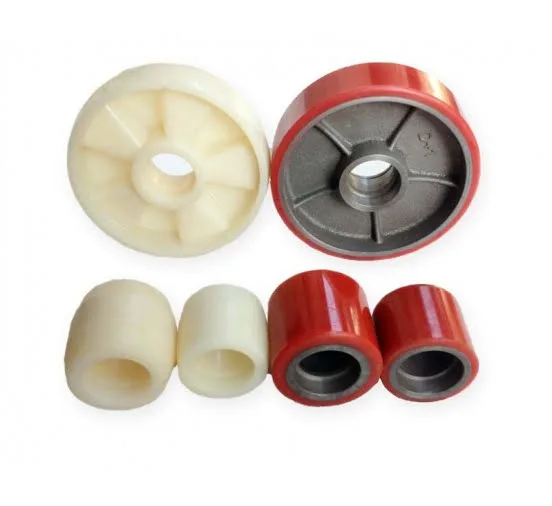
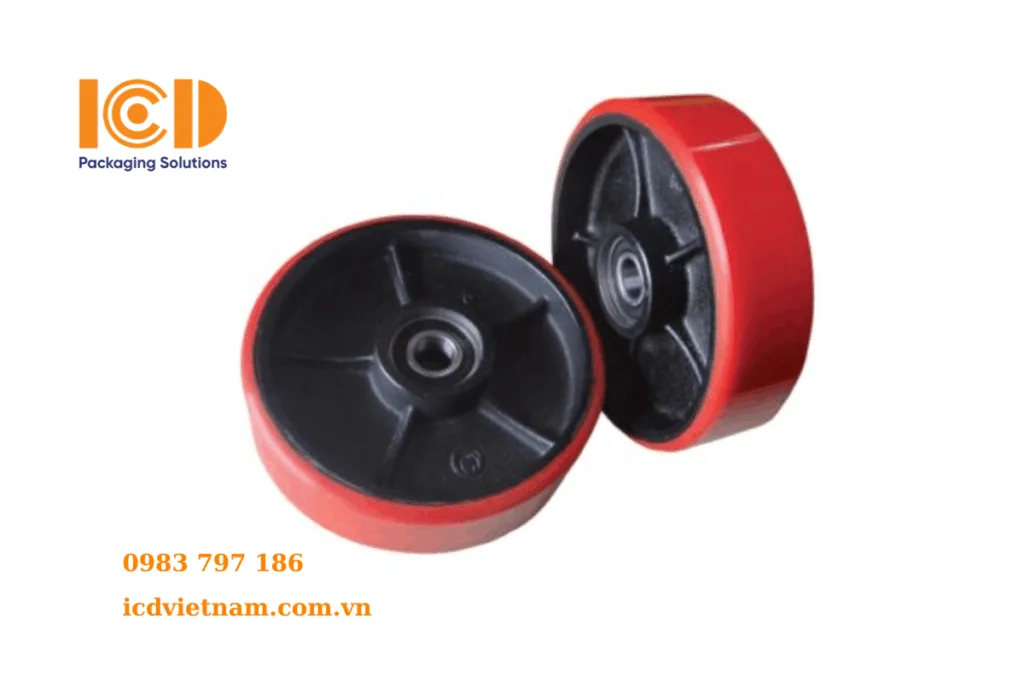
- Red PU (polyurethane) wheels with cast-iron cores are the most common choice for warehouses with epoxy-coated or tiled floors. PU has good elasticity, giving a smooth ride without scratching the surface. However, if the warehouse is wet or has chemical exposure, PU degrades and peels quickly.
- White nylon wheels are the best option for humid environments, cold stores, or areas with frequent chemical contact. Nylon is extremely hard and durable, handling very heavy loads without deforming. The only drawback is significant noise on rough concrete floors.
Replacement parts price reference (2026):
| Part | Specification | Reference price (2026) |
|---|---|---|
| PU load wheel (pair) | 82×70 mm, cast-iron core | 180,000 - 280,000 VND |
| Nylon load wheel (pair) | 82×70 mm | 120,000 - 200,000 VND |
| PU steering wheel | 200×50 mm | 250,000 - 400,000 VND |
| Bearing (per unit) | 6204 / 6205 standard | 40,000 - 80,000 VND |
8-Step Wheel Replacement Procedure (Standard Hand Pallet Jack)
This procedure applies to most standard Xilin hand pallet trucks currently on the market.
- Set up a safe work area. Choose a flat, dry floor. Lower the forks to the minimum position and wedge the wheels you are not replacing to prevent the jack from rolling unexpectedly.
- Raise the fork arm. Use a floor jack or wooden blocks under the fork arm until the wheel to be removed clears the floor by 5 to 10 cm. This relieves pressure on the axle.
- Clean around the axle pin. Use a wire brush or clean rag to remove dirt around the axle end. If rust is visible, spray WD-40 and wait about 5 minutes for the fluid to penetrate.
- Remove the retaining pin. Use needle-nose pliers to straighten and pull out the cotter pin. If the jack uses a pressed steel pin, place the punch precisely on the pin center and tap steadily with the rubber mallet until the pin falls out the other side.
- Pull out the axle. Once the pin is out, support the wheel from below with one hand and use the punch to push the axle gently out of the bracket. The old wheel can be heavy - keep it away from your feet.
- Inspect the bearing and bushing. After removing the wheel, check whether the old bearing still spins freely. If the bearing is loose or seized, replace it at the same time for consistent performance.
- Install the new wheel. Clean the axle and apply a thin coat of heat-resistant grease. Slide the new wheel into position, pass the axle through the bracket and bearing on both sides. Make sure the axle exits both sides of the fork arm bracket.
- Secure and test. Drive in a new cotter pin and bend the ends to lock it. Lower the jack and do a test pull with a light load to confirm the wheel rolls smoothly and evenly.
High-Lift and Electric Pallet Jack Wheels
For high-lift (stacker) models, the procedure is more involved due to the raised mast and load chain. When removing the steering wheel, pay attention to the mechanical brake assembly integrated underneath. The axle on a high-lift jack is typically longer and has more washers and spacers - note their positions before disassembly so nothing is left out on reassembly.
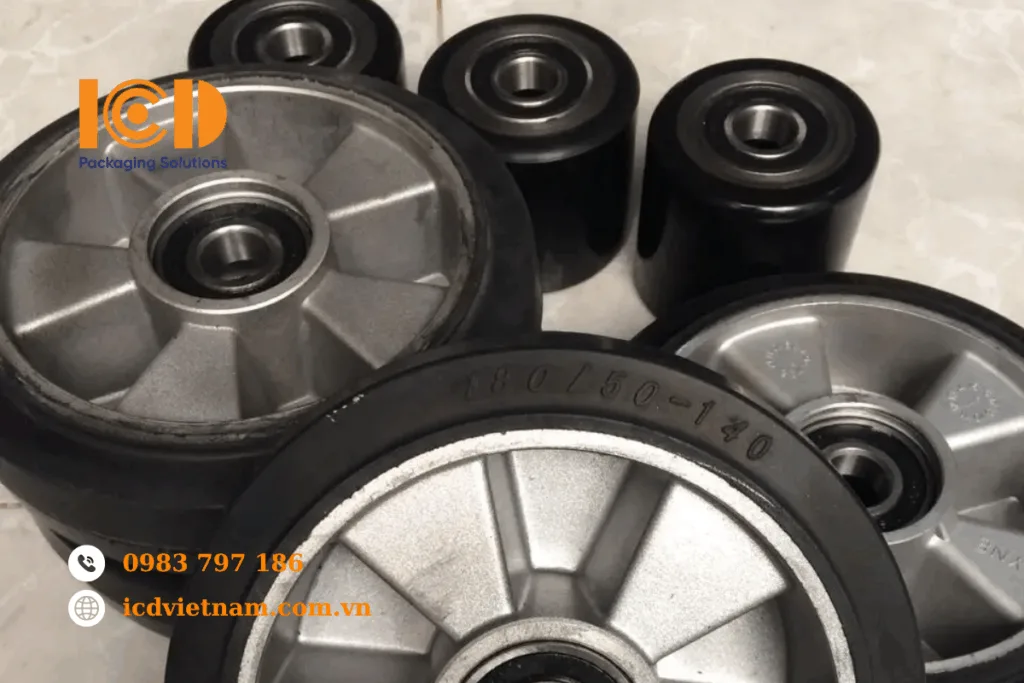
For electric pallet jacks, electrical safety is critical. Disconnect the battery fully before touching any wheel. The steering wheel on electric models often integrates the drive motor, so if the outer tread is worn you may need to remove the entire motor-wheel assembly or replace only the rubber tread shell, depending on the manufacturer design.
3 Removal Methods: Choose the Right One to Avoid Frame Damage
- Mechanical puller (bearing puller) - RECOMMENDED:
- Use a 3-jaw bearing puller (150,000 - 300,000 VND, available to purchase or borrow from ICD)
- Hook the three jaws onto the wheel rim, thread the center bolt against the axle tip, and turn to draw the wheel off evenly
- No damage to fork arms; works in all conditions
- Hydraulic press - professional:
- Requires a hydraulic press (available at specialist forklift workshops)
- Place the fork arm in the press and push the axle out with 5 to 10 tonnes of force
- Fastest method but requires equipment
- Heat method - HIGH RISK:
- Apply a torch around the axle area; the metal expands and the wheel slides free
- Drawback: temperatures above 200 deg C draw the temper from C45 steel fork arms, reducing strength by 30 to 40 percent permanently
- Use ONLY when the wheel is completely seized and neither other method works - then inspect the fork arm for bending or cracking afterward
Common Mistakes and How to Prevent Them
- Axle seized by rust: soak with WD-40 or penetrating oil for 30 minutes before pulling. Heavy rust may need an overnight soak.
- Bearing broken during removal: caused by pulling off-center. Make sure the puller jaws are seated level so force is applied evenly around the wheel.
- New wheel surface scratched during installation: always use a rubber mallet - never a steel hammer - and place a wooden block between the mallet and the wheel.
- Forgetting to grease the axle: a dry axle causes the wheel to seize again within 3 to 6 months. Apply lithium heat-resistant grease before pressing the new wheel on.
Wheel Maintenance After Replacement
To keep new wheels lasting longer, apply bearing grease monthly. This prevents water from entering the bearing and reduces friction between the axle and the wheel bore. Also keep the warehouse floor clear of metal fragments and plastic strapping - these are the leading cause of bearing burnout and premature wheel failure when they wrap around the axle.
Related articles
| Xilin Hand Pallet Trucks - Full Range | How to Maintain a Pallet Jack | Pallet Jack Hydraulic Oil: When and How to Change |
Frequently asked questions about changing pallet jack wheels
1. Why can I not drive out the steel pin even with a lot of force?
The main cause is rust forming a rigid bond between the pin and the axle hole. Do not apply excessive force - it will bend the fork frame. Spray rust-penetrating solution and use a punch of the correct diameter so the force acts on the pin center.
2. Are PU and nylon wheels interchangeable on the same axle?
Most standard hand pallet jacks use a common axle diameter for both wheel types. The critical measurement is the inner diameter of the bearing - confirm it matches before ordering the replacement wheel.
3. Does changing wheels yourself void the pallet jack warranty?
Wheels are normally consumable parts not covered under long-term manufacturer warranty. However, if the jack is still within its full warranty period, contact the supplier for guidance before performing any deep mechanical work.
4. How long does wheel replacement take for a non-specialist?
With all tools ready and following the 8-step procedure, replacing one pair of front load wheels takes about 15 to 20 minutes.
5. How do I identify the correct wheel size without removing it first?
Check the technical specification plate on the jack body, or measure the outer diameter and width of the wheel directly. For the most accurate bearing bore measurement, remove one wheel and measure with a caliper.
6. Should I replace both wheels or just the damaged one?
Replace in pairs. Running one new and one worn wheel causes the jack to lean, loading the frame unevenly and wearing out the new wheel faster.
7. Why does the jack still make a clunking noise after installing new wheels?
A missing washer or a bearing not fully pressed into the wheel bore are the most common causes. Remove the wheel and check that all components are seated correctly.
8. Can I press a bearing into a new wheel without a hydraulic press?
Yes. Use a steel tube with an outer diameter matching the bearing outer race, then tap it evenly with a rubber mallet to seat the bearing flush.
9. Can worn PU wheels be re-coated instead of replaced?
Re-coating services exist for cast-iron cores, but the cost is typically close to buying a new wheel and the durability is lower than a factory-cast original.
10. How do I prevent the cotter pin from falling out during operation?
Use a stainless steel or zinc-plated cotter pin of good quality. After fitting, bend both ends tightly against the axle so they cannot snag on cargo and spring loose.
Contact ICD Vietnam
Hotline: 0983 797 186 / 090 345 9186 / 090 5859 186
Email: sales@icdvietnam.com.vn | Zalo: Chat Zalo