Table of Contents
- 1. How does a high-lift hand pallet truck pump differ from a low-profile one?
- 2. Parts of the manual stacker’s pump assembly
- 3. High-lift pump faults: causes and remedies according to the manufacturer
- 4. SDJ hydraulic oil and maintenance schedule
- 5. Restore the pump or replace it?
- Frequently asked questions
- 1. Is a high-lift hand pallet truck pump the same as a low-profile one?
- 2. Why do the forks of a high-lift hand pallet truck rise but not lower?
- 3. What fault makes a high-lift hand pallet truck lower slowly while holding a load?
- 4. What oil does a high-lift hand pallet truck use, and how often is it changed?
- 5. How do I bleed the air on a high-lift hand pallet truck?
- Contact us for high-lift hand pallet truck advice
- References
Reviewed and updated by ICD - Week 43/2026
The hydraulic pump of a high-lift hand pallet truck is a hand pump assembly mounted on the mast: with each pull of the lever, a roller on the lever end presses the pump core to push oil into the cylinder, the ram rises and pulls a pulley and chain, and the forks rise twice the stroke of the ram. Unlike a low-profile hand pallet truck, where the ram pushes a linkage hidden in the forks, a high-lift truck lifts by chain, adds a relief valve that needs adjusting and uses a different oil; this article follows the Xilin SDJ manual stacker operating manual exactly.
Quick summary:
- The pump of a Xilin manual stacker lifts loads of 500, 1,000 or 1,500 kg (SDJ series) to 1.6 to 3 m through a pulley and chain, at a lifting speed of 21-25 mm/s.
- The five common symptoms (will not lift, will not lower, lifts by itself, lowers by itself, lifts slowly) all have a cause-and-remedy table in the manufacturer’s document, shown in section 3.
- The SDJ oil is ISO VG 22 hydraulic oil, with the level about 2 mm below the filler opening when the forks are at their lowest; do not pour in the 46# oil used by low-profile hand pallet trucks.
- Replacing seals restores the pump; a bent ram must be replaced, and a damaged pump body or valve body means repairing or replacing the assembly.
1. How does a high-lift hand pallet truck pump differ from a low-profile one?
In both types the principle is still that a small pump rod forces oil into a large cylinder. The difference lies in how force reaches the load. According to the Xilin SDJ operating manual, the cylinder force is transferred to the load by a pulley and chain; the English version of the manual describes it more clearly: the roller on the lever presses on the pump core, oil goes from the pump cylinder to the lift cylinder, and the ram rises and pulls the forks up through the chain with twice the travel.
| Ram rises |
800 mm
|
| Forks rise |
1,600 mm
|
The first consequence is force. A 2:1 chain doubles the force on the ram compared with the weight of the load. On an SDJ1000 lifting 1,000 kg, the force on the ram is about 2,000 kgf (about 19.6 kN); a Ø75 mm hydraulic cylinder per the manufacturer’s data has a cross-section of about 44 square centimetres, so the oil pressure is estimated at about 44 bar, not counting the mass of the fork carriage, friction and chain efficiency. That is, in the range of a few tens of bar.
The second consequence is the control. The control lever has three positions: lift, neutral and lower. To lower a load, bring the release lever on the mast to the neutral position and pull it toward you: the harder you pull, the faster it lowers, and when you let go the forks stop. The lowering speed can be adjusted to the weight of the load.
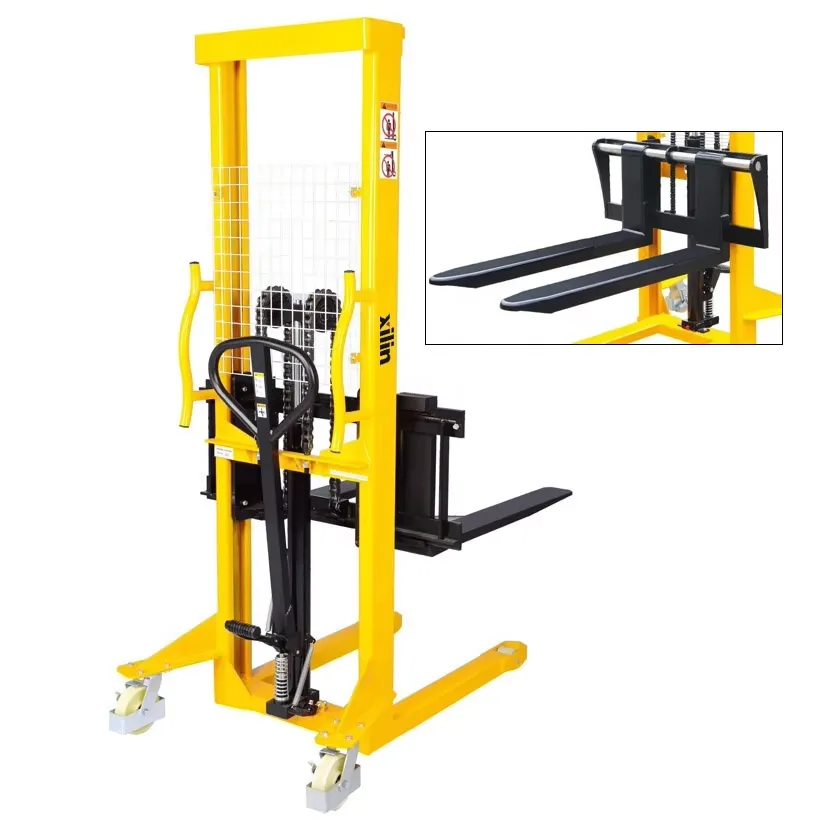
SDJ specifications from the manufacturer
| Model | Capacity | Load centre | Lift height | Lifting speed | Cylinder | Weight |
|---|---|---|---|---|---|---|
| SDJ500 | 500 kg | 600 mm | 1,600 mm | 25 mm/s | Ø75 mm | 213 kg |
| SDJ1000 | 1,000 kg | 600 mm | 1,600 / 2,500 / 3,000 mm | 25 mm/s | Ø75 mm | 214 / 292 / 305 kg |
| SDJ1500 | 1,500 kg | 400 mm | 1,600 mm | 21 mm/s | Ø75 mm | 239 kg |
The most notable figure in the table is the load centre of the SDJ1500: 400 mm, shorter than the 600 mm of the two lighter models. A tall or long load placed far off the mast lets the truck lift less than the capacity on its plate, and that is why a pump with no fault still cannot lift the load.
2. Parts of the manual stacker’s pump assembly
3. High-lift pump faults: causes and remedies according to the manufacturer
The table below is translated from the troubleshooting section of the Xilin SDJ manual stacker operating manual. Causes are listed in the order the manufacturer gives; check in that order, because the first cause is usually the cheapest to correct.
| Symptom | Possible causes | Remedy |
|---|---|---|
| Forks will not rise or rise slowly | Relief valve not adjusted; debris in the pump keeps the check valve from sealing; pump leaking; seal damaged; valve body damaged | Adjust the valve; change the oil; repair or replace the pump; replace the seal; repair or replace the valve body |
| Press the release lever and the forks do not lower | Relief valve adjusted wrongly; mechanical hinge not working; body parts stuck; ram bent | Adjust the valve; repair the joint; repair or replace the stuck part; replace the ram |
| Forks still rise when the lever has not reached its end position | Relief valve not adjusted well | Readjust the relief valve |
| Forks lower by themselves when the lever is not in the lower position | Relief valve adjusted wrongly; pump leaking; high-pressure head seal damaged | Adjust the valve; repair or replace the pump; replace the seal |
| Slow lifting speed | Serious hydraulic leak; aged or damaged seals; air in the system | Repair the leak; replace the seals; bleed the air |
Read this table the way a repairer does: for the first four symptoms the relief valve heads the list of causes, and adjusting the valve is the least laborious step. Only when adjusting the valve, changing the oil and bleeding the air still fail to make the truck lift do the seals, pump body and ram come into play. For debris in the pump that keeps the check valve from sealing, the manufacturer simply directs an oil change.
4. SDJ hydraulic oil and maintenance schedule
The oil in an SDJ manual stacker is HLD hydraulic oil to DIN 51524 part 2, viscosity ISO VG 22. Tell it apart from the Xilin low-profile hand pallet truck, where the manual calls for 46# anti-wear oil; pouring heavier oil into the mast makes the pump heavy and lifting slow, especially in cold weather. Xilin also advises changing to winter oil below about +5 degrees C.
How to top up the oil: when you notice the forks cannot lift the maximum load, add oil to the dedicated reservoir with the forks at their lowest, with the oil level about 2 mm below the filler opening. A new truck should have its oil changed after the first month of work, and then about every 6 months.
The safety section of the same document is also worth repeating: when travelling with a load, keep the forks no more than 300 mm off the floor, place the load centred between the forks and close to the mast, do not stand under the forks, and at the end of the shift lower the forks to their lowest, never leaving them hanging in the air or at the top position.
5. Restore the pump or replace it?
Restore it when the fault is in the seals, dirty oil or an unadjusted valve: these are all short jobs and the ram is still polished and unscored. When the manufacturer says “replace the ram” (bent ram) or “repair or replace” the pump body or valve body, repairing on the spot is only a temporary fix if the ram surface is deeply scored, because a new seal is still ground to pieces. With a cracked pump body or a bent ram, replacing the assembly is the safe choice.
| Where it is damaged | Manufacturer’s remedy |
|---|---|
| Relief valve not adjusted, dirty oil, air in the system | Adjust the valve, change the oil, bleed the air |
| Aged or damaged seals, high-pressure head seal | Replace the seal |
| Pump leaking, damaged pump body or valve body | Repair or replace |
| Bent ram | Replace the ram |
ICD Vietnam distributes Xilin high-lift hand pallet trucks and repairs forklifts; new trucks carry a 12-month warranty. If your truck shows one of the symptoms in the table above and adjusting the valve and changing the oil do not improve it, call the hotline at the end of the article for advice before taking the pump apart.
Frequently asked questions
1. Is a high-lift hand pallet truck pump the same as a low-profile one?
The principle is the same (the pump rod forces oil into the cylinder), but a high-lift truck lifts by pulley and chain with fork travel twice the ram travel, has a relief valve that needs adjusting and uses ISO VG 22 oil, unlike the 46# oil of Xilin low-profile hand pallet trucks.
2. Why do the forks of a high-lift hand pallet truck rise but not lower?
According to the Xilin manual: the relief valve is adjusted wrongly, the mechanical hinge is not working, body parts are stuck or the ram is bent. Check the valve and the joint first; a bent ram must be replaced.
3. What fault makes a high-lift hand pallet truck lower slowly while holding a load?
Usually the relief valve is not adjusted well, the pump is leaking or the high-pressure head seal is damaged. If the forks still sink with no oil stain, it is an internal leak; if there is oil around the rod, it is an external leak.
4. What oil does a high-lift hand pallet truck use, and how often is it changed?
ISO VG 22 hydraulic oil (HLD to DIN 51524 part 2). A new truck has its oil changed after the first month and then about every 6 months; check the oil level every 3 months.
5. How do I bleed the air on a high-lift hand pallet truck?
Raise the control lever to the lower position, then lower and raise it about 12 times to drive the air out of the pump chamber.
Contact us for high-lift hand pallet truck advice
Hotline: 0983 797 186 | 090 345 9186 | 090 5859 186
Zalo: icdvietnam | Email: sales@icdvietnam.com.vn
Delivery within Hanoi and Ho Chi Minh City takes 1-3 working days under ICD Vietnam’s shipping policy.
See a related product: ICD SDJ1000 3 m high-lift hand pallet truck, 1 and 1.5-tonne capacity, lifting up to 3 m, distributed by ICD Vietnam.
References
- Xilin (Ningbo Ruyi), SDJ, SDJA-I, SDJAS manual stacker operating manual: SDJ specifications, principle, maintenance, ISO VG 22 oil, bleeding, troubleshooting table, safety.
- SDJ manual stacker operating manual (English version): hydraulic system construction, roller pressing the pump core, chain with doubled travel.
- Ningbo Ruyi (Xilin): Xilin hand pallet truck series information.
Written by Le Van Thang and the ICD Vietnam technical team, distributor of Xilin (Ningbo Ruyi) forklifts. The pressure figure is an estimate calculated from the manufacturer’s specifications, not a measurement. Last updated: 19 October 2026.