Table of Contents
- When do you need to remove a pallet jack wheel?
- Steering wheels and fork wheels: two kinds of wheel, two ways to remove them
- Tools for removing pallet jack wheels
- Types of pallet jack wheel and how to choose
- How to remove the wheels of a low-profile hand pallet truck
- Removing wheels from high-lift hand pallet trucks and electric trucks
- 3 ways to remove a stuck wheel: pick the right one to avoid damaging the fork
- Common problems when removing wheels and how to fix them
- Wheel maintenance after replacement
- Frequently asked questions about removing pallet jack wheels
- 1. Why can’t I drive the steel pin out even with a lot of force?
- 2. Can PU and nylon wheels use the same axle?
- 3. Does removing the wheels myself void the forklift warranty?
- 4. How long does a non-specialist take to change the wheels?
- 5. How can I know the exact wheel size without removing it first?
- 6. Should I replace the whole pair or just the damaged wheel?
- 7. Why does the truck still clunk after fitting a new wheel?
- 8. Do I need a special tool to press a bearing into a new wheel?
- 9. Can a worn pallet jack wheel have its tread rebuilt?
- 10. How do I stop a cotter pin from breaking or falling out in use?
- 11. How should a forklift be maintained regularly?
- 12. Does operating a forklift require inspection or certification?
- 13. What policies does ICD Vietnam have for forklifts?
- See related products
- References
Reviewed and updated by ICD - Week 43/2026
Removing a pallet jack wheel comes down to three jobs: block the truck securely so the wheel you are removing is off the floor, remove the retaining pin (cotter pin or steel pin) and push the axle out, and check the bearing before fitting the new wheel. On a Xilin low-profile hand pallet truck, the steering wheel is about 180 mm in diameter and the fork wheels about 70 - 74 mm; measuring the exact size before ordering a replacement is the step most often skipped.
This article gives an 8-step procedure for removing and replacing pallet jack wheels on your own at the warehouse, with a tool list, how to choose between PU and nylon wheels, and how to handle problems such as a stuck pin or a rusted axle. It focuses on practical technique that saves repair cost and keeps the truck running smoothly and durably after the change.
When do you need to remove a pallet jack wheel?
Recognising the right moment for technical work protects the truck frame and the hydraulic pump.
The clearest sign is that the truck feels heavier to move than usual although the load has not changed. Visually, the outer PU or nylon layer peels off in patches, leaving the cast-iron core underneath. If you keep pulling the truck like this, the core rubs directly on the floor, damaging the warehouse floor and making a lot of noise.
Another sign is heavy shaking when moving. This happens when one of the load wheels wears unevenly or the bearing inside has broken. If you see small bits of plastic falling along the truck’s path, the wheel must come off and be replaced.
Table of real wheel wear signs:
| Wheel position | Technical sign | How to check |
|---|---|---|
| Load wheel (fork wheel) | Tread peeling, metal core showing, deep cracked grooves | Lower the forks to the lowest height, then look at and turn each wheel under the fork tip by hand |
| Steering wheel | Hard to turn, stuck bearing, worn flat on one side | Lift slightly so the wheel is off the floor, turn it by hand and listen for grinding, and shake it to check for play |
The Xilin hand pallet truck manual makes checking the wheels and axle a daily item. A bad wheel caught early only needs the wheel replaced; left too long, a broken bearing lets the steel balls scratch the axle and the whole axle must be replaced.
Steering wheels and fork wheels: two kinds of wheel, two ways to remove them
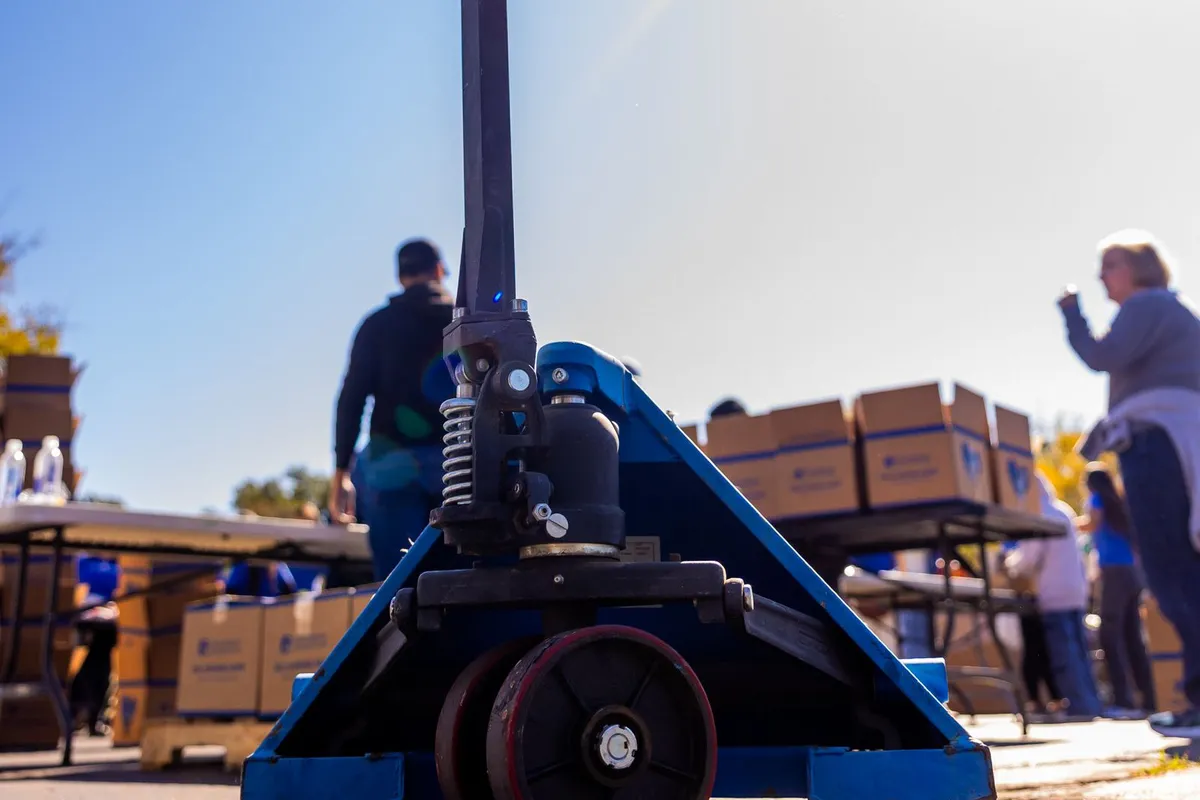
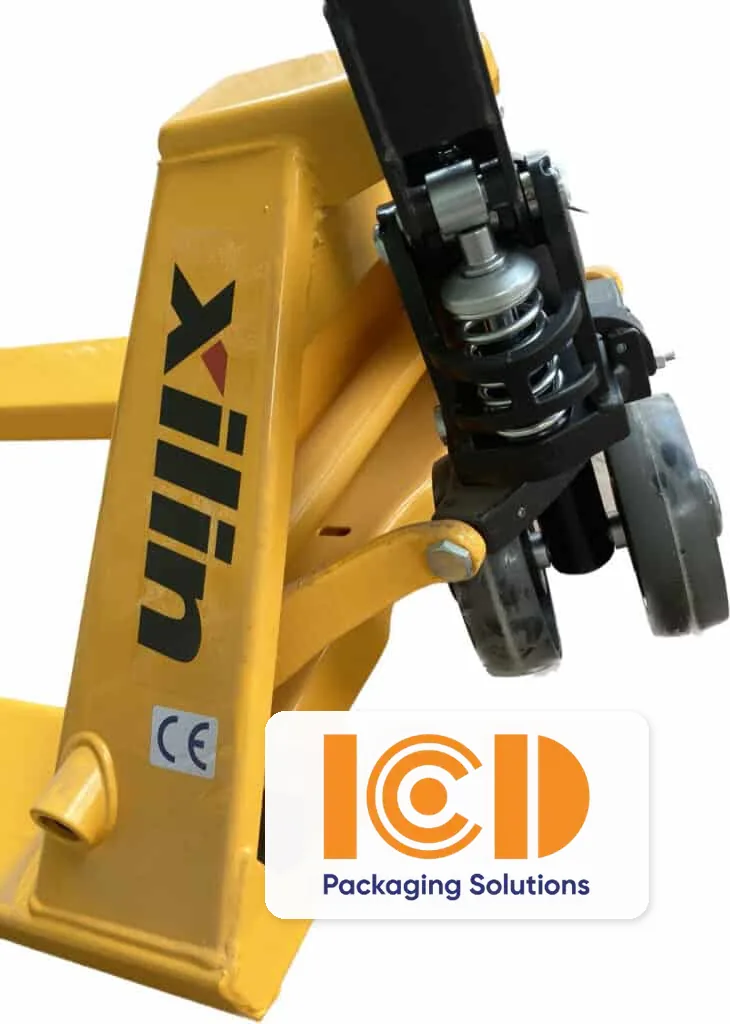
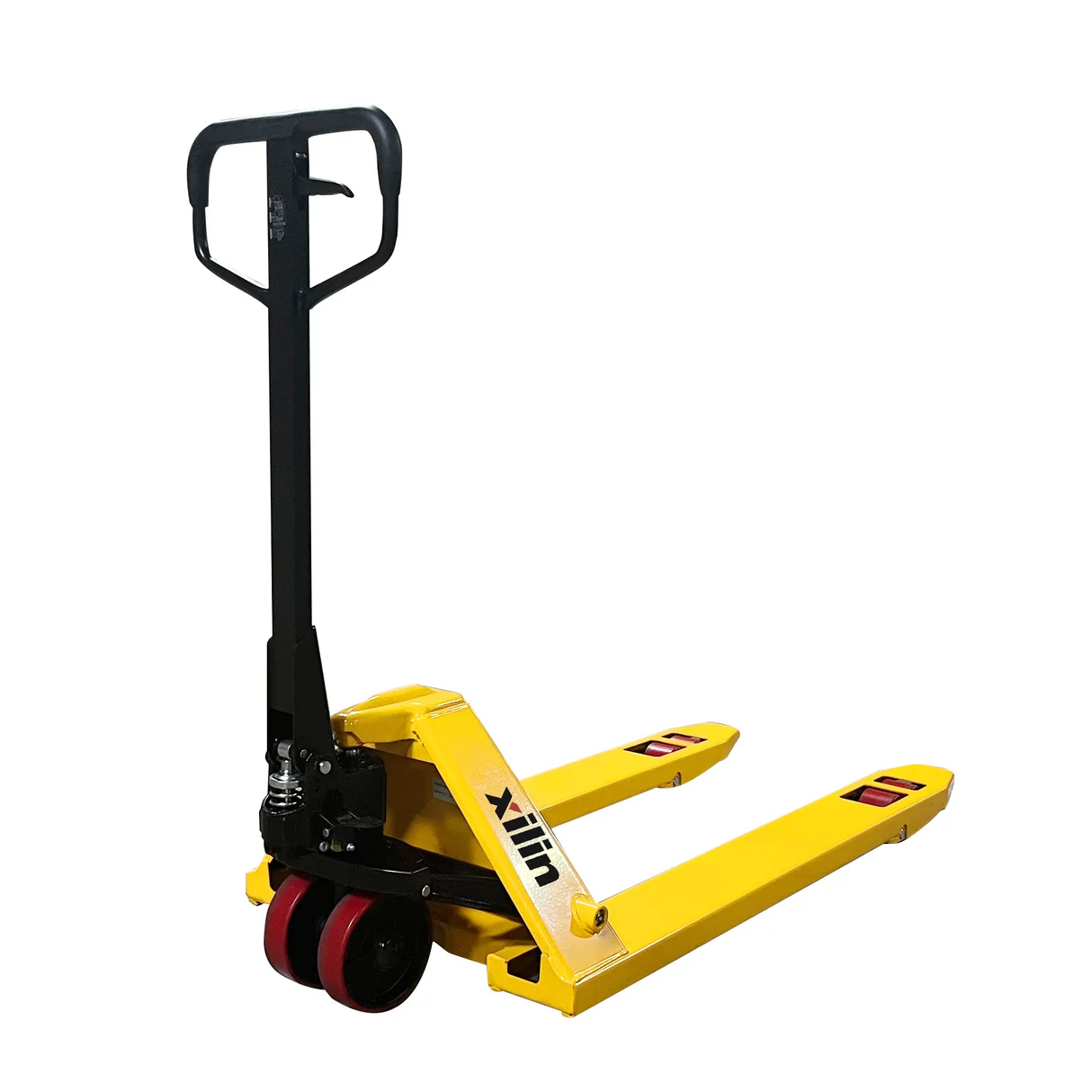
A low-profile hand pallet truck has two groups of wheels. The steering wheel is the larger pair under the pump assembly, which turns with the handle. The fork wheels (also called load wheels) are the small wheels under the tips of the two forks, carrying most of the pallet’s load. The two groups differ in size and in how they are fitted, so before buying a replacement you need to know which group you are changing.
Fork wheels come in two types: single wheels (one wide wheel per fork) and tandem wheels (two narrower wheels per fork on a rocking frame). Tandem wheels distribute load better when the truck rolls over floor gaps or ramp edges. According to Xilin’s data sheet, the BF-III comes with guide rollers at the fork tips to make entering and leaving pallets easier, and offers a choice of single or tandem fork wheels.
| Specification (mm) | BF-III | DF-III |
|---|---|---|
| Steering wheel | φ180 (φ200 optional) | φ180 / φ160 |
| Single fork wheel | φ74×93 | φ70×80 |
| Tandem fork wheel | φ74×70 | φ70×60 |
| Optional wheel materials | Nylon, PU, rubber | Nylon, PU, rubber |
The two numbers in a cell are the wheel diameter and width. Although both are 2.5 - 3 tonne hand pallet trucks, the BF-III and DF-III fork wheels are not the same size, so do not buy wheels by the truck’s capacity but by model or by real measurements. For a BF-III with a 200 mm steering wheel, the matching fork wheel is 80 mm according to the manufacturer’s note.
Tools for removing pallet jack wheels
To make removal and refitting fast and avoid damaging surrounding parts, prepare a full set of tools. Tools you need:
| Tool | Main function |
|---|---|
| Needle-nose pliers | Remove cotter pins and retaining clips |
| Rubber mallet | Drive axles and steel pins without deforming them |
| Pin punch set | Push pins sitting deep in the axle hole out |
| WD-40 or penetrating oil | Treat rusted or seized spots |
| Auxiliary jack or support blocks | Raise the truck fork to create working space |
| Three-jaw puller (bearing puller) | Pull a stuck wheel or bearing off evenly without bending the fork |
| Grease, calipers | Grease the axle when refitting; measure wheel diameter, axle hole and bearing |
Types of pallet jack wheel and how to choose
Choosing the right wheel type before you take anything apart decides how long the truck lasts after maintenance.
Red PU wheels with a cast-iron core are the most popular choice for workshops and warehouses with epoxy-painted or tiled floors. PU is elastic, so the truck runs smoothly and leaves no scratches. However, if your warehouse has a lot of water or chemicals, PU wheels quickly rot and peel.
White nylon wheels are the solution for wet environments, cold rooms or places with many chemicals. Nylon is hard and durable and carries large loads without deforming. The drawback is loud noise on rough concrete floors.
Rubber wheels are the third option Xilin lists for both the BF-III and DF-III: quiet and grippy, suited to places that need less noise or anti-slip. When replacing, keep the same wheel type for the whole pair; mixing a PU wheel on one side with nylon on the other makes the truck pull to one side and wear unevenly.
How to remove the wheels of a low-profile hand pallet truck
This procedure applies to most standard manual Xilin hand pallet trucks. Follow the order and never skip the safety blocking step.
- Set up a safe work area. Choose a flat, dry floor. Lower the forks to their lowest and use heavy objects to chock the wheels you are not removing so the truck cannot roll away.
- Raise the part of the truck with the wheel to be removed. Use an auxiliary jack or solid wooden blocks under the fork so the wheel to be removed just leaves the floor. This reduces pressure on the wheel axle. Never put your hands or feet under a part of the truck held up only by hydraulics.
- Clean around the axle pin. Use a wire brush or a cloth to remove dirt around the axle ends. If you see rust, spray a layer of WD-40 and wait a few minutes for it to soak into the gaps.
- Remove the retaining pin. Use needle-nose pliers to straighten and pull out the cotter pin. If the truck uses a driven steel pin, set the pin punch exactly on the centre of the pin and tap evenly with a hammer until the pin drops out the other side.
- Pull out the wheel axle. Once the pin is out, support the wheel from underneath with one hand and use the punch with the other to push the axle gently out of the bracket hole. Be careful: the old wheel can be quite heavy and drop on your foot.
- Check the bearing and sleeve. With the wheel off, check whether the old bearing still turns well. If it is loose or stuck, replace it with a new bearing at the same time as the wheel so the whole assembly performs consistently.
- Fit the new wheel. Clean the wheel axle thoroughly and apply a thin layer of grease. Position the new wheel, pass the axle through the bracket hole and the bearing, and make sure the axle goes all the way through both sides of the bracket.
- Secure and test run. Fit the new retaining pin and bend over the cotter pin ends to lock it. Lower the truck and pull it with a light load to check the wheel turns evenly and smoothly.
Removing wheels from high-lift hand pallet trucks and electric trucks
On a high-lift hand pallet truck such as the SDJ series, the procedure is more complex because of the mast and the lift chain. Lower the forks and mast fully before blocking the truck. When removing the steering wheel, watch for the integrated mechanical brake assembly underneath. The axle of a high-lift truck is usually longer and has several shim washers, so note their positions so none is left out. If you need to lift loads high rather than just move them horizontally, see also high-lift hand pallet trucks in Hanoi.
For an electric pallet truck, the procedure demands care with electrical safety. Before removing a wheel you must disconnect the battery completely. The steering wheel of an electric truck often has a motor built in, so if the wheel is worn you usually have to remove the whole motor assembly or replace just the wheel shell, depending on the manufacturer’s design. Leave this to a technician.

3 ways to remove a stuck wheel: pick the right one to avoid damaging the fork
When a wheel or bearing is stuck hard on the axle, do not hit it with a hammer. There are three methods, ranked from safest to riskiest:
1. Use a puller (mechanical extractor), the first choice. Hook the three jaws of the puller on the wheel rim, rest the centre screw on the axle end and turn slowly to pull the wheel off evenly. This does not damage the fork and works for most wheel conditions. Place the puller square to the centre with even force on all three jaws, otherwise the bearing can break while you pull.
2. Hydraulic press, for a professional workshop. This needs a hydraulic press, usually found only in a forklift repair shop. Put the fork in the press and press the axle out. It is the fastest method but needs the equipment.
3. Heating, high risk. Use a torch to heat the area around the axle hole so the metal expands. High temperature can change the hardness of heat-treated fork steel and damage nearby bearings and seals. Use it only when the other two methods fail to free the wheel, and afterwards check whether the fork is bent or cracked.
Common problems when removing wheels and how to fix them
Stuck steel pin or axle seized by rust. This is the most common situation after long periods without maintenance. Soak with WD-40 or penetrating oil before pulling; heavy rust may need longer soaking before you drive the pin out. Heating is only the last resort, as noted above.
Broken bearing inside the wheel. When the bearing is smashed, steel balls can fall into the gap between axle and wheel and jam it hard. Use a puller or a flat chisel to pry the wheel off slowly, then clean scratches off the axle with sandpaper before fitting the new wheel. The cause is usually pulling off-centre.
Fitting the wheel the wrong way round. Some wheels have an asymmetric bearing seat. Look closely at the old wheel before removing it so the new wheel goes in the right way.
Scratching the new wheel while fitting. Fit a new wheel with a rubber mallet, not a steel hammer, and put a piece of wood in between.
Forgetting to grease the axle. A dry axle makes the wheel seize quickly. Apply heat-resistant (lithium-based) grease before driving in the new wheel.
Wheel maintenance after replacement
To make the new wheel last, lubricate the axle and joints regularly. The Xilin hand pallet truck manual sets daily checks of the wheels and axle and monthly lubrication of joints and pins. Greasing keeps water out of the bearing and reduces friction between the axle and the wheel core.
Also keep the warehouse floor clear, so metal debris or plastic strapping does not wind around the wheel axle, a common cause of burnt bearings and wheel failure.
| Item | Per the Xilin manual |
|---|---|
| Wheels and axle | Check daily |
| Joints and pins | Lubricate monthly |
| Hydraulic oil level | Check every 3 months |
Frequently asked questions about removing pallet jack wheels
1. Why can’t I drive the steel pin out even with a lot of force?
The main cause is rust bonding the pin to the axle hole. Do not use too much force, as it will bend the truck frame. Spray rust remover and use a pin punch of the correct size so the force is concentrated on the centre of the pin.
2. Can PU and nylon wheels use the same axle?
On the same truck model, PU and nylon wheels usually have the same fitting size. What matters is measuring the outer diameter, the wheel width and the inner diameter of the bearing exactly so the axle fits properly.
3. Does removing the wheels myself void the forklift warranty?
Normally, wheels are consumable parts and are not covered by the manufacturer’s long-term warranty list. However, if the truck is still within its full warranty period, contact the supplier for guidance before doing any deep mechanical work yourself.
4. How long does a non-specialist take to change the wheels?
It depends on the condition of the pins and bearings. With clean, rust-free pins, changing a pair of fork wheels is fairly quick; rusted pins or broken bearings can take far longer. Having all tools and the correct wheel size ready before you start is the best way to save time.
5. How can I know the exact wheel size without removing it first?
Read the model on the truck plate and look it up in the manufacturer’s data sheet: BF-III steering wheel φ180, fork wheel φ74×93 (single) or φ74×70 (tandem); DF-III steering wheel φ180 or φ160, fork wheel φ70×80 or φ70×60. For the most accurate result, still remove one wheel and measure the axle hole and bearing.
6. Should I replace the whole pair or just the damaged wheel?
Replace in pairs. A new wheel on one side and a worn old wheel on the other makes the truck lean, puts uneven pressure on the frame and makes the new wheel fail sooner.
7. Why does the truck still clunk after fitting a new wheel?
You may have left out a washer, or the new bearing was not pressed fully into the wheel bore. Take it apart and check that every part fits snugly.
8. Do I need a special tool to press a bearing into a new wheel?
If you have no hydraulic press, you can use a length of tube with a diameter equal to the outer ring of the bearing, then drive it into place with a rubber mallet, tapping evenly.
9. Can a worn pallet jack wheel have its tread rebuilt?
There are services that re-cast PU onto an old cast-iron core. However, the cost of re-casting is usually not much below buying new, and the durability is hard to match a wheel cast originally at the factory.
10. How do I stop a cotter pin from breaking or falling out in use?
Use a good-quality stainless steel or zinc-plated steel cotter pin. When fitting, bend both ends back tight against the axle so they do not catch on goods and pop out.
11. How should a forklift be maintained regularly?
Per the Xilin hand pallet truck manual: check the wheels and axle daily, lubricate joints and pins monthly, and check the hydraulic oil level every 3 months (46# anti-wear oil). During the 12-month warranty, contact ICD Vietnam for guidance before working on the truck yourself.
12. Does operating a forklift require inspection or certification?
A hand pallet truck pulled and pushed by human strength is not on the list requiring inspection. Powered forklifts with a lifting capacity of 1,000 kg or more fall on the list of machines and equipment with strict occupational safety requirements under Circular 36/2019/TT-BLDTBXH, so they must be inspected; operators need safety training as required by regulation.
13. What policies does ICD Vietnam have for forklifts?
ICD Vietnam distributes genuine Xilin (Ningbo Ruyi) forklifts with a 12-month warranty, and offers forklift repair and rental services. Send the truck model and the condition of the wheels for advice on the right course of action. Delivery terms are confirmed when you order.
ICD Vietnam distributes genuine Xilin (Ningbo Ruyi) hand pallet trucks and offers forklift repair services. If the truck is still under warranty or the wheel is badly damaged, contact us for advice before taking it apart yourself.
Contact ICD Vietnam on hotline 0983 797 186 or by email at sales@icdvietnam.com.vn, and send the truck model and the wheel position to be replaced for advice.
References
- BF-III and DF-III data sheets: Ningbo Ruyi - Hand Pallet Truck (steering wheel, single and tandem fork wheel sizes, optional wheel materials).
- Xilin hand pallet truck manual (Ningbo Ruyi): schedule for checking wheels and axle, lubricating joints and checking oil.
- Circular 36/2019/TT-BLDTBXH dated 30 December 2019 promulgating the list of machines, equipment and materials with strict occupational safety requirements: National database of legal documents.
- Written by Le Van Thang of ICD Vietnam; ICD Vietnam has operated since 2011 and distributes Xilin forklifts. Updated October 2026.