Mục lục
HDPE plastic pellet prices are not fixed - they fluctuate with global oil prices, USD exchange rates, and supply-demand pressure from major producers in China, South Korea, and the Middle East.
Quick summary:
- Virgin HDPE pellet price 2026: 28,800 - 36,000 VND/kg (approx. 1.20 - 1.50 USD/kg)
- Recycled HDPE is 30-40% cheaper but unsuitable for food-contact products
- Price fluctuations are driven mainly by ethylene and crude oil prices
- 4 common HDPE grades: film grade, blow molding grade, injection grade, pipe grade
I often receive questions from customers who manufacture plastic pallets: “Why does the HDPE price change from one week to the next?” The answer lies in the nature of the material - HDPE (High Density Polyethylene) is a petrochemical product, meaning its entire value chain depends on crude oil prices, ethylene cracking costs, and the production decisions of major petrochemical corporations worldwide. This is not a fixed-price commodity like cement or steel - it fluctuates weekly.
Understanding HDPE price fluctuation mechanisms not only helps you buy at the right time, but also helps you plan production and control raw material costs more effectively. Especially for businesses manufacturing plastic pallets, packaging, and plastic pipes - HDPE raw material typically accounts for 60-75% of product cost.
This article provides a detailed reference price table by HDPE grade, explains why products with the same “HDPE” label can differ in price by up to 2x, and highlights key checks when purchasing to avoid receiving the wrong material.
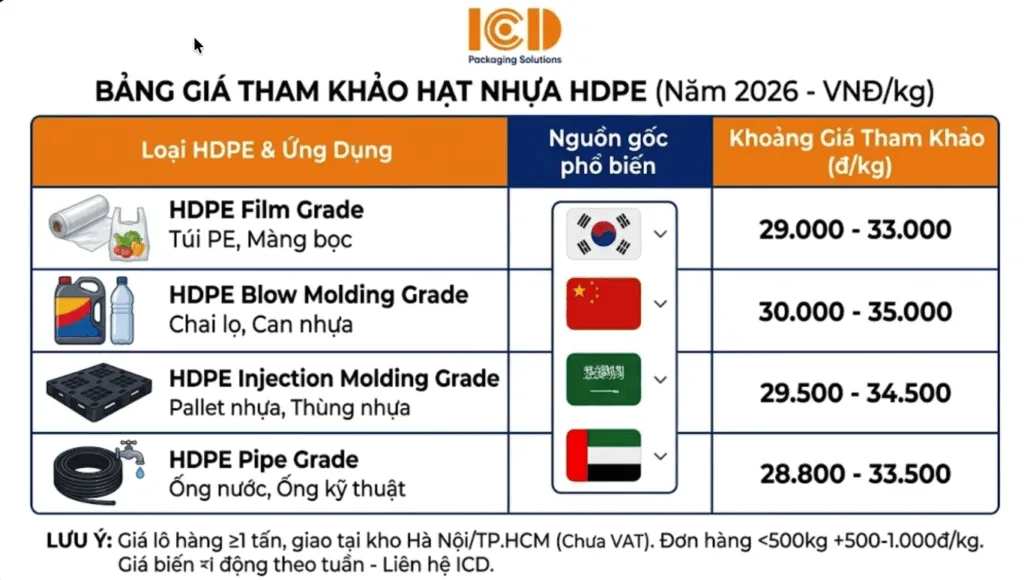
HDPE is not a homogeneous product - there are many different grades optimized for specific applications. Each grade has a different melt flow index (MFI), tensile strength, and processability, leading to different price levels. The table below summarizes reference prices for the most common virgin HDPE grades on the Vietnamese market in early 2026.
| HDPE Grade | Main Application | Common Origin | Reference Price (VND/kg) |
|---|---|---|---|
| HDPE Film Grade | PE bags, wrapping film | South Korea, China | 29,000 - 33,000 |
| HDPE Blow Molding Grade | Bottles, containers, jerricans | Saudi Arabia (SABIC), South Korea | 30,000 - 35,000 |
| HDPE Injection Molding Grade | Plastic pallets, crates, boxes | Saudi Arabia, UAE, South Korea | 29,500 - 34,500 |
| HDPE Pipe Grade | Water pipes, technical pipes | Saudi Arabia, China | 28,800 - 33,500 |
| Recycled HDPE | Non-food-contact products | Domestic sources | 17,000 - 22,000 |
Prices above are for minimum 1-tonne orders, delivered to warehouse in Hanoi or Ho Chi Minh City, excluding VAT. Orders under 500kg typically incur an additional 500-1,000 VND/kg due to splitting costs. Prices fluctuate weekly - contact ICD for the most up-to-date quote.
Why Do HDPE Plastic Pellet Prices Fluctuate Continuously?
HDPE is synthesized from ethylene - a monomer obtained from the cracking of naphtha or ethane. This entire chain starts from crude oil, so when Brent crude rises by 10 USD/barrel, HDPE prices typically follow within 3-6 weeks (the lag from when crude oil is processed to when HDPE reaches distributors in Vietnam).
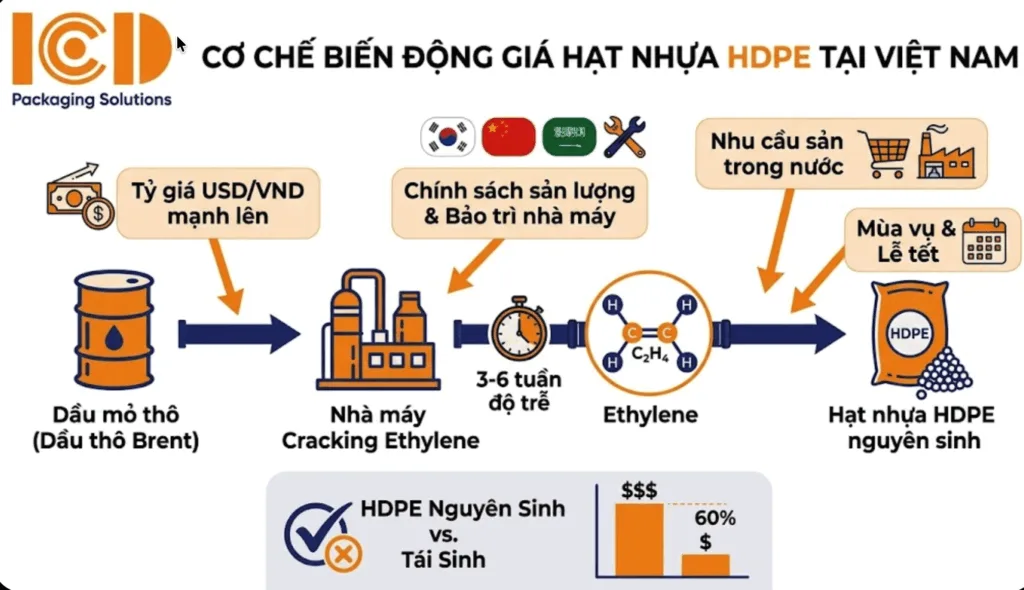
Beyond oil prices, 3 other factors strongly affect HDPE prices in Vietnam. First is the USD/VND exchange rate: since HDPE is imported and priced in USD, every strengthening of the dollar raises the VND price of HDPE even if international prices have not changed. Second is the production policy of major plants - SABIC (Saudi Arabia), LG Chem (South Korea), Sinopec (China) - when one of these undergoes scheduled maintenance, regional Asian prices typically rise slightly due to temporary supply reduction. Third is domestic manufacturing demand: before peak packaging seasons for Tet goods or agricultural exports, HDPE demand spikes and pulls prices up.
Tracking international HDPE prices through platforms such as ChemOrbis or Thitruonghatnhua.com gives you a basis for negotiating with suppliers and deciding the right time to buy.
Distinguishing HDPE Grades on the Market
One of the most common mistakes when buying HDPE pellets is simply asking “how much does HDPE cost per kg” without specifying the required grade. This is like asking “how much does a vehicle cost” without saying whether you want a truck or a passenger car - the answers will differ enormously and both can be correct.
Each HDPE grade is optimized for a specific group of applications by adjusting the average molecular weight and molecular weight distribution during polymerization. The most important index for differentiation is the Melt Flow Index (MFI) - measuring the flow rate of molten plastic under a standard load of 2.16 kg at 190°C:
- Low MFI (0.1 - 0.5 g/10 min): Pipe grade and blow molding grade - applications requiring high strength and pressure resistance
- Medium MFI (0.5 - 2.0 g/10 min): Injection molding grade - injection-molded applications such as pallets, crates, and boxes
- High MFI (2.0 - 10 g/10 min): Film grade - thin film blowing applications
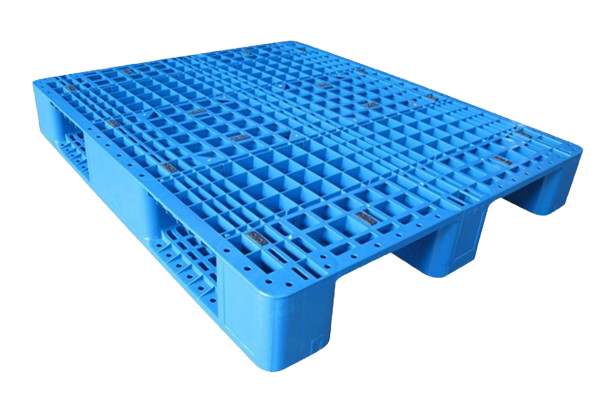
Using the wrong grade not only affects product quality - in many cases injection molding machines cannot process the material or produce defective products, wasting the entire batch of raw material. For plastic pallets specifically, ICD Vietnam uses HDPE injection molding grade with MFI of 0.7-1.2 g/10 min to achieve the optimal balance between mechanical strength and mold-filling capability.
Virgin HDPE vs. Recycled HDPE: Up to 60% Price Difference
The price difference between virgin HDPE and recycled HDPE - from 17,000 VND/kg up to 34,000 VND/kg - is the source of much confusion when purchasing plastic raw materials. Some dishonest suppliers may blend or sell recycled HDPE at virgin prices, causing significant losses for buyers.
Virgin HDPE has long and uniform polymer chains that have not been broken or contaminated with impurities - this is why it has superior tensile strength, impact resistance, and service life. Products made from virgin HDPE meet food-contact standards (food-grade), approved by the FDA and QCVN 12-1:2011/BYT. Recycled HDPE is recovered from used plastic products - bottles, old plastic pipes, waste packaging - through grinding, washing, and re-pelletizing. Quality varies significantly depending on the source of waste material and the processing method of each recycling facility.
The simplest way to identify: virgin HDPE typically has a milky white or slightly translucent color, uniform and consistent pellets, and may include a Certificate of Origin and datasheet from the original manufacturer. Recycled HDPE often has a grey or uneven color, pellets may contain contaminants, and there is no official manufacturer datasheet.
How to Buy HDPE Pellets at the Right Price and Avoid Low-Quality Material
I once encountered a case where a plastic can manufacturer in Hung Yen purchased a batch of HDPE blow molding grade blended with 20% recycled material. The finished products had air voids, the defect rate increased from 2% to 15%, and it took 3 weeks to identify the cause. The losses in raw materials and production time far exceeded the initial savings from buying at a lower price.
To avoid similar risks, there are 4 things to do when ordering HDPE in bulk:
- Request a Certificate of Analysis (COA) for each batch. The COA is a quality analysis certificate issued by the original manufacturer or an independent testing laboratory, clearly stating MFI, density, tensile strength, and other key indices. Reputable suppliers always have COAs ready to provide upon request.
- Check packaging and batch codes. Virgin HDPE from major manufacturers is packed in 25 kg bags or 500-1,000 kg big bags clearly printed with the manufacturer’s name, grade, production batch code, and production date. Goods of unclear origin are often packed in plain white bags with no label or re-printed labels.
- Run a small trial before buying a large batch. Order 50-100 kg for a trial run on your injection molding or blow molding machine - check processing temperature, injection pressure, defect rate, and surface quality. The cost of this test is very small compared to the risk of a multi-tonne batch that fails quality requirements.
- Choose a supplier with a contractual commitment. The contract should clearly state the grade, MFI, density, country of origin, and terms for handling non-conforming goods. This is the legal basis protecting you in case of quality disputes.
Frequently Asked Questions About HDPE Plastic Pellet Prices
What is the current HDPE plastic pellet price?
Virgin HDPE plastic pellet prices in Vietnam in early 2026 range from 28,800 to 36,000 VND/kg depending on grade and origin. HDPE injection molding grade (used for pallets and plastic crates) is typically 29,500 - 34,500 VND/kg. Prices fluctuate weekly due to dependence on crude oil prices and the USD/VND exchange rate. For the most up-to-date pricing, contact ICD Vietnam directly or monitor the market at thitruonghatnhua.com.
Which HDPE grade is suitable for manufacturing plastic pallets?
Plastic pallets are typically produced using HDPE injection molding grade with MFI of 0.5 to 2.0 g/10 min (measured at 190°C, 2.16 kg load). This grade has the appropriate viscosity to fill large pallet molds while ensuring mechanical strength after processing. Some premium pallet manufacturers use bimodal HDPE (bimodal molecular weight distribution) to achieve higher load capacity, but raw material costs are approximately 10-15% higher.
Where can I buy HDPE plastic pellets reliably in Vietnam?
There are 3 main channels for buying HDPE plastic pellets in Vietnam: official agents of major manufacturers (SABIC, LG Chem, Sinopec), direct importers with physical warehouses, and secondary distributors. The first channel offers the best quality assurance but typically requires large minimum orders (5-10 tonnes/order). The direct import channel is suitable for orders of 1-5 tonnes. Secondary distributors are more flexible on minimum quantities but require careful verification of origin documentation.
How much cheaper is recycled HDPE compared to virgin HDPE?
Recycled HDPE typically costs 17,000 to 22,000 VND/kg, which is 35-45% lower than virgin HDPE of the same type. This price difference may be attractive in terms of raw material cost, but you also need to factor in: higher defect rates during processing, inconsistent product quality due to variable recycled material sources, and application limitations (cannot be used for food-contact products, pharmaceuticals, or exports to markets with strict requirements).
Conclusion
HDPE plastic pellet prices in 2026 range from 28,800 - 36,000 VND/kg for virgin and 17,000 - 22,000 VND/kg for recycled. However, the more important figure than price per kg is the raw material cost per conforming product - a cheap batch of HDPE with a high defect rate can end up more expensive than good-quality virgin HDPE. Buy the right grade, request complete documentation, and run a small trial before committing to large quantities.
ICD Vietnam is a plastics industry specialist (we do not sell plastic pellets). For consultation on HDPE plastic pellets, please contact:
- North Vietnam: 0983 797 186 / 090 345 9186 / 090 5859 186
- South Vietnam: 098 6784 186
- Email: sales@icdvietnam.com.vn