
Table of Contents
- Construction: why a hollow sheet is still stiff
- Weight by thickness: read the figure together with the tolerance
- Water, chemical and heat resistance: remember the limits
- Sheet grades by additive and color
- What Danpla is used for
- Fabrication and notes on printing and bonding
- When Danpla is not suitable
- Frequently asked questions
- Contact
- References
Reviewed and updated by ICD - Week 43/2026
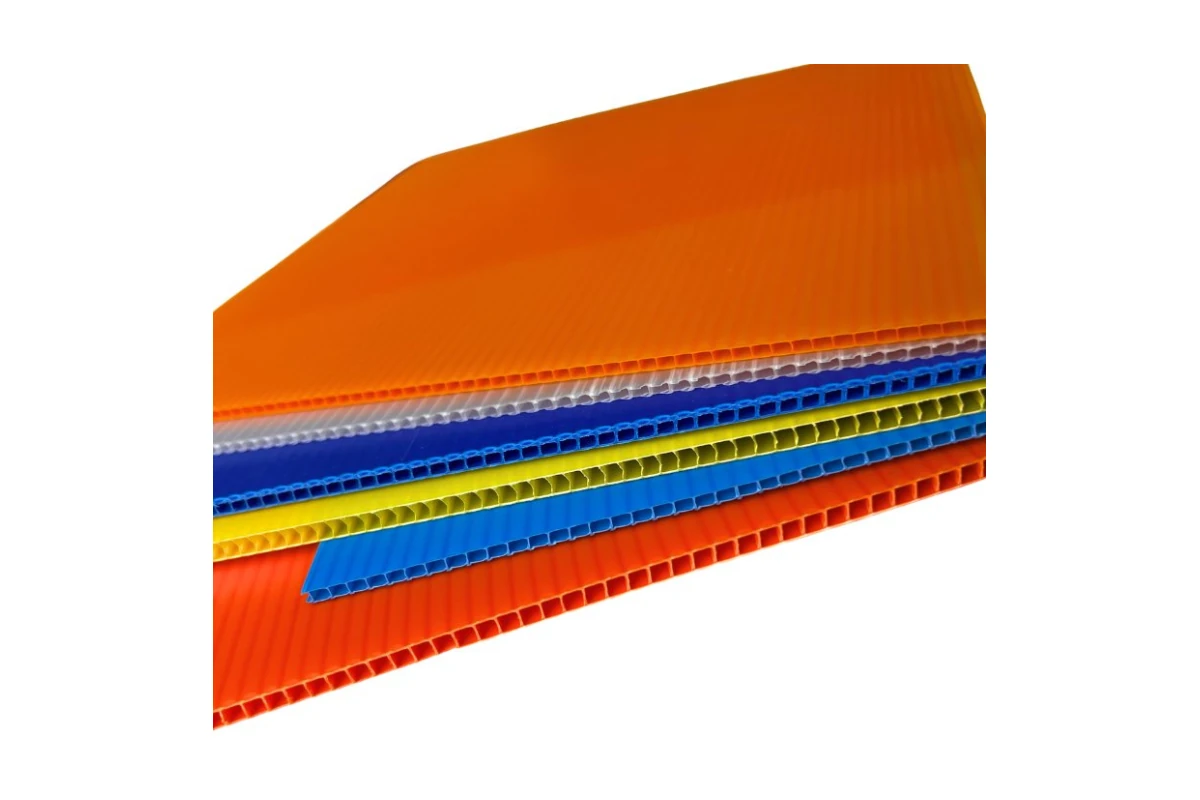
Danpla plastic sheet is polypropylene (PP) sheet extruded as one piece, made of two flat skins joined by vertical ribs that form rows of parallel hollow channels. The hollow structure makes the sheet far stiffer than the amount of plastic used would suggest, waterproof and reusable; under other names, the material is hollow PP sheet, fluted PP sheet, or corrugated plastic, Coroplast, Correx and Corflute on the international market.
This guide answers the questions buyers ask first: how it is built, how much it weighs at each thickness, how much heat and chemical exposure it can take, which type is used for electronics, and when Danpla is not suitable. The figures come from the datasheets of hollow PP sheet manufacturers and Coroplast technical bulletins, listed at the end.
Construction: why a hollow sheet is still stiff
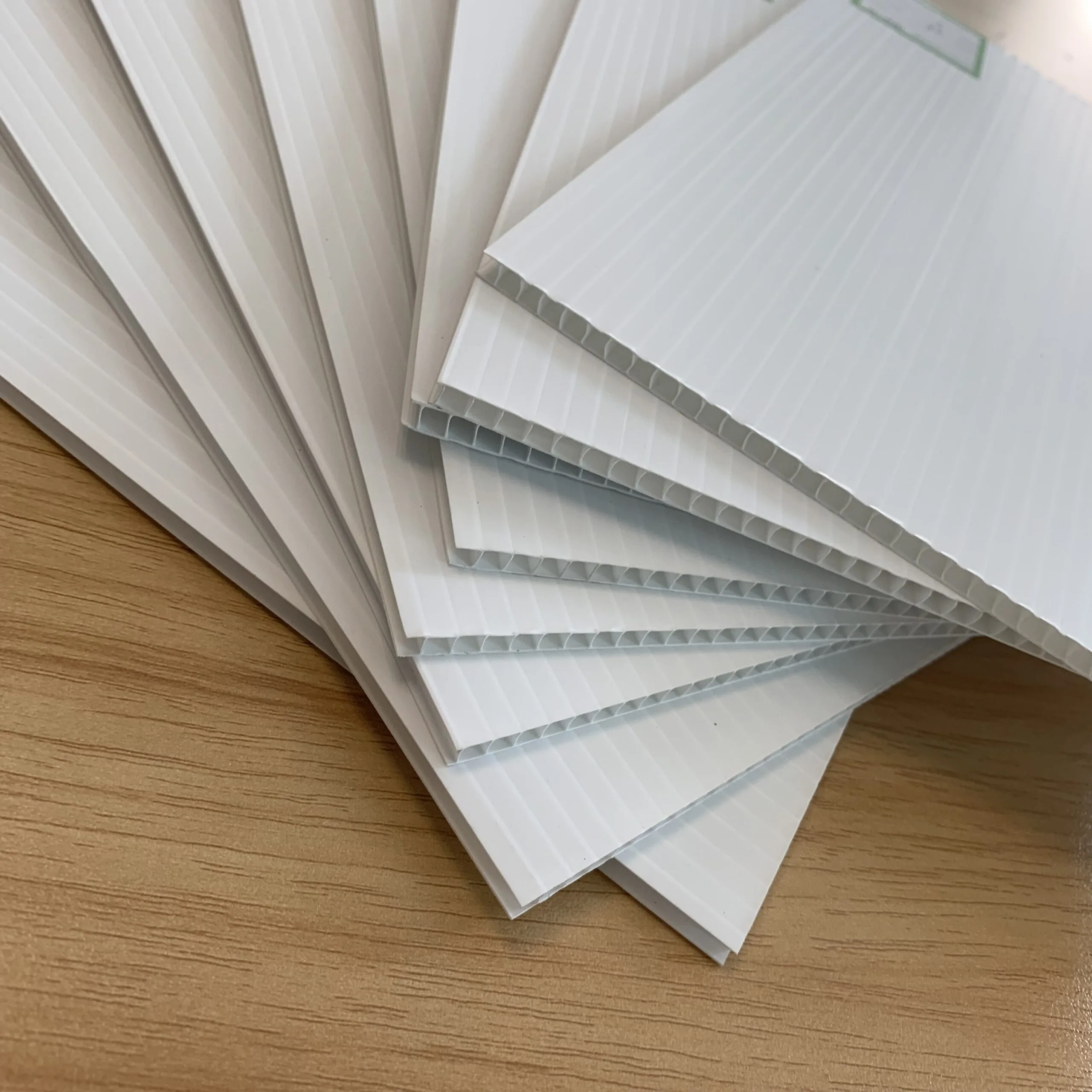
The cross-section of the sheet has three parts: the top skin, a row of vertical ribs (called flutes) and the bottom skin. All three are extruded through a single die, then cooled and shaped, so there is no glue layer in between. The ribs run along one direction of the sheet. That is why the sheet folds easily across the flutes but is stiffer along them; when specifying sheet sizes, the general convention is to give the dimension across the flutes first and the dimension along them second (Coroplast fabrication guide).
The resin is PP copolymer. Manufacturers choose copolymer over homopolymer for better impact resistance at low temperature and to allow folding again and again without breaking, a property called a “living hinge”. The Coroplast technical bulletin gives a resin density of 0.9 g/cm³, water absorption of 0.02% after 24 hours and a melting point of 162 °C; another datasheet (Amari) gives a heat deflection temperature HDT of 100 °C at 0.46 MPa. Those are properties of the base resin, while the finished sheet is used in practice within -20 to +70 °C per the Corplast specification, and Coroplast gives a normal range of -27 to +71 °C.
Weight by thickness: read the figure together with the tolerance
Two sheets of the same thickness can still weigh differently, because the manufacturer chooses the rib thickness and the flute density. Thicker ribs make the sheet heavier, stiffer and more expensive. The table below combines the g/m² ranges from three foreign datasheets; when ordering, state both the thickness and the g/m² you want (for example 4 mm / 700 g/m²), because weight tolerance is around 2 to 5%.
| Thickness | Common g/m² range | Notes |
|---|---|---|
| 2 mm | 300 to 500 | Liners, light cover sheets, printed signs |
| 3 mm | 400 to 600 | Small dividers, light boxes |
| 4 mm | 600 to 900 | Most common for crates, dividers and layer pads |
| 5 mm | 800 to 1,200 | Higher-load crates, support sheets |
| 6 mm | 900 to 1,600 | Heavy layer pads, large crates |
| 8 mm | 1,400 to 2,000 | Rigid structures |
| 10 mm | 1,600 to 2,200 | Support and load-bearing pads |
Sources of the ranges: Corplast, Americover and one Cloroplast datasheet; see the References. For example, Americover gives 2 mm as 490 g/m², 3 mm as 600, 4 mm as 750 and 5 mm as 1,000, while Corplast gives 4 mm as 650 to 750. We do not quote a weight per sheet because it depends on size and production lot; for the exact figure for an order, ask the supplier and quote g/m². For choosing the sheet size, see the Danpla sheet size guide.
Water, chemical and heat resistance: remember the limits
PP does not absorb water, so the sheet does not soften or rot when damp, unlike corrugated board. The Coroplast bulletin tested 90 days at 20 °C: 10% acetic acid, acetone, 96% ethanol, isopropyl alcohol, hydrochloric acid, 50% sodium hydroxide and water all gave a “nil” result, meaning negligible effect. In the other direction, benzene and xylene have a slight to moderate effect at 20 °C and a stronger one at 60 °C, and carbon tetrachloride gives a moderate to severe result. So PP sheet suits many cleaning agents, alcohols and dilute acids, but not aromatic or chlorinated solvent environments.
On heat: the sheet starts to soften well before its melting point, so for goods that must be stacked at high temperature (container trucks in the sun, hot warehouses), use a thicker sheet and test first. At low temperature, PP copolymer keeps better impact strength than homopolymer; Coroplast gives a free-fall impact strength of the base resin at -29 °F (about -34 °C) of 23 ft-lbs. As for UV: ordinary sheet outdoors will age, turn brittle and fade, so long-term outdoor use needs a grade with a UV stabilizer; we found no standard number of months for every type of sheet, so we do not state one.
Sheet grades by additive and color
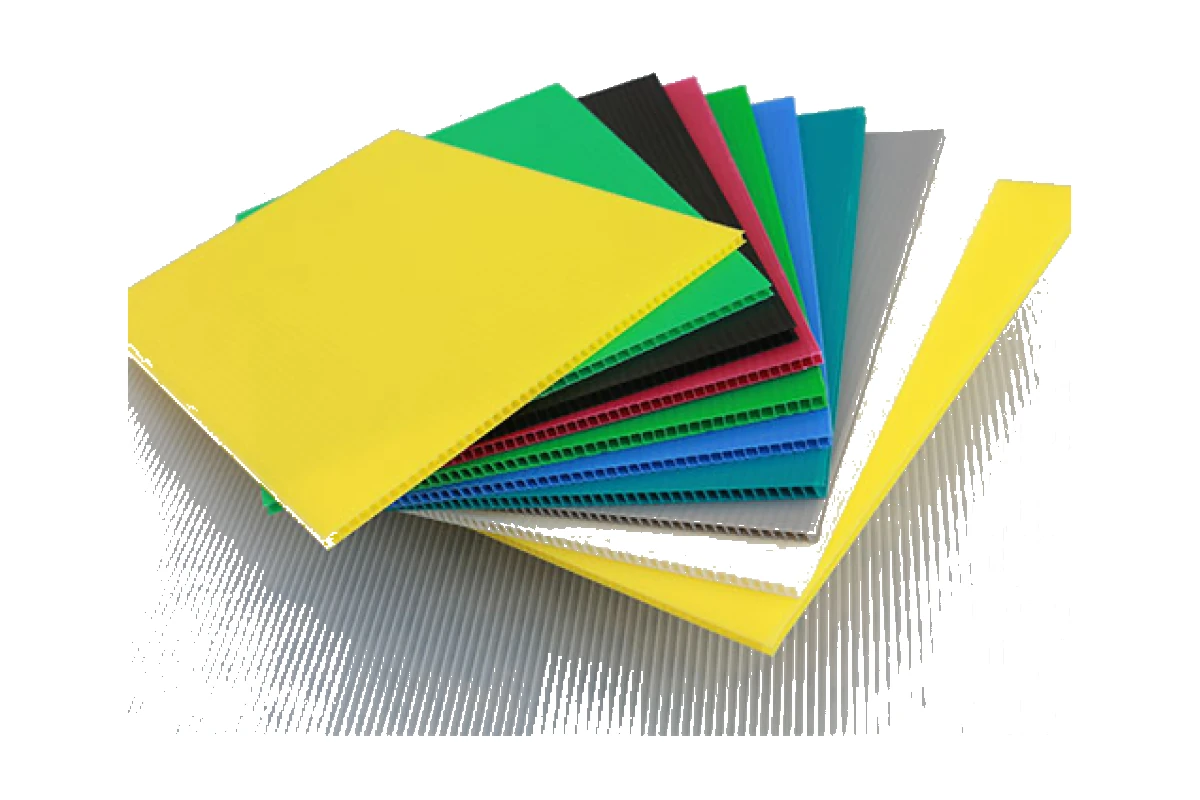
Wikipedia and Coroplast documents both state that additives are mixed into the molten plastic before extrusion to make UV-resistant, anti-static, flame-retardant, custom-color, corrosion-inhibiting or static-dissipative grades. The ICD catalog includes white sheet, clear sheet, anti-static sheet and 3, 4 and 5 mm thick sheets; see Danpla plastic.
| Grade | Difference | Use when |
|---|---|---|
| Standard sheet (white, blue, black, multicolor) | PP copolymer, corona-treated surface for printing | Liners, dividers, signs, packing boxes |
| Anti-static sheet (ESD) | Has conductive or dissipative additive; checked by surface resistance | Holding components and circuit boards in an EPA zone |
| UV-resistant sheet | UV absorbing or stabilizing additive | Outdoors, canopies, signage |
| Clear sheet | Uncolored PP, goods visible inside | Covers and packaging where you need to see the goods |
Surface resistance is not “the lower the better” but must fall in the right class. According to the ESD Association (ANSI/ESD S541, tested to STM11.11), the shielding class has a surface resistance of no more than 10³ Ω, and the dissipative class is above 10⁴ Ω and below 10¹¹ Ω; packaging inside an EPA zone must be low-charging and in the conductive or dissipative class. When buying, ask the supplier for STM11.11 test results, not just the words “anti-static”.
What Danpla is used for
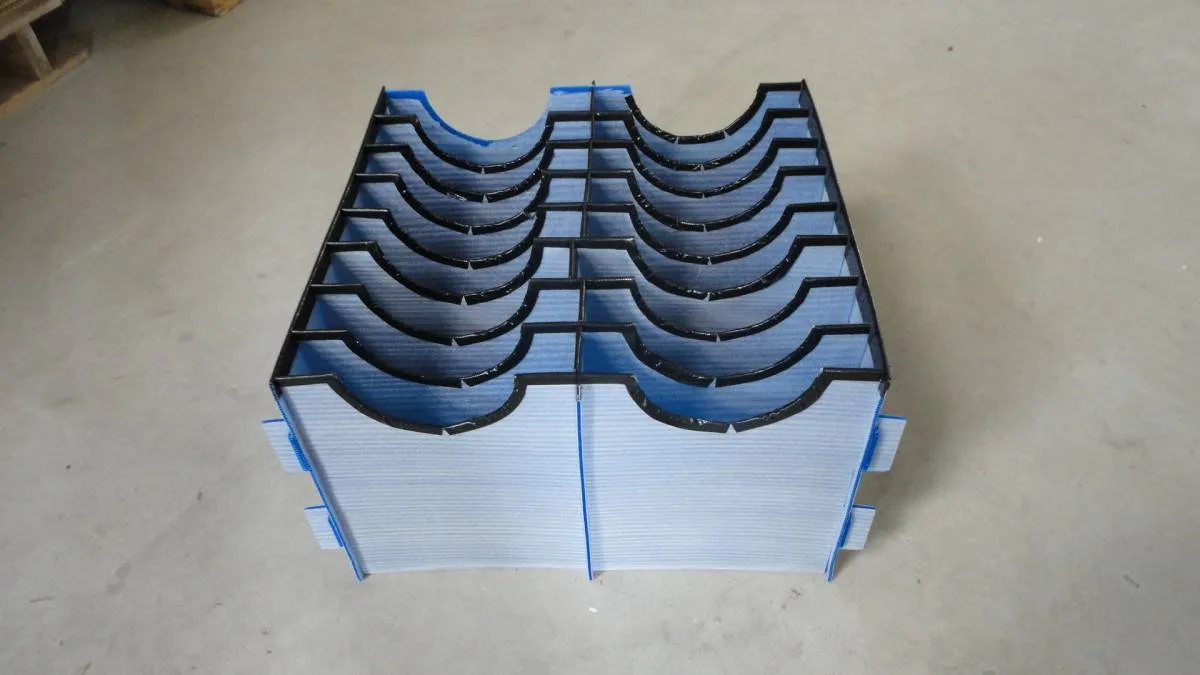
The uses come from three properties: light, waterproof and easy to fabricate. In packaging, the sheet is die-cut and folded into boxes, trays and component dividers; ICD offers Danpla plastic boxes that are foldable, lidded or divided. In warehouses, the sheet serves as layer pads between tiers of goods on a pallet and as a temporary floor cover. In advertising, the corona-treated surface takes UV ink, so it is used for signs and standees. In construction, the sheet protects floors, walls and glass during works.
On cost compared with cardboard: a Danpla sheet costs more than a one-time carton, so the advantage only appears when the sheet is reused. The real number of reuses depends on handling, the chemicals it meets and the return process. We have no sourced general figure for “how many reuses”, so this guide does not state one; for each line, the most reliable way is to test one batch and count the cycles until the fold corners fail.
Fabrication and notes on printing and bonding
Sheet is cut with a knife or die-cut; unlike carton, the blade must cut through both skins. Fold lines are made by scoring, and Coroplast advises a wider scoring blade than usual when folding across the flutes. Joining is by ultrasonic welding or hot air welding, or with staples, rivets and glue made for PP. For printing or labeling, the surface needs corona treatment; many datasheets give a minimum of 46 dyne/cm, and the Coroplast bulletin warns against touching with bare hands and against dust, which reduce adhesion. PP is a polyolefin that does not absorb ink, so it needs ink made for polyolefins or UV ink. Sterilizing with alcohol and ethylene oxide gas does not harm the sheet; gamma radiation repeated 4 to 5 times at standard dose makes the polymer brittle.
When Danpla is not suitable
Do not use it as a structure carrying a large load concentrated at one point, since the hollow ribs crush easily; do not leave it in constant sun without a UV stabilizer; do not expose it to aromatic or chlorinated solvents; do not hold hot goods beyond the temperature range above. If goods are heavy or stacked high, you need plastic pallets or solid plastic crates, and Danpla is usually used for layer pads and dividers.
Frequently asked questions
Is Danpla plastic sheet different from hollow PP sheet?
No. Danpla is a common trade name in Vietnam, while hollow PP sheet and fluted PP sheet are the technical names. Worldwide the same material is called corrugated plastic, Coroplast, Correx or Corflute.
How much does 4 mm Danpla weigh per square meter?
Datasheets give about 600 to 900 g/m², for example Americover lists 750 g/m² and Corplast lists 650 to 750 g/m². Order with both thickness and g/m² because tolerance is around 2 to 5%.
Can Danpla be printed on?
Yes, after the surface is corona-treated; many datasheets give a minimum of 46 dyne/cm. PP does not absorb ordinary ink, so use UV ink or ink made for polyolefins.
What measure is used for anti-static Danpla?
Surface resistance per ANSI/ESD STM11.11: the dissipative class is above 10⁴ Ω and below 10¹¹ Ω, and the shielding class is no more than 10³ Ω. Ask for the measurement, and do not rely on black color alone.
What temperature can Danpla take?
The normal service range is about -20 to +70 °C per the Corplast specification; the base PP resin melts at around 162 to 168 °C. Do not use it close to the limit under load.
Contact
ICD Vietnam Industrial Production Co., Ltd.
Northern Vietnam: 3rd Floor, Thang Long A1 Building, Bau Hamlet, Thien Loc Commune, Hanoi - 0983 797 186 / 090 345 9186 / 090 5859 186
Southern Vietnam: 551/212 Le Van Khuong Street, Tan Thoi Hiep Ward, District 12, Ho Chi Minh City - 098 6784 186
Email: sales@icdvietnam.com.vn
Zalo: Chat on Zalo now
References
- Corplast (Malaysia), General Specifications for twinwall hollow profile sheets (g/m² range by thickness, -20 to +70 °C) - corplast.com
- Americover, Corrugated Plastic Boards Standard Products and Tolerance (g/m² by thickness, corona treatment above 46 dyne/cm) - americover.com
- Technical Data Sheet, Cloroplast (g/m² range 2-12 mm, rib thickness) - polycenter.cr
- Coroplast, Overview & Product Details, Technical Bulletins CSS-001/002/005 (copolymer, properties, chemical resistance, fabrication, sterilization) - professionalplastics.com
- Amari Plastics, Corrugated Polypropylene datasheet (density 0.9 g/cm³, HDT, impact strength) - amariplastics.com
- Wikipedia, Corrugated plastic (trade names, additives, recycling code 5) - wikipedia.org
- ESD Association, Fundamentals of ESD Part 3 (resistance classes under ANSI/ESD S541 and STM11.11) - esda.org