
Table of Contents
Reviewed and updated by ICD - Week 43/2026
HDPE can be used continuously up to roughly 65 to 80 °C and tolerates short exposure up to about 90 °C, while on the cold side it stays tough below -75 °C. The “withstands 120 °C” figure often seen online is not a service temperature for HDPE: it is a threshold quoted for very brief contact, and the melting point is far higher (129 to 135 °C) but by then the plastic has long lost its stiffness.
This guide focuses on the real service temperature limits of HDPE and how to read them for pallets, containers and pipes. The crystalline melting point is analyzed separately in the HDPE melting point guide, and melt flow index is covered in the HDPE melt flow index guide. For an overview of the material, see what HDPE plastic is.
The temperature thresholds of HDPE
Each thermal property describes a different phenomenon, so they cannot be used interchangeably. The table below collects the thresholds and their sources, to be used together with the other articles in the HDPE group.
| Property | Value | Meaning for material selection | Source |
|---|---|---|---|
| Brittleness temperature | below -75 °C | Only below this level does the plastic start to shatter on impact; good for cold storage | CPChem, ASTM D746 |
| Heat deflection temperature (HDT) at 0.45 MPa | 62 to 80 °C | Temperature at which a lightly loaded sheet begins to sag | ExxonMobil; sheet datasheet |
| HDT 1.8 MPa | about 46 °C | Under a heavier load the sag point is much lower | CPChem Marlex 9010 |
| Vicat softening point | 118 to 127 °C | Temperature at which a needle penetrates the sample; not a service temperature | PTT, CPChem, IRPC, ExxonMobil |
| Continuous use | 65 to 80 °C | Conservative design limit per BPF and datasheets | BPF; GEP |
| Short-term tolerance | about 90 °C | Temporary heat contact, without large loads | GEP |
| Melting point | 129 to 135 °C | The crystalline region melts; beyond the usable range | ExxonMobil, ASTM D3418 |
The practical consequence is that the design limit of a load-bearing product sits near the HDT, not near the melting point. A heavily loaded pallet at 60 to 70 °C already risks long-term sagging even though it is more than 60 °C below the melting point. For the same reason, load ratings in catalogues are usually stated for room temperature and must be reduced in hot environments.
HDPE at high temperature: what to avoid
At high temperature HDPE gradually softens, loses stiffness and deforms easily under load; near the melting range it flows like a liquid and is no longer a structural material. Heat combined with UV or oxygen ages the material faster, which is why outdoor grades contain UV stabilizers and antioxidants.
HDPE is not suitable for medical equipment that needs steam sterilization: it cannot be autoclaved at 121 °C the way PP can, and Wikipedia lists a maximum short-term temperature of about 120 °C only as a reference, not as a capability for regular use. For equipment that must be autoclaved, PP is chosen rather than HDPE (PP melts at about 160 °C).
HDPE at low temperature
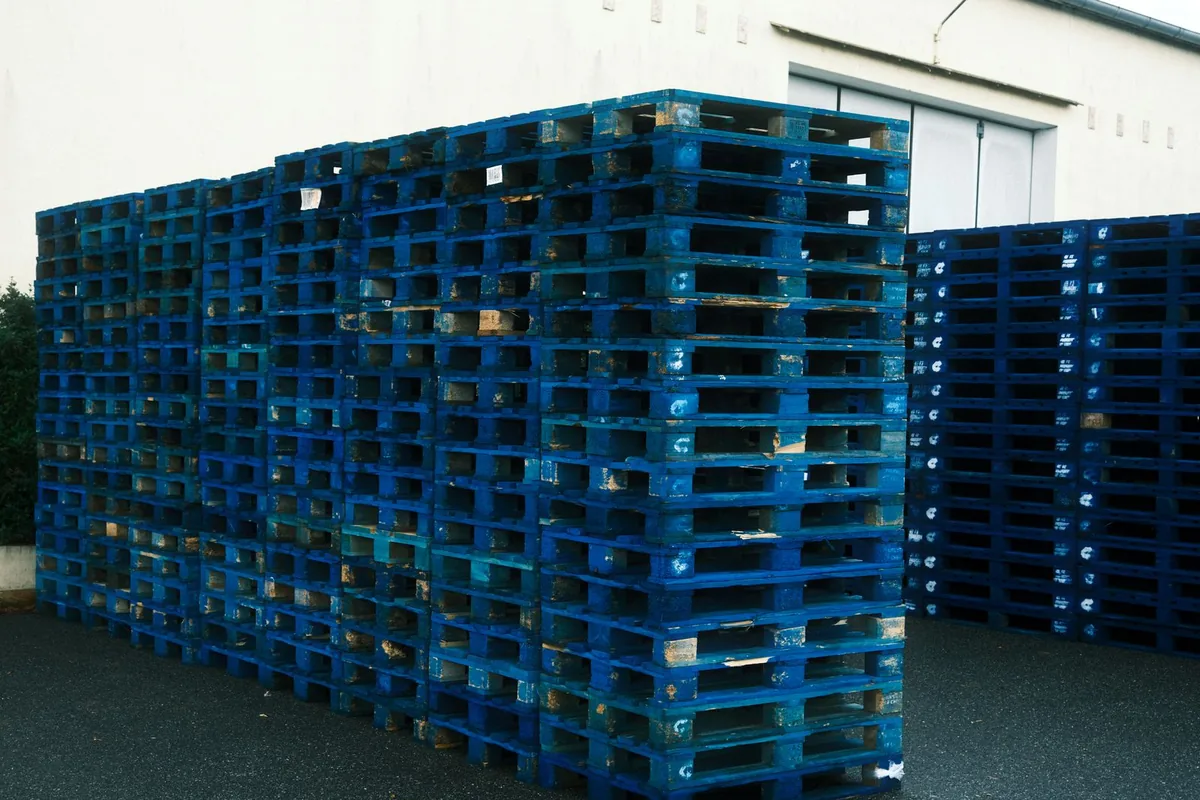
On the cold side HDPE holds up well beyond -40 °C: the brittleness temperature of the Marlex 9010 grade is below -75 °C and the glass transition temperature is about -95 to -110 °C. That is why HDPE is a familiar choice for plastic pallets in cold storage and for containers of frozen goods. What needs checking is the specific grade and wall thickness, because impact loads at extremely low temperature can still crack a thinly designed product.

What changes the real thermal limit
Beyond the nature of the material, three factors shift the real limit: the grade (virgin or recycled), the load and the time. Recycled grades vary in properties from batch to batch, so test data for that batch is needed; details are in the article on whether HDPE plastic is safe. Load sharply lowers the HDT (from 62 to 80 °C at 0.45 MPa down to about 46 °C at 1.8 MPa), and the longer the exposure to heat, the more pronounced ageing and long-term sag become. Contact with chemicals also reduces heat resistance, especially aromatic hydrocarbons and strongly oxidizing acids.
Conclusion: design HDPE products with a continuous temperature of 65 to 80 °C as the upper limit (depending on load), treat 90 °C as a temporary-contact threshold, and ask the manufacturer when the environment is hotter. Do not use the melting point or the 120 °C figure as a design basis.
Frequently asked questions
What temperature can HDPE plastic withstand?
About 65 to 80 °C for continuous use and about 90 °C for short exposure per sheet datasheets; the heat deflection temperature is only 62 to 80 °C (0.45 MPa).
How cold can HDPE plastic go?
The brittleness temperature is below -75 °C (ASTM D746, Marlex 9010 grade), so it works well in cold storage; also check wall thickness and impact load.
Can HDPE be autoclaved?
No. HDPE cannot withstand steam at 121 °C the way PP can, so equipment that needs autoclaving usually uses PP.
Can HDPE pipe carry hot water?
It is not suitable for domestic hot water: pressure PE pipe is used up to 60 °C (PPI), and at 80 °C the minimum life drops to about 1 year (PIPA, PE100).
Is the melting point of HDPE a usable temperature?
No. The melting point is 129 to 135 °C, but the plastic is already soft and deforms under load from about 62 to 80 °C, so the design limit is much lower.
Contact ICD Vietnam for plastic pallet advice
ICD Vietnam Industrial Manufacturing Co., Ltd.
North: 3rd Floor, Thang Long A1 Building, Bau Hamlet, Thien Loc Commune, Hanoi, 0983 797 186 / 090 345 9186 / 090 5859 186
South: 551/212 Le Van Khuong Street, Tan Thoi Hiep Ward, District 12, Ho Chi Minh City, 098 6784 186
Email: sales@icdvietnam.com.vn
Zalo: Chat on Zalo now
References
- Wikipedia, High-density polyethylene (density 0.93-0.97 g/cm3, applications, recycling code 2) - en.wikipedia.org
- ExxonMobil Chemical, HDPE product guide (melting range 129-135 °C per ASTM D3418, HDT, processing temperature, MI by application group) - exxonmobilchemical.com
- GEP Plastics, HDPE sheet data sheet (long-term service temperature 80 °C, short-term 90 °C) - geplastics.co.za
- Chevron Phillips Chemical, Marlex 9010 technical data sheet (Vicat, HDT, brittleness temperature) - cpchem.com
- PTT Global Chemical, HD1600J technical data sheet (injection molding, MI 12 g/10 min, Vicat 118 °C) - productsandsolutions.pttgcgroup.com
- IRPC, HDPE V1160 technical data sheet (injection temperature 190-240 °C, Vicat 120-122 °C) - polimaxx.irpc.co.th
- BPF, Plastipedia: Polyethylene (High Density) HDPE - bpf.co.uk
- Plastics Pipe Institute, Handbook of PE Pipe, Chapters 6 and 8 (pressure PE pipe used from -40 °C to 60 °C; non-pressure up to 82 °C) - plasticpipe.org
- PIPA, POP013: Temperature rerating of PE pipes (pressure derating factors by temperature, PE100) - pipa.com.au