
Table of Contents
Reviewed and updated by ICD - Week 43/2026
The melt flow index (MFI) of HDPE is the mass of molten plastic that flows through a standard die in 10 minutes at 190 °C under a 2.16 kg load, measured in g/10 min; the lower the number, the higher the molecular weight and the more viscous the plastic. Commercial HDPE covers a very wide MFI range, from under 0.1 to over 30 g/10 min depending on the application, so there is no single “standard MFI” for HDPE.
For buyers of HDPE plastic, MFI is the first figure to read on the datasheet to know whether a grade is meant for blow moulding, injection moulding or film. This article explains how it is measured, how to read it by application using resin-maker data, and the misunderstandings that come up most often. The melting point of HDPE is covered in HDPE melting point, and the service temperature limits in HDPE heat resistance.
What is the melt flow index?
MFI (Melt Flow Index), also called MI or MFR, measures how readily molten plastic flows under standard conditions set by ISO 1133 or ASTM D1238. The pellets are heated in a barrel, a piston under a fixed load pushes the melt through a small die, and the operator weighs the plastic that comes out in 10 minutes (Wikipedia). For polyethylene the usual conditions are 190 °C and a 2.16 kg load. Note that 2.16 kg is the mass of the weight, so it is a load and not a pressure.
The relationship to remember: low MFI means a viscous melt, long polymer chains and a high molecular weight; high MFI means a more fluid melt and shorter chains. Long chains give better toughness and stress-crack resistance but are harder to process, while short chains process quickly but are more brittle. This is the core trade-off for anyone choosing a resin grade.
For very viscous HDPE, resin makers add the HLMI index, measured under a 21.6 kg load, because at 2.16 kg the flow is too small to measure well (many blow moulding grades list an MI below 0.10 and an HLMI of 5 to 11 g/10 min).
How it is measured, and the equipment
A melt flow tester has a heated barrel with precise temperature control, a piston carrying a weight, and a standard die at the bottom. The sample is loaded into the barrel and left to reach a stable temperature, the load is applied, and the extrudate is cut at regular intervals and weighed. Some instruments also report the volume flow rate (MVR) by tracking how far the piston travels.
Keep in mind that test conditions change with the type of plastic. Polypropylene is tested at 230 °C and 2.16 kg, so a PP melt flow figure cannot be compared directly with an HDPE figure measured at 190 °C. Plant laboratories check every batch of pellets by MFI to see whether the batch is consistent with the datasheet and whether it shows signs of contamination with another plastic. Another example of how materials differ is in whether PP can hold hot water.
HDPE MFI by application
Real ExxonMobil data show a much wider range than a simple low, medium and high split, and it varies by processing method, as in the table below.
| Application | MI (190 °C, 2.16 kg), g/10 min | Example ExxonMobil grade |
|---|---|---|
| Blow moulding of large containers, IBC | 0.2 to 0.7 | Paxon AA45-004 (0.35); AD60-007 (0.73) |
| Very high viscosity blow moulding, drums, pipe | below 0.10 (HLMI 1.7 to 11) | Paxon BA53-055, BA54-030 |
| Garbage carts, plastic pails | 4.5 to 19 | HD 6704.18 (4.5); HD 6719.17 (19) |
| Injection-moulded boxes, crates, pallets | 8.2 | HD 6908.19 (copolymer, high stiffness) |
| Lids, thin walls | 14 to 33 | HD 6714.17 (14); HD 6733.17 (33) |
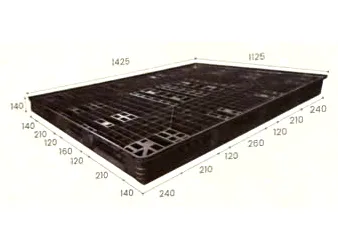
Two points follow from this. First, injection-moulded industrial products such as boxes, crates and pallets use a medium MI grade (about 8 in this example) so the melt can fill a large mould. Second, low MFI (below 1) is for blow moulding, pipe and drums, where maximum toughness and stress-crack resistance are needed. For load-bearing products such as plastic pallets, read the datasheet of the specific grade rather than relying on a generic group.
How does MFI affect processing and cost?
MFI directly affects melt temperature, injection pressure and cycle time. High-MFI pellets flow easily, which allows multi-cavity moulds, thin walls and short cycles, so they usually reduce processing time and cost; for example, an IRPC datasheet recommends injection moulding HDPE at 190 to 240 °C. In return the product tends to be less tough and less resistant to cracking, so quality control needs to be tighter. Low-MFI pellets, by contrast, need higher temperatures and pressures, or a suitable process such as blow moulding.
MFI says nothing about food safety: the grade needs its own declaration of conformity, see whether HDPE plastic is safe.
Frequently asked questions
What is the melt flow index of HDPE?
The mass of molten plastic that flows through a standard die in 10 minutes under fixed conditions (190 °C and 2.16 kg for polyethylene), measured in g/10 min.
What are the standard MFI test conditions for HDPE?
190 °C and a 2.16 kg load under ISO 1133 or ASTM D1238; for very viscous plastic, HLMI is added at 21.6 kg.
Is a high or low MFI better?
Neither is better in absolute terms. Low MFI (long chains) gives better toughness and crack resistance and is used for blow moulding and pipe; high MFI flows easily and is used for thin-wall injection moulding.
What is the MFI of HDPE for injection-moulded pallets?
ExxonMobil HD 6908.19, made for boxes, crates and pallets, has an MI of 8.2 g/10 min. For a specific grade, read the manufacturer’s datasheet.
Can the MFI of HDPE be compared with that of PP?
Not directly, because PP is tested at 230 °C while HDPE is tested at 190 °C.
Contact us for ICD Vietnam plastic pallets
ICD Vietnam Industrial Manufacturing Co., Ltd.
North: 3rd Floor, Thang Long A1 Building, Bau Hamlet, Thien Loc Commune, Hanoi, 0983 797 186 / 090 345 9186 / 090 5859 186
South: 551/212 Le Van Khuong Street, Tan Thoi Hiep Ward, District 12, Ho Chi Minh City, 098 6784 186
Email: sales@icdvietnam.com.vn
Zalo: Chat on Zalo now
References
- Wikipedia, Melt flow index (ISO 1133, ASTM D1238, PE test conditions 190 °C) - en.wikipedia.org
- ExxonMobil Chemical, HDPE product guide (Americas): MI table (190 °C, 2.16 kg) by application: blow moulding 0.2-0.7, pails 4.5-19, thin wall 33, boxes, crates, pallets 8.2 - exxonmobilchemical.com
- IRPC, HDPE V1160 technical data sheet (injection temperature 190-240 °C, Vicat 120-122 °C) - polimaxx.irpc.co.th