

Table of Contents
- Humidity targets and solutions by item
- Why an ordinary desiccant packet easily ruins items that need moderate humidity
- Cameras and lenses
- Electronics, circuit boards, laptops
- Wet phone: rice or a desiccant packet
- Gun safe, gun cabinet
- Guitars and wooden instruments
- Cigars: desiccant packet or humidity control packet
- Common mistakes
- Frequently asked questions
- What humidity is ideal for cameras?
- How do I use a desiccant packet for a camera?
- Which desiccant beads should I use for a camera?
- Can a desiccant packet be used for a wet phone?
- How much desiccant does a gun safe need?
- What humidity keeps guns and safes from rusting?
- Can a desiccant packet be used for a guitar?
- What is a cigar desiccant packet?
- Contact ICD Vietnam for advice on desiccant packets
- References
- Related articles
Reviewed and updated by ICD - Week 47/2026
Cameras and lenses should be kept at 40 to 50% relative humidity (Sony, Tamron) using a sealed box, a desiccant packet and a hygrometer. An ordinary desiccant packet only absorbs, so it does not suit guitars (45 to 55%) or cigars (65 to 72%): those need a two-way humidity control packet. For gun safes, the NRA itself advises avoiding passive desiccants.
This article sets the humidity target for each item side by side, then goes through each one: which packet to use, where to put it and how to estimate the dose. Where a calculation is my own estimate I say so on the spot, and where there is no reliable source I say so instead of giving a number.
Humidity targets and solutions by item
| Item | Reference humidity | Suitable solution | Note |
|---|---|---|---|
| Cameras, lenses | 40 to 50% RH (Sony, Tamron) | Sealed box with desiccant and hygrometer, or a dry cabinet | Over-drying degrades seals, lubricating grease and coatings (Tamron) |
| Electronics, laptops, circuit boards | No common level for all devices | Sealed bag or box with a desiccant packet for long storage | The biggest risk is condensation from temperature change, not steady humidity |
| Wet phone | Not applicable | Leave it somewhere dry and airy, wait as Apple instructs | Apple does not include rice or desiccant packets in its guidance |
| Gun safe, gun cabinet | 50 to 55% RH (NRA Museum) | Control the whole room, electric rod heater; limit passive silica | Below this the wooden stock cracks, above it the metal rusts |
| Guitar acoustic | 45 to 55% RH, 40 to 60% acceptable (Taylor) | Two-way control packet, hygrometer in the guitar case | In year-round humid regions Taylor says silica packets can be used |
| Cigars (humidor) | 65 to 72% RH (Boveda) | Two-way control packet, usually 69% | Do not mix several humidifying products in one box |
Why an ordinary desiccant packet easily ruins items that need moderate humidity
Dry silica gel beads pull the humidity in a box very low, while cameras, wooden instruments and cigars all need a level in the middle. The Canadian Conservation Institute (CCI) handles this by conditioning the beads to the target humidity before use: to let the beads equilibrate at 50% RH, they need to hold an extra 27.07% water on their dry weight. Beads conditioned this way no longer absorb strongly; they only buffer fluctuations around 50%.
So the capacity figure for silica (more than 27% of its weight at 50% RH per the Farnell datasheet) only says how much dry beads can absorb at most, not what level the beads will hold the box at. For items that must stay at 40 to 55%, there are two correct approaches: use conditioned beads or a two-way control packet (saturated salt in a vapor-permeable film that absorbs when humidity is high and releases when it is dry), with a hygrometer to check. One-way packets such as calcium chloride (AbsorGel) or clay suit shipping cartons and boxes, where the goal is to keep things dry, not to hold one exact humidity level.
Cameras and lenses
Lens fungus is a mix of dust and moisture that gets into the lens elements; per Sony it looks like a spider web, blurs images and is not easy to restore, so prevention matters more than cure. Sony sets the best humidity for storing a camera at about 40 to 50%, and Tamron also gives 40 to 50% and warns that keeping it too dry degrades lubricating grease, rubber and coatings. So the target is a band, not as dry as possible.
The cheapest approach, per Sony, is a simple dry box: an airtight plastic box with a desiccant inside, a hygrometer added if the box does not have one, the battery removed from the body, and the lens removed if there are body and rear caps. An electronic dry cabinet holds humidity steady on its own and suits people with many cameras, at the cost of electricity and money. A two-way packet holds a moderate level in a small box without over-drying, so it is the safest choice if you want to use a packet.
A rough estimate for a 20 liter box (0.02 m³). Saturated air at 20 °C holds 17.3 g of water per m³; if the air outside the box is 20% RH more humid than inside and the box exchanges air once a day (the level CCI uses as representative of a moderately sealed display case), 17.3 x 0.2 x 0.02 = 0.07 g of water gets in each day, about 2 g a month. With dry beads absorbing more than 27% of their weight, about 8 g of beads is enough for the moisture entering over 30 days, so the packets of a few grams to 20 g that are usually sold are more than enough. A plastic box with a rubber gasket exchanges air less than once a day, so the real figure is smaller.
Two more habits are worth keeping: let the camera adapt to the temperature before opening the box or bag when going from a cold place to a hot, humid one, because condensation from temperature change is the main cause of fungus per Tamron; and take the lens out every two to three months to turn the focus and zoom rings so the air inside is replaced.
Electronics, circuit boards, laptops
There is no common humidity level for all electronics that I could find a reliable source for, so this article gives no number. The mechanism is easier to verify: water vapor condensing when a device goes from a cold room to a hot, humid place is what does harm fast, and a desiccant packet cannot deal with water that has already formed droplets. So for long storage, wrap the device in a sealed bag or box with a desiccant packet, remove the battery from devices that have one, and let the device adapt to the temperature before unwrapping.
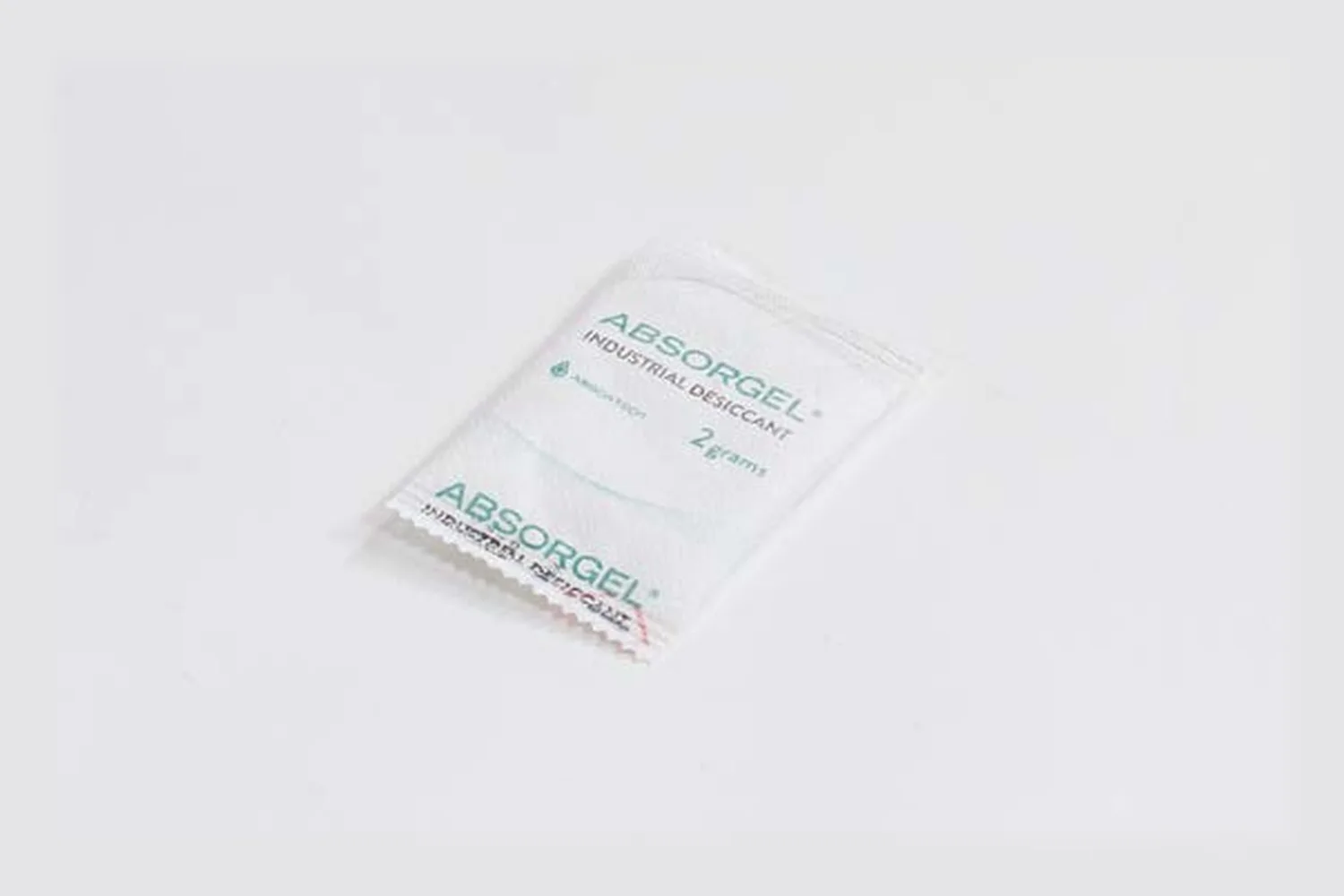
A desiccant packet also only lowers the humidity of the environment; it does not replace the protective coating on a circuit board (conformal coating) or special adhesive. For electronics cartons shipped by sea, the dose by carton volume is in how to use desiccant packets correctly. ICD has AbsorGel Pouch-D in 2 to 50 g sizes, made of calcium chloride mixed with starch, for small cartons and electronic components; this packet can cause serious eye irritation so keep it out of reach of children.
Wet phone: rice or a desiccant packet
Apple says plainly not to put an iPhone in a bag of rice, because small grains can get inside and damage the phone. Apple describes tapping the phone gently to let water drain from the charging port, leaving it somewhere dry with airflow, unplugging the cable and only trying to charge again after at least 30 minutes, with up to 24 hours possible for it to dry completely. Another Apple page on water resistance says to wait at least 5 hours before charging, so waiting longer is the safer choice, and do not use heat sources or compressed air to dry it.
Neither Apple page mentions desiccant packets. I could not find a test or guideline confirming that a desiccant works better than rice, so this article does not recommend one. If the phone is completely dead, or went into seawater or dirty water, the thing to do is still to take it to a repair shop.
| Apple source | What to do | Wait time before charging |
|---|---|---|
| Liquid-detection alert | Tap gently to drain water, leave somewhere dry and airy | At least 30 minutes, up to 24 hours |
| Water and dust resistance | Wipe with a soft lint-free cloth, let it dry | At least 5 hours |
| Both pages | Do not use rice, heat sources or compressed air | No mention of desiccant packets |
Gun safe, gun cabinet
The NRA National Firearms Museum keeps firearms at about 70 °F with 50 to 55% humidity, and the museum’s own material says 50% is the middle ground for both wood and metal: too humid and the metal rusts, too dry and the wooden stock cracks. More notable is that NRA Family holds that silica gel and other passive desiccants absorb moisture ineffectively and can cause extra problems, so they should be avoided; it uses electric rod heaters in the safe, places the safe against an interior wall and watches a hygrometer every day for the first year.
If you still want a desiccant packet for a small safe in a damp place, estimate by the moisture entering. A 0.2 m³ safe (same calculation: outside 20% RH more humid than inside, one air exchange per day) receives about 17.3 x 0.2 x 0.2 = 0.7 g of water a day, about 21 g after 30 days, equal to about 77 g of dry beads. A 200 g packet would fill up after about two and a half months by that calculation. A safe with a tight gasket lets in less in practice, but moisture from the items inside and from the liner adds to it.
| Space | Volume | Water entering after 30 days | Dry silica beads needed to absorb it |
|---|---|---|---|
| Camera box | 20 liters (0.02 m³) | about 2 g | about 8 g |
| Small safe | 0.2 m³ | about 21 g | about 77 g |
Both rows are the author’s estimates using the CCI calculation above, with outside 20% RH more humid than inside, one air exchange per day and dry beads absorbing 27% of their weight.
Guitars and wooden instruments
Taylor builds guitars in a 46% RH environment and advises keeping them within 45 to 55%, with 40 to 60% acceptable. Too dry and the strings sit close to the fretboard and buzz, fret ends stick out, the wood cracks, the top sinks and the bridge lifts; too humid for long (several weeks at 80 to 90%, or several months at 60 to 70%) and the guitar becomes over-humidified. Because the target is a narrow band, Taylor recommends the D’Addario two-way packet holding 45 to 50%, usable for two to six months, with an electronic hygrometer in the guitar case (needle types drift easily).
One detail often overlooked: Taylor advises avoiding a soundhole cover that seals the hole unless there is also a packet at the headstock, because the neck needs moisture too. In places with high humidity all year, Taylor itself advises placing a few silica gel or bamboo charcoal packets in the case and replacing them every few months, along with a room dehumidifier. So silica packets are not forbidden for guitars; they suit long humid spells, while in a moderate climate a two-way packet is safer.
| Guitar humidity levels | Meaning per Taylor |
|---|---|
| 45 to 55% RH | Ideal band |
| 40 to 60% RH | Acceptable |
| About 46% RH | Environment where Taylor builds guitars |
| 60 to 70% for several months, or 80 to 90% for several weeks | Guitar can become over-humidified |
Cigars: desiccant packet or humidity control packet
Boveda defines the ideal range for cigars as 65 to 72% RH and advises a 69% packet for most boxes, 65% for drier cigars or long aging, and 72% for open boxes or dry environments. The company’s packets are a two-way system, so it says not to mix several RH levels in one box and not to use them alongside other humidifying products because they cancel each other out.
For cigars, an industrial desiccant packet is not something to buy: they only absorb and will dry the cigars out. The search phrase “cigar desiccant packet” almost always means this two-way control packet. On propylene glycol-treated beads the sources contradict each other: Boveda puts beads and gel in the one-way group, which makes humidity fluctuate, while Smoke Rings University describes silica beads for cigars as a two-way system but one that must be refilled with water every two to four weeks and only suits small boxes.
| Boveda packets | RH level | When to use (per Boveda) |
|---|---|---|
| B65 | 65% | Drier cigars, easier to burn, long aging |
| B69 | 69% | Default level for wooden boxes, acrylic, bag-and-box |
| B72 | 72% | Open-air boxes, dry environments |
| B75 | 75% | Very dry; not for use in an airtight box |
Common mistakes
The worst mistake is having no hygrometer: then nobody knows whether the box is too dry or still humid. The second is using an absorb-only packet for a guitar or cigars, or putting too many dry silica packets in a camera box, so humidity falls below the level needed. A box that is not sealed also fills the packet quickly, because it has to absorb the room air as well.
- Put a hygrometer in the box and read it after a few hours.
- Choose a one-way or two-way packet according to the humidity the item needs.
- Write the date the packet was placed and check periodically, replacing it when it is full or hard.
For humidity thresholds for goods see safe humidity for storing goods and for how to measure see how to measure humidity. For choosing bead types see types of desiccant, for indicator beads see color-changing desiccant beads. For export electronics cartons, see ICD desiccant packets.
Frequently asked questions
What humidity is ideal for cameras?
Sony and Tamron both give about 40 to 50% RH. Tamron warns that keeping it too dry degrades lubricating grease, rubber and coatings.
How do I use a desiccant packet for a camera?
Put the camera in a sealed plastic box with a desiccant and a hygrometer, with the battery removed from the body. Watch the hygrometer and do not let humidity fall below 40%.
Which desiccant beads should I use for a camera?
Silica gel with a color-change indicator shows when it needs drying; to hold 40 to 50% you need conditioned beads or a two-way packet, because dry beads pull humidity too low.
Can a desiccant packet be used for a wet phone?
Apple does not include desiccant packets in its guidance and says not to put the phone in rice. Apple describes leaving it somewhere dry and airy and waiting at least 30 minutes (up to 24 hours) before charging; another Apple page says to wait at least 5 hours.
How much desiccant does a gun safe need?
There is no reliable standard dose. My estimate for a 0.2 m³ safe is about 77 g of dry beads for the moisture entering over 30 days, but NRA Family advises avoiding passive desiccants and holding the safe at 50 to 55% with electric rod heaters.
What humidity keeps guns and safes from rusting?
The NRA museum keeps 50 to 55% RH. Above this the metal rusts, below it the wooden stock cracks.
Can a desiccant packet be used for a guitar?
An absorb-only packet easily dries the guitar out. Taylor advises a two-way packet holding 45 to 50% and a hygrometer in the case; in regions humid all year, it uses silica or bamboo charcoal packets and replaces them every few months.
What is a cigar desiccant packet?
It is a two-way control packet that holds a fixed RH level, usually 69%, within the 65 to 72% range Boveda recommends for cigars; it is not an industrial desiccant packet.
Contact ICD Vietnam for advice on desiccant packets
ICD Vietnam Industrial Manufacturing Co., Ltd.
Northern Vietnam: 3rd Floor, Thang Long A1 Building, Thon Bau, Thien Loc Commune, Hanoi, 0983 797 186 / 090 345 9186 / 090 5859 186
Southern Vietnam: 551/212 Le Van Khuong Street, Tan Thoi Hiep Ward, District 12, Ho Chi Minh City, 098 6784 186
Email: sales@icdvietnam.com.vn
Zalo: Chat on Zalo now
References
- Sony USA, How should interchangeable lens cameras be stored? (40 to 50% humidity, dry box and desiccant) - sony.com
- Tamron, How to maintain and clean lenses for cameras (40 to 50%, using too much desiccant, condensation) - tamron.com
- Apple Support, If you see a liquid-detection alert on your iPhone (30 minutes, up to 24 hours, no rice); together with About splash, water, and dust resistance of iPhone 7 and later (wait at least 5 hours) - support.apple.com
- NRA National Firearms Museum, Caring for your Collectible Firearms (50% RH) - nramuseum.org
- NRA Family, Top 6 Expert Tips to Prevent Gun Rust (50 to 55% RH, avoid passive silica) - nrafamily.org
- Taylor Guitars, How to Use a Guitar Humidifier (45 to 55%, two-way packet, soundhole cover); together with Symptoms of a Wet Guitar - taylorguitars.com
- Boveda, What Boveda RH do I need for cigars? (65 to 72%, B69, do not mix products) - help.bovedainc.com
- Smoke Rings University, Cigar Humidification (one-way crystal gel, treated silica beads) - smokingpipes.com
- Canadian Conservation Institute, Technical Bulletin 33: Silica Gel, Passive Control of Relative Humidity (2018) - publications.gc.ca
- Non-Indicating Silica Gel datasheet (capacity by humidity, regeneration at 120-150 °C) - farnell.com