
Table of Contents
- Step 1: Choose the right packet for the purpose
- Step 2: Calculate the dose for your space
- Step 3: Place the packets correctly
- Step 4: When to replace or re-dry
- A few household tips
- Common mistakes
- Frequently asked questions
- How do you use desiccant packets correctly?
- How many grams of desiccant should I use in a wardrobe?
- Where is the best place to put a desiccant packet?
- How long does a desiccant packet last?
- How many desiccant bags does a 40ft container need?
- Can I calculate the desiccant dose myself?
- Does using a desiccant packet require an airtight enclosure?
- How do you use an anti-moisture packet?
- Contact ICD Vietnam for desiccant advice
- References
- Related articles
Reviewed and updated by ICD - Week 40/2026
Using desiccant packets correctly comes down to four things: choose the right type, calculate enough dose for the volume, place them in a reasonably enclosed space and replace them when they are full. The common reference rule for silica gel is a minimum of 1 g for every cubic foot (about 28 liters) of enclosed space, increased 1.5 to 2 times in regions above 65% RH and 2 to 3 times for moisture-sensitive items such as electronics (according to industry technical documents).
For container cargo, the manufacturer Absortech has a table of bag counts by voyage. This article collects the formulas and placement for every case, then points to the specific guide for each item.
Step 1: Choose the right packet for the purpose
There is no single type of packet that works for everything.
Clothes, shoes and handbags in a wardrobe use silica gel or clay; see desiccant packets for wardrobes, shoes and handbags. Cameras, lenses, electronics and instruments need indicator silica gel in an airtight box (desiccant packets for cameras, electronics and instruments), and sweets and dry food need a food-contact type (food-grade desiccant packets).
Car headlights and windshields have their own article at car dehumidifier bags for headlights and windshields. Cartons and sea containers use gel-form calcium chloride or clay, see ICD desiccants; transformers, air compressors and insulated glass use industrial beads as in industrial desiccants. The differences between bead types are in types of desiccant.
Step 2: Calculate the dose for your space
Quick formula for silica gel (home, shop)
Take the volume of the enclosed space (length x width x height) and convert it to cubic feet (1 cubic meter is about 35.3 cubic feet). The minimum dose is 1 g per cubic foot, then multiply by a factor for the conditions:
- Humid regions: multiply by 1.5 to 2
- Moisture-sensitive equipment: multiply by 2 to 3
| Space | Volume | Reference dose (silica gel) | Notes |
|---|---|---|---|
| Shoebox | about 0.5 cubic ft | 10 to 20 g | Tuck inside or place against the bottom |
| Bedroom wardrobe | 20 to 40 cubic ft (about 0.6 to 1.1 cubic m) | 100 to 200 g, split across 2 to 4 spots | Place at mid height, avoid the floor |
| Bathroom cabinet | 5 to 15 cubic ft | 100 to 200 g | Choose a high-humidity packet |
| Small safe | 5 to 15 cubic ft | about 200 g | Box of valuables, prefer an indicator packet |
| Standard safe | 15 to 30 cubic ft | about 500 g | |
| Large safe | 30 to 50 cubic ft | 800 g to 1 kg |
Formula by the grams of absorption needed (technical reference)
Industry documents give the formula: desiccant mass = volume x absorption capacity (by weight) x (starting humidity minus target humidity) divided by 100. For example, a 10-liter box that needs to go from 60% down to 20% RH, with a desiccant absorbing 10% of its weight, needs about 40 g.
The military standard MIL-D-3464E uses a desiccant “unit”: 1 unit absorbs 3 g of water vapor at 20% RH or 6 g at 40% RH (25 °C). Industry documents apply a minimum of about 1.2 units per cubic foot of air, equivalent to about 26 g of silica gel per unit.
These formulas give a starting result; in practice you need to add a factor when the packaging is not airtight or the goods will sit for a long time.
Container cargo: calculate by voyage
For sea freight, moisture enters continuously and temperature changes along the route, so the dose is calculated by time and not only volume. Absortech’s table for the AbsorGel Hanging-C 1.0 kg hanging bag:
| Route | Type of cargo | 20ft container | 40ft container |
|---|---|---|---|
| Short (about 30 days) | Dry cargo | 5 bags | 9 bags |
| Short (about 30 days) | Humid cargo | 7 bags | 11 bags |
| Long (about 60 days) | Dry cargo | 7 bags | 11 bags |
| Long (about 60 days) | Humid cargo | 11 bags | 14 bags |
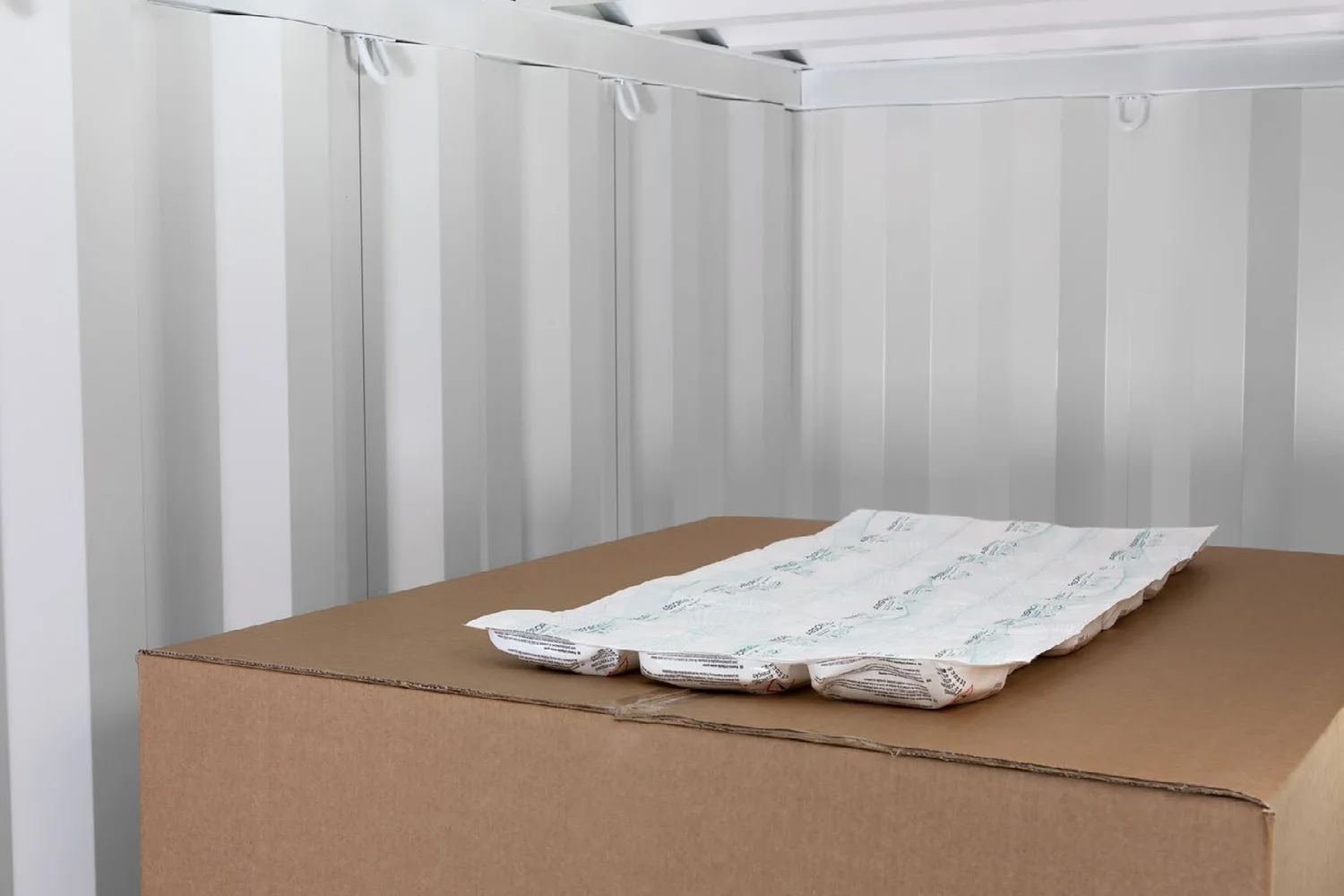
For cargo stacked tight against the roof and walls with no lashing rings, use the Blanket-C blanket laid on the pallet. In small cartons, use Pouch packets or the AbsorTerra clay packet. ICD recalculates quantities for your real shipment when you send the volume, route and type of cargo.
Step 3: Place the packets correctly
A packet only works in a reasonably enclosed space: a closed cabinet, a lidded box, a closed carton. Place it in an open room and it absorbs the whole room and fills very quickly.
For a wardrobe, split small packets into the compartments instead of piling one large packet in, because moisture is unevenly distributed; place them at mid height or on a shelf and avoid damp floors. In a safe, put one packet at the front bottom and one at the back.
Do not press a packet against sensitive goods; leave it in a corner or on a small mesh so it does not stain the surface. In a container, hang it vertically in the wall corrugation and leave a gap of about 25 mm from the cargo, following the manufacturer’s instructions.
Packets must always be kept away from children and pets; see what happens if you swallow a desiccant packet.
Step 4: When to replace or re-dry
An indicator silica gel packet that changes color (blue to pink, orange to green) is full and needs re-drying or replacing; the meaning of the colors is in color-changing desiccant beads. A calcium chloride packet that has run or whose gel is full should be replaced and not reused.
In a wardrobe, the reference cycle is 4 to 8 weeks in humid regions and 3 to 6 months in dry regions; some Vietnamese articles advise replacing at least monthly when the environment is very damp.
Silica gel is re-dried at 120 °C for about 2 to 3 hours, with details in how to reuse desiccant beads.
A few household tips
Besides cabinets and boxes, desiccant packets are also used to remove damp odors in shoes, keep spices from clumping in salt and seasoning jars, keep silver from tarnishing and old photo books free of musty smell, or keep razor blades lasting longer in a sealed bag (source: VnExpress). A packet under the windshield also reduces fogging.
Common mistakes
The most common mistake is placing a packet in an open space such as by a window or in a cabinet that is not closed, so the packet absorbs the whole room and is wasted. Next is using too few packets, so the humidity stays high and the goods still get moldy; calculate by volume and increase the dose in humid regions.
Leaving a packet saturated for too long can also let it release moisture again. Placing calcium chloride packets against salt-sensitive goods easily causes stains and corrosion when it leaks, so choose the gel type and place it the right way up.
A desiccant placed together with an oxygen absorber in a sealed bag weakens the oxygen absorber (see oxygen absorber vs desiccant packet). Using a recycled packet for food or medicine means its cleanliness cannot be controlled.
And if you do not measure humidity you do not know whether the packets are enough, so place a small hygrometer, as explained in how to measure humidity.
For ideal humidity levels for storing goods see safe humidity for storing goods and ideal indoor humidity level. Palletized goods also need PE stretch film to reduce moisture ingress.
Frequently asked questions
How do you use desiccant packets correctly?
Choose the right type, calculate the dose by volume (at least 1 g of silica gel per cubic foot), place them in a reasonably enclosed space, spread them across several spots and replace them when they change color or run.
How many grams of desiccant should I use in a wardrobe?
A 20 to 40 cubic foot wardrobe (0.6 to 1.1 cubic meters) needs about 100 to 200 g, split across 2 to 4 spots; increase in humid regions.
Where is the best place to put a desiccant packet?
In an enclosed space, at mid height or on a shelf, spread across several spots. Do not place it against a damp floor or press it on sensitive goods.
How long does a desiccant packet last?
It depends on humidity and size: 4 to 8 weeks in humid regions and 3 to 6 months in dry regions in a wardrobe; one voyage for container cargo.
How many desiccant bags does a 40ft container need?
According to Absortech’s table with Hanging-C 1.0 kg: 9 bags (dry cargo, 30 days) up to 14 bags (humid cargo, 60 days). ICD recalculates for your shipment.
Can I calculate the desiccant dose myself?
Yes, from the volume and the humidity you want to reach. A common industry formula: volume x absorption capacity x (starting RH minus target RH) divided by 100. Add a factor for packaging that is not airtight.
Does using a desiccant packet require an airtight enclosure?
Not strictly, but it is more effective in an enclosed space. A desiccant in an open room fills very quickly.
How do you use an anti-moisture packet?
The same as a desiccant packet: place it in an enclosed space, at the right dose, and replace it when full.
Contact ICD Vietnam for desiccant advice
ICD Vietnam Industrial Production Co., Ltd.
North: 3rd Floor, Thang Long A1 Building, Bau Hamlet, Thien Loc Commune, Hanoi, 0983 797 186 / 090 345 9186 / 090 5859 186
South: 551/212 Le Van Khuong, Tan Thoi Hiep, District 12, Ho Chi Minh City, 098 6784 186
Email: sales@icdvietnam.com.vn
Zalo: Chat on Zalo
References
- MIL-D-3464E, Desiccants, activated, bagged
- VnExpress, Tips for making use of desiccant packets (Vietnamese)
- Absortech, AbsorGel Hanging-C Technical Product Sheet (bag counts by voyage)