
Table of Contents
Reviewed and updated by ICD - Week 43/2026
PET is transparent and is the plastic of drink bottles; PP is more opaque but stiff, light and suited to crates, pallets and heat-resistant boxes: choose PET when you need to see inside, choose PP when you need something stiff, light and able to carry heavy loads. This article compares them using sourced figures. For PP against other plastics, see also PP vs PE: which is better and PP vs HDPE compared.
Key points in brief
PET has a higher melting point than PP, but PET bottles start to soften at about 70-80 °C, which is lower than the softening temperature of solid PP products. PP is lighter than water, while PET is heavier than water. PET is transparent and is recycled more than PP; PP is stiff, easy to make into living hinges and easy to injection-mould into crates and pallets.
What is PET plastic?
PET (polyethylene terephthalate) is a thermoplastic in the polyester group, with identification code 1. According to Wikipedia, PET is strong and impact resistant, absorbs moisture, and can be either an amorphous transparent form or a semi-crystalline form that may be opaque white. Its main uses are soft drink bottles, clear food containers and polyester fibre used in clothing, carpets and upholstery.
The glass transition temperature of PET is about 70-80 °C: above that the plastic starts to soften and tends to crystallise, so PET bottles are not suited to holding boiling water. For hot contents, a grade of PET designed for the purpose is needed.
What is PP plastic?
PP (polypropylene) is a thermoplastic, code 5, melting at about 160-165 °C with a density of 0.90-0.91 g/cm³. Its heat deflection temperature is about 95-102 °C under a light load and 57 °C under a heavy load (Basell datasheet). The EPA describes PP as stiffer than PE and well known for living-hinge parts such as flip-top lids. PP homopolymer becomes brittle around 0 °C. PP food containers must meet regulations (FDA 21 CFR 177.1520, QCVN 12-1:2011/BYT).
PET vs PP comparison table
| Criterion | PET plastic | PP plastic |
|---|---|---|
| Identification code | No. 1 | No. 5 |
| Clarity | Can be transparent (amorphous form) | Opaque; homopolymer haze is about 30% at 1 mm thick, random copolymer is clearer |
| Melting point | about 250-260 °C | about 160-165 °C |
| Softening under load or heat | Starts to soften at about 70-80 °C | Deflects under a light load at about 95-102 °C |
| Density | Heavier than water | 0.90-0.91 g/cm³, lighter than water |
| Main uses | Water bottles, clear containers, polyester fibre | Crates, pallets, lids, food containers, car parts |
| Recycling (EPA 2018, US) | PET bottles 29.1% | No separate figure |
Should you choose PET or PP?
If you need to see inside, or are filling drink bottles: PET. If you need crates, baskets or pallets that carry load, containers that are reheated, or living-hinge parts: PP. Each plastic comes in many resin grades, so you need the specifications of the exact grade rather than the generic name.
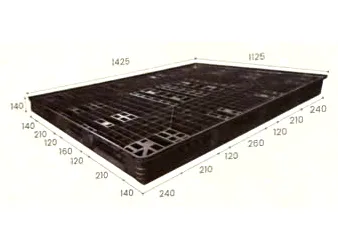
ICD Vietnam plastic pallets and crates are injection-moulded thermoplastic; see plastic pallets to choose a suitable size and load capacity, with the resin grade stated in the specifications of each line.
Frequently asked questions
How do PET and PP plastic differ?
PET is transparent, code 1, and softens at about 70-80 °C; PP is more opaque, code 5, lighter than water and stiffer, melting at about 160-165 °C.
Which is more common in plastic pallet manufacturing?
Industrial plastic pallets and crates are usually PP or HDPE; PET is rarely used because its processing and properties are different. There is no authoritative market-share data, so no specific ranking is given.
What is PET plastic commonly used for?
Soft drink bottles, clear food containers and polyester fibre (Wikipedia).
Contact us for ICD Vietnam plastic crates and pallets
ICD Vietnam Industrial Manufacturing Co., Ltd.
North: 3rd Floor, Thang Long A1 Building, Bau Hamlet, Thien Loc Commune, Hanoi, 0983 797 186 / 090 345 9186 / 090 5859 186
South: 551/212 Le Van Khuong Street, Tan Thoi Hiep Ward, District 12, Ho Chi Minh City, 098 6784 186
Email: sales@icdvietnam.com.vn
Zalo: Chat on Zalo now
References
- Wikipedia, Polyethylene terephthalate (melting point, glass transition temperature, clarity, code 1) - en.wikipedia.org
- Basell, Moplen HP500N datasheet (HDT, Vicat, density) - pimd.vn
- Ducor Petrochemicals, DuPure G 72 TF datasheet (haze, density, temperature) - ducorchem.com
- US EPA, Containers and Packaging: Product-Specific Data (2018 recycling rates) - epa.gov
- Smith R.L., Takkellapati S., US EPA, Recycling Plastics in the U.S.: Polypropylene Flows and Recycling Processes (AIChE 2023; plastic code list, PP properties) - cfpub.epa.gov
- US FDA, 21 CFR 177.1520 Olefin polymers - law.cornell.edu
- QCVN 12-1:2011/BYT, National technical regulation on safety and hygiene for synthetic plastic packaging and utensils in direct contact with food - nafiqad5.gov.vn