
Table of Contents
Reviewed and updated by ICD - Week 43/2026
PP can hold hot water, but boiling water at 100 °C is already close to the limit of a load-bearing PP item, so use only food-grade products that are intact, and do not heat them directly on a stove. PP melts at about 160-165 °C, about 60 °C above boiling water, but the heat deflection temperature under load of common PP grades is only about 95-102 °C at light load. Below is how to read those two figures and what to check before pouring hot water into a PP container.
What is PP (polypropylene) plastic
PP is a thermoplastic polymer made by polymerizing propylene. It is light (density about 0.90-0.91 g/cm³), stiffer than polyethylene, more heat resistant and chemically resistant, so it appears from household goods to industrial products. On the bottom of a product, PP carries code 5 inside the arrow triangle under the resin identification system.
Key properties of PP
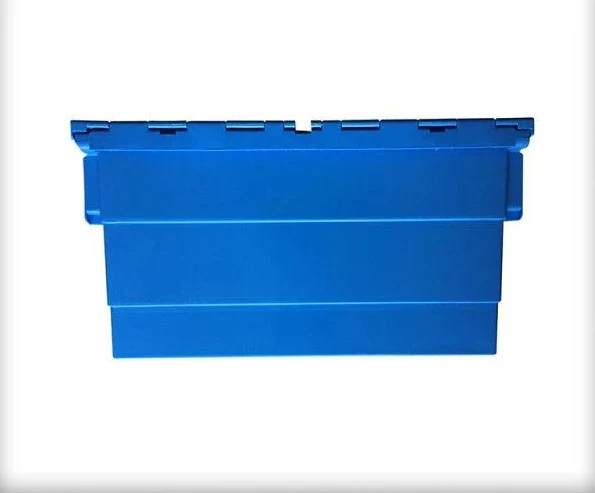
- Stiffness and mechanical strength: stiffer than PE, suited to crates, trays, boxes and engineering parts; homopolymer is brittle in the cold, while copolymer resists impact better (Simona).
- Heat resistance: melts at about 160-165 °C; softens under load from about 85-100 °C (Basell, Ducor).
- Chemical resistance: inert to most acids, alkalis and alcohols at room temperature; strong oxidizers can damage it with long contact.
- Light weight: lighter than water, which lowers product weight and transport cost.
- BPA-free: bisphenol A is a raw material of polycarbonate, not of PP; this does not replace checking the food contact standard of each product.
Can PP hold hot water
The answer is yes, within limits. A melting point of 160-165 °C is well above the temperature of boiling water, so water at 100 °C does not melt PP. But the Vicat softening temperature of common PP is only about 85-92 °C and the deflection temperature under light load about 95-102 °C, which means a thin container wall holding boiling water is already close to the softening threshold. So with hot water, thickness and resin quality matter more than the melting point.
The Vietnamese regulation QCVN 12-1:2011/BYT also shows this temperature range is taken into account: PE and PP utensils must meet a dry residue limit of 30 µg/ml, and for utensils used above 100 °C the migration test condition is 95 °C for 30 minutes. That means a compliant PP container has been tested with nearly boiling water, while a container of unknown origin has no such evidence.
Applications of PP today
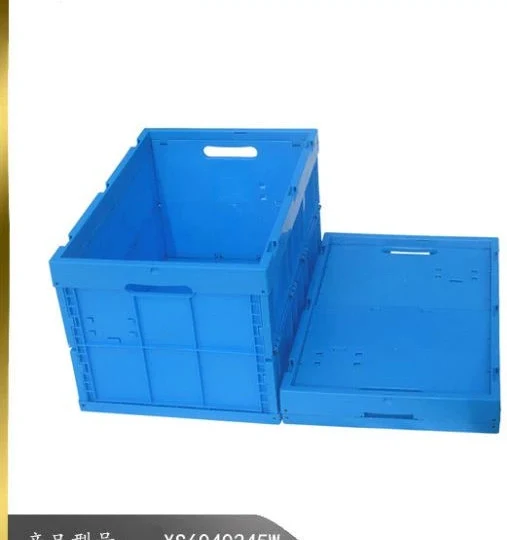
In food packaging, PP makes lunch boxes, storage boxes, cups and lids. In household goods, PP makes basins, baskets, plastic chairs and toys. In medicine, PP makes syringes, containers and instruments that need disinfecting. In cars, PP makes bumpers, interior trim and battery cases. As fiber and nonwoven fabric, PP makes bags, face masks, diapers and filter media. The part ICD Vietnam makes directly is plastic crates, baskets and pallets.
How PP is made
The process has three main steps. First is polymerization: propylene gas is polymerized with a catalyst (the Ziegler-Natta system was the first, tied to Giulio Natta’s discovery in 1954) in a reactor to form polypropylene chains. Next is pelletizing: the molten polymer is pressed through a die, cooled quickly and cut into virgin resin pellets. Last is fabrication: PP pellets go to a factory to be injection molded, extruded or blow molded into products.
Comparing PP with PET
PP and PET are both common in packaging but differ in temperature and clarity.
| Criterion | PP | PET |
|---|---|---|
| Identification code | 5 | 1 |
| Melting | about 160-165 °C | about 250-260 °C |
| Clarity | Opaque or hazy; homopolymer has 30% haze at 1 mm; random copolymer is clearer | Clear, glossy |
| Main uses | Boxes, lids, crates, pallets, fiber, car parts | Water bottles, soft drink bottles, polyester fiber |
PET has a higher material melting point, but PET in bottle form begins to soften at about 70-80 °C, so a PET soft drink bottle does not hold boiling water; a food-grade PP container is the standard choice for hot items.
PP plastic pallets in warehousing
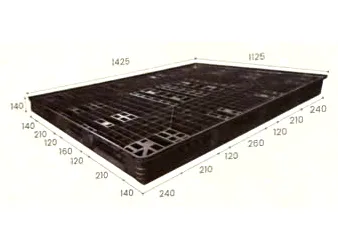
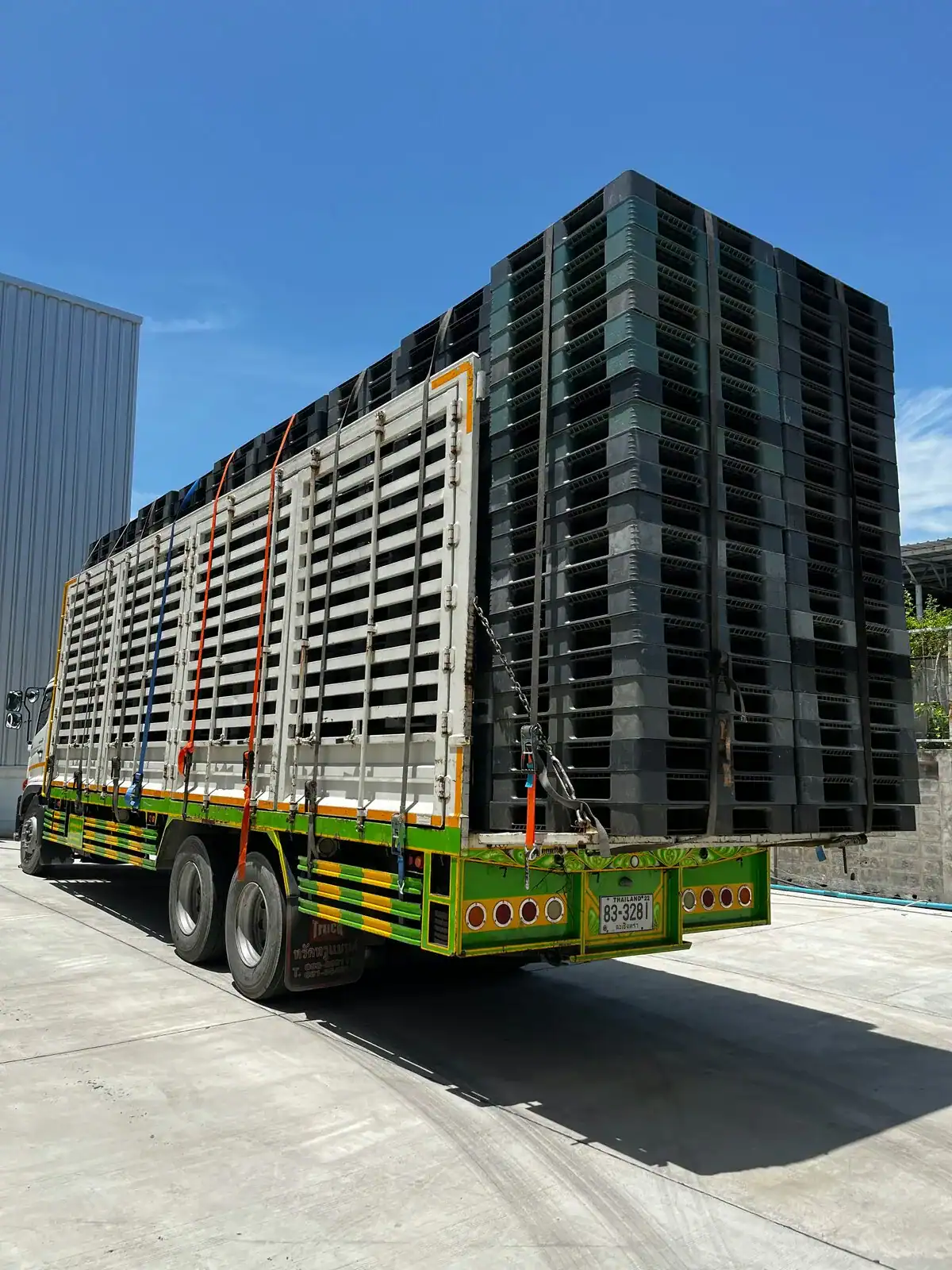
If a business needs ICD Vietnam plastic pallets for a warehouse, choose by load, warehouse temperature and hygiene conditions. Plastic pallets do not absorb water like wooden ones, so they are easy to hose down, free of termites and mold, and suit food warehouses; they also resist ordinary chemicals well. The difference between PP and HDPE pallets lies in temperature: PP handles heat better while HDPE handles cold better (HDPE only turns brittle below about -73 °C per a study published in Polymers in 2021, while homopolymer PP turns brittle around 0 °C). Freezer cold stores should favor HDPE or PP copolymer; ordinary warehouses with heavy loads and lots of forklifts can use PP.
For a quote and load advice, contact ICD Vietnam on the numbers at the end of this guide.
Frequently asked questions
What temperature can PP withstand?
It melts at about 160-165 °C, but a load-bearing product softens from about 85-102 °C. The practical limit is set by the maker of each resin grade.
Can PP be used with hot water?
Yes with food-grade containers that are intact and not heated directly on a stove; boiling water at 100 °C is already close to the limit, so do not leave it long and replace the container when scratched or deformed.
What are the standout properties of PP?
Stiff, light, good chemical resistance and more heat resistant than PE; the weaknesses are brittleness in the cold for homopolymer and poor UV resistance without additives.
Contact ICD Vietnam for crate and plastic pallet advice
ICD Vietnam Industrial Production Co., Ltd.
Northern Vietnam: 3rd Floor, Thang Long A1 Building, Bau Hamlet, Thien Loc Commune, Hanoi - 0983 797 186 / 090 345 9186 / 090 5859 186
Southern Vietnam: 551/212 Le Van Khuong Street, Tan Thoi Hiep Ward, District 12, Ho Chi Minh City - 098 6784 186
Email: sales@icdvietnam.com.vn
Zalo: Chat on Zalo now
References
- Wikipedia, Polypropylene (melting point, history, clarity, applications) - en.wikipedia.org
- QCVN 12-1:2011/BYT, National technical regulation on safety and hygiene for synthetic plastic packaging and utensils in direct contact with food - nafiqad5.gov.vn
- Harvard Health, Microwaving food in plastic: dangerous or not? - health.harvard.edu
- Basell, Moplen HP500N datasheet (HDT, Vicat, density) - pimd.vn
- Ducor Petrochemicals, DuPure G 72 TF datasheet (haze, density, temperature) - ducorchem.com
- Simona, technical Handbook (PP homopolymer brittle in the cold, copolymer impact resistant) - simona.de
- Salakhov et al., Low-Temperature Mechanical Properties of High-Density and Low-Density Polyethylene, Polymers 2021 (HDPE brittle below about -73 °C) - pmc.ncbi.nlm.nih.gov
- Wikipedia, Polyethylene terephthalate (melting point, glass transition temperature)
Related articles
- How many times can PP plastic be used before it must be discarded?
- What temperature can PP plastic withstand
See also: is PP plastic safe.