
Table of Contents
- What is recycled HDPE plastic?
- The HDPE recycling process step by step
- How much energy does recycling HDPE save?
- Does repeated recycling reduce HDPE quality?
- Can recycled HDPE be used for food?
- Products made from recycled HDPE
- What about chemical recycling?
- Frequently asked questions
- Contact ICD Vietnam for plastic pallet advice
- References
Reviewed and updated by ICD - Week 43/2026
HDPE can be recycled, and it is the plastic with the most complete physical recycling chain: collection, sorting, hot wash, grinding, filtered extrusion and pelletising. But the quality of the recycled pellets depends on the scrap source and processing conditions, and use in food contact is only possible when the process is approved by the regulator. HDPE carries recycling code number 2; for general properties see the article What is HDPE plastic, its properties and applications.
If you are simply asking “can HDPE plastic be recycled“, the answer is yes, and the rest explains the conditions. This article goes through the recycling process step by step, sourced energy-saving figures, research results on repeated reprocessing, the food limits under current regulations, and which products suit recycled pellets.
What is recycled HDPE plastic?
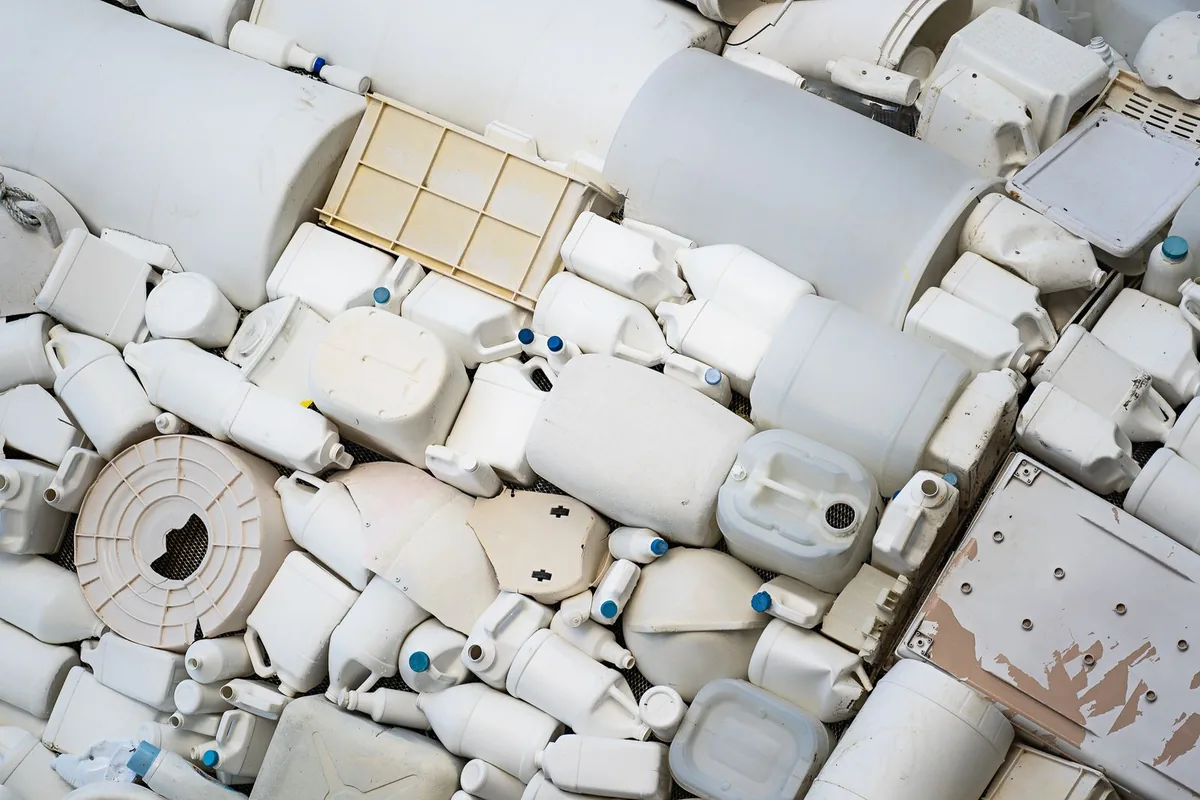
Recycled HDPE is pellets or products obtained from used HDPE such as old bottles, jerrycans, crates, pipes and pallets, after cleaning, grinding and re-extruding. HDPE is a thermoplastic, so it can be melted and reshaped, unlike thermosets such as epoxy. The pellets obtained are usually called recycled pellets (see recycled HDPE pellets).
Recycling figures vary widely by product type and country. According to the US Environmental Protection Agency (EPA), natural HDPE bottles (milky white, like milk jugs) reached a recycling rate of 29.3% in 2018, while the recycling rate for plastics in general was only about 8.7%.
The HDPE recycling process step by step
Most HDPE is recycled mechanically, meaning the chemical structure is not broken down and the plastic is only cleaned and reshaped. Recycling plants publish fairly similar processes, for example the Veolia Plastics technical dossier for rHDPE pellets.
The first step is collection and sorting by plastic type and colour. Next comes removing contaminants: metal is pulled out with magnets, labels and caps are separated by air or screens, and other plastics are separated in a float-sink tank. HDPE is lighter than water (density 0.93 to 0.97 g/cm3) so it floats, while materials above 1 g/cm3 such as PET and PVC sink, which separates them fairly thoroughly.
The plastic is then ground, hot-washed with an alkaline solution and surfactant to loosen grease, label glue and food residue, and dried. The ground flakes are melt-extruded, filtered through multi-layer screens and cut into pellets. For pellets destined for packaging that needs higher cleanliness, plants add a decontamination step: holding the pellets just below the melting point under vacuum so volatile chemicals escape. Finally the pellets are checked for melt flow index (MFI), density and colour, then bagged.
How much energy does recycling HDPE save?
The Association of Plastic Recyclers’ life cycle inventory report (APR, 2018) shows that post-consumer recycled HDPE pellets need 12% of the energy of virgin plastic under the cut-off allocation method, and 56% under the open-loop method. An independent study by Bataineh (2020) also found 12 to 13% under cut-off and about 62% under system expansion, with greenhouse gas reductions of 25 to 75% depending on the method.
In other words, the saving is real and significant, but the specific figure depends on how impact is allocated between the first and second life. When you meet a marketing claim with a single figure, ask which method it used.
Does repeated recycling reduce HDPE quality?
Yes, but not as simply as “a 10 to 20% drop each time”. Studies of reprocessed HDPE give different results depending on the resin, the number of cycles and processing conditions, as in the table below.
| Study | Conditions | Main result |
|---|---|---|
| Mnif and Elleuch 2015 | Reprocessing up to 3 cycles | Mechanical properties fall after each cycle, most after the first; rheology unchanged in the first 3 cycles; adding ageing makes the decline faster |
| Zhang 2024 | More than 8 cycles | Viscosity rises up to 6 times from cycle 4 to 8, from branching and not yet extensive cross-linking; mass recovery above 95% |
| Vidakis 2021 | Recycling for 3D printing | Mechanical properties improve up to cycle 5 and then decline |
Two mechanisms happen together when plastic is subjected to heat and shear in the extruder: chain scission shortens the chains, and branching or cross-linking makes them bulkier. The outcome depends on the resin and conditions, so there is no fixed reduction that applies to every batch. For a buyer, the practical conclusion is to ask for test data on the exact batch of pellets or the exact product, rather than trust a general percentage.
Can recycled HDPE be used for food?
The Vietnamese regulation QCVN 12-1:2011/BYT on synthetic plastic packaging and utensils in food contact sets migration limits: for polyethylene and polypropylene, a maximum dry residue of 30 µg/ml when tested with heptane, 20% ethanol and 4% acetic acid, plus limits for lead, cadmium and heavy metals. The document has no separate clause banning or permitting recycled plastic, and the product must have a declaration of conformity.
That does not mean recycled plastic is automatically usable for food. In Europe, Regulation (EU) 2022/1616 only allows recycled plastic in food contact when the recycling process is on the approved list. In the US, the FDA reviews case by case, based on whether the process reduces contaminants to a negligible exposure level, about 0.5 ppb in the diet. In 2015 EFSA assessed the HDPE milk and juice bottle recycling processes submitted at that time and concluded that they did not yet meet the criteria; in the same report EFSA found no safety concern for recycled HDPE of up to 30% used in trays for whole fruit and vegetables at room temperature or below.
Scientific studies show why caution is needed. Horodytska (2020) found 134 substances in recycled LDPE and HDPE, and Vera (2024) recorded 69 substances that can migrate from recycled HDPE used in toys, including residues from cleaning products. Perez-Bondia (2024) showed that vacuum treatment at 120 °C for 5 hours cut the volatile content of 42 of 67 compounds by more than 50%, but toxicity data are still missing, and fatty foods raise migration.
Products made from recycled HDPE
Recycled pellets suit products with no food contact and no need for perfectly uniform properties: industrial bins, drainage pipes, floor mats, formwork boards, outdoor chairs, aquaculture cages and plastic pallets. For pallets, ICD Vietnam’s article on virgin plastic pallets says recycled pallets suit goods with no hygiene requirement, one-way export and temporary racking. When you need to choose between the two for a specific warehouse, you can browse the plastic pallet category or contact us for advice.
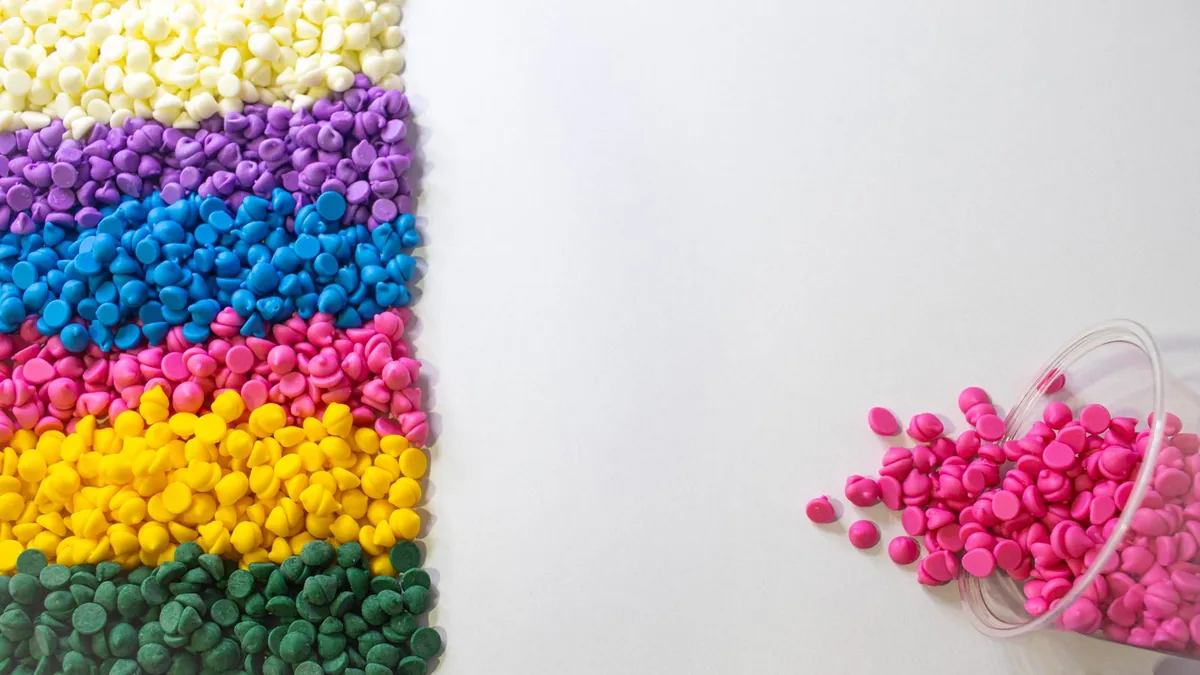
On colour, recycled pellets from multicoloured scrap usually come out dark because pigments have dissolved into the plastic and cannot be bleached back to light. Only strict colour sorting from the start gives light pellets. However, colour does not prove origin: dark pellets can still be clean recycled resin, and virgin resin can also be dyed black. Warehouse standards are set by the auditor and the customer.
What about chemical recycling?
Chemical recycling breaks polymers down to monomers or hydrocarbons to make plastic again, which in principle gives quality close to virgin plastic. The technology is developing and is not yet widespread at large industrial scale.
Frequently asked questions
Can HDPE plastic be recycled?
Yes. HDPE is a thermoplastic with recycling code 2, commonly recycled mechanically: sorting, hot wash, grinding, filtered extrusion and pelletising.
How many times can HDPE be recycled?
There is no fixed number. Studies cover 3 to more than 8 processing cycles; mechanical properties usually change after each cycle, most after the first, and the result depends on the resin and processing conditions.
How much energy does recycling HDPE save?
According to APR, recycled HDPE pellets need 12% of the energy of virgin plastic under the cut-off method and 56% under open-loop; the figure depends on how impact is allocated.
Can recycled HDPE be used for food?
Only when the recycling process is approved by the regulator (EU 2022/1616, FDA case by case) and the product has a declaration of conformity under QCVN 12-1:2011/BYT. Without those documents, do not use it for food.
Why are recycled HDPE pellets often dark?
Because multicoloured scrap is mixed, the pigments dissolve into the plastic and cannot be bleached out. Colour does not reflect quality or origin.
Contact ICD Vietnam for plastic pallet advice
ICD Vietnam Industrial Manufacturing Co., Ltd.
North: 3rd Floor, Thang Long A1 Building, Bau Hamlet, Thien Loc Commune, Hanoi, 0983 797 186 / 090 345 9186 / 090 5859 186
South: 551/212 Le Van Khuong Street, Tan Thoi Hiep Ward, District 12, Ho Chi Minh City, 098 6784 186
Email: sales@icdvietnam.com.vn
Zalo: Chat on Zalo now
References
- Veolia Plastics, Technical dossier for the rHDPE recycling process (hot wash, float-sink separation, vacuum decontamination) - dagenhamplastics.veolia.co.uk
- Association of Plastic Recyclers, Life Cycle Impacts for Postconsumer Recycled Resins: PET, HDPE and PP (2018; recycled HDPE needs 12% of virgin energy under cut-off, 56% under open-loop) - plasticsrecycling.org
- US EPA, Plastics: Material-Specific Data (natural HDPE bottle recycling rate 29.3% in 2018) - epa.gov
- EFSA CEF Panel, Scientific opinion on the safety assessment of recycling processes for HDPE (2015) - efsa.onlinelibrary.wiley.com
- EUR-Lex, Regulation (EU) 2022/1616 on recycled plastic in food contact - eur-lex.europa.eu
- FDA, Guidance: Use of Recycled Plastics in Food Packaging (Chemistry Considerations), 2021 - fda.gov
- Ministry of Health, QCVN 12-1:2011/BYT on safety and hygiene of synthetic plastic packaging and utensils in direct contact with food - nafiqad5.gov.vn
- Mnif R., Elleuch R., Effects of reprocessing cycles and ageing on HDPE blends, Matériaux & Techniques (2015) - doi.org
- Vidakis N. et al., Mechanical Response of HDPE over Multiple Recycling Processes, Recycling 2021 - mdpi.com
- Wikipedia, High-density polyethylene (density 0.93-0.97 g/cm3, applications, recycling code 2) - en.wikipedia.org