
Table of Contents
Reviewed and updated by ICD - Week 43/2026
Short answer: PA plastic can be sterilized with steam, but only PA66 is stable: BASF reports that PA66 passes a 134 °C sterilization test for 50 cycles under DIN 58946, while PA6 does not. Ethylene oxide at 30 to 70 °C (up to 8 hours) is usable, and 25 kGy irradiation is usable but causes slight yellowing. UV is the riskiest method because 254 nm light breaks the amide bond directly.
Many articles online call ethylene oxide (EO) the “gold standard” and gamma “optimal” for PA without citing figures. Checked against BASF datasheets, a medical component supplier’s compatibility table and independent studies, the picture is more complicated. This guide sums up what each source actually states, and says plainly where no data exists.
Which sterilization methods suit PA plastic
The table below combines two independent sources. BASF tested two unreinforced grades, Ultramid B27 E (PA6) and A27 E (PA66); the table from Industrial Specialties Mfg (a medical component supplier) groups PA6 and PA66 together on a Good, Fair, Poor scale. The two sources do not use the same scale so the levels cannot be converted one for one, but both point to the same trend: EO is easiest, while steam and irradiation need checking.
| Method | BASF (B27 E, A27 E) | ISM table (PA6, PA66) | Main note |
|---|---|---|---|
| Steam 121 to 134 °C | PA66 passes 134 °C, 50 cycles; PA6 does not | Autoclave: Fair | Choose PA66; parts swell slightly from water absorption |
| Ethylene oxide gas | 30 to 70 °C, up to 8 hours: passes | Good | Must be aerated to remove residual EO |
| Gamma irradiation 25 kGy | Passes, slight yellowing | Fair | Dose needs checking |
| Electron beam | Not stated | Fair | No BASF data |
| UV light (germicidal lamp) | No corresponding entry | None | See the UV section below |
For chemical disinfectants BASF is more specific: alcohols, aldehydes and quaternary ammonium salts are usable; phenol-based and chlorine-based disinfectants are only limited. Boiling at 100 °C and disinfection with hot air, steam and alternating hot air are also rated usable.
How UV affects PA plastic
There are two kinds of effect to separate. With sunlight and longer-wavelength radiation, PA ages mainly because impurities in the plastic absorb the light and generate free radicals. With UV-C, the 254 nm radiation used in germicidal lamps, Hu (1998) reports energy sufficient to break the NH-CO bond directly and start photo-oxidation of PA6. A UV-C germicidal lamp is therefore the worst method for a PA part left for long inside the irradiated zone.
On the extent of damage, quantitative data was found only for nylon 6 fabric, none for injection-molded parts. Ye and co-authors (2021) irradiated nylon 6 fabric with UV for 8 minutes and the fabric yellowed, its breaking force fell from 1008 to 425 N and its melting temperature fell from 223.3 to 215.6 °C, because amide bonds broke and the amorphous region grew. The test condition was high-intensity irradiation, not representative of an ordinary germicidal lamp, but it shows the direction of the effect: yellowing, loss of strength, loss of thermal stability.
For outdoor use, BASF states that grades with a weather stabilizer (type K) withstand UV, with carbon black giving the highest effect; unstabilized natural-color grades fail most easily. This means the question “can PA withstand UV” has different answers by grade, and unstabilized natural grade is the worst choice.
Steam sterilization: PA6 and PA66 differ
The most important point about steam is that PA6 and PA66 give different results, which generic articles do not mention. BASF rates steam at 100 °C as only limited; a 50 µm PA film at 116 °C shows signs of molecular degradation after 5 cycles; in a 134 °C test for 50 cycles under DIN 58946 (parts 1 to 5), PA66 passes and PA6 does not. For PA6, repeated autoclaving at 134 °C should be considered unsuitable.
| Steam condition (BASF) | PA6 (B27 E) | PA66 (A27 E) |
|---|---|---|
| Steam 100 °C | Limited | Limited |
| 50 µm film, 116 °C | Degrades after 5 cycles | Degrades after 5 cycles |
| 134 °C, 50 cycles (DIN 58946) | Fails | Passes |
Kubyshkina and co-authors (2011) tested a PA6 at 121 °C, 75 minutes, 0.2 MPa and found that time-dependent behavior (creep) hardly changed after autoclaving; their conclusion leans toward the view that nylon withstands steam well, with the note that parts may swell slightly from water absorption. The two results do not conflict: a few cycles at 121 °C do less harm than dozens of cycles at 134 °C.
Water absorption is the main mechanism behind dimensional change. At 23 °C and 50% RH, PA6 absorbs 2.6% to 3.4% water and saturates at 9% to 10% (BASF Ultramid B3K), so after wet autoclaving a tight-fitting part can jam; parts need moisture conditioning before inspection. Glass-fiber-reinforced grades hold their shape better, but they are a different grade from BASF’s B27 E and need their own datasheet.
Ethylene oxide and gamma irradiation
BASF states that EO gas at ordinary temperature is usable, above 80 °C it is not, and a sterilization process of 30 to 70 °C lasting up to 8 hours is usable with PA. Industrial Specialties Mfg rates EO as Good. But Kubyshkina and co-authors (2011), testing PA6, found that EO (50 °C, 8 hours) was the method with the strongest effect on the time-dependent behavior of one narrow-molecular-weight-distribution PA6. This is one study on one grade, not enough for a general conclusion, but enough to show that “EO does not change any mechanical property” is too absolute.
Gamma irradiation: BASF tested a 25 kGy dose over 6 hours; PA is usable but yellows slightly. Kubyshkina notes that polyamide is sensitive to radiation cross-linking but suits a single irradiation dose; ISM rates gamma as Fair. Gamma therefore passes only as a single exposure, at the right dose, tested on the specific grade, not as an absolute “optimal”.
A practical ranking for PA: for a part that needs sterilizing only once, EO below 70 °C and gamma at 25 kGy are the two options with data; for a part that must be sterilized repeatedly, PA66 in a 121 to 134 °C autoclave has BASF data, while PA6 should be limited.
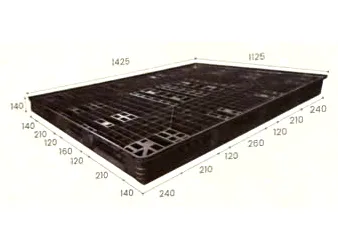
Beyond medical devices, warehouse supplies also need the right material for the environment. Browse ICD Vietnam’s plastic pallet range to choose by load capacity and rack type.
Frequently asked questions
Can PA plastic be sterilized with steam?
PA66 can: BASF reports it passes a 134 °C, 50-cycle test under DIN 58946. PA6 does not pass under those conditions; parts also swell slightly from water absorption.
Can PA plastic be sterilized with UV light?
Not advisable for PA parts left for long inside the irradiated zone. UV-C at 254 nm breaks the NH-CO bond, causing yellowing and loss of strength; no quantitative data exists for injection-molded parts.
Is ethylene oxide safe for PA plastic?
BASF states PA tolerates EO at 30 to 70 °C for up to 8 hours. One independent study on PA6 found EO strongly affected time-dependent properties, so test on the exact grade.
Can gamma irradiation be used on PA plastic?
BASF states a 25 kGy dose is usable with slight yellowing; ISM rates it Fair. Suitable for a single exposure at the right dose.
Why does PA66 withstand autoclaving better than PA6?
PA66 has a higher melting point (260 versus 220 °C) and a higher HDT; in BASF’s DIN 58946 test, PA66 passed and PA6 failed at 134 °C.
How does PA moisture absorption matter after autoclaving?
Dimensions grow slightly and stiffness falls: the tensile modulus of PA6 drops from about 3,100 to 1,000 MPa once it has absorbed moisture to equilibrium.
Contact ICD Vietnam
ICD Vietnam Industrial Manufacturing Co., Ltd.
North: 3rd Floor, Thang Long A1 Building, Bau Hamlet, Thien Loc Commune, Hanoi, 0983 797 186 / 090 345 9186 / 090 5859 186
South: 551/212 Le Van Khuong Street, Tan Thoi Hiep Ward, District 12, Ho Chi Minh City, 098 6784 186
Email: sales@icdvietnam.com.vn
Zalo: Chat on Zalo now
References
- BASF, Ultramid Nylon Chemical Resistance (B27E PA6, A27E PA66: steam, 25 kGy irradiation, ethylene oxide gas, disinfectants) - chemicals.basf.com
- Industrial Specialties Mfg, Plastics Compatibility with Sterilization Methods (PA6, PA66: autoclave Fair, ethylene oxide Good, gamma Fair, e-beam Fair; edition of 23/01/2019) - industrialspec.com
- Kubyshkina and co-authors (2011), The Influence of Different Sterilization Techniques on the Time-Dependent Behavior of Polyamides (PA6: autoclave 121 °C 75 minutes, ethylene oxide, H2O2 plasma), J. Biomaterials and Nanobiotechnology - doi.org
- Hu X. (1998), Wavelength sensitivity of photo-oxidation of polyamide 6, Polymer Degradation and Stability 62 - sciencedirect.com
- Ye T., Wang C., Yin Y. (2021), Effects of ultraviolet irradiation on structure and properties of nylon 6 (nylon 6 fabric irradiated with UV for 8 minutes: yellowing, breaking force from 1008 to 425 N, melting from 223.3 to 215.6 °C), Radiation Research and Radiation Processing 39 - doi.org/10.11889/j.1000-3436.2021.rrj.39.030204
- BASF, Ultramid B3K (PA6) Product Information, 09/2026: density 1130 kg/m3, melting point 220 °C, saturation moisture 9% to 10%, equilibrium at 23 °C/50% RH 2.6% to 3.4%, HDT A 60 °C, drying 80 °C for 4 hours - download.basf.com
- BASF, Ultramid (PA) brochure, section Behavior on exposure to weather (type K weather-resistant, carbon black most effective) - basf.com