
Table of Contents
- What is PA plastic
- Chemical formula and how to read the names PA6 and PA66
- PA6 and PA66 data table
- Drying temperature for PA pellets
- What temperature can PA withstand
- Is PA plastic safe
- How PA6 and PA66 differ
- 3D printing PA
- Comparing PA and PE
- What PA price depends on
- Applications of PA
- Frequently asked questions
- What is PA plastic?
- How does PA differ from PE and PP?
- What is the drying temperature for PA pellets?
- What temperature can PA withstand?
- Is PA plastic safe in food contact?
- How do you identify PA with a burn test?
- Can PA be recycled?
- What is the recycling code for PA?
- Why is PA often mixed with glass fiber?
- Contact ICD Vietnam
- References
Reviewed and updated by ICD - Week 43/2026
PA (polyamide, commonly called nylon) is an engineering thermoplastic with repeating amide groups in its main chain. The two common types are PA6 (melting at about 220 °C) and PA66 (about 260 °C), both with a density of about 1.13 g/cm³. Its biggest weakness is moisture absorption: at 23 °C and 50% humidity the pellets settle at about 2.5 to 3.4% water, and stiffness then falls by more than half compared with the dry state.
This guide fixes the baseline figures for our group of articles on PA plastic on ICD Vietnam, drawn from resin-maker datasheets, food contact rules and regulator documents. Where a number depends on the resin grade, I state which grade it refers to, and where there is no reliable source I give no number.
What is PA plastic
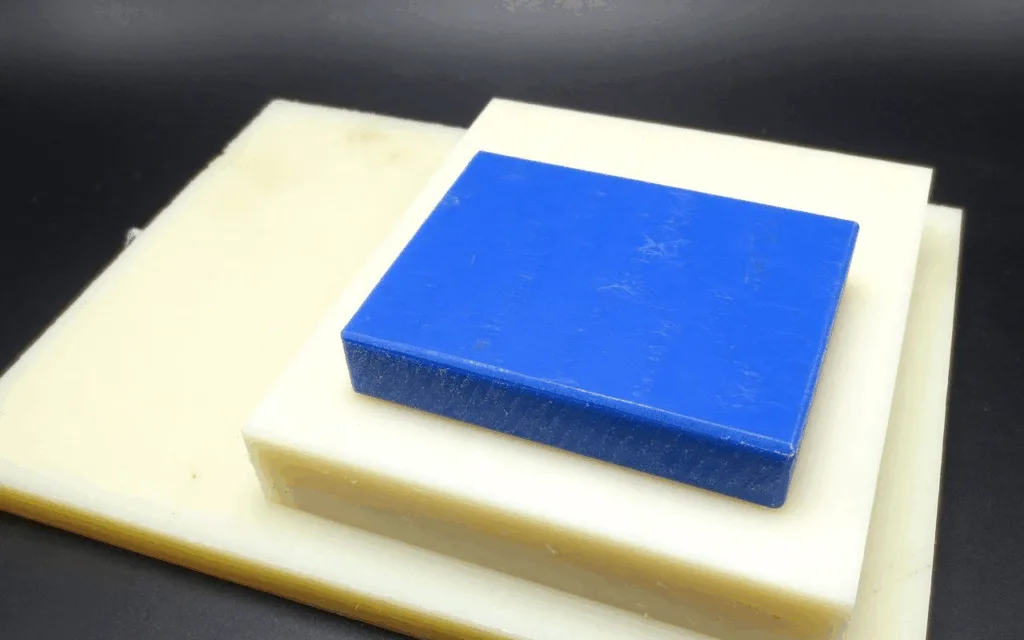
PA is the abbreviation for polyamide, a long polymer chain with repeating amide groups (-NH-CO-). Nylon is the trade name DuPont gave when it succeeded in synthesizing polyamide 66, and it has since become a generic noun (Asahi Kasei). Polyamide was first developed as a textile fiber and only later used as an injection molding material, thanks to its mechanical strength, wear resistance and heat resistance.
Unlike commodity plastics such as PE or PP used for bags, film and boxes, PA belongs to the engineering plastics: rigid, tough, with a low coefficient of friction and good resistance to oils and fuels. Uncolored PA pellets are usually milky white to slightly yellowish and take color well, so products come in many colors.
Chemical formula and how to read the names PA6 and PA66
The number in the name tells how many carbon atoms sit between the amide groups. PA6 forms by ring-opening polymerization of caprolactam, and its repeat unit is [NH-(CH₂)₅-CO]ₙ. PA66 is the condensation product of hexamethylenediamine and adipic acid (6 carbons each), with the formula [NH-(CH₂)₆-NH-CO-(CH₂)₄-CO]ₙ. The larger the number, the sparser the amide groups, and the less the material absorbs moisture and the more flexible it is (PA11, PA12), at the cost of lower heat resistance.
The amide groups form hydrogen bonds between chains, which is why PA is rigid, strong in tension and wear resistant. The same groups also pull water in, so it is a double-edged trait: stiff because of hydrogen bonds, but moisture absorbing for the same reason.
PA6 and PA66 data table
The two columns below come from BASF datasheets for two unreinforced injection molding grades, B3K (PA6) and A3K (PA66). Figures from other makers differ by a few percent; for example B27 E gives a density of 1140 kg/m³, saturated water uptake of 8.5% and equilibrium of 2.2% (Albis, copied from BASF). So treat these as reference ranges, and always take the real figures from the datasheet of the exact grade you buy.
| Property | PA6 (B3K) | PA66 (A3K) | Notes |
|---|---|---|---|
| Density (ISO 1183) | 1130 kg/m³ | 1130 kg/m³ | About 6 times lighter than steel (Mitsubishi) |
| Melting point (DSC, ISO 11357) | 220 °C | 260 °C | 40 °C apart |
| Saturated water uptake (23 °C, immersed) | 9 to 10% | 8 to 9% | By weight |
| Equilibrium moisture (23 °C, 50% RH) | 2.6 to 3.4% | 2.5 to 3.1% | Typical level in workshops and warehouses |
| Mold shrinkage (ISO 294-4) | 0.75% | 1.5% along flow, 1.8% across | Unreinforced grades |
| HDT A (1.8 MPa) | 60 °C | 75 °C | Heat deflection temperature under load |
| HDT B (0.45 MPa) | 180 °C | 220 °C | Lighter load |
| Heat index, 50% strength lost after 20000 hours | 100 °C | 101 °C | Long-term continuous use |
| Tensile modulus dry / conditioned | 3100 / 1000 MPa | 3000 / 1100 MPa | Conditioned is the 23 °C/50% RH equilibrium state |
| Yield strength dry / conditioned | 80 / 40 MPa | 85 / 50 MPa | Falls by nearly half when conditioned |
Read the table at the two points most easily confused. First, a melting point of 220 or 260 °C is only the temperature at which the material turns liquid, not a working temperature. Second, the tensile modulus of PA6 falls from 3100 to 1000 MPa once it has absorbed moisture: the same part is only about a third as stiff in the humid season as when freshly dried. Engineering drawings for PA parts usually have to be calculated with the conditioned figures, not the dry ones.
Drying temperature for PA pellets
PA pellets must be dried before injection molding or extrusion. The BASF schedule for Ultramid B3K is drying at 80 °C for 4 hours in a dry air dryer, bringing pellet moisture to 0.03 to 0.06%; the time may need to be extended if the bag has been opened or the pellets stored for long. BASF also warns that over-drying raises melt flow during processing. Melt temperature for injection molding is 250 to 270 °C for PA6 (mold 40 to 60 °C) and 280 to 300 °C for PA66 (mold 60 to 80 °C).
Water left in the pellets turns to vapor when the pellets are at melt temperature, creating bubbles and silver streaks on the surface and breaking the polymer chains (hydrolysis), which makes the part brittle. A dry air dryer removes moisture better than an ordinary hot air dryer, especially on humid days. Unopened bags should be kept somewhere dry; if a bag has been stored in the cold, wait for the pellets to reach room temperature before opening to avoid condensation on the pellets (BASF).
What temperature can PA withstand
Three figures coexist and are often mixed up. A melting point of 220 °C (PA6) and 260 °C (PA66) is where the material flows. The heat deflection temperature under load (HDT A, 1.8 MPa) is only 60 °C for PA6 and 75 °C for PA66 for unreinforced grades; at the lighter 0.45 MPa load (HDT B) it is 180 and 220 °C. Long-term working ability is measured by the heat index: after 20000 hours at 100 °C (PA6) or 101 °C (PA66), tensile strength is halved.
| Concept | PA6 (B3K) | PA66 (A3K) | What it is used for |
|---|---|---|---|
| Melting point | 220 °C | 260 °C | Choosing processing temperature |
| HDT A, 1.8 MPa | 60 °C | 75 °C | High-load parts at high temperature |
| HDT B, 0.45 MPa | 180 °C | 220 °C | Lightly loaded parts |
| Short-term resistance | 180 °C | 200 °C | Short thermal cycles |
| Heat index 5000 hours | 112 °C | 118 °C | Shorter life |
| Heat index 20000 hours | 100 °C | 101 °C | Long life |
Practical consequence: the claim ‘PA works steadily at 100 to 120 °C for a long time’ that is common online is only true if the part carries almost no load, or if a glass fiber reinforced grade is used. An unreinforced PA part under load above about 60 to 75 °C will deform. Glass fiber reinforcement raises HDT considerably, but that is a different grade with its own datasheet.
Is PA plastic safe
The answer depends on the resin grade, temperature and contact time, so there is no ‘absolutely safe’ answer. The United States permits nylon 6 and nylon 66 in food contact under 21 CFR 177.1500 with specific extractive limits (for example nylon 66 at most 1.5% extracted into water, nylon 6 at most 1.0%, by weight of plastic). In the EU, Regulation 10/2011 sets specific migration limits for the monomers: caprolactam 15 mg/kg of food, hexamethylenediamine 2.4 mg/kg, adipic acid 60 mg/kg.
| PA monomer | EU 10/2011 migration limit | Related PA |
|---|---|---|
| Caprolactam | 15 mg/kg of food | PA6 |
| Hexamethylenediamine | 2.4 mg/kg of food | PA66 |
| Acid adipic | 60 mg/kg of food | PA66 |
The German BfR points out that for PA kitchen utensils, oligomers (short polymer segments) can migrate into food in significant amounts at temperatures above 70 °C, so the BfR advises keeping contact with hot food as brief as possible. This means a nylon ladle or spatula used to stir hot food continuously is not the safest case, even if the PA resin meets food contact standards.
PA is made from caprolactam or from hexamethylenediamine with adipic acid, and bisphenol A is not used as a monomer. Some articles call PA baby bottles a ‘new trend’, ‘clear as glass’ and ‘sterilizable without migration’. We found no reliable source confirming these claims; baby bottle materials on the market today are mainly PP, PPSU, glass and silicone, and this guide does not recommend PA for baby bottles.
How PA6 and PA66 differ
PA66 melts 40 °C higher, has an HDT about 15 °C higher and is slightly stiffer and more wear resistant; in return it shrinks more (1.5 to 1.8% against 0.75%) and costs more. PA6 is tougher, easier to process, has a glossier surface and is cheaper. Measurements by Mitsubishi Chemical on semi-finished stock show 24-hour water uptake of PA66 (0.6%) lower than PA6 (0.72%), while saturation is the reverse (PA66 8%, PA6 6.6%); so comparing moisture uptake of the two needs the test conditions stated.
How to choose: gears, plain bearings and parts near heat sources or under continuous load usually go to PA66; parts needing toughness, appearance and a good price, such as caps and handheld tool housings, usually go to PA6. The two also differ in molding: PA66 needs a melt temperature about 30 °C higher (table above).
3D printing PA
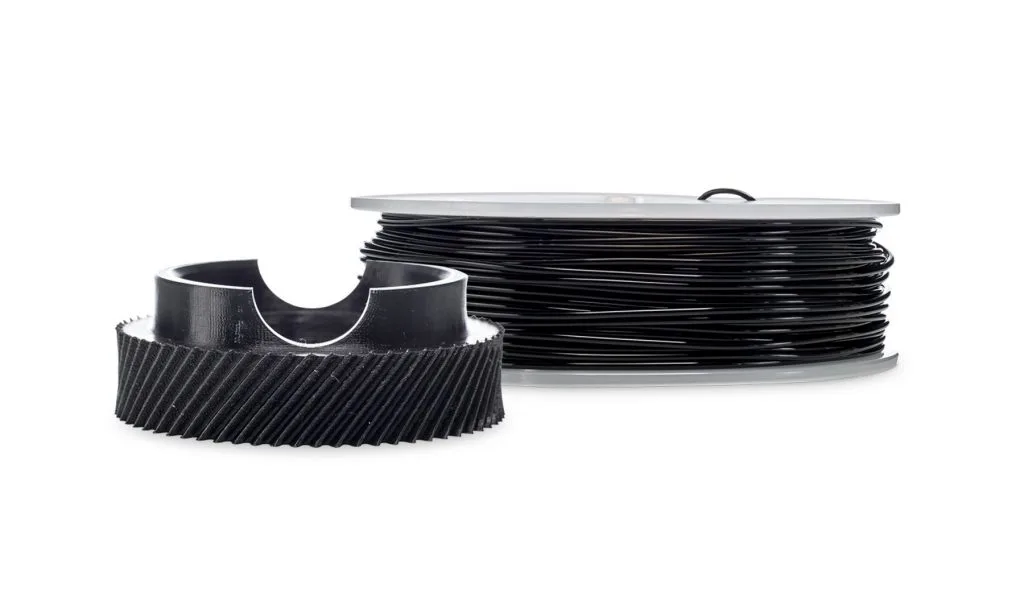
Nylon 3D printing filament is used for parts that do real work such as hinges, hooks, gears and couplings, unlike PLA and ABS which are usually used for models. Prusa Research ranks nylon as ‘very difficult to print’ and advises only experienced users: the filament absorbs up to about 10% of its weight in water if stored wrongly, needs drying for at least 4 hours below 90 °C before printing, a nozzle at about 285 °C, a bed at about 110 °C, and an enclosure because the material warps strongly and gives off fumes with a harsh smell and ultrafine particles.
Defects from damp filament are bubbles, a fuzzy surface and uneven layers, exactly like damp pellets in injection molding. Carbon-fiber-filled filament warps far less and can be printed without an enclosure (Prusa, stated for PA11 carbon). A printed part keeps absorbing moisture, so its stiffness differs between the humid season and the dry season.
Comparing PA and PE
The two groups of materials are in different classes. PE is a commodity plastic, flexible, cheap, used for bags, film, bottles and water pipe; PA is an engineering plastic, rigid, with better heat and wear resistance, used for machine parts. For concrete numbers, I use the Borealis HDPE datasheet (Borstar BB2588): density 958 kg/m³, melting point 132 °C, Vicat 127 °C, yield strength 30 MPa.
| Property | HDPE (BB2588) | PA6 (B3K) | PA66 (A3K) |
|---|---|---|---|
| Density | 958 kg/m³ | 1130 kg/m³ | 1130 kg/m³ |
| Melting point | 132 °C | 220 °C | 260 °C |
| Yield strength (dry) | 30 MPa | 80 MPa | 85 MPa |
| Moisture absorption | Very low, no effect on design | 2.6 to 3.4% at 50% RH | 2.5 to 3.1% at 50% RH |
| Used for | Bottles, crates, pipe, plastic pallets | Gears, bushings, machine housings | Gears, connectors, heat-resistant parts |
Many articles say PE ‘softens at around 80 to 90 °C’. For HDPE the Vicat softening temperature is 127 °C, so that statement is not correct for this grade; PE still loses to PA under heat plus load, but the number must be given for each PE grade. For holding water and chemicals, PE is the usual choice; for gears, plain bearings and rollers, it has to be PA.
What PA price depends on
PA pellets cost considerably more than PP, PE and ABS, and move with petrochemical feedstock prices, so this guide gives no figure. PA66 is usually more expensive than PA6, virgin pellets cost more than recycled, and glass fiber reinforced grades differ in price by fiber content. Mitsubishi Chemical also notes that PA66 costs more than PA6 and that PA6 is the economical choice when the extra properties of PA66 are not needed. For an exact quote, ask the pellet supplier by grade, origin and quantity.
Applications of PA
The automotive industry is the largest consumer of PA, about 35% according to a review in the journal Polimeros (2022), higher than the 30% often cited. Under the hood, PA is used for engine covers, air intake manifolds, coolant tanks and fuel systems thanks to heat and oil resistance; interiors and exteriors use it for door handles and mirror housings. The main benefit is being lighter than metal.
Electrical and electronics use PA for circuit breaker housings, connectors and insulating parts; to reach flame retardance a grade with flame retardant additive must be used, since ordinary PA only partly self-extinguishes (Aikolon). Cable ties are a familiar product made from PA66. Machinery uses PA for gears, plain bearings, conveyor rollers, screws and plastic bolts thanks to low friction and wear resistance, without frequent lubrication. Textiles use nylon fiber for sportswear, socks and straps. Household items include ladles and spatulas used with non-stick pans, with the migration temperature caution noted above.
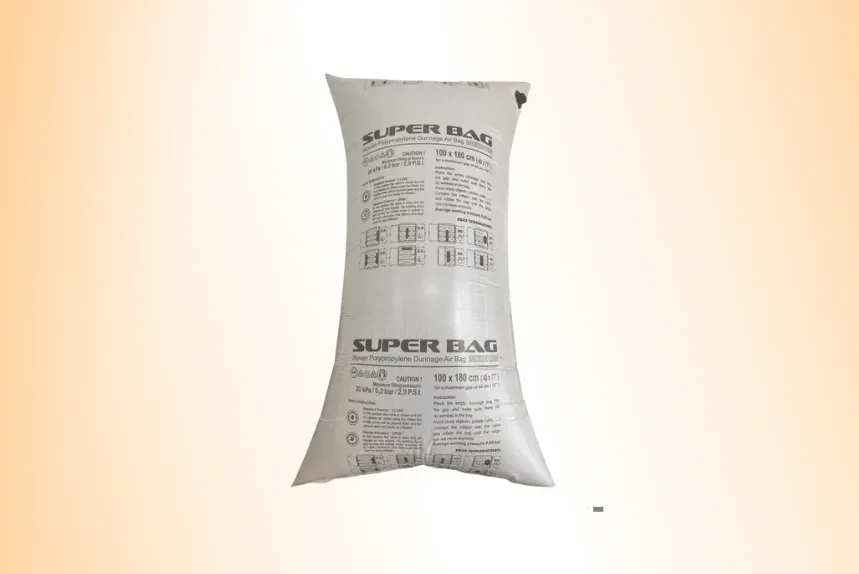
In packaging and logistics, PA appears in the core of container air dunnage bags: according to ICD Vietnam’s own documentation, the bag core is a PA/PE composite film, in which PA acts as the gas barrier so the bag holds pressure throughout the journey; the outer shell is kraft paper or woven PP. So saying PA is the main material of an air bag is not correct, PA is only one layer in the core; another manufacturer’s catalog gives about 15% PA in the core film.
Frequently asked questions
What is PA plastic?
PA (polyamide, commonly called nylon) is an engineering thermoplastic with repeating amide groups in its main chain. The two common types are PA6 (melting at about 220 °C) and PA66 (about 260 °C).
How does PA differ from PE and PP?
PE and PP are commodity plastics, cheap and flexible, used for bags, film and boxes. PA is an engineering plastic, rigid, with better wear and heat resistance but it absorbs moisture, so it is used for machine parts.
What is the drying temperature for PA pellets?
BASF recommends 80 °C for 4 hours in a dry air dryer for Ultramid B3K PA6 pellets, bringing pellet moisture to 0.03 to 0.06%. Other grades may differ, so follow the supplier’s datasheet.
What temperature can PA withstand?
Melting at 220 °C (PA6) and 260 °C (PA66). Under long-term load it is much lower: HDT A is only 60 and 75 °C, and the 20000-hour heat index is about 100 °C for unreinforced grades.
Is PA plastic safe in food contact?
Resin that meets food contact standards (21 CFR 177.1500 in the US, 10/2011 in the EU) is safe under the stated conditions. The BfR notes that oligomers migrate significantly above 70 °C, so limit prolonged hot contact.
How do you identify PA with a burn test?
PA burns with a blue flame edged in yellow, smells like burning horn or wool, and melts and drips heavily. This is only a rough identification, because flame retardant additives can distort the result (Boedeker).
Can PA be recycled?
It can be recycled because it is a thermoplastic, but it is harder than common plastics because it absorbs moisture and loses quality with each melting. Recycled material is usually used for engineering parts with lower requirements.
What is the recycling code for PA?
PA is not in groups 1 to 6, so it falls in group 7 (Other); products usually add the letters PA or Nylon to tell it apart.
Why is PA often mixed with glass fiber?
A code such as PA66 GF30 means PA66 reinforced with 30% glass fiber. Reinforcement raises stiffness, HDT and dimensional stability and reduces shrinkage, at the cost of being more brittle with a rougher surface.
Contact ICD Vietnam
ICD Vietnam Industrial Production Co., Ltd.
Northern Vietnam: 3rd Floor, Thang Long A1 Building, Bau Hamlet, Thien Loc Commune, Hanoi - 0983 797 186 / 090 345 9186 / 090 5859 186
Southern Vietnam: 551/212 Le Van Khuong Street, Tan Thoi Hiep Ward, District 12, Ho Chi Minh City - 098 6784 186
Email: sales@icdvietnam.com.vn
Zalo: Chat on Zalo now
References
- BASF, Ultramid B3K (PA6) Product Information, 09/2026: density 1130 kg/m3, melting point 220 °C, saturated water uptake 9 to 10%, equilibrium at 23 °C/50% RH 2.6 to 3.4%, HDT A 60 °C, drying 80 °C 4 hours - download.basf.com
- BASF, Ultramid A3K (PA66) Product Information, 09/2026: melting point 260 °C, saturated water uptake 8 to 9%, equilibrium 2.5 to 3.1%, HDT A 75 °C, shrinkage 1.5/1.8%
- 21 CFR 177.1500, Nylon resins (conditions and extractive limits for nylon 6 and nylon 66 in food contact, eCFR) - ecfr.gov
- BfR (Germany), Polyamide Kitchen Utensils: Keep contact with hot food as brief as possible (SML caprolactam 15, hexamethylenediamine 2.4, adipic acid 60 mg/kg under Reg. EU 10/2011; PA oligomers migrate into hot food above 70 °C) - bfr.bund.de
- Asahi Kasei, What are polyamide resins (nylon resins)? (structure, carbon numbers in PA names, pros and cons) - asahi-kasei-plastics.com
- Mitsubishi Chemical Group, Nylons as Engineering Plastics (PA6 and PA66, water uptake, wear ISO 7148-2) - mcam.com
- Prusa Knowledge Base, Polyamide (Nylon) (dry at least 4 hours below 90 °C, absorbs up to 10% of weight, nozzle 285 °C) - help.prusa3d.com
- Borealis, Borstar BB2588 HDPE Product Data Sheet, 05/08/2024 (density 958 kg/m3, melting point 132 °C, Vicat 127 °C) - borealisgroup.com
- Aikolon, Identification of plastics by burning (PA: blue flame edged in yellow, smell of burning horn or wool, melts and drips heavily) - aikolon.fi
- Boedeker Plastics, Plastic Identification (burn test for rough identification only) - boedeker.com
- ICD Vietnam, article Dunnage Bag Materials: Kraft, Woven PP, PA/PE (internal documentation on air dunnage bag construction: PA/PE core, kraft or woven PP shell)
- Polimeros (2022), Recent advances in the use of Polyamide-based materials for the automotive industry (automotive accounts for 35% of PA consumption) - doi.org
- Standards ISO 1874 (molding and extrusion polyamide materials) and ASTM D4066 (polyamide classification)