
Table of Contents
Reviewed and updated by ICD - Week 43/2026
Short answer: PA is stiffer, carries more load and resists heat better than PE, but it absorbs 2.6 to 3.4% water (PA6) and so changes size; PE absorbs almost no water (0.01%), is lighter (it floats on water) and is softer. PA plastic melts at 220 °C (PA6) or 260 °C (PA66), while PE plastic melts at about 95 to 115 °C (LDPE) and 132 °C (HDPE). Neither is better in every case; it depends on the job.
PA (nylon) and PE (polyethylene) differ from the molecular level: PA has amide groups that form hydrogen bonds, so it is stiff and heat resistant but attracts water; PE is only a hydrocarbon chain, so it is inert, light and does not absorb water. This article sets the figures from both sides next to each other, corrects some familiar claims (such as “PA withstands over 200 °C”) and explains how to tell the two apart when you meet material of unknown origin.
PA and PE compared using datasheet figures
PE figures come from Borealis BB2588 HDPE resin (an injection and blow moulding grade) and from the MatWeb summary for LDPE; PA figures come from BASF Ultramid B3K (PA6) and A3K (PA66). Any specific resin may vary; the table is only for comparing scale.
| Criterion | PA6, PA66 | HDPE | LDPE |
|---|---|---|---|
| Density | 1.13 g/cm³ | 0.958 g/cm³ | about 0.92 g/cm³ |
| Melting point | 220 °C (PA6), 260 °C (PA66) | 132 °C | 95 to 115 °C |
| HDT 1.8 MPa | 60 °C (PA6), 75 °C (PA66) | not in the source | about 67 °C (MatWeb average) |
| Water absorption | equilibrium 2.6 to 3.4%, saturation 9 to 10% (PA6) | very low | 0.01% |
| Tensile strength at yield | 80 MPa dry, 40 MPa wet (PA6) | 30 MPa | not in the source |
| Tensile modulus | 3,100 MPa dry, 1,000 MPa wet (PA6) | not in the source | not in the source |
Two common claims need correcting. “PA withstands more than 200 °C”: this is true only of the melting point; under a 1.8 MPa load PA6 deforms at about 60 °C, and only glass-fibre-reinforced grades reach several hundred degrees. “PE is 100% waterproof”: PE absorbs very little water (0.01%) but water vapour still passes through thin film (the MatWeb summary for LDPE gives about 17.4 g/m² per day, depending on thickness); so resisting water absorption is not the same as being completely impermeable.
How to tell PA from PE when the material is unknown
The simplest test is to drop a sample in water. PE has a density below 1 (HDPE 0.958) so it floats; PA6 and PA66 are both 1.13 so they sink. This test rules out one of the two groups straight away, unless the sample contains fillers or glass fibre that change the density.
A burn test can also give a rough identification: Boedeker has a table of flame colour, smell and dripping behaviour for each plastic, with a warning that flame retardants and additives can mask the true behaviour. No measured source was found for hand-feel tips (PE “waxy”, PA “slippery”) or for the sound when tapped, so treat them as personal experience only.
Applications of PA
PA suits parts that carry load and friction: castor wheels, bushings, gears. For wheels, Blickle lists a nylon tread of 70 to 80 Shore D with a floor pressure of about 40 N/mm², and Bulldog Castors lists a working range of -30 to +80 °C. PA66 cable ties are another familiar use: the ERIKS datasheet lists a range of -35 to +85 °C, 105 °C for short periods, moderate UV resistance (the black type is the UV-resistant one) and good resistance to oils and greases. So “a cable tie withstands long direct sunlight” holds only for the UV-stabilised black type.
Two common drawbacks of PA: water absorption changes dimensions and lowers stiffness, and the resin must be dried before moulding (80 °C for 4 hours for PA6, BASF).
Applications of PE
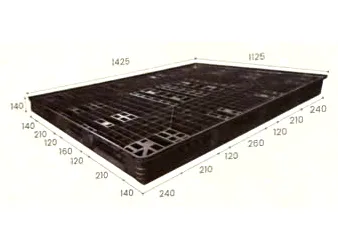
PE accounts for most packaging and containment demand: PE pallet stretch film secures loads, along with drums, plastic jerrycans, agricultural mulch film, pallets and plastic crates. The reasons are that PE is light, inert, tough against impact at ordinary temperatures and easy to process. Virgin HDPE is the base material of ICD Vietnam’s plastic pallets and industrial plastic crates; its strength is toughness and impact resistance, its weakness is that it softens when hot, so static load and temperature must be judged together.
Frequently asked questions
How do PA and PE plastics differ?
PA is stiff, melts at 220 °C (PA6) or 260 °C (PA66) and absorbs 2.6 to 3.4% water. PE is softer, melts at 95 to 132 °C, absorbs 0.01% water and floats on water.
Is PA more heat resistant than PE?
Yes: the melting point of PA6 is 220 °C, higher than PE at 132 °C. But under a 1.8 MPa load PA6 deforms at about 60 °C, so both load and temperature must be considered.
Is PE completely waterproof?
PE absorbs very little water (0.01%) but water vapour still passes through thin film, so say that PE resists water absorption, not that it is absolutely impermeable.
How can I tell PA from PE by eye?
Drop it in water: PE (HDPE 0.958 g/cm³) floats, PA (1.13 g/cm³) sinks. A burn test gives only a rough identification because additives can mask the behaviour.
Are plastic cable ties made of PA or PE?
Most electrical cable ties are nylon 6.6 (PA66), with a range of -35 to +85 °C according to ERIKS; only the UV-stabilised black type is used outdoors for a long time.
When should I choose PE instead of PA?
When you need light weight, no water absorption, packing or containment, and a working temperature below about 80 °C.
Contact ICD Vietnam
ICD Vietnam Industrial Manufacturing Co., Ltd.
Northern Vietnam: 3rd Floor, Thang Long A1 Building, Thon Bau, Thien Loc Commune, Hanoi - 0983 797 186 / 090 345 9186 / 090 5859 186
Southern Vietnam: 551/212 Le Van Khuong Street, Tan Thoi Hiep Ward, District 12, Ho Chi Minh City - 098 6784 186
Email: sales@icdvietnam.com.vn
Zalo: Chat on Zalo now
References
- BASF, Ultramid B3K (PA6) Product Information, 09/2026: density 1,130 kg/m3, melting point 220 °C, saturation moisture 9 to 10%, equilibrium at 23 °C/50% RH 2.6 to 3.4%, HDT A 60 °C, drying 80 °C for 4 hours - download.basf.com
- BASF, Ultramid A3K (PA66) Product Information, 09/2026: melting point 260 °C, saturation moisture 8 to 9%, equilibrium 2.5 to 3.1%, HDT A 75 °C, shrinkage 1.5/1.8%.
- Borealis, Borstar BB2588 HDPE Product Data Sheet, 05/08/2024 (density 958 kg/m3, melting point 132 °C, Vicat 127 °C) - borealisgroup.com
- LookPolymers, Overview of materials for LDPE, Molded (summary from MatWeb: melting point 95 to 115 °C, water absorption 0.01%) - lookpolymers.com
- ERIKS, Datasheet RX cable ties nylon 6.6 (PA66, -35 to +85 °C, 105 °C short term, moderate UV resistance, UL 94 V2) - eriksdigitalcdn.azureedge.net
- Blickle, Info box wheel and castor series (tread hardness: nylon 70 Shore D, cast nylon 80 Shore D, PU 92 Shore A; mean floor pressure nylon 40, PU 92 Shore A 8 N/mm2) - blickle.com
- Bulldog Castors, Engineering Polymers: Material Properties of Polymeric Caster Wheels (nylon 80 to 90 Shore D, -30 to +80 °C, nylon 6 and 66 both used for wheels and wheel cores) - bulldogcastors.co.uk
- Boedeker Plastics, Plastic Identification (burn test for rough identification only) - boedeker.com