
Table of Contents
Reviewed and updated by ICD - Week 43/2026
Short answer: PA (polyamide) plastic can be used for food contact when it is a compliant resin: the US has 21 CFR 177.1500 for nylon 6 and nylon 66, and the EU has Regulation 10/2011. PA is not made from bisphenol A (BPA). But “absolutely safe” is not correct: BfR (Germany) notes that PA oligomers migrate significantly into food hotter than 70 °C, and recycled PA has no clear legal route into food use.
Many articles online claim PA is “absolutely safe, withstands 260 °C and releases nothing”. All three claims need correcting: 260 °C is the melting point of PA66, not a safe cooking temperature, and migration depends on the resin, the temperature and the contact time. This article relies on FDA and EU rules and BfR advice to separate what has a basis from what does not.
BPA and the substances that can really migrate from PA
PA does not use bisphenol A as a raw material. The list of substances BfR checks for PA kitchen utensils includes caprolactam (PA6), hexamethylenediamine and adipic acid (PA66), and no bisphenol A; this matches the structure of PA described by Asahi Kasei (a repeating chain of amide groups formed from an amine and an acid). So “PA contains no BPA” has a basis, but it is a statement about raw materials and does not mean “nothing migrates”.
The substances of concern are residual monomers and oligomers. EU 10/2011 sets specific migration limits: caprolactam 15 mg/kg of food, hexamethylenediamine 2.4 mg/kg, adipic acid 60 mg/kg (figures as quoted by BfR). The US rule 21 CFR 177.1500 sets a maximum residual caprolactam of 0.7% by weight for nylon 6/66 type 4.1 and separately regulates the amount extracted in water and solvents. 21 CFR 177.1500 is a rule on resin composition, not an “FDA certificate” for the finished product, as many articles call it.
| Regulation | Issued by | What it covers for PA |
|---|---|---|
| 21 CFR 177.1500 | FDA (US) | Permitted nylon types, extraction limits, residual caprolactam |
| Regulation (EU) 10/2011 | EU | Specific migration limits for each monomer, checked under the conditions of use |
| BfR advisory (Germany) | BfR | Reduce the time PA kitchen utensils are in contact with hot food |
Temperature: 260 °C is not a safe cooking level
PA6 melts at 220 °C and PA66 at 260 °C (BASF). That is the temperature at which the material turns liquid, not a temperature for use. Under a 1.8 MPa load, PA6 deforms at about 60 °C and PA66 at 75 °C (unreinforced grades). On food safety, BfR has a clear advisory: PA oligomers migrate into food significantly when hot above 70 °C, so keep PA ladles and spatulas in contact with hot food as briefly as possible.
Three comparisons found in many articles (PET “deforms above 70 °C”, PVC “gives off toxic gas when burned”, PA “stable at 100 to 120 °C without releasing free radicals”) have no measured source that could be found, so they are not used. The sourced parts are the melting points, the HDT and the 70 °C advisory above.
Virgin and recycled PA
Virgin resin has a clear material record, so it is the only sensible choice for food contact. Recycled resin is different: FDA reviews each case, naming three main concerns: contaminants from earlier use, input material not permitted for food, and additives that do not meet the rules. The EU rules under Regulation 2022/1616: recycled plastic in food contact may be placed on the market only when it uses a listed or authorised recycling technology and meets the requirements of 10/2011.
In practice, EFSA currently assesses mainly mechanical recycling technologies for post-consumer PET. No authorised PA recycling process for food contact was found, so for recycled PA a cautious conclusion is: do not use it for food unless the supplier can show a process authorisation. For castor wheels, machine parts and industrial mesh, recycled PA is still usable because there is no food contact.
Where PA is used, on a sound basis
Row 6.2 in the table of 21 CFR 177.1500 allows nylon 6 as food-contact film no thicker than 0.001 inch (about 25 micron), so nylon film inside multilayer packaging has a legal basis. Repeated-use utensils such as ladles and spatulas are covered by a similar rule but must follow the extraction limits above and BfR’s heat advice. In industry, PA is used for wheels, bushings and gears, where there is no food contact; that falls under the articles on PA6 and PA66 and outside the scope of food safety.
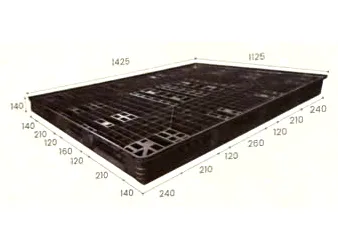
If you are choosing logistics supplies rather than nylon parts, see ICD Vietnam’s plastic pallet lines by load capacity and rack type.
Frequently asked questions
Is PA plastic safe?
Yes, when it is a food-grade resin (21 CFR 177.1500, EU 10/2011) and used at the right temperature. Do not say “absolutely safe”: BfR notes that oligomers migrate significantly when hot above 70 °C.
Does PA plastic contain BPA?
No. PA is made from caprolactam, or from hexamethylenediamine with adipic acid; BPA is not on the list of PA monomers.
How much heat can PA plastic withstand?
It melts at 220 °C (PA6) and 260 °C (PA66), but under a 1.8 MPa load it holds only to 60 and 75 °C. For hot food, keep it under 70 °C according to BfR advice.
Can recycled PA be used for food?
It should not be. The EU requires a listed or authorised recycling technology (2022/1616) and FDA reviews each case; no authorised PA process was found.
Is 21 CFR 177.1500 an FDA certificate?
No. It is a rule on permitted nylons and extraction limits, not a certificate for the finished product.
Is it fine to use PA ladles and spatulas with a hot pan?
Limit long contact with hot food, and do not leave PA resting on a pan that is heating.
Contact ICD Vietnam
ICD Vietnam Industrial Manufacturing Co., Ltd.
Northern Vietnam: 3rd Floor, Thang Long A1 Building, Thon Bau, Thien Loc Commune, Hanoi - 0983 797 186 / 090 345 9186 / 090 5859 186
Southern Vietnam: 551/212 Le Van Khuong Street, Tan Thoi Hiep Ward, District 12, Ho Chi Minh City - 098 6784 186
Email: sales@icdvietnam.com.vn
Zalo: Chat on Zalo now
References
- 21 CFR 177.1500, Nylon resins (conditions and extraction limits for nylon 6 and nylon 66 in food contact, eCFR) - ecfr.gov
- BfR (Germany), Polyamide Kitchen Utensils: Keep contact with hot food as brief as possible (SML caprolactam 15, hexamethylenediamine 2.4, adipic acid 60 mg/kg under Reg. EU 10/2011; PA oligomers migrate into hot food above 70 °C) - bfr.bund.de
- Regulation (EU) 2022/1616 on recycled plastic materials and articles intended to come into contact with food (EUR-Lex summary) - eur-lex.europa.eu
- FDA, Recycled Plastics in Food Packaging (case-by-case review, 3 main concerns: contaminants, non-compliant input material and additives) - fda.gov
- EFSA, Plastic recycling process application procedure (currently assesses mechanical recycling technologies for post-consumer PET) - efsa.europa.eu
- BASF, Ultramid B3K (PA6) Product Information, 09/2026: density 1,130 kg/m3, melting point 220 °C, saturation moisture 9 to 10%, equilibrium at 23 °C/50% RH 2.6 to 3.4%, HDT A 60 °C, drying 80 °C for 4 hours - download.basf.com
- BASF, Ultramid A3K (PA66) Product Information, 09/2026: melting point 260 °C, saturation moisture 8 to 9%, equilibrium 2.5 to 3.1%, HDT A 75 °C, shrinkage 1.5/1.8%.
- Asahi Kasei, What are polyamide resins (nylon resins)? (structure, carbon numbers in PA names, strengths and weaknesses) - asahi-kasei-plastics.com