Table of Contents
- Desiccant color chart and meaning
- How color-changing beads work
- Blue (cobalt) beads and orange (methyl violet) beads
- When a sealed packet hides the color
- Frequently asked questions
- What is the difference between orange and blue desiccant beads?
- What does it mean when desiccant beads turn pink?
- Can color-changing desiccant beads be reused?
- Are blue desiccant beads poisonous?
- What color do orange desiccant beads change to?
- Do white desiccant beads change color?
- What are black desiccant beads?
- When should indicator desiccant beads be replaced?
- Contact ICD Vietnam for desiccant advice
- References
- Related articles
Reviewed and updated by ICD - Week 40/2026
Desiccant beads that change from blue to pink (or from orange to green) carry an indicator showing that the beads have absorbed a lot of water and are nearly out of capacity. When about 70 to 80% of the beads in a container have changed color, re-dry or replace them.
The point to remember on safety: blue beads use a cobalt chloride indicator, classified by the EU as carcinogenic category 1B and restricted in many applications; orange beads are a cobalt-free choice, usable for export goods to the EU.
Desiccant color chart and meaning
| Bead type | Color when dry | Color when saturated | Indicator | Safety and regulation |
|---|---|---|---|---|
| White silica gel (no indicator) | Clear or white | Cloudy white | None | Low toxicity, used for food, pharmaceuticals, electronics |
| Blue silica gel | Deep blue | Pink (via violet), may turn cloudy white at about 40% saturation | Cobalt chloride | Classed by the EU as carcinogenic 1B, restricted in many fields; not for use with food or medicine |
| Orange silica gel | Orange | Pale green or colorless | Organic indicator (cobalt-free) | Cobalt-free, suits modern regulation and EU export |
| Pink beads | Light or dark pink | Already saturated (blue converted) | Cobalt chloride (already absorbed moisture) | Handle with the same caution as blue beads |
| Black beads | Black | No color change | Activated carbon or iron powder (oxygen absorber) | Carbon for odor; an iron powder packet is an oxygen absorber |
| Clay, bentonite | Grey-brown, beige | No color change | None | No indicator, monitor with a hygrometer or by weight |
| Calcium chloride (container bag) | White | Wet or turns to gel | None | Shown by the amount of gel, not by color |
How color-changing beads work
The indicator changes color according to the amount of water the bead has absorbed, without changing the nature of the silica gel. For the blue type, the color shifts from deep blue to violet and then pink as the beads absorb about 8% of their weight in moisture, and only turns fully pink or cloudy white near saturation at about 40%.
The orange type changes from orange to yellow and then pale green. Industry documents note that beads that have turned pale green still have about 20 to 30% capacity, so the color is a relative sign and not an on-off switch.
The practical replacement threshold is when about 70 to 80% of the beads have changed color: do not replace as soon as a few beads change, but do not wait until all have fully changed either, as you would lose the protection margin.
When re-drying, blue beads can only tolerate no more than 125 °C, above which the indicator is destroyed; orange beads tolerate heat better and are stable at 120 to 150 °C for 2 to 4 hours, and according to one manufacturer can be regenerated at about 132 to 160 °C. The exact temperature should follow the documentation of the supplier of the beads you bought, and the full drying steps are in how to reuse desiccant beads. The beads are dry when they return to their original color.
Blue (cobalt) beads and orange (methyl violet) beads
The base silica gel is inert; the risk comes from the indicator. Blue beads use cobalt chloride, a heavy-metal salt, listed by ECHA as a substance of very high concern (SVHC), classified by the EU as carcinogenic 1B, toxic by inhalation and a respiratory sensitizer.
For this reason it is restricted or banned for many consumer goods, medicine and food applications in the EU, the UK, Australia and Canada, and museum sources advise caution when using it near objects and staff.
Orange beads use methyl violet, an organic indicator that contains no cobalt, considered safer but still not for eating.
From this the choice is fairly clear. Food, medicine, consumer goods and goods exported to the EU should use white or orange silica gel. Electrical cabinets, laboratories and tightly controlled industry can use blue beads where regulation allows, because the indication is clear and the price moderate.
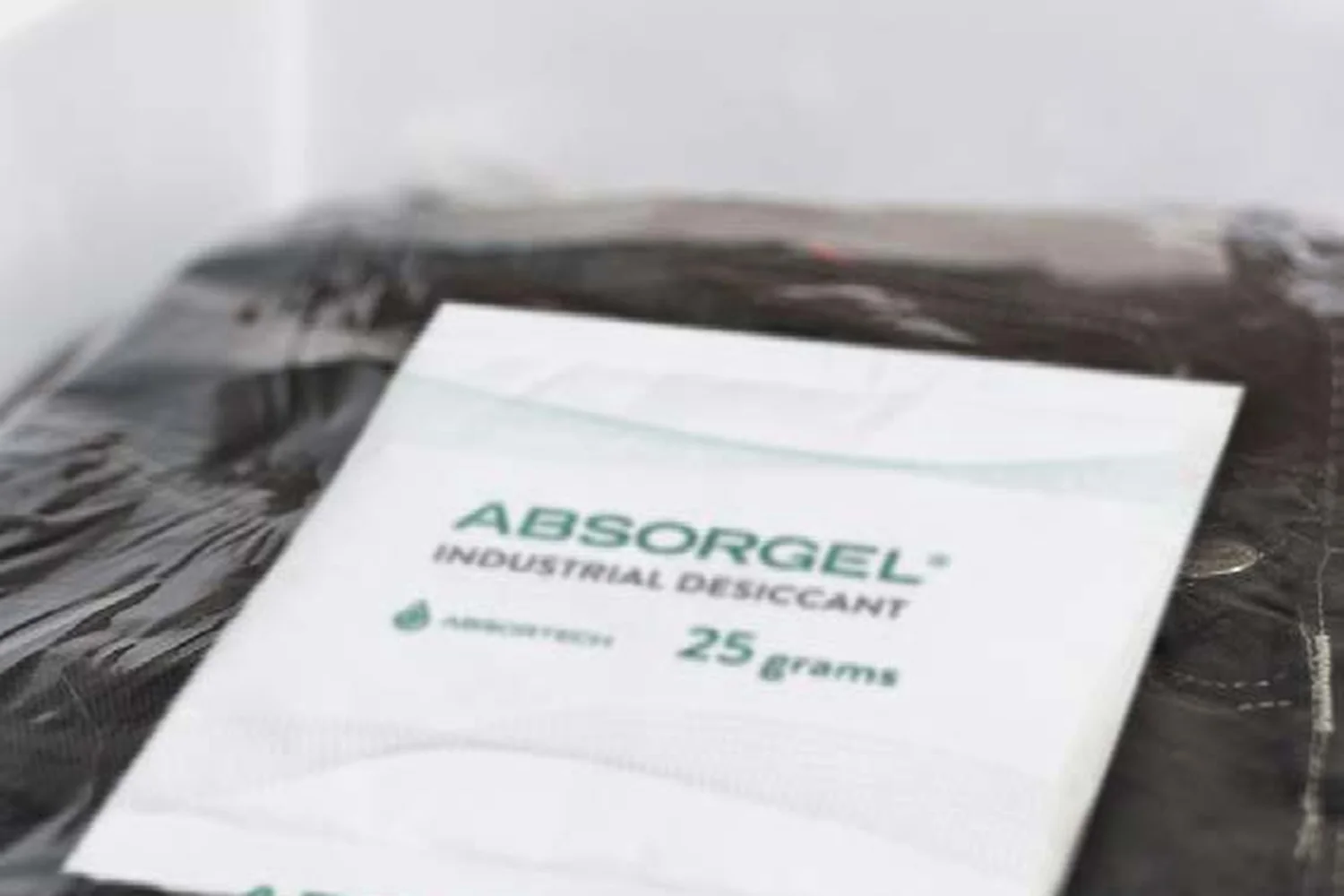
If you only need to absorb moisture without a color signal, white silica gel or clay is the most economical, while sea containers and export goods should use gel-form calcium chloride that absorbs over 300% with REACH and RoHS documentation; see ICD desiccants. The AbsorGel Hanging-C bags from Absortech use calcium chloride mixed with starch, with no cobalt indicator, and the manufacturer publishes REACH and RoHS compliance statements and an SGS test report (September 2025); for document details see HS code and MSDS for desiccant beads. If someone has swallowed blue beads, see what happens if you swallow a desiccant packet.
When a sealed packet hides the color
A sealed desiccant packet usually does not show the color of the beads. There are three alternatives: use a humidity indicator card placed next to the packet (see how to measure humidity), place a few indicator beads in a clear tube beside the packet, or monitor by weight.
Silica gel absorbs at most about 40% of its weight at 90% humidity, so a packet that has become noticeably heavier than when new is a sign it is nearly full.
Clay and calcium chloride packets have no indicator: clay is monitored with a hygrometer or by weight, while calcium chloride is signaled by the amount of gel and not by color.
Black beads are usually activated carbon for odor control or an iron-powder oxygen absorber, and pale pink beads in an old packet are blue beads that have absorbed moisture, so handle them with the same caution as blue. For a comparison of bead types, see types of desiccant.
Frequently asked questions
What is the difference between orange and blue desiccant beads?
Blue beads use cobalt chloride (blue to pink, classed as carcinogenic 1B in the EU); orange beads use methyl violet (orange to green), which is less hazardous.
What does it mean when desiccant beads turn pink?
Blue silica gel turns pink when it is saturated with moisture, meaning it has lost or nearly lost its ability to absorb. Re-dry or replace it.
Can color-changing desiccant beads be reused?
Yes. Dry at about 120 °C for 2 to 3 hours (blue beads not above 125 °C); the beads are dry when they return to their original color.
Are blue desiccant beads poisonous?
Blue beads contain cobalt chloride, which is more toxic than white silica gel and restricted in the EU. Treat with caution and do not use with food.
What color do orange desiccant beads change to?
From orange to pale green or colorless when saturated. This is the cobalt-free type.
Do white desiccant beads change color?
They have no indicator. When saturated, white beads turn more cloudy but it is hard to notice.
What are black desiccant beads?
Usually activated carbon for odor control or an iron-powder oxygen absorber. Use a magnet to tell them apart: iron is attracted.
When should indicator desiccant beads be replaced?
When about 70 to 80% of the beads have changed color.
Contact ICD Vietnam for desiccant advice
ICD Vietnam Industrial Production Co., Ltd.
North: 3rd Floor, Thang Long A1 Building, Bau Hamlet, Thien Loc Commune, Hanoi, 0983 797 186 / 090 345 9186 / 090 5859 186
South: 551/212 Le Van Khuong, Tan Thoi Hiep, District 12, Ho Chi Minh City, 098 6784 186
Email: sales@icdvietnam.com.vn
Zalo: Chat on Zalo