Table of Contents
- Comparison of desiccant types
- Silica gel: the most common and flexible type
- Calcium chloride: strongest absorber, for heavy humidity
- Clay (bentonite): cheap, works well in cool places
- Molecular sieve 3A, 4A, 5A: for very low humidity
- Activated alumina and activated carbon
- Which one should you choose
- Frequently asked questions
- How many types of desiccant are there?
- Which desiccant is best?
- What is silica gel desiccant?
- How is bentonite clay different from silica gel?
- What is the difference between molecular sieve 3A, 4A and 5A?
- Can calcium chloride desiccant be reused?
- Does activated carbon absorb moisture?
- What are black desiccant beads?
- Contact ICD Vietnam for desiccant advice
- References
- Related articles
Reviewed and updated by ICD - Week 40/2026
There are five common groups of desiccant: silica gel, clay (bentonite), molecular sieve, calcium chloride and activated alumina; which one to choose depends on humidity, temperature and where you need to keep things dry. Silica gel is stable at room temperature and reusable; calcium chloride absorbs many times its own weight but is single-use, suited to sea containers; molecular sieve is strongest at very low humidity; clay is cheapest but less heat-stable.
This article compares them with figures and explains how to choose for each situation.
Comparison of desiccant types
| Type | Capacity (by weight) | Heat tolerance | Reusable | Cost | Best for |
|---|---|---|---|---|---|
| Silica gel | About 10% at 10% RH, 25% at 30% RH, 40% at 90% RH | Best below about 25 °C; less effective above 38 °C | Yes (120 °C, 2 to 3 hours) | Low to medium | Electronics, medicine, dry food, wardrobes, camera boxes |
| Calcium chloride | About 150% at 50% RH, 250 to 300% at 70% RH, up to 600% at 85% RH | Keeps working in heat | No | Medium to high | Sea containers, humid tropical warehouses |
| Clay (montmorillonite, bentonite) | About 8 to 10% at 10% RH, 20 to 25% at 30% RH, 25 to 31% at 90% RH | Poor in heat; releases moisture above about 50 °C | Limited (performance drops) | Lowest | Cartons, cool stores, low budgets |
| Molecular sieve (3A, 4A, 5A) | High at low humidity, can dry below 1% RH | Withstands over 200 °C | Yes (high heat, 100+ cycles) | High | Precision equipment, compressed air, industry, ultra-dry |
| Activated alumina | High at medium to low humidity, also adsorbs some gases | Good | Yes (high heat) | Medium | Compressed air dryers, gas treatment |
| Activated carbon | Mainly adsorbs odors and gases, poor at moisture | Good | Limited | Low | Odor control, not a primary desiccant |
Capacity figures follow industry technical documents; for clay, some sources say it is reusable and some say single-use, so plan conservatively.
Silica gel: the most common and flexible type
Silica gel is porous silicon dioxide (SiO2), holding water vapor on the surface of its pores through physical adsorption.
According to industry technical documents it can hold up to about 40% of its own weight, works effectively at 60 to 90% humidity and is stable up to about 49 °C. In practice you meet three kinds.
Clear white beads are used for dry food and pharmaceuticals; according to industry documents, in the US only silica gel is approved by the FDA for contact with food and medicine. Orange beads are a cobalt-free indicator type, changing from orange to green.
Blue beads use a cobalt chloride indicator, turning pink at about 8% moisture by weight, and should not be used near food; the meaning of the colors is in color-changing desiccant beads.
Calcium chloride: strongest absorber, for heavy humidity
Calcium chloride is a powerful hygroscopic salt. According to technical comparison tables it absorbs about 150% at 50% RH and up to 600% at 85% RH, far more than silica gel (40% at 90% RH).
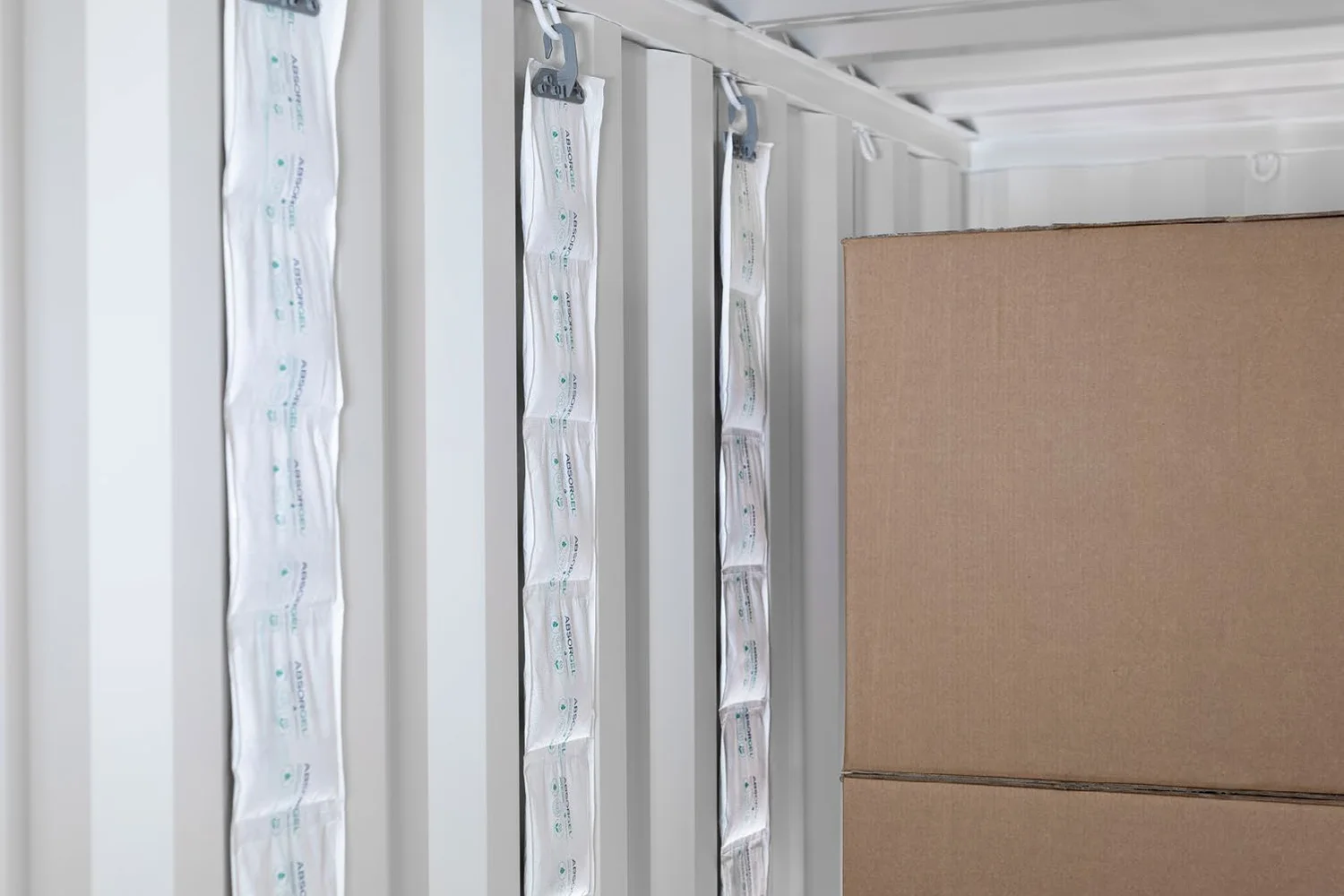
The trade-off is that once saturated it dissolves into a brine (deliquescence) and can only be used once. Absortech solves this weakness by mixing calcium chloride (over 94%) with starch to form a gel, so AbsorGel bags absorb over 300% in real conditions while keeping the liquid inside the bag.
This is why the Hanging-C container bag, Blanket-C blanket and Pouch packets use calcium chloride for long sea voyages.
Clay (bentonite): cheap, works well in cool places
Activated clay (montmorillonite) has a capacity of about 20 to 30% of its weight and is the cheapest of the types. Its limit is that it releases moisture again once temperature exceeds about 50 °C, so it is not suited to containers crossing hot tropical regions.
For cartons, footwear and cool stores, clay is the economical choice. The Absortech AbsorTerra packet uses montmorillonite clay in FSC kraft paper, absorbing 20 to 30% under DIN 55473, suitable for cartons and storage boxes.
Molecular sieve 3A, 4A, 5A: for very low humidity
Molecular sieve (zeolite) has uniform pore size, and the number in the name (3A, 4A, 5A) is the pore diameter in angstroms.
The 3A type is typically used to absorb water while excluding larger molecules, so it is common in solvent and gas drying; 4A and 5A have larger pores and absorb a wider range of molecules.
According to industry technical documents, molecular sieve can pull humidity below 1% RH and withstand over 225 °C, but it is expensive and has no FDA approval for food and drug packaging in the US. It is used widely in industry, precision instruments and insulated glass.
Activated alumina and activated carbon
Activated alumina is mainly used in compressed air dryers and gas treatment, absorbing moisture well at medium levels. Activated carbon leans toward absorbing odors and gases, so it cannot replace a desiccant; black “odor control” packets are usually carbon.
Which one should you choose
For sea containers of 30 days or more, gel-form calcium chloride (a hanging bag or a blanket laid on the pallet) is the reasonable choice because of its large capacity and its ability to keep working in heat and humidity.
For cartons of garments and footwear, clay or small calcium chloride packets give low cost and are enough for the small volume.
Wardrobes, shoe boxes and camera boxes suit indicator silica gel because it is reusable and shows by color when it is full; dry food and medicine need food-contact grade silica gel.
Precision equipment, compressed air and insulated glass use molecular sieve or alumina for deep drying at low humidity, while odor control uses activated carbon because it is not a desiccant.
Beyond the bead type, look at the real conditions where it will be used.
Capacity must be calculated at the humidity you actually meet (50%, 70% or 85% RH), not an ideal figure; above 38 °C silica gel and clay lose effectiveness; and if there is contact with food or medicine, choose a compliant grade and avoid cobalt indicator beads.
Single use versus reuse is covered in how to reuse desiccant beads, export documents (SDS, REACH, RoHS) in HS code and MSDS, and the dose needed for a given volume in how to use desiccant packets correctly.
Absorbing moisture is not always enough. For metal goods that need rust protection, combine with VCI anti-corrosion; oxygen absorbers work by a different mechanism, see oxygen absorber vs desiccant packet. The full range is at ICD desiccants.
Frequently asked questions
How many types of desiccant are there?
The common ones are silica gel, clay, calcium chloride, molecular sieve, activated alumina and activated carbon (odor control). The three most often seen in Vietnam are silica gel, clay and calcium chloride.
Which desiccant is best?
There is no single best for every place: calcium chloride absorbs the most, silica gel can be reused, clay is cheapest, and molecular sieve is strong at very low humidity. Choose by humidity, temperature and purpose.
What is silica gel desiccant?
Porous silicon dioxide beads that draw water vapor into their pores by physical adsorption, holding up to about 40% of their weight at high humidity and reusable after drying.
How is bentonite clay different from silica gel?
Clay is natural earth, cheaper, absorbing about 20 to 30% but less heat-stable; silica gel absorbs more and is more stable at room temperature.
What is the difference between molecular sieve 3A, 4A and 5A?
The pore diameter (3, 4 or 5 angstroms), which decides which molecules fit. 3A absorbs water while excluding larger molecules; 4A and 5A absorb more widely.
Can calcium chloride desiccant be reused?
No. Saturated calcium chloride becomes a brine and is single-use.
Does activated carbon absorb moisture?
Very poorly. Activated carbon is mainly used to absorb odors and gases.
What are black desiccant beads?
Usually activated carbon for odor control, or sometimes an oxygen absorber with iron powder. Tell them apart with a magnet: iron is attracted.
Contact ICD Vietnam for desiccant advice
ICD Vietnam Industrial Production Co., Ltd.
North: 3rd Floor, Thang Long A1 Building, Bau Hamlet, Thien Loc Commune, Hanoi, 0983 797 186 / 090 345 9186 / 090 5859 186
South: 551/212 Le Van Khuong, Tan Thoi Hiep, District 12, Ho Chi Minh City, 098 6784 186
Email: sales@icdvietnam.com.vn
Zalo: Chat on Zalo