Table of Contents
- What happens with each type of desiccant packet
- Why a desiccant packet gets warm
- Putting a desiccant packet in water
- Desiccant packet leaking or dripping
- Can a desiccant packet explode
- What to do when a packet splits, overheats or leaks
- Frequently asked questions
- Do desiccant packets get hot?
- Why does a desiccant packet get hot?
- Is a hot desiccant packet dangerous?
- Is it a problem to put a desiccant packet in water?
- Will a desiccant packet explode in water?
- Does a desiccant packet dissolve in water?
- Why is my desiccant packet leaking?
- Is the liquid from a desiccant packet poisonous?
- Contact ICD Vietnam for desiccant advice
- References
- Related articles
Reviewed and updated by ICD - Week 40/2026
A desiccant packet that gets hot, crackles in water or leaks has a clear cause, but how dangerous it is depends entirely on what is inside: silica gel only warms slightly and crackles in water, calcium chloride gives off strong heat and turns into a liquid, while quicklime (calcium oxide) and iron-powder oxygen absorbers are the two types that can genuinely get hot. Most Vietnamese articles only talk about silica gel and conclude “safe, only a 5 to 10 °C rise”. That is right for silica gel but wrong if your packet is another type, so the first step is to identify the packet.
What happens with each type of desiccant packet
| Phenomenon | Silica gel | Clay | Calcium chloride (container bag, gel packet) | Quicklime (calcium oxide) | Oxygen absorber (iron powder) |
|---|---|---|---|---|---|
| Heat in use | Slightly warm, barely noticeable | Slightly warm | Hot on contact with a lot of water | Strongly hot on contact with water, can cause burns | May feel warm as the iron oxidizes |
| Put in water | Beads absorb water, crackle, do not dissolve | Gradually disintegrates | Dissolves completely, releases heat | Strongly exothermic, forms corrosive slaked lime | Does not dissolve, rust contamination |
| Leaking | No | No | May turn into a liquid (deliquescence) | No leak, clumps | No |
| Fire, explosion | No | No | Not recorded | May ignite combustible material when heat is large | Not recorded, avoid the microwave because it contains metal |
| Danger level | Low | Low | Medium | High | Low, a risk if swallowed |
Why a desiccant packet gets warm
When water vapor attaches to the surface of the beads, energy is released as heat.
For silica gel, a study in Scientific Reports measured the heat of water adsorption at about 40 to 42 kJ/mol and stated clearly that this is a physical interaction, hydrogen bonding between water molecules and the silica surface, not a chemical reaction.
That is why a small packet only warms slightly; many Vietnamese pages cite a rise of about 5 to 10 °C when the beads absorb strongly in a very humid environment, and a large packet meeting high humidity shows more heat.
A packet that is clearly hot usually falls into four cases. A calcium chloride packet that has water dripped on it dissolves and releases strong heat, and documents on dissolving CaCl2 warn of burn risk if the concentrated solid touches skin or wet eyes.
Quicklime packets (calcium oxide), common in snacks and dried seafood imported from Japan and Korea, react very exothermically with water to form calcium hydroxide, which can cause severe burns and is hot enough to ignite combustible material; the packet is usually printed with a warning not to put it in water.
Iron-powder oxygen absorbers can warm up because iron oxidation is an exothermic reaction (see oxygen absorber vs desiccant packet). Finally, a box left in a sunny car or beside a heat source is hot because of the environment, not because of the packet’s reaction.
In short, a packet that warms slightly in humid air is usually normal. A packet that is abnormally hot together with leaking, fizzing or a strange smell is a sign that calcium chloride or quicklime is meeting water; in that case put on gloves, remove it, keep it away from flammable items and rinse with plenty of water.
Putting a desiccant packet in water
With a silica gel packet, the beads crackle and gradually change color in water, and Hackaday records that beads can pop and fracture slightly when fully submerged.
The cause has not been confirmed with certainty: it may be pressure changes as water fills the pores creating stress inside the bead, or heat released quickly.
The beads do not dissolve, only absorb water, swell slightly, soften gradually and lose their absorbing ability once full; indicator beads change from blue to pink or orange to green, and white beads turn cloudy. If a packet falls into water, take it out and dry it if you want to reuse it (see how to reuse desiccant beads).
Other types react quite differently. A calcium chloride packet soaked in water dissolves, heats up and gives an irritating solution, so wear gloves, pour it away and rinse with plenty of water, avoiding splashes in the eyes.
A quicklime packet gives off strong heat in water; do not handle it with bare hands, keep it away from flammable items and rinse with plenty of water. A wet oxygen absorber rusts and clumps, so throw it away rather than reuse it.
Desiccant packet leaking or dripping
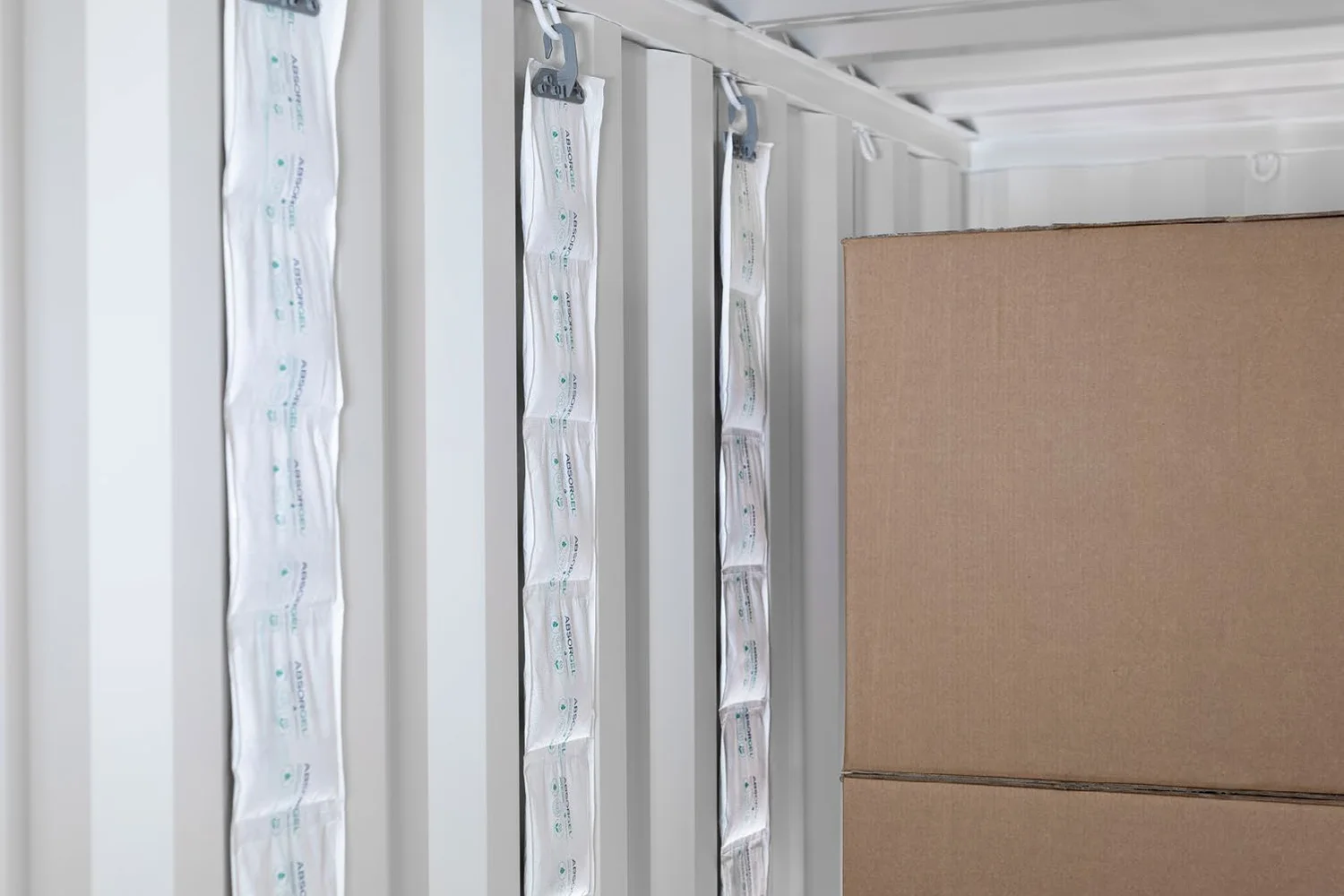
Only calcium chloride packets leak: it absorbs so much moisture that it dissolves into a brine. Absortech deals with this by mixing calcium chloride (over 94%) with starch so it forms a gel as it absorbs, which is how the AbsorGel bag absorbs over 300% of its weight while keeping the liquid in the bag.
If you see a packet leaking, it is usually one of three causes:
- The packet is saturated and no longer holds its gel well: replace it with a new one.
- Hung or placed incorrectly: follow the instructions, leave a gap from the cargo and use the AbsorHook supplied with the container hanging bag.
- The bag is torn: the brine corrodes metal and stains packaging; wipe clean with a damp cloth, rinse with water and dry.
Can a desiccant packet explode
There is no explosion mechanism for silica gel, clay and calcium chloride in normal conditions; the crackling “pop” of silica beads in water is just beads cracking slightly.
The real risks are heat burns and irritation when calcium chloride or quicklime packets meet water, and quicklime is hot enough to ignite combustible materials it touches.
Do not put packets in a microwave or burn them: paper, plastic and fabric casings give off smoke, and packets containing metal such as iron powder are not suitable for microwaves. This is general safety advice, not a test of each packet type.
What to do when a packet splits, overheats or leaks
With calcium chloride or quicklime, wear rubber gloves and goggles, because a calcium chloride solution causes serious eye irritation (H319). Collect the packet in a plastic bag, avoid spilling it on goods and flammable items, and keep it away from food, children and pets.
Wipe clean with a damp cloth, rinse with water and dry metal surfaces to prevent rust. If it gets on skin or in eyes, rinse immediately with a lot of water; if the eye still feels gritty or sore see an eye doctor, and with quicklime see a doctor if there is a burn.
Finally replace it with a new packet of the right type and the right dose, calculated by volume and shipping time.
If someone has swallowed, mouthed or inhaled it, see what happens if you swallow a desiccant packet. For the right type for sea freight see types of desiccant and the ICD desiccants range.
Frequently asked questions
Do desiccant packets get hot?
Silica gel warms slightly as it absorbs moisture through physical adsorption, typically a rise of about 5 to 10 °C in a very humid environment. Calcium chloride and quicklime packets give off much more heat when they meet water.
Why does a desiccant packet get hot?
The beads absorb water vapor and release energy as heat; oxygen absorbers also release heat as iron oxidizes; quicklime packets get hot on contact with water.
Is a hot desiccant packet dangerous?
Slight warmth in a silica gel packet is normal. Abnormal heat with leaking or a strange smell calls for checking the packet type, which may be calcium chloride or quicklime.
Is it a problem to put a desiccant packet in water?
A silica gel packet absorbs water, crackles and does not dissolve; beads full of water stop working. A calcium chloride packet dissolves and releases heat, a quicklime packet reacts strongly, so be careful.
Will a desiccant packet explode in water?
It does not explode. The crackling is silica beads cracking slightly. The main risk is heat burns with calcium chloride and quicklime.
Does a desiccant packet dissolve in water?
Silica gel and clay do not dissolve; calcium chloride dissolves completely.
Why is my desiccant packet leaking?
It is a calcium chloride packet that has absorbed too much moisture and dissolved. AbsorGel packets use starch to form a gel and limit leaking. Replace the packet when it is full.
Is the liquid from a desiccant packet poisonous?
A calcium chloride solution irritates the eyes and skin and upsets digestion. Rinse with water and keep it away from children and pets.
Contact ICD Vietnam for desiccant advice
ICD Vietnam Industrial Production Co., Ltd.
North: 3rd Floor, Thang Long A1 Building, Bau Hamlet, Thien Loc Commune, Hanoi, 0983 797 186 / 090 345 9186 / 090 5859 186
South: 551/212 Le Van Khuong, Tan Thoi Hiep, District 12, Ho Chi Minh City, 098 6784 186
Email: sales@icdvietnam.com.vn
Zalo: Chat on Zalo
References
- Scientific Reports, Silica gel adsorption and desorption isotherms (heat of water adsorption)
- Hackaday, Reusing bags of desiccant (silica beads popping when soaked)
- Hawkins, Calcium oxide and its exothermic reactions
- Rose of Jericho, Quicklime health and safety data
- ProjectXeros, CaCl2 dissolved in water: the science of exothermic heat
- Absortech, AbsorGel Technical Product Sheet (calcium chloride gelling, H319)