Table of Contents
- What humidity is safe by goods and material
- What relative humidity (RH) is and why it changes with temperature
- Container rain and cargo hold sweat: the mechanism according to ship insurers
- How high humidity damages goods
- Vietnam’s climate and the gap to the safe threshold
- Controlling humidity in warehouses and containers
- How to protect containerized sea freight from moisture
- Common mistakes
- Frequently asked questions
- Contact ICD Vietnam for desiccant advice
- References
- Related articles
Reviewed and updated by ICD - Week 40/2026
Relative humidity in a warehouse should be kept below 60%, ideally 30 to 50%, to limit mold (EPA guidance), but the exact threshold differs by goods: corrugated cartons lose 50 to 60% of their stacking strength at 90% RH, pallet timber needs moisture content below 20% so it does not feed mold, medicine in Vietnam is allowed up to 75% RH under GPP guidance, and paper documents are ideally kept at 45 to 55%. The difficulty is that Vietnam’s climate is hot and highly humid (ICH zone IVb, 30 °C and 75% RH), meaning the natural environment already exceeds the safe threshold for many kinds of goods.
This article collects the thresholds, explains how goods are damaged and how to control humidity in warehouses and containers.
What humidity is safe by goods and material
| Subject | Reference humidity level | Source |
|---|---|---|
| Indoor and enclosed storage in general | Below 60% RH, ideally 30 to 50% | EPA |
| General warehouse (non-sensitive goods) | Below 65 to 70%; mold grows fast above 65% for a long time | AIC, NARA |
| Electronics, metal, machinery | Below 50% to prevent rust; some sources say surfaces begin to oxidize from about 60% | MIA |
| Pharmaceuticals in Vietnam (GPP) | Humidity not above 75%, temperature not above 30 °C | Long Chau pharmacy (summary of Circular 02/2018/TT-BYT) |
| Stability testing for medicine in Southeast Asia | 30 °C and 75% RH (zone IVb) | ICH, Pharmaguideline |
| Cameras, lenses | 40 to 50% RH, fungus grows fast above 60% | Beyond Photo Tips |
| Paper, books, archival documents | 45% (±10%), mold grows fast above 65 to 70% for a long time | AIC, NARA, Canadian Council of Archives |
| Food, dry agricultural products | Below 50 to 55% (depending on type) | MIA |
| EPAL pallet timber | Timber moisture not above 22% at production, below 20% so it does not feed mold | Palettes Europe, Emmitsburg |
| Corrugated cartons | The closer to 90% RH, the more strength is lost | Paperindex, ScienceDirect |
Vietnamese documents give different figures (for example garments and footwear below 70% RH, agricultural goods 40 to 45%). Even for the same goods the threshold depends on storage time and temperature, so the numbers above are reference points and you need to measure with a hygrometer.
What relative humidity (RH) is and why it changes with temperature
RH is the percentage of water vapor actually in the air compared with the maximum the air can hold at the same temperature. Cold air holds less water vapor, so when temperature falls while the vapor amount stays the same, RH rises.
When the temperature drops below the dew point, water vapor condenses into droplets. In a container this is the condensation the shipping industry calls container sweat, and Vietnamese people call container rain; see what is a desiccant.
Container rain and cargo hold sweat: the mechanism according to ship insurers
Ship insurers (Britannia, Steamship Mutual) and INTERCARGO distinguish two types. Ship’s sweat happens when the steel of the hold or container cools below the dew point of the air inside, usually when a ship moves from a hot humid region to a colder one, and water drips from the walls onto the cargo.
Cargo sweat is the opposite: warm humid air meets cold cargo and condenses right on the surface of the goods, usually when a container door is opened in a hot humid place or when cargo is discharged.
Agricultural cargo with natural moisture also releases water vapor itself, causing continuous local condensation.
The “dew point rule” for ventilating ship holds (ventilate only when the dew point of outside air is lower than inside) applies to the holds of large ships and not to sealed containers; for containers, the common solution is a sufficient dose of desiccant.
How to calculate dew point is in how to measure humidity.
How high humidity damages goods
Cartons suffer the clearest consequences. Research on the effect of temperature and humidity on carton strength (ScienceDirect) records that when humidity rises from 70 to 90% RH, compressive strength falls by about 36 to 40% depending on temperature.
Paperindex records that a carton at 90% RH keeps only about 40% of its stacking strength compared with dry, equivalent to a loss of 50 to 60%. In goods stacked high on a pallet, the bottom cartons carry the largest load and so collapse first.
Figures from Paperindex, for reference only, depending on paper type and exposure time.
Other goods are damaged in their own ways. Cartons and paper soften, boxes collapse, mold grows and printing is lost. Pallet timber gets moldy and warps, and timber above 20% moisture can feed fungus that spreads to the goods (Palettes Europe).
The consequences differ by type of goods:
- Metal and components: rust, surface oxidation, even short circuits.
- Textiles, footwear and leather: mold, yellowing, odor.
- Dry food and powders: clumping, softening, loss of crispness.
- Tablets: absorb moisture and lose potency, so they need moisture-controlled packaging.
Vietnam’s climate and the gap to the safe threshold
Under the ICH climate zoning, Vietnam falls in zone IVb (hot and very humid), with stability testing at 30 °C and 75% RH. This is also why the GPP guidance for medicine allows humidity up to 75%.
But that is the maximum acceptable level, while many kinds of goods (electronics, paper, cameras, cartons) are much safer at 40 to 60%. The natural environment in the damp season far exceeds these marks, so simply “keeping it somewhere dry” is not enough and active measures are needed.
Controlling humidity in warehouses and containers
There are six things to do together. First is to place desiccant packets in cartons or hang bags in containers, used for boxed goods and sea freight (see ICD desiccants). Second is to use dry pallets: kiln-dried wooden pallets that meet the standard or plastic pallets, which do not absorb moisture, for goods touching the warehouse floor.
Third is to wrap pallets tightly in PE stretch film to reduce moisture ingress. Fourth is to measure with a hygrometer and ventilate when humidity is high and the dew point allows. Fifth is to keep goods raised off the floor and away from windows where rain blows in (SEC Warehouse), especially in the damp season.
Sixth is to use a dehumidifier for sealed stores with prolonged dampness; MIA gives a reference of 10 to 30 liters per day for stores under 50 m² and 30 to 70 liters per day for stores of 50 to 150 m².
How to protect containerized sea freight from moisture
Sea cargo passes through many temperature swings, and humidity in the container can exceed the safe threshold even when the goods were dry at loading.
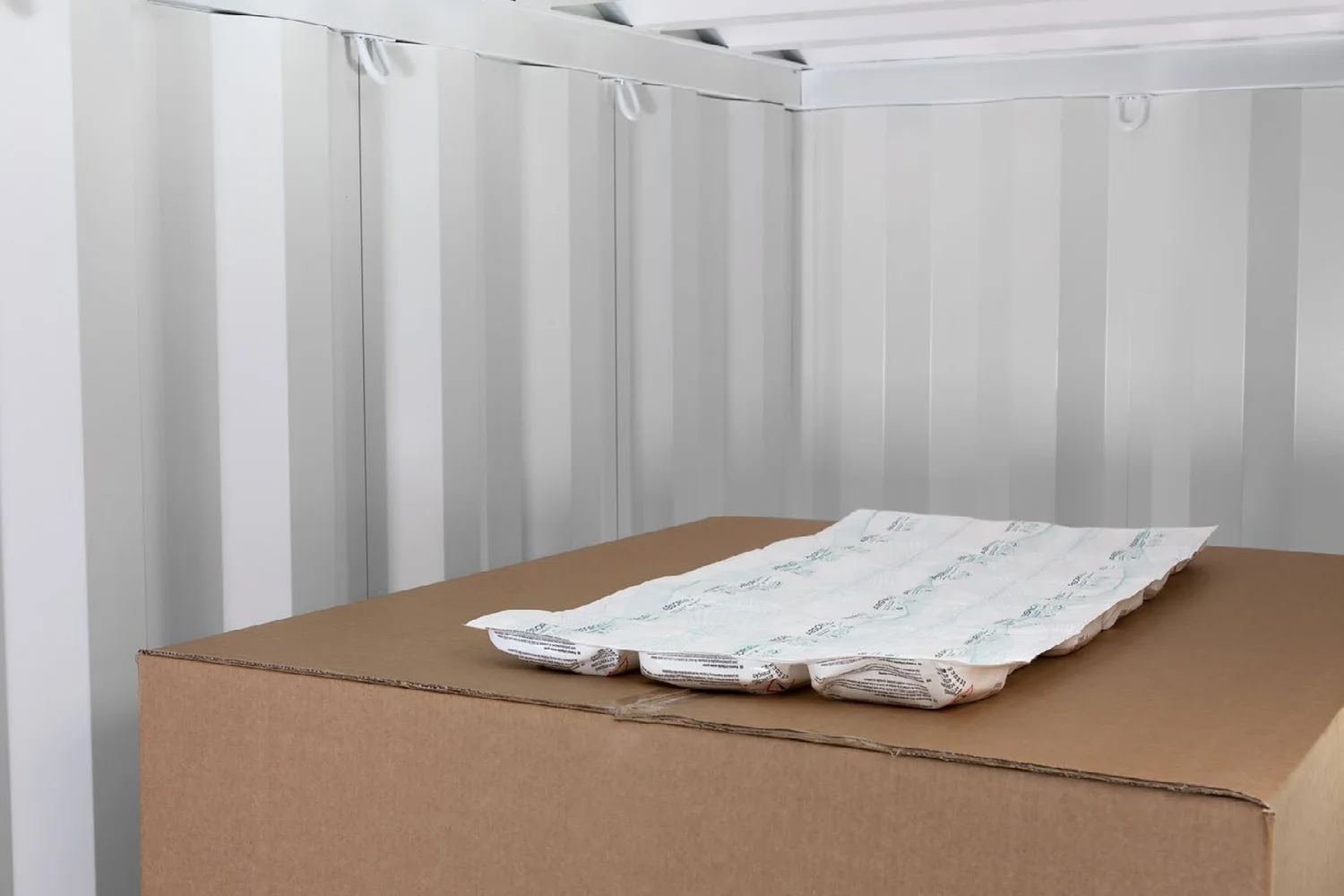
The solution is a combination: load dry goods (cartons and pallets at the right moisture), use proper pallets, then add a high-capacity desiccant such as the Hanging-C bag or Blanket-C blanket. For dosing see how to use desiccant packets correctly, and to choose the type see types of desiccant.
Common mistakes
The first mistake is trusting feel instead of using a hygrometer.
Next is placing desiccant packets in an open space, so the packet absorbs the whole room and fills quickly; loading goods before they are dry, because damp pallets and cartons carry water vapor into the container; ignoring the pallet when timber above 20% moisture can feed mold; and watching only temperature while forgetting the dew point, when RH changes very quickly as temperature changes.
Indoor humidity and health: see ideal indoor humidity level. Preventing mold in wardrobes and homes: prevent mold and damp in home and wardrobe.
Frequently asked questions
What humidity is safe?
Indoors and in enclosed storage: below 60% RH, ideally 30 to 50% (EPA). Electronics and cameras 40 to 50%; paper 45% (±10%); medicine under GPP not above 75%. Mold grows fast above 65% for a long time.
What humidity is considered high?
Above 60% needs action according to the EPA; above 65 to 70% the risk of mold rises sharply.
At what humidity does mold grow?
Mold grows fast when RH stays above about 65 to 70% for several days; at 45 to 55% the chance of spores germinating is lower.
At what humidity do cartons go soft?
From 70 to 90% RH, compressive strength falls by about 36 to 40%; at 90% RH only about 40% of the dry stacking strength remains.
What humidity should a pharmacy store have under GPP?
Humidity not above 75% and temperature not above 30 °C at room temperature conditions, according to guidance summarizing Circular 02/2018/TT-BYT.
What timber moisture is acceptable for pallets?
EPAL pallet timber needs a moisture content not above 22% at production, and below 20% so it does not feed mold.
What is container rain?
Water vapor condensing into droplets on the container wall when the wall temperature falls below the dew point, dripping onto the cargo. Prevent it with dry goods and a sufficient dose of desiccant.
How do I reduce humidity in a warehouse?
Combine a hygrometer, sensible ventilation, pallets and dry goods, desiccant packets, PE film, raising goods off the floor and a dehumidifier when needed.
Contact ICD Vietnam for desiccant advice
ICD Vietnam Industrial Production Co., Ltd.
North: 3rd Floor, Thang Long A1 Building, Bau Hamlet, Thien Loc Commune, Hanoi, 0983 797 186 / 090 345 9186 / 090 5859 186
South: 551/212 Le Van Khuong, Tan Thoi Hiep, District 12, Ho Chi Minh City, 098 6784 186
Email: sales@icdvietnam.com.vn
Zalo: Chat on Zalo
References
- EPA, A brief guide to mold, moisture and your home
- Paperindex, How humidity changes corrugated box stack planning
- Palettes Europe, Pallet FAQ: EPAL, ISPM 15
- Long Chau pharmacy, Temperature and humidity for GPP pharmacies (Vietnamese)
- Pharmaguideline, Climatic zones for stability studies (ICH zone IVb)
- Beyond Photo Tips, Ideal humidity for camera storage
- NARA, Mold and mildew: prevention of microorganism growth
- Steamship Mutual, The problem of sweat