
Table of Contents
Reviewed and updated by ICD - Week 43/2026
Mold shrinkage of unreinforced PA plastic is roughly 0.75% to 1.8% depending on the grade and the measuring direction. BASF lists PA6 (B3K) at 0.75% and PA66 (A3K) at 1.5% along the flow and 1.8% across it. Adding 30% glass fiber cuts shrinkage along the flow to 0.2% to 0.4%, but cross-flow shrinkage stays at 0.8% to 0.9%, so the claim of “under 0.5%” holds in one direction only.
This guide sets the shrinkage figures for PA side by side by source, explains why shrinkage is uneven between directions and why mold temperature, holding pressure and moisture change part dimensions, then covers how to limit warpage. The figures come from BASF datasheets and technical documents from Covestro and EMS-Grivory.
How much does PA plastic shrink
Mold shrinkage is the amount a part gets smaller compared with the dimensions of the cold mold cavity. Under DIN 16901, the value is measured after the part has rested for 16 hours in a standard climate (Covestro). Because it depends on the grade and the test conditions, the same material can show several different figures in different documents; the table below keeps each source separate so they are not mixed.
| Material | Shrinkage along the flow | Shrinkage across the flow | Source |
|---|---|---|---|
| Unreinforced PA6 (Ultramid B3K) | 0.75% | (single value) | BASF datasheet |
| Unreinforced PA6, holding pressure 500 bar | 1.0% | 1.2% | Covestro |
| Unreinforced PA66 (Ultramid A3K) | 1.5% | 1.8% | BASF datasheet |
| PA6 + 30% glass fiber, holding pressure 500 bar | 0.2% | 0.8% | Covestro |
| PA66-GF30 (Ultramid A3WG6) | 0.38% | 0.93% | BASF datasheet |
| POM (Ultraform N2320) | 2.1% | 2.1% | BASF datasheet |
Two points stand out. First, unreinforced PA6 and PA66 range from about 0.75% to 1.8%, much wider than articles that say “about 1% to 2%”, because the value depends on the grade and molding conditions. Second, POM is often placed next to PA in gears, and its 2.1% shrinkage is larger than PA: mold design cannot use one common factor for both materials.
Why PA shrinkage is not the same in every direction
PA is a semi-crystalline plastic: as it cools, the polymer chains arrange into crystalline regions and the volume decreases. According to Covestro, a part cannot shrink evenly in three dimensions; most of the volumetric shrinkage is taken up in the thickness, while length and width are restrained by the outer skin that freezes first and by the mold. With unreinforced grades the difference between the two directions is small (1.0% versus 1.2% for PA6).
Glass fiber changes this completely. Fibers lying along the flow direction stop the polymer chains from shrinking that way, so PA6 + 30% fiber shrinks only 0.2% along the flow but still 0.8% across it, a ratio of four to one. Covestro adds that fiber content above roughly 20% to 25% hardly reduces shrinkage any further. The difference between the two directions is the main cause of warpage in fiber-reinforced parts.
Factors that affect shrinkage
Holding pressure and holding time are the two most important variables. A study by Jansen and co-authors (Polymer Engineering & Science, 1998) concluded that holding pressure has the strongest effect on shrinkage, that higher holding pressure reduces shrinkage in all directions, and that a longer holding time also reduces shrinkage until the gate freezes. A higher melt temperature generally reduces shrinkage by transmitting pressure better. A holding pressure that is too low or too short is therefore a common cause of sink marks and undersized parts.
Mold temperature acts in a less obvious way than many people expect. Covestro describes for polyamide that a cold mold (about 40 °C) cools fast, gives low crystallinity, low mold shrinkage but high post-shrinkage; a hot mold (about 120 °C) gives high crystallinity, and most shrinkage happens inside the mold. A cold mold therefore does not really “shrink less”: it shifts the shrinkage to the period after the part leaves the mold or when it works at high temperature. EMS-Grivory advises choosing a mold surface temperature above the glass transition temperature and above the service temperature to minimize distortion from post-shrinkage. BASF lists mold temperatures of 40 to 60 °C for B3K and 60 to 80 °C for A3K.
Moisture changes dimensions in the opposite direction. Covestro points out that for polyamide, besides post-shrinkage there is also growth in size as the part absorbs water. At 23 °C and 50% RH, PA6 B3K absorbs 2.6% to 3.4% and PA66 A3K 2.5% to 3.1% (BASF), so the dimensions of a molded part keep changing with the seasons; a tight-fitting part needs moisture conditioning before inspection.
Wet pellets damage parts before molding in a different way: bubbles, silver streaks and polymer chain breakage. BASF recommends drying B3K at 80 °C for 4 hours in a dry-air dryer to bring pellet moisture to 0.03% to 0.06%.
| Factor | Effect on dimensions | Source |
|---|---|---|
| Higher holding pressure | Shrinkage falls in all directions | Jansen and co-authors 1998; Covestro |
| Longer holding time | Shrinkage falls until the gate freezes | Jansen and co-authors 1998 |
| Cold mold (about 40 °C) | Low mold shrinkage, high post-shrinkage | Covestro |
| Hot mold (about 120 °C) | High crystallinity, shrinkage happens inside the mold | Covestro |
| Moisture absorption after molding | Dimensions grow gradually with humidity | Covestro; BASF |
| Glass fiber 25% to 30% | Shrinkage along the flow drops sharply, across the flow remains | Covestro; BASF |
How to reduce warpage and dimensional error
Using glass-fiber-reinforced grades reduces overall shrinkage and raises stiffness; in return there is a difference between the two directions, so pay attention to gate position and flow direction. With unreinforced grades, keeping holding pressure, holding time and mold temperature steady from cycle to cycle matters more than picking one exact shrinkage figure, because the molding conditions themselves decide how much the part shrinks.
For mold design, allow for shrinkage in both directions with reinforced grades, place gates so the flow fills evenly (symmetric gates for symmetric parts), and increase the draft angle because the part shrinks onto the core. The last two are standard mold-design practice; no resin-maker data specific to PA was found, so no figures are given.
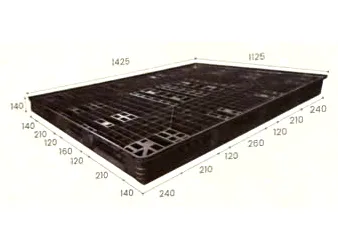
If your business is also looking for warehouse supplies, browse ICD Vietnam’s plastic pallet range to choose by load capacity and rack type.
Frequently asked questions
How much does PA plastic shrink?
Unreinforced: PA6 B3K 0.75%, PA66 A3K 1.5% along and 1.8% across the flow (BASF). The figure varies by grade and molding conditions.
How much does glass-filled PA shrink?
PA6 + 30% fiber: 0.2% along, 0.8% across (Covestro, 500 bar holding). PA66-GF30 A3WG6: 0.38% along, 0.93% across (BASF).
Why does shrinkage differ along and across the flow?
Glass fibers lying along the flow resist shrinkage in that direction. Unreinforced grades differ less.
How does mold temperature affect PA shrinkage?
A cold mold gives low mold shrinkage but high post-shrinkage; a hot mold crystallizes more and the shrinkage happens inside the mold (Covestro).
Why do PA parts change size with the seasons?
PA absorbs moisture: equilibrium is 2.5% to 3.4% at 50% RH. Water uptake enlarges the part; tight-fitting parts should be moisture-conditioned before measuring.
How should PA pellets be dried before molding?
BASF recommends 80 °C for 4 hours in a dry-air dryer for B3K, bringing pellet moisture to 0.03% to 0.06%.
Contact ICD Vietnam
ICD Vietnam Industrial Manufacturing Co., Ltd.
North: 3rd Floor, Thang Long A1 Building, Bau Hamlet, Thien Loc Commune, Hanoi, 0983 797 186 / 090 345 9186 / 090 5859 186
South: 551/212 Le Van Khuong Street, Tan Thoi Hiep Ward, District 12, Ho Chi Minh City, 098 6784 186
Email: sales@icdvietnam.com.vn
Zalo: Chat on Zalo now
References
- BASF, Ultramid B3K (PA6) Product Information, 09/2026: density 1130 kg/m3, melting point 220 °C, saturation moisture 9% to 10%, equilibrium at 23 °C/50% RH 2.6% to 3.4%, HDT A 60 °C, drying 80 °C for 4 hours - download.basf.com
- BASF, Ultramid A3K (PA66) Product Information, 09/2026: melting point 260 °C, saturation moisture 8% to 9%, equilibrium 2.5% to 3.1%, HDT A 75 °C, shrinkage 1.5/1.8%
- BASF, Ultramid A3WG6 PA66-GF30 (mold shrinkage 0.38% along, 0.93% across) - picoplast.nl
- BASF, Ultraform N2320 003 LEV AT (POM, shrinkage 2.1%)
- Covestro, The fundamentals of shrinkage in thermoplastics (shrinkage, crystallization, mold wall temperature, PA6 with glass fiber) - solutions.covestro.com
- Jansen, van Dijk, Husselman, Effect of processing conditions on shrinkage in injection molding, Polymer Engineering & Science (1998) - doi.org
- EMS-Grivory, Guide Injection Molding Polyamides (mold temperature above Tg and service temperature) - emsgrivory.com