Mục lục
Key takeaways:
- PE plastic (Polyethylene) is one of the most recyclable polymers, especially resin codes 2 (HDPE) and 4 (LDPE).
- This article directly answers whether PE plastic can be recycled by analyzing mechanical and chemical recycling mechanisms, clarifying the differences between LDPE and HDPE recycling processes.
- Detailed analysis of the recycled PE pellet production process, from collection and sorting through extrusion and pelletizing.
- Warnings about real-world challenges (contaminants, cost, quality) and guidelines for safe, environmentally responsible use of recycled PE plastic.
1. Can PE plastic be recycled? Confirmation and classification
Can PE plastic be recycled? The answer is: absolutely yes. PE plastic is one of the most widely and effectively recycled polymers in the world. This recyclability stems from its thermoplastic structure, which allows the material to be melted and reshaped multiple times without serious quality degradation.
PE plastic resin codes and recyclability
In the international plastic classification system, PE plastic is identified through two most common codes:
| Resin code | PE type | Recyclability | Common applications after recycling |
| No. 2 (HDPE) | High-Density PE | Very good (priority recyclable) | PE pipes, trash bins, pallets, plastic lumber. |
| No. 4 (LDPE) | Low-Density PE | Good (requires more thorough cleaning) | Liners, floor tiles, industrial containers (non-food). |
PE plastic and the environment: the importance of recycling
Recycling PE plastic plays a critically important role in reducing plastic pollution and conserving resources. Each tonne of recycled PE plastic significantly reduces the amount of crude oil needed to produce virgin plastic. This is the economically viable and sustainable approach that recycled PE pellet manufacturers are pursuing.
2. Detailed recycled PE pellet production process
The production of recycled PE pellets (also called regenerated PE pellets) is primarily a physical process that requires technical precision to remove contaminants and produce a uniform product.
Step 1: Collection, sorting, and input inspection
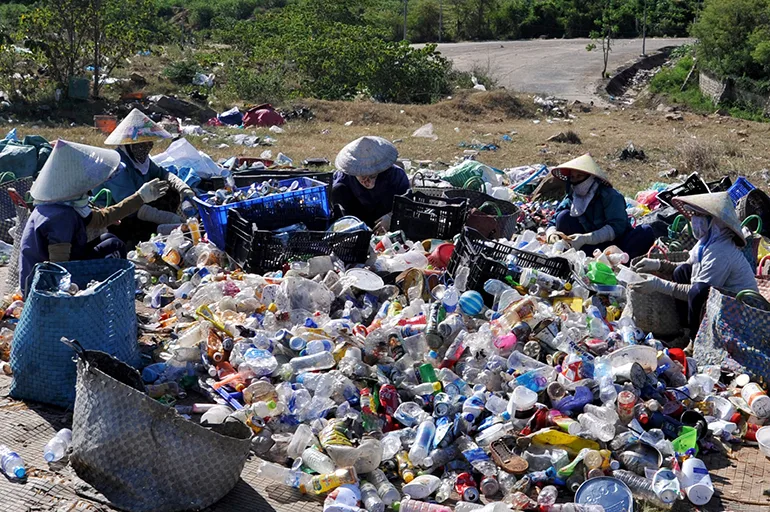
PE waste is collected from industrial sources (packaging film, containers) and post-consumer sources (bags, bottles). Initial sorting separates HDPE from LDPE because mixing them degrades the quality of the final product. Input inspection checks for contamination level and plastic grade purity.
Step 2: Shredding and washing
The collected PE plastic is shredded into small flakes (5-20 mm). These flakes are then washed in hot water with detergent to remove labels, food residues, oils, and other contaminants. This step is critical - poorly washed material produces low-quality pellets with an unpleasant odor.
Step 3: Density separation
Washed flakes pass through a water-float tank. PE flakes (density 0.91-0.97 g/cm3) float while heavier contaminants (PET, PVC, metal fragments) sink. This efficiently separates PE from unwanted materials.
Step 4: Drying
Separated PE flakes are dried to below 1% moisture content. Excess moisture in the extruder creates bubbles and voids in the final pellets, causing quality defects.
Step 5: Extrusion and pelletizing
Dried flakes are fed into a twin-screw extruder where they are melted at 180-220 degrees C, filtered through a melt filter to remove residual fine contaminants, then extruded through a die plate and cut into uniform pellets (3-5 mm diameter). These are the recycled PE pellets sold to manufacturers.
3. Challenges in PE plastic recycling
- Contamination: Food residues, adhesive labels, and multi-layer laminated films are the biggest challenges. Heavily contaminated batches may not be recyclable and end up in landfill.
- Color mixing: Mixing different-colored PE waste produces gray or black recycled pellets, limiting their use in applications requiring specific colors.
- Quality degradation per cycle: Each recycling cycle causes some molecular chain degradation, reducing the mechanical properties of the material. After 3-5 recycling cycles, PE quality declines noticeably.
- Economics: Collecting, sorting, and processing PE waste requires significant investment. In some markets, virgin PE pellets are cheaper than recycled PE, reducing the economic incentive for recycling.
4. Safe and responsible use of recycled PE plastic
- Never use for food contact: Recycled PE pellets are not food-safe unless specifically certified. Use only for non-food applications.
- Verify source and certification: When purchasing recycled PE pellets, request quality certificates (heavy metal content, melt flow index, density) from the supplier.
- Appropriate applications: Recycled HDPE is excellent for pipes, pallets, park benches, and industrial containers. Recycled LDPE is suitable for black trash bags, agricultural film, and floor liners.
Frequently Asked Questions
1. How many times can PE plastic be recycled?
In theory, PE plastic can be recycled multiple times (typically 3-7 cycles before quality becomes unacceptable). In practice, mixing with other plastics or contamination usually limits the effective recycling count.
2. Why is HDPE easier to recycle than LDPE?
HDPE (code 2) has a more consistent chemical structure and is typically used as single-layer containers, making collection and cleaning easier. LDPE (code 4) is often used in multi-layer laminated films that are difficult to separate and clean, complicating the recycling process.
3. Can I recycle PE stretch wrap film?
Yes, PE stretch wrap (LLDPE/LDPE) is recyclable but typically not accepted in curbside collection due to its tendency to jam sorting machinery. Take it to a designated drop-off location. Many ICD Vietnam customers return used stretch wrap for proper recycling.
References
- Wikipedia: Recycling of Plastics - PE Recycling Process
- Wikipedia: HDPE - Recycling and Applications