
Mục lục
- What is HDPE and why is it widely used in food applications?
- The science: why HDPE does not migrate harmful substances
- Legal standards for HDPE in food contact
- HDPE food-grade applications in the food industry
- HDPE vs other plastics in food applications
- Key precautions when using HDPE with food
- Related articles
- Frequently Asked Questions
- Contact ICD Vietnam
HDPE (High Density Polyethylene, resin code 2) is the only polyethylene certified by the FDA and the European Commission for direct food contact. That safety is conditional: it depends on virgin versus recycled grade, operating temperature, and whether the product genuinely meets food-grade standards. This guide explains where the boundary is.
What is HDPE and why is it widely used in food applications?
HDPE - High Density Polyethylene, resin code 2 in the international classification system - is a synthetic polymer made from ethylene with a linear, low-branch chain structure that produces high molecular density (930-970 kg/m3). That high density creates the properties that make HDPE the preferred material for food packaging and containers.
Three reasons the food industry favours HDPE. First, HDPE has very high chemical inertness - it does not react with most acids, alkalis, oils and organic substances at normal temperatures, meaning there is no chemical exchange between the plastic and the food. Second, HDPE does not require plasticizers because it is inherently flexible at room temperature - unlike PVC, which needs phthalates to be processed into flexible film. Third, HDPE is mechanically strong, lightweight, moisture-resistant and easy to recycle, optimising packaging cost throughout the food supply chain.
In practice, HDPE appears throughout the food industry: milk bottles, fruit juice bottles, cooking oil containers, butter and yogurt tubs, dry cereal bins, supermarket vegetable trays, and - an application where ICD Vietnam has the most hands-on experience - plastic pallets used in cold-store food warehouses.
The science: why HDPE does not migrate harmful substances
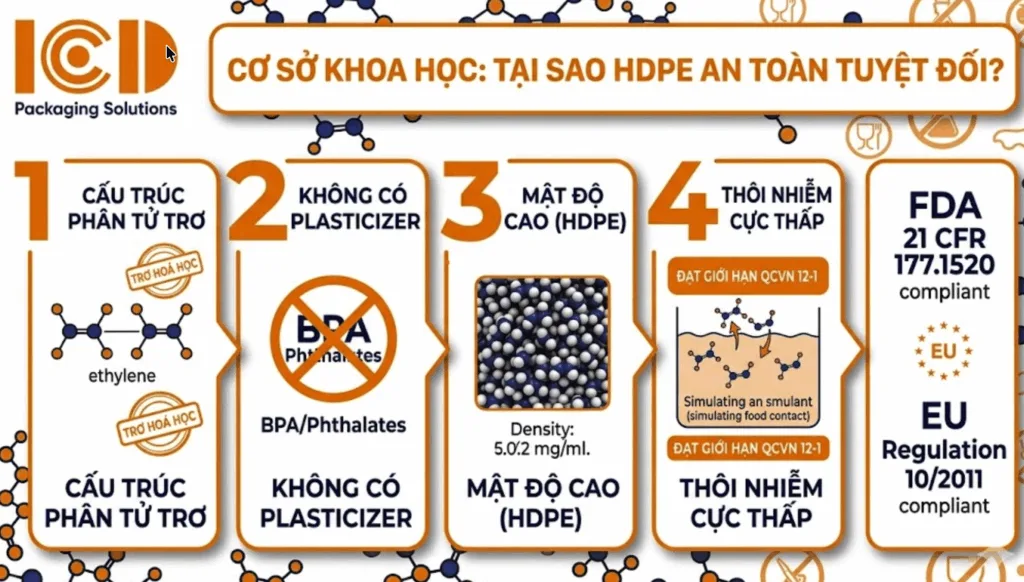
The safety of HDPE in food applications is not a marketing claim - it has a clear scientific foundation. The key point is that there is no migration mechanism for toxic substances from virgin HDPE into food under normal use conditions.
Migration occurs when a substance inside a packaging material moves into the food. For plastics, migrating substances can include residual monomer (ethylene in the case of polyethylene), additives (heat stabilisers, antioxidants, processing lubricants), and oligomers (short polymer chains). High-quality virgin HDPE has residual monomer and oligomer levels far below the detection limit of standard test methods. Free ethylene is non-toxic at low concentrations and does not accumulate. The additives used in food-grade HDPE are all tightly controlled against the EU-permitted additive list (Regulation 10/2011/EC) and the FDA (21 CFR).
Independent migration studies by the European Food Safety Authority (EFSA) and the FDA both confirm: virgin HDPE meeting the relevant standards does not produce migration levels of concern under typical food-contact conditions (room temperature to 70 degrees C, contact time up to 30 days).
Legal standards for HDPE in food contact
For an HDPE plastic product to be permitted for food contact in Vietnam, it must comply with QCVN 12-1:2011/BYT - the National Technical Regulation on plastic materials and utensils in direct contact with food, issued by the Ministry of Health. This standard sets migration limits for heavy metals (lead, cadmium, arsenic, mercury), total migration limits (the maximum amount of substance that may migrate into a food simulant), and microbiological criteria.
The equivalent international standards are:
- FDA 21 CFR 177.1520 (United States): specific regulations for olefin polymers (including polyethylene) in food contact, with a listed catalogue of permitted additives
- EU Regulation No 10/2011/EC: regulation on plastic food-contact materials in Europe, in which HDPE is listed as a compliant material
- Codex Alimentarius CAC/RCP 40-1993: international standard on good hygiene practice in food processing and handling, including requirements for contact materials
One critical point: the fact that a material is HDPE does not automatically mean the finished product meets food-grade requirements. The manufacturer must actively select the appropriate HDPE grade, use only permitted additives, and have migration test results from an accredited laboratory before any food-grade claim can be made.
HDPE food-grade applications in the food industry
Food-grade HDPE appears at virtually every point in the food supply chain - from production to retail - because it simultaneously meets hygiene safety requirements, mechanical durability, and acceptable cost.
At the consumer packaging level, HDPE is the most common material for fresh milk bottles, fruit juice bottles, butter and margarine tubs, drinking water containers, and dry food bags. These products all need a material that is lightweight, moisture-resistant, odour-free, and does not affect the flavour of the food - HDPE satisfies all of them.
At the industrial and food-logistics level, the most important application is HDPE plastic pallets in cold stores and food-processing facilities. HDPE plastic pallets have a non-absorbent surface that does not rot or harbour mould the way wooden pallets do, and they can be cleaned easily with high-pressure water or disinfectant chemicals. This is why large supermarket chains, dairy plants, and cold stores handling agricultural produce for export are required to use plastic pallets rather than wooden pallets. ICD Vietnam supplies food-grade HDPE plastic pallets to hundreds of businesses in the food and agricultural sectors across the country.
HDPE vs other plastics in food applications
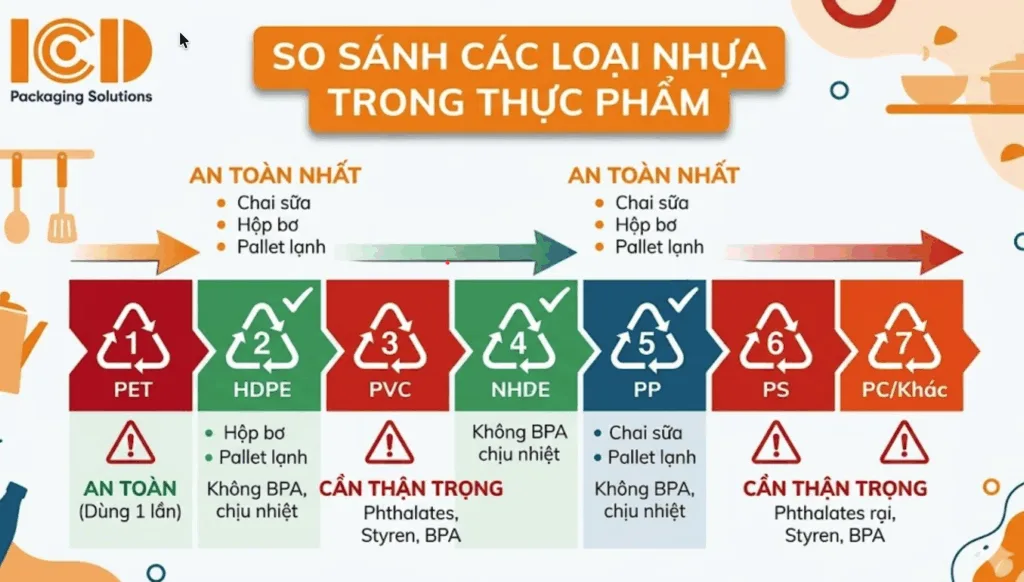
Not all plastics are as safe as HDPE. Understanding the differences helps when selecting packaging materials or food containers.
| Plastic type | Resin code | Safety level | Notes |
|---|---|---|---|
| HDPE | 2 | High safety | No BPA, FDA certified for food contact |
| LDPE | 4 | Safe | Used for soft PE bags and food-wrap film |
| PP (Polypropylene) | 5 | Safe | Better heat resistance than HDPE; microwave-safe containers available |
| PET | 1 | Safe (single use) | Mineral water bottles - do not reuse repeatedly |
| PVC | 3 | Use with caution | Soft PVC contains phthalates - avoid contact with hot food |
| PS (Polystyrene) | 6 | Limited use | Styrene can migrate - avoid contact with hot or fatty food |
| PC and other code 7 | 7 | Check carefully | PC contains BPA - avoid entirely for children and hot food |
A simple rule to remember: resin codes 2, 4, and 5 are safe for food under normal conditions. Code 1 is safe but for single use only. Avoid codes 3, 6, and 7 for any food application, especially with hot or fatty food.
Key precautions when using HDPE with food
Although HDPE is certified safe, four specific situations require extra care to maintain the highest level of food safety.
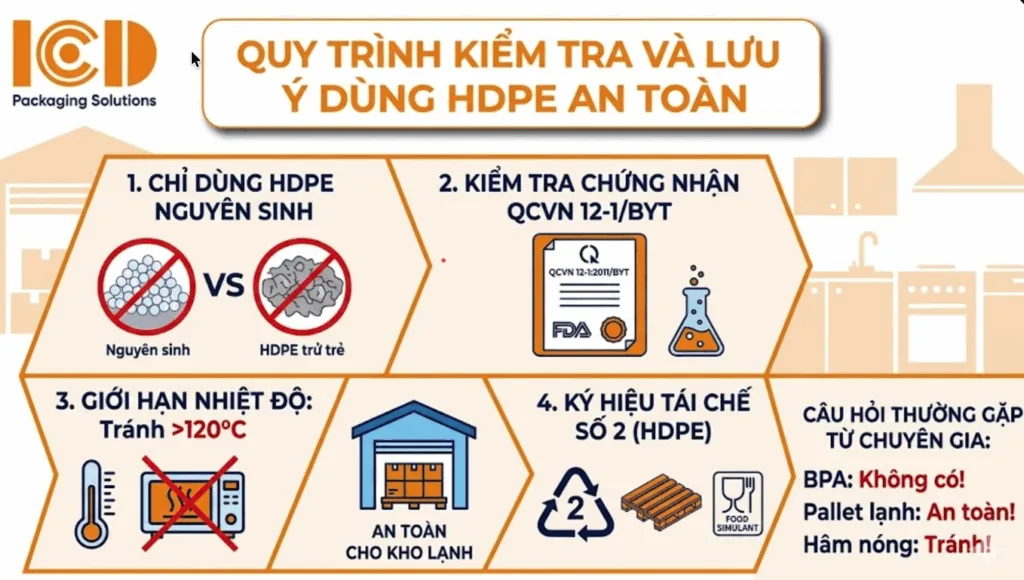
Temperature is the most important limit. HDPE begins to deform at around 120 degrees C and can release decomposition products at higher temperatures. This is not a problem for most food applications - hot food at 60-80 degrees C is well within the safe range. The risk arises when an HDPE container is accidentally placed in a microwave on a high-heat setting, or when boiling water is poured directly into a thin-walled HDPE bottle. Recommendation: do not reheat food in HDPE containers in a microwave - use PP (code 5) instead.
Recycled HDPE does not meet food-grade standards. This is a point that many consumers and businesses confuse. Recycled HDPE is collected from mixed plastic waste streams - which may include chemical bottles, used motor-oil containers, and pesticide containers - and even after washing there is a risk of chemical contaminants that cannot be fully removed. Both QCVN 12-1:2011/BYT and EU Regulation 10/2011/EC require food-contact materials to be either virgin resin or recycled resin that has passed a strictly controlled decontamination process. Standard commercial recycled resin does not meet this requirement.
Avoid reusing HDPE beverage bottles repeatedly, especially at elevated temperatures. Although virgin HDPE is very stable, repeated reuse of beverage bottles can allow bacteria to grow in microscopic surface scratches on the interior. This is a microbiological risk, not a chemical one, but it is still worth noting.
Check the recycling symbol on the product. A food-grade HDPE product carries the triangular recycling symbol with the number 2 inside, usually with the letters “HDPE” or “PE-HD” beneath. If the product has no symbol or the symbol is unclear, do not use it for food.
Related articles
| HDPE plastic pallets for food and cold-store use | Plastic vs wood pallets: which is right for your warehouse? | Technical articles: packaging materials and logistics |
Frequently Asked Questions
Does HDPE contain BPA?
No. BPA (Bisphenol A) is used in the manufacture of polycarbonate plastic (code 7) and certain epoxy resins - not polyethylene. HDPE is a polymer made purely from ethylene; there is no chemical mechanism by which BPA can appear in the molecular structure of HDPE. This is a key difference from PC plastic and why HDPE is the preferred material for infant feeding bottles and food packaging.
Are HDPE plastic pallets safe for food storage?
Yes, provided the pallets are made from virgin food-grade HDPE. HDPE plastic pallets have major advantages over wooden pallets in food environments: they do not absorb moisture, do not rot, do not harbour insects or mould, and have a smooth surface that is easy to clean and sanitise. Many supermarket chains and food-processing plants require plastic pallets to maintain HACCP standards and food hygiene compliance. ICD Vietnam supplies HDPE plastic pallets for food and agricultural applications with clearly documented material origin certification.
How do I verify genuine food-grade HDPE?
Three methods: (1) Check for the resin code 2 inside the triangular recycling symbol on the product. (2) Request migration test certification from the supplier, tested to QCVN 12-1:2011/BYT or an equivalent standard, issued by an accredited laboratory. (3) Check the HDPE raw-material datasheet and confirm it states “food contact grade” or “FDA compliant.” If the supplier cannot provide any of these documents, source from a different supplier.
Does HDPE degrade with prolonged contact with fatty food?
Not significantly. HDPE has good resistance to oils and organic solvents at normal temperatures. However, prolonged contact with vegetable oils at elevated temperatures (above 60 degrees C) can cause HDPE to absorb a small amount of oil into the surface structure, affecting rigidity and colour over time. This is why industrial cooking oil is typically stored in thick-walled HDPE containers kept in a cool environment. Under normal storage conditions (below 40 degrees C), HDPE is completely stable in contact with food-grade fats and oils.
Can HDPE be used in a microwave?
Generally not recommended, unless the product is explicitly marked “microwave safe” by the manufacturer following testing under microwave conditions. HDPE has a lower softening point than PP - at the high temperatures inside a microwave (which can reach 150-200 degrees C in some modes), HDPE may deform. Although physical deformation does not necessarily mean toxic substances are released, for complete safety use PP containers (code 5) when reheating food in a microwave.
Contact ICD Vietnam
Hotline: 0983 797 186 / 090 345 9186 / 090 5859 186
Email: sales@icdvietnam.com.vn | Zalo: Chat Zalo