Mục lục
- What Is a Plastic Crate? Definition and Basic Characteristics
- Classification by Structure
- Classification by Material: PP or HDPE?
- Standard Industrial Plastic Crate Sizes
- Classification by Lid and Special Features
- Plastic Crate Applications by Industry
- 5 Common Mistakes When Buying Plastic Crates
- How to Read a Plastic Crate Technical Specification
- Related articles
- Contact ICD Vietnam
A plastic crate (also called a plastic bin or plastic container) is an industrial storage unit injection-moulded from virgin PP or HDPE resin. ICD Vietnam supplies solid-wall and open-mesh variants in standard footprints from 300×200 mm to 610×420 mm, with load capacities from 10 kg to 80 kg, ready to dispatch from Hanoi. Virgin resin is mandatory - recycled plastic cracks within 6-12 months of intensive use and fails food-safety standards.
What Is a Plastic Crate? Definition and Basic Characteristics
A plastic crate (also referred to as a plastic bin or plastic tote) is an industrial container moulded from virgin thermoplastic resin, typically PP or HDPE. The production process uses injection moulding with high-precision metal tooling, producing parts that are dimensionally consistent, structurally strong, and designed to stack under load.
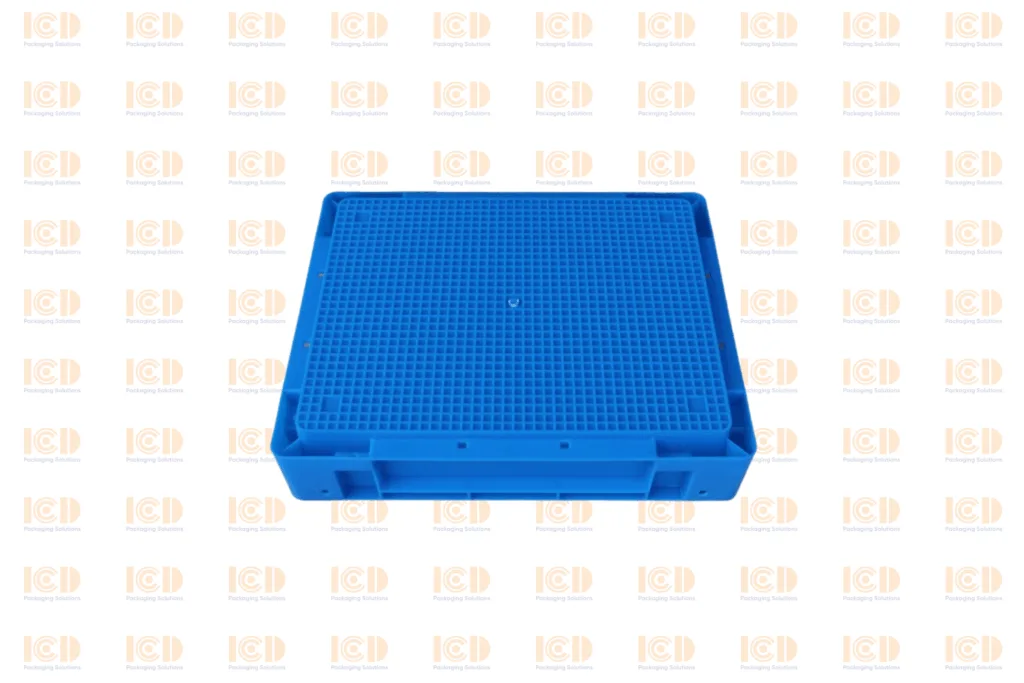
The critical distinction to make from the start: industrial plastic crates are fundamentally different from the household storage bins sold in supermarkets. Industrial crates are designed to handle 30-80 kg loads and to operate continuously in factories, cold stores, and production lines - whereas domestic bins are intended only for light home storage.
On materials: a high-quality plastic crate must use 100% virgin resin - meaning plastic that has never been processed before. Recycled plastic may cost 20-30% less but becomes brittle and cracks within 6-12 months of intensive use, and it does not meet food-safety standards for food or pharmaceutical applications.
Classification by Structure
The most important and practical way to classify crates when buying is by surface structure. This determines which goods the crate suits and which working environment it fits.
Solid-wall plastic crate (Closed / Solid Container)
A solid-wall crate has fully enclosed sides and base. This design prevents goods from falling out and allows it to contain small granules, powder, or liquids (with a lid). Solid-wall crates are generally stiffer than open-mesh crates and can carry heavier loads at the same footprint.
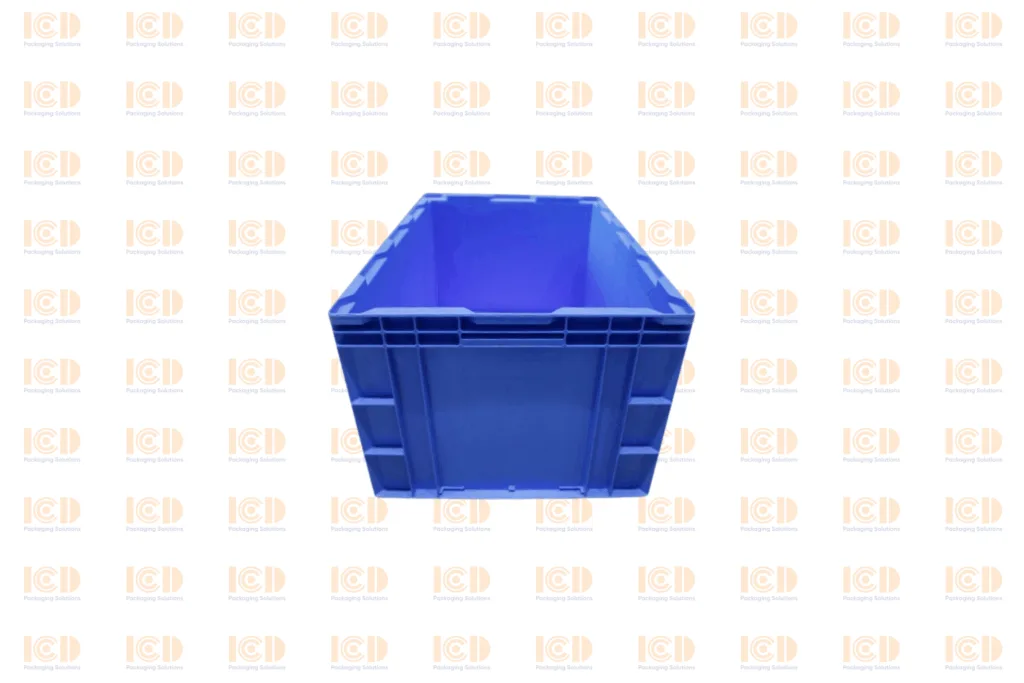
Typical applications: electronic components, mechanical spare parts, packaged food, and goods requiring dust protection. This is the most common type in electronics factories, automotive assembly plants, and logistics operations in Vietnam.
Open-mesh plastic crate (Vented / Open Container)
An open-mesh crate (sometimes called a ventilated crate or produce crate) has ventilation holes in the sides and base. This mesh design allows air to circulate freely, drains water quickly, and significantly reduces crate weight when empty. At the same footprint, an open-mesh crate is approximately 15-25% lighter than a solid-wall equivalent.
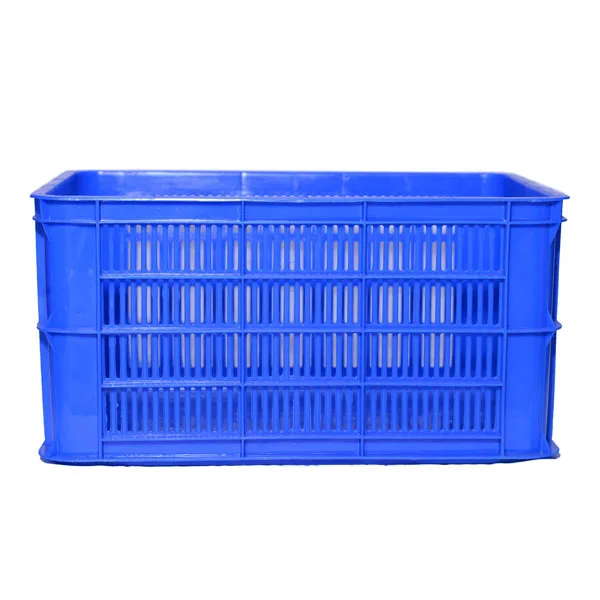
Typical applications: produce, vegetables, fruit, seafood, and goods that need ventilation to prevent moisture and mould. In agriculture and seafood processing, the open-mesh crate is nearly the default choice because of its drainage performance and ease of cleaning.
Classification by Material: PP or HDPE?
This is the question I receive most from business customers. Both resins are good - but “good” for different purposes. Choosing the wrong material leads to premature crate failure or unnecessary cost.
| Criterion | PP (Polypropylene) | HDPE (High-Density Polyethylene) |
|---|---|---|
| Rigidity | High, stiffer | Medium, more flexible |
| Heat resistance | Good (up to 120 degrees C) | Moderate (up to 80-90 degrees C) |
| Impact resistance | Moderate | Better, especially at low temperatures |
| Chemical resistance | Good with oils and organic chemicals | Good with most chemicals and dilute acids |
| Weight | Lighter (0.9 g/cm3) | Slightly heavier (0.95 g/cm3) |
| Cost | 5-10% higher | Slightly lower |
| Best suited for | Components, food, high-temperature environments | Large-volume crates, liquid containment, chemicals, cold stores |
Simple selection rule: If the crate is used in an electronics factory, food production, or a hot environment - choose PP. If you need a high-volume crate (over 100 litres), liquid containment, or cold-store use - choose HDPE. If still unsure, contact ICD for advice specific to your requirements.
Standard Industrial Plastic Crate Sizes
One of the most common mistakes I see is businesses buying plastic crates without checking compatibility with their pallets and racking. The result is crates that do not fit, must be placed off-centre, reduce storage capacity, and create a tipping hazard during transport.
Industrial plastic crates are designed on a modular dimension system where the crate base dimensions are multiples of 100 mm to ensure compatibility with standard pallets. The most common pallets in Vietnam are 1200×1000 mm and 1200×800 mm (Euro pallet) - hence the most common crate sizes are:
| Size range | L x W x H (mm) | Typical load capacity | Common applications |
|---|---|---|---|
| Small | 300 x 200 x 147 mm | 10-15 kg | Small components, spare parts |
| Small | 400 x 300 x 147 mm | 15-25 kg | Components, tools |
| Medium | 600 x 400 x 147 mm | 30-50 kg | General goods, produce |
| Medium | 600 x 400 x 220 mm | 40-60 kg | Food and beverage |
| Large | 610 x 420 x 390 mm | 50-80 kg | Logistics, heavy-duty warehousing |
Important note: Dimensions listed in catalogues are external dimensions. Internal dimensions (the actual usable space) are approximately 15-25 mm smaller on each side due to wall thickness. Always use internal dimensions when calculating load volume, not external dimensions.
Classification by Lid and Special Features
Beyond the basic structure and material classification, plastic crates are further differentiated by additional features serving the specific needs of individual industries. Understanding these options helps you select the right crate from the start rather than adding accessories later.
- Lidded plastic crate: Available with a separate lid or a hinged lid, protecting goods from dust and moisture. Common in cold stores, food production, and pharmaceutical operations.
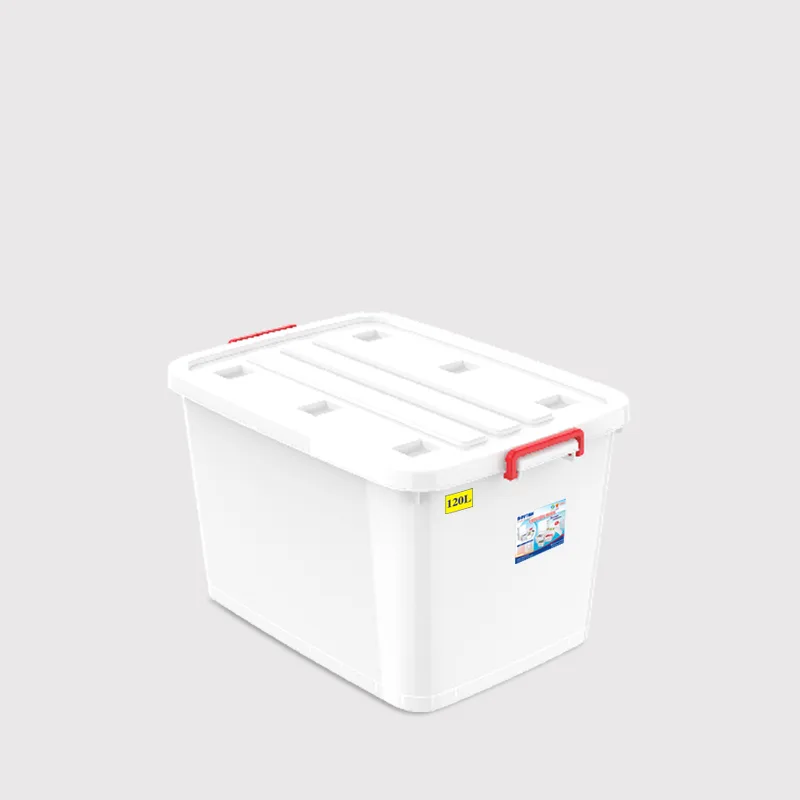
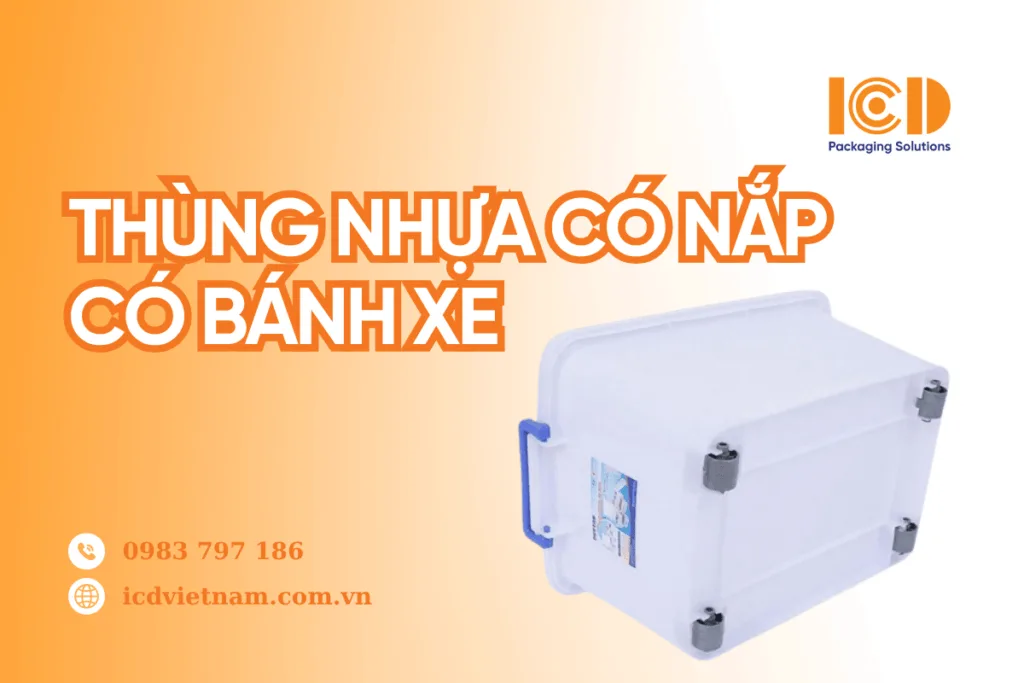
- Wheeled plastic crate: Four 360-degree swivel castors fitted to the base allow easy movement within a warehouse without a forklift. Suited to large crates (over 60 litres).
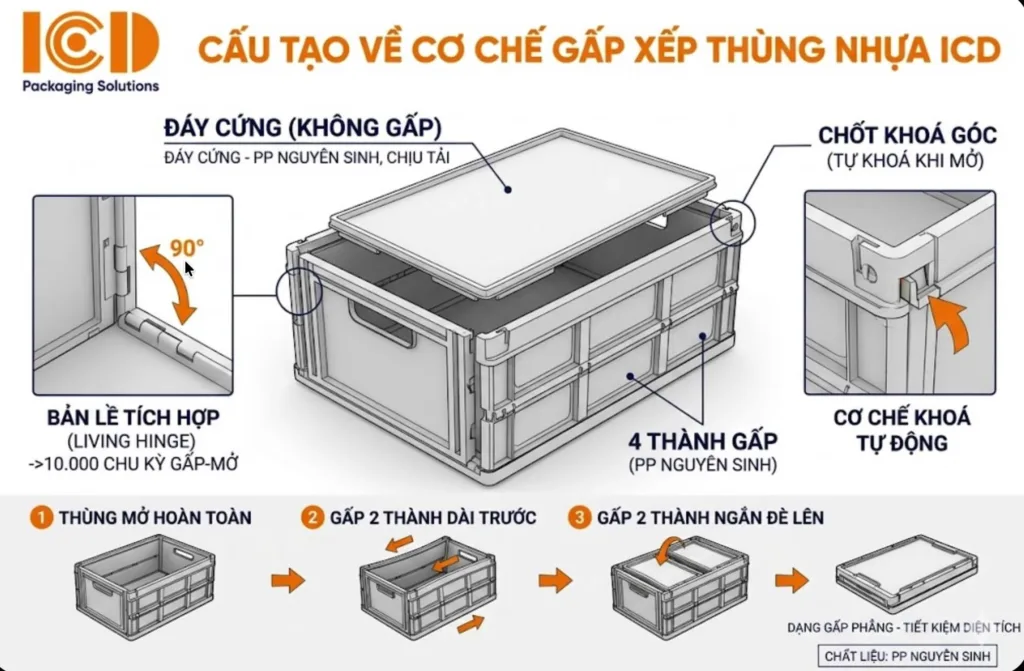
- Foldable / collapsible plastic crate: Designed to fold flat when empty, reducing volume to approximately 25% of the open size. Significantly reduces the cost of returning empty crates.
- ESD anti-static plastic crate: Made from PP compounded with carbon black for conductivity, protecting sensitive electronic components from electrostatic discharge. Mandatory on PCB assembly and semiconductor lines.
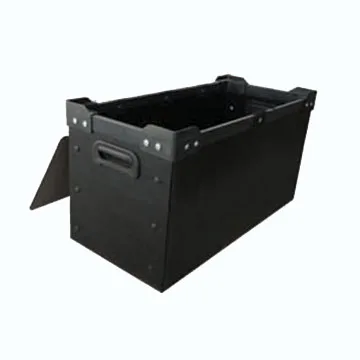
- Danpla plastic crate: Not a conventional injection-moulded crate - this is a crate fabricated from hollow-core PP sheet (similar to corrugated cardboard but in plastic), lighter and more flexible for custom dimensions.
Plastic Crate Applications by Industry
Plastic crates are not a one-size-fits-all product. Each industry has different requirements for size, material, features, and hygiene standards. The following is a practical guide by the most common sectors in Vietnam.
- Logistics and warehousing: Prioritise solid-wall plastic crates in the 600×400 mm or 610×420 mm footprint to match standard pallets. Requirements include good stacking performance, anti-slip ribs, and a continuous load capacity of 50-80 kg. Korean logistics crates (EU series) are popular for their design optimised for automated conveyor systems.
- Electronics and components: Use virgin PP crates, optionally with internal dividers to sort small parts. In PCB assembly and semiconductor environments, ESD anti-static trays are mandatory to prevent damage from electrostatic discharge.
- Agriculture and food: Prioritise open-mesh crates (produce crates) to keep vegetables from becoming damp and bruised. The material must be virgin PP or HDPE in an uncoloured or food-safe colour. FDA and HACCP standards require crates that are easy to clean and have no hidden crevices where bacteria can harbour.
- Aquaculture: Requires large HDPE crates (500-5,000 litres) resistant to salt water, disinfectant chemicals, and continuous temperature variation. Round HDPE tanks are the popular choice for intensive fish and shrimp farming.
- Chemicals and pharmaceuticals: Requires premium-grade virgin HDPE with no recycled-plastic additives, tested for migration according to applicable standards. An airtight lid and pressure-relief valve are necessary features for volatile chemicals.
5 Common Mistakes When Buying Plastic Crates
Based on years of advising businesses, I have compiled the 5 mistakes that first-time buyers most frequently make. Avoiding these will save you significant cost and prevent having to replace crates prematurely.
- 1. Choosing by price instead of specification. Low-cost plastic crates typically use recycled or low-grade virgin resin. After 6-12 months of intensive use the crate becomes brittle and cracks at the corners. Early replacement cost far exceeds the saving from buying cheap in the first place.
- 2. Not checking pallet compatibility. Buying a 500×350 mm crate for a 1200×1000 mm pallet leaves gaps on the pallet face, making the load unstable in transit. Always verify: number of crates x crate width = pallet width (within 5 mm).
- 3. Using an open-mesh crate for goods that need containment. Open-mesh crates save cost and weight, but are not suitable for small items, powder, or goods requiring dust protection. Some customers have bought open-mesh crates for small electronic components - only to find components falling through the mesh holes when stacked.
- 4. Ignoring the stacking load rating. Static load capacity (crate sitting still) and stacking load capacity are very different figures. A crate rated at 50 kg of contents may not withstand 4-5 loaded crates stacked on top during truck transport. Always ask the supplier for the stacking load rating, not just the static load.
- 5. Using recycled plastic for food contact. This is the most serious mistake. Recycled plastic may contain heavy metals and unknown additives carried over from its previous use. If your product is in direct contact with the crate - vegetables, seafood, processed food - virgin resin with a food-safety certification is mandatory.
How to Read a Plastic Crate Technical Specification
Plastic crate catalogues list many parameters, but not all are equally important. The following are the figures to focus on when comparing different products.
- External dimensions (L x W x H): Used to calculate compatibility with pallets and racking.
- Internal dimensions: Used to calculate actual usable storage volume.
- Load capacity: Must state both static load and stacking load - these two figures are completely different.
- Empty weight: Affects transport cost and the physical effort required by handling staff.
- Material: PP or HDPE, virgin or recycled, safe colour additives.
- Standards: ISO 9001, and FDA or HACCP food-safety certification where required for food applications.
Related articles
| Plastic Crates - Full product range | Solid-wall plastic crates | Open-mesh plastic crates |
1. Which is more durable - PP or HDPE plastic?
There is no absolute answer because durability depends on the working environment. PP is stiffer and more heat-resistant (up to 120 degrees C), making it better for hot environments and food contact. HDPE is tougher under impact, especially at low temperatures, and more resistant to chemicals, making it better for cold stores, large-volume crates, and chemical environments. Under normal conditions (ambient warehousing or office), both have equivalent service lives when virgin resin is used.
2. How long does a plastic crate last?
A good-quality virgin PP or HDPE plastic crate has an average service life of 5-10 years under normal industrial conditions. Service life drops to 1-3 years if recycled plastic is used, if the crate is frequently exposed to UV light without UV-stabiliser additives, or if it is cleaned with incompatible chemicals. Signs that replacement is needed: cracks appearing at corners, the crate colour turning chalky white, or the walls becoming brittle on light impact.
3. Can plastic crates be ordered in a custom size?
Yes, but a sufficiently large order quantity is required (typically 500-1,000 units per model depending on the manufacturer) to amortise tooling cost reasonably. New tooling cost ranges from approximately 15-50 million VND depending on size and complexity. If quantities are lower, it is better to find the closest standard size rather than commissioning new tooling. ICD Vietnam can advise which standard size best meets your requirements.
4. What is the difference between a lidded and a non-lidded plastic crate?
A lidded crate protects goods from dust, moisture, and insects, and allows safer stacking. However, lidded crates are heavier and cost 15-30% more than the equivalent non-lidded version. Choose a lidded crate for: goods sensitive to dust or moisture, food, pharmaceuticals, and electronic components. Use non-lidded crates for: bulk goods, produce that needs ventilation, and stored goods that are not moved frequently.
5. How do I tell virgin plastic from recycled plastic?
Virgin plastic crates have a uniform colour, a smooth glossy surface, and no spots or unusual colour streaks. When tapped lightly, the sound is clear and resonant. Recycled plastic crates tend to have a dull, uneven colour, possible black or brown speckling, a slightly matt surface, and a duller sound when tapped. The most reliable method is to ask the supplier for a material certificate and to check the resin identification code on the base of the crate (PP = triangle number 5, HDPE = triangle number 2).
Contact ICD Vietnam
Hotline: 0983 797 186 / 090 345 9186 / 090 5859 186
Email: sales@icdvietnam.com.vn | Zalo: Chat Zalo