


Table of Contents
- Why electronic components need antistatic trays
- How ESD trays conduct and dissipate charge
- Classifying trays by surface resistance (ANSI/ESD S541)
- How to measure the surface resistance of an ESD tray
- When ESD trays are mandatory in an ESD protected area (EPA)
- How to tell a genuine ESD tray from a fake one
- ESD boxes, containers and sheets at ICD Vietnam
- Notes on using and storing ESD trays
- Frequently asked questions about antistatic plastic trays
- What is an ESD antistatic plastic tray?
- What tray resistance counts as acceptable?
- Is a conductive ESD tray better than a dissipative one?
- Can I measure ESD tray resistance with a multimeter?
- Is a black antistatic plastic tray an ESD tray?
- Does an ESD tray lose its effect with long use?
- Can I send components to customers in an open ESD tray?
- How does an antistatic EVA foam tray differ from an ESD plastic tray?
- How long is the warranty on ICD Vietnam ESD trays?
- Contact us about antistatic ESD trays
- References
- Related articles
Reviewed and updated by ICD - Week 43/2026
An ESD (antistatic) plastic tray is a tray for electronic components made from conductive or dissipative plastic, so that charge on the tray drains to ground in a controlled way instead of discharging into component leads. Under ANSI/ESD S541, the tray surface that touches components should lie in the dissipative range, from 10⁴ to below 10¹¹ ohm. A genuine tray can only be recognised by measuring its surface resistance; neither a black colour nor an ESD symbol printed on the tray is enough to conclude anything.
I am Le Van Thang and I have worked at ICD Vietnam since 2011. The question electronics factory customers ask me most is not what an ESD tray costs but how to know whether the batch they just received is really antistatic. This guide follows the order you need to answer that question: how an ESD tray handles charge, how to measure surface resistance, when an ESD control programme makes ESD trays mandatory, and five ways to spot a fake tray. The size, construction and general selection of component trays are in the component tray article in the related articles section at the bottom of the page.
Why electronic components need antistatic trays
Components need antistatic trays because an ordinary plastic tray is an insulating material: charge generated when a component slides on the tray stays where it is and then discharges into the component on the next touch, causing immediate or latent damage.

Charge is generated whenever two surfaces touch and then separate, a phenomenon called triboelectric charging: peeling film, taking a component out of a tray and dragging a tray across a bench all generate charge. An ESD control programme under ANSI/ESD S20.20-2021 is built for components sensitive from 100 V under the human body model (HBM) and 200 V under the charged device model (CDM), far below the static level a person can feel at a fingertip. Because it cannot be felt, workers do not know when a component is discharged; the only trace is usually a higher defect rate at inspection or returns from customers.
How ESD trays conduct and dissipate charge
Plastic is naturally an insulating material; an ESD tray is made by mixing a conductive substance into the plastic to form a path for charge to flow, or by mixing in an antistatic agent (antistat) so the surface generates less charge and conducts through a thin layer of moisture.
The most common way for moulded trays is to mix carbon black powder or carbon fibre into PP, PS or ABS pellets. When the content is high enough, the carbon particles touch to form a continuous network through the tray wall, so the tray conducts both on the surface and through the bulk, and keeps this property for the life of the tray. The second way is to mix in an antistat: according to a 2019 scientific review in the International Journal of Sciences, antistat molecules gradually migrate to the surface and attract moisture and ions from the air to form a thin conductive layer. This layer is washed away and weakens when the air is dry, so an antistat tray may pass when new but slip out of the range after a few washes.
The most commonly misunderstood point is the idea that the more conductive a tray is, the safer. According to an analysis published in In Compliance Magazine in 2017 by ESD Association experts, experience at many plants shows that more than half of black ESD materials measure a surface resistance below 10⁵ ohm, which is too conductive to protect components from CDM-type discharge. When an already-charged component touches an overly conductive tray, the charge discharges almost instantly, creating a large current pulse; it is the current, not the voltage, that damages the component. That article proposes an optimum range of 10⁶ to 10⁹ ohm at the point of contact, provided the material is homogeneous.
Classifying trays by surface resistance (ANSI/ESD S541)
The packaging standard ANSI/ESD S541 divides materials into three groups by resistance: conductive below 10⁴ ohm, dissipative from 10⁴ to below 10¹¹ ohm, insulative from 10¹¹ ohm upwards. S541 is the packaging standard that accompanies the ANSI/ESD S20.20 ESD control programme; S20.20 itself does not set the boundaries of these three groups.
| Material group | Surface resistance | Role for a component tray |
|---|---|---|
| Conductive | Below 10⁴ ohm | Grounds quickly; risk of a current pulse with CDM-sensitive components if it is the contact surface |
| Dissipative | 10⁴ to below 10¹¹ ohm | The group to use for the component contact surface; many factories specify a narrower range, for example 10⁶ to 10⁹ ohm |
| Insulative | From 10¹¹ ohm | Ordinary plastic trays; not for ESD-sensitive components |
| Discharge shielding | Conductive layer of 10³ ohm or below | Mandatory in addition when components leave the ESD protected area |
Three points are often missed when reading this table. First, resistance is only one of the properties S541 considers; the standard also requires the material to generate little charge, and according to the ESD Association, low charge generation cannot be deduced from resistance and must be tested separately. Second, the 10⁶ to 10⁹ ohm range often seen in catalogues is a narrow range inside the dissipative group specified by individual factories, not a boundary of the standard. Third, some sales materials call the 10⁴ to 10⁶ ohm range conductive; under S541, that range already belongs to the dissipative group.
How to measure the surface resistance of an ESD tray
Surface resistance is measured with a resistance meter that has two electrodes placed on the same face of the tray, applies a test voltage and reads the value in ohms; flat material is measured under ANSI/ESD STM11.11, while small trays or curved surfaces use the two-point measurement under STM11.13.
A laboratory measurement used to classify a material differs from a check on the factory floor. The classification test under STM11.11 is done on a flat sample, with standard electrodes and a controlled environment; the ESD Association notes that even when done correctly, results between runs still vary by about half an order of magnitude. A floor check only aims to detect trays that have drifted out of the range. On the test voltage, on the ESD Association’s technical forum, an expert explains that for material of 10⁶ ohm and above, measuring at 100 V gives repeatable results while measuring at 10 V can be unstable; that is why meters usually choose 10 V for low values and 100 V for high values.
The tray checking procedure I usually suggest to customers has these steps:
- Clean the tray and let it dry; record the room temperature and humidity at the time of measurement.
- Place the tray on an insulating surface, not on an ESD mat, to avoid measuring a path through the mat by mistake.
- Measure at least three locations: inner base, wall and top rim, because unevenly mixed material will vary between locations.
- Also measure the resistance from the tray surface to the grounding point if the tray sits on a grounded shelf or bench.
- Compare the value with the range the factory specifies; a tray outside the range should be labelled as rejected and removed from the ESD protected area.
- Record the tray code, the date measured and the measured value in the records; re-measure after every wash and on the cycle set in the ESD control plan.
When ESD trays are mandatory in an ESD protected area (EPA)
ESD trays are mandatory when ESD-sensitive components are handled within an ESD control programme under ANSI/ESD S20.20 or IEC 61340-5-1: all packaging and holding trays entering the ESD protected area (EPA) must generate little charge and be conductive or dissipative.
An EPA is an area where people, work surfaces, floors and tools are all grounded, for example an SMT line, an assembly bench or a board test room. According to the ESD Association, IEC 61340-5-1 is technically equivalent to S20.20, so a factory following either standard meets the same requirement. The S20.20-2021 edition extends the requirement to single-use packaging as well, and packaging used as a handling surface (for example a tray that both holds parts and serves as an assembly spot) must meet the same requirements as an ESD work surface. The standard also limits the voltage on ungrounded conductors in an EPA to 35 V, so a metal tray or a conductive tray left loose on an insulating bench is also a risk.
| Location | Requirement for trays and packaging | Example |
|---|---|---|
| Inside the EPA | Low charge generation; conductive or dissipative | Open ESD tray on an SMT line, grounded assembly bench |
| Outside the EPA | Add a discharge shielding structure around the components | ESD box with a sealed lid, static shielding bag, large enough air gap |
| Packaging used as a handling surface | Meets the same requirements as an ESD work surface | A tray that both holds parts and serves as an assembly spot on the bench |
Conversely, there are situations that do not need an ESD tray: holding mechanical parts, plastic housings, screws not yet fitted to a circuit, or passive components that are not static-sensitive in the factory’s own assessment. Using ESD trays for everything raises costs and weakens the discipline of telling trays apart; many factories choose ordinary trays in a clearly different colour for non-sensitive goods so that nobody takes the wrong one.

How to tell a genuine ESD tray from a fake one
The only sure way is to measure surface resistance at several points and compare with the manufacturer’s test certificate; a black colour, a hand-in-triangle symbol or embossed ESD lettering are only signs, not proof.
Black colour usually comes from carbon, but plastic mixed with ordinary black pigment is still an insulating material, and the eye cannot tell them apart. The ESD protective symbol under ANSI/ESD S8.1 is printed on the mould by the manufacturer itself; S541 requires ESD packaging to state its material properties and be traceable, so a tray with a symbol but no resistance figures or measurement method still says nothing. When you receive a new batch of trays, I advise customers to check the five points below before putting them on the line:
- A test certificate that states the value, the method (STM11.11, STM11.13 or IEC 61340-2-3), the test voltage and the humidity at the time of measurement.
- Measure at least three points on each sample tray yourself; a difference of more than one order of magnitude is a sign of non-homogeneous material.
- If the measured value is below 10⁵ ohm at the contact surface for CDM-sensitive components, ask the supplier again, because the tray may be too conductive.
- Wash one tray by the factory’s own procedure and measure again; a tray with only an antistat coating will drop noticeably after washing.
- Ask clearly whether the material is plastic with carbon mixed through the bulk or only coated or sprayed on the surface.
ESD boxes, containers and sheets at ICD Vietnam
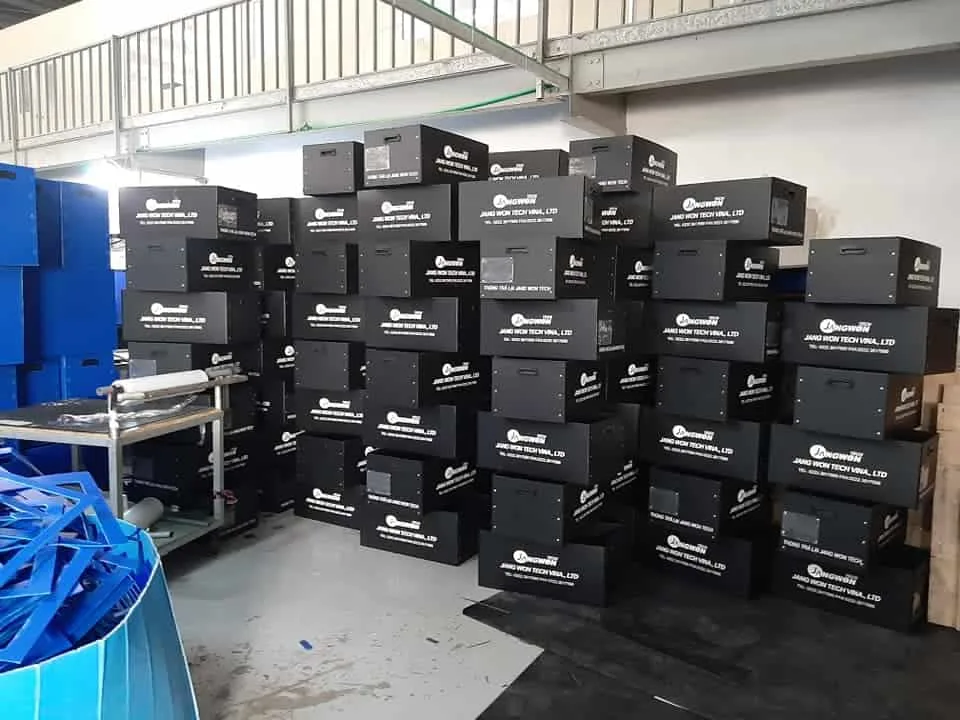
ICD Vietnam has three groups of antistatic products: ESD plastic boxes with lids, open-front ESD component bins and ESD Danpla sheets, boxes and dividers. The product pages do not yet publish resistance values, so when we quote, we attach the measured specifications to the factory’s required resistance range on request.
A box with a sealed lid is the choice for boards and components that must leave the EPA and pass through a shared warehouse or move between workshops, because the lid forms a layer around the components; even so, if the ESD control plan requires discharge shielding, you need to confirm that the box and lid meet the shielding properties or wrap them in a static shielding bag. Open-front bins suit assembly lines inside the EPA, where workers take components continuously. ESD Danpla is light and can be cut into divider cells to the exact shape of the components, often used as liner trays and dividers inside large boxes.
Notes on using and storing ESD trays
An ESD tray keeps its effect only when it is measured periodically, washed correctly and not mixed with ordinary trays. Wash with clean water or a solution the manufacturer allows; strong detergents and solvents can remove the surface antistat layer. Do not stick tape or ordinary paper labels on the component contact surface because they are insulating materials. An ESD tray with a damaged rim, a crack or a reading outside the range should be removed from the EPA altogether; do not reuse it temporarily for another job in the same area because someone will pick it up by mistake.
Frequently asked questions about antistatic plastic trays
What is an ESD antistatic plastic tray?
It is a tray for electronic components made from plastic mixed with a conductive or antistatic agent, with a surface resistance in the conductive or dissipative range, so that charge flows to ground in a controlled way instead of discharging into components. An ordinary plastic tray is an insulating material, at 10¹¹ ohm or above.
What tray resistance counts as acceptable?
Under ANSI/ESD S541, the component contact surface should be a dissipative material, from 10⁴ to below 10¹¹ ohm. Many factories specify a narrower range such as 10⁶ to 10⁹ ohm, and ESD experts advise avoiding a contact surface below 10⁵ ohm for components sensitive to CDM-type discharge. The exact range is set by each factory’s ESD control plan.
Is a conductive ESD tray better than a dissipative one?
Not necessarily. A conductive tray grounds quickly, but when an already-charged component touches it, the charge discharges almost instantly and creates a current pulse that can damage the component. So the component contact surface should be a dissipative and homogeneous material; conductive material suits shielding layers or parts that do not touch components.
Can I measure ESD tray resistance with a multimeter?
No. An ordinary multimeter uses a low voltage and cannot reliably measure the 10⁶ to 10¹¹ ohm range. You need a surface resistance meter with 10 V and 100 V test voltages and suitable electrodes; results can still vary by about half an order of magnitude between runs.
Is a black antistatic plastic tray an ESD tray?
Not necessarily. Black usually comes from carbon, but plastic mixed with ordinary black pigment still insulates; conversely, a black tray with a lot of carbon can be too conductive. You can only conclude after measuring surface resistance at several points and finding the values inside the range the factory specifies.
Does an ESD tray lose its effect with long use?
It can. A tray with carbon mixed through the bulk keeps its properties more stably; a tray using a surface antistat can weaken after many washes or in dry air. Dust and oil on the surface also distort readings. That is why you need to re-measure after each wash and on the cycle set in the ESD control plan.
Can I send components to customers in an open ESD tray?
No. Under ANSI/ESD S541, when components leave the ESD protected area, the packaging must also have a discharge shielding structure. Put the tray into an ESD box with a sealed lid that meets the shielding requirements, or wrap it in a static shielding bag before shipping.
How does an antistatic EVA foam tray differ from an ESD plastic tray?
An antistatic EVA foam tray is soft, with cells cut to hug the components, mainly protecting against impact and scratches, and is usually used as a liner inside a box. An ESD plastic tray is rigid, withstands stacking and many cycles on the line. Both need resistance specifications if they are used for ESD-sensitive components.
How long is the warranty on ICD Vietnam ESD trays?
ICD Vietnam plastic crate products carry a 12-month warranty under the warranty and repair policy published on the website. The resistance specification for each batch is confirmed when we quote, to the range the factory requires.
Contact us about antistatic ESD trays
ICD Vietnam Industrial Manufacturing Co., Ltd
Send the type of components, the resistance range the factory specifies and where the tray will be used (inside or outside the EPA) to get advice and a quote with resistance specifications.
- Northern Vietnam: 0983 797 186 / 090 345 9186 / 090 5859 186.
- Southern Vietnam: 098 6784 186.
- Email: sales@icdvietnam.com.vn.
- Zalo: 090 345 9186.
ICD Vietnam plastic crate products carry a 12-month warranty under the warranty and repair policy published on the website.
References
- ANSI/ESD S541, Packaging Materials for ESD Sensitive Items (EOS/ESD Association).
- ESD Association, ESD Fundamentals Part 3: Basic ESD Control Procedures and Materials.
- ESD Association, ESD Fundamentals Part 6: ESD Standards.
- ANSI/ESD S20.20-2021.
- C. Newberg, T. Dangelmayer, T. Welsher, Are Your ESD Tote Boxes and Containers Too Conductive?, In Compliance Magazine, 2017.
- A. C. Sparavigna, Engineered Polymers in Packaging: Some Solutions to Prevent Electrostatic Discharge, International Journal of Sciences, 2019.
- ESD box, ESD component bin and ESD Danpla specifications: ICD Vietnam product pages, checked on 16 October 2026.
Related articles
- ICD electronic component trays
- What are component trays: types and uses
- How to read crate and open-wall crate codes
If you only need an ordinary storage crate, see where to buy used plastic crates; for ESD trays, buy new ones that come with resistance specifications.