Table of Contents
Reviewed and updated by ICD - Week 40/2026
A collapsible plastic crate (folding crate) is an industrial plastic crate with an integrated hinge design that allows all four walls to fold flat when empty, reducing height to just 25-30% of the open position. This property solves a problem that traditional rigid crates cannot: dramatically cutting the space needed to transport and store empty crates. ICD Vietnam supplies collapsible crates in virgin PP, standard sizes 400×300, 600×400 and 800×600 mm, load capacity 15-30 kg, stocked in Hanoi with nationwide delivery.
Quick summary
- Collapsible crates fold flat when empty, saving 60-75% space compared with rigid crates.
- Structure: rigid base + 4 folding walls via integrated plastic hinges, virgin PP or HDPE material.
- Best use cases: return-trip logistics, retail and supermarket chains, seasonal produce, and 3PL warehousing.
- Purchase price is 30-50% higher than rigid crates, but the saving on empty-return transport and warehouse rent is substantial.
Construction and folding mechanism
A collapsible plastic crate has three main components.
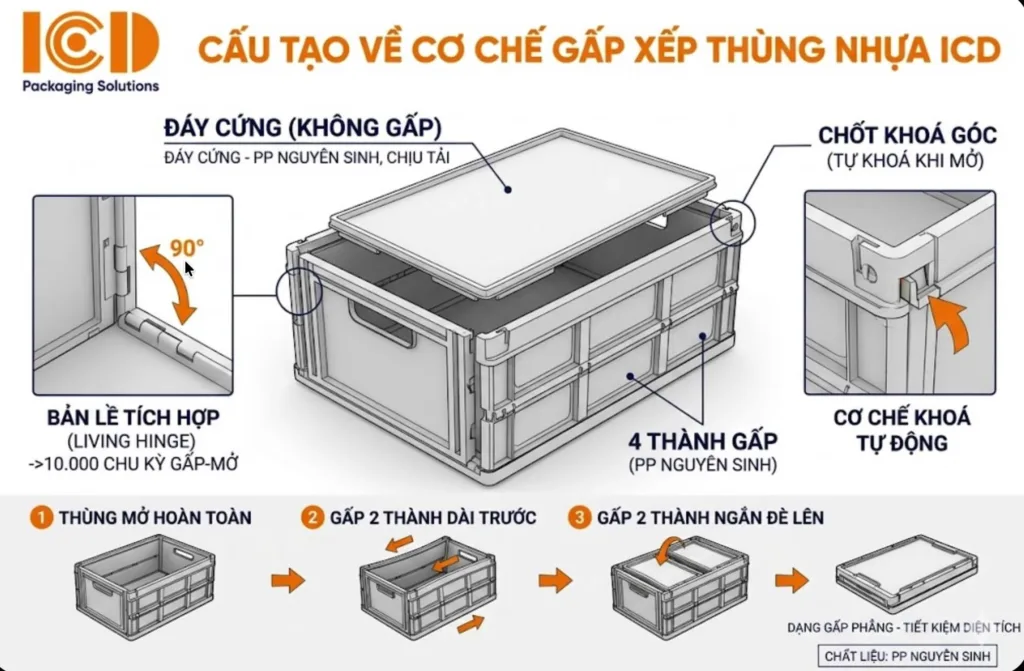
- Rigid base - a solid flat surface identical to a solid crate, cannot fold, bears the full weight of the goods.
- Four folding walls - each wall connects to the base via an integrated plastic hinge, allowing it to rotate 90 degrees and lie flat on the base when folded.
- Locking mechanism - when open, the walls lock to each other at all four corners via plastic latches, creating a structure as rigid as a one-piece crate.
To fold: release the latches at all four corners, fold the two long walls inward first, then fold the two short walls on top.
The primary material is virgin PP because PP has better flexibility than HDPE - critical for a hinge that must withstand thousands of fold-unfold cycles without cracking. The integrated living hinge is engineered to handle a minimum of 10,000 fold-unfold cycles, equivalent to 5-7 years of daily use.
Collapsible crate vs rigid crate: side-by-side comparison
| Criterion | Collapsible crate | Rigid crate (solid/vented) |
|---|---|---|
| Space when empty | Folds flat, occupies 25-30% of volume | Retains full volume |
| Load capacity | 15-30 kg (lower than rigid) | 20-80 kg |
| Stacking when full | 4-5 tiers | 5-8 tiers |
| Impact resistance | Lower (hinge is the weak point) | Higher (one-piece) |
| Purchase price | 30-50% more expensive | Base price |
| Empty-return transport cost | Reduced by 60-70% | High cost when returning empty |
| Service life | 3-5 years (hinge wear) | 5-10 years |
| Best for | Two-way logistics, 3PL, seasonal use | Long-term storage, fixed internal warehouse |
Conclusion: the collapsible crate does not fully replace the rigid crate - it complements it in situations where empty-return transport and storage costs are the main concern. If the crates stay in one fixed location (internal warehouse, production line), a rigid crate is still the better choice on price and durability.
Ideal use cases for collapsible crates
Two-way logistics (full outbound, empty return): After delivering goods to customers, empty crates must return to the warehouse. With rigid crates, the truck carries bulky empties back. Collapsible crates fold flat - one truck run handles the same empties as three rigid-crate runs.
Retail and supermarket chains: Goods are delivered from the distribution centre to stores in collapsible crates. After the shelves are stocked, the empty crates fold flat and go back to the DC. This model is standard in Europe (ALDI, LIDL chains) and is gaining traction in Vietnam.
Seasonal produce: Harvest season demands thousands of crates; off-season they sit in storage for 8-9 months. Collapsible crates cut off-season storage area by 70% - a significant saving for businesses paying rent by the square metre.
3PL warehousing: Warehouse rent is charged per m2, and every m2 of empty crate storage is wasted cost. Collapsible crates reduce empty storage area by 70% - translated into rent savings, the figure adds up quickly.
ROI calculation: when does the collapsible crate pay off?
A collapsible crate costs 30-50% more to buy than a rigid crate. When does that extra investment break even? The answer depends on two variables: the cost of transporting empties and the cost of storing empties.
Example: Company A needs 2,000 crates and returns 2,000 empty crates to the warehouse every month (distance Liên hệ báo giám). Rigid crates require Liên hệ báo giáuck runs; collapsible crates need only 1.5 runs. Saving: 2.5 runs/month x Liên hệ báo giá = Liên hệ báo giá. Extra purchase cost: 2,000 crates x Liên hệ báo giá = 100 million VND. Break-even: 100 million / 3.75 million per month = approximately 27 months. If the business uses the crates for more than 3 years, the ROI is clearly positive.
On the other hand, if the crates never need to be transported empty (used on-site, internal warehouse), a collapsible crate offers no benefit - it is only more expensive and less durable. In that case, choose a rigid crate.
Related articles
| Industrial plastic crates: types and applications | Solid plastic crates: when durability matters | All plastic crate articles |
Frequently asked questions about collapsible plastic crates
1. Are collapsible crates as durable as rigid crates?
No. The hinge is the weakest point - after 3-5 years of use (or 10,000 fold-unfold cycles), the hinge starts to loosen and can crack. Load capacity is also 20-30% lower than a one-piece rigid crate. However, for light logistics applications (consumer goods, produce, parcels), this level of durability is entirely adequate.
2. Can collapsible crates hold liquids?
Not recommended. The joint between the folding wall and the base is not 100% sealed like a one-piece crate - liquids can leak through the hinge gap. If you need to hold liquids, choose a solid one-piece plastic crate.
3. Does ICD Vietnam supply collapsible plastic crates?
Yes. ICD Vietnam supplies collapsible plastic crates in virgin PP, multiple standard sizes (400×300, 600×400, 800×600 mm), load capacity 15-30 kg. In stock at the Hanoi warehouse, nationwide delivery. Call 0983 797 186 to request a sample and quotation.
4. Which industries use collapsible crates most?
The most common users are logistics and distribution companies running two-way routes, supermarket and retail chains, fresh produce exporters with seasonal peaks, and 3PL warehousing operators who pay rent by the square metre. Any business that regularly moves or stores empty crates benefits from the folding design.
5. What sizes do collapsible plastic crates come in?
Standard footprints are 400×300, 600×400 and 800×600 mm - aligned with standard pallet footprints so the crates stack efficiently. Custom sizes are available for specific production or logistics requirements.
Contact ICD Vietnam
Hotline: 0983 797 186 / 090 345 9186 / 090 5859 186
Email: sales@icdvietnam.com.vn | Zalo: Chat Zalo