
Table of Contents
- 1. What is a blue plastic crate?
- 2. Blue plastic crate sizes from ICD Vietnam
- 3. Why are plastic crates often blue?
- 4. Using crate colour to sort goods in a factory
- 5. Why are black plastic crates and pallets usually recycled?
- 6. Virgin blue crates compared with recycled black crates
- 7. Choosing the right blue plastic crate
- Frequently asked questions
- What else is a blue plastic crate called?
- What material is a blue plastic crate made from?
- Why does the food industry often use blue plastic crates?
- Is a blue plastic crate more durable than other colours?
- Which crate is the blue 610x420x390 plastic crate?
- What do the codes 1T5, 2T5, 3T1 on an open plastic crate mean?
- Can blue plastic crates be used for food?
- How long is the warranty on ICD Vietnam plastic crates?
- Contact us about blue plastic crates
- References
Reviewed and updated by ICD - Week 43/2026
The most common blue plastic crate is the open-sided crate with a 610 x 420 mm opening, 100 to 390 mm high, weighing roughly 0.9 to 2.2 kg each, made from virgin PP combined with HDPE. Blue is favoured in the food industry because almost no food is blue, so a broken fragment of plastic that gets into the product is easy to see; a bright, even colour is also easier to achieve with virgin resin.
In a warehouse or workshop, plastic crates, bins and trays can be bought in many colours, but blue is the colour customers ask for most when handling food and farm produce. This article compiles the blue crate sizes ICD Vietnam currently lists on its product pages, explains why blue suits the food industry, how businesses use crate colour to separate product flows, and how a bright virgin-resin crate differs from the black crate that is usually made from recycled plastic.
1. What is a blue plastic crate?
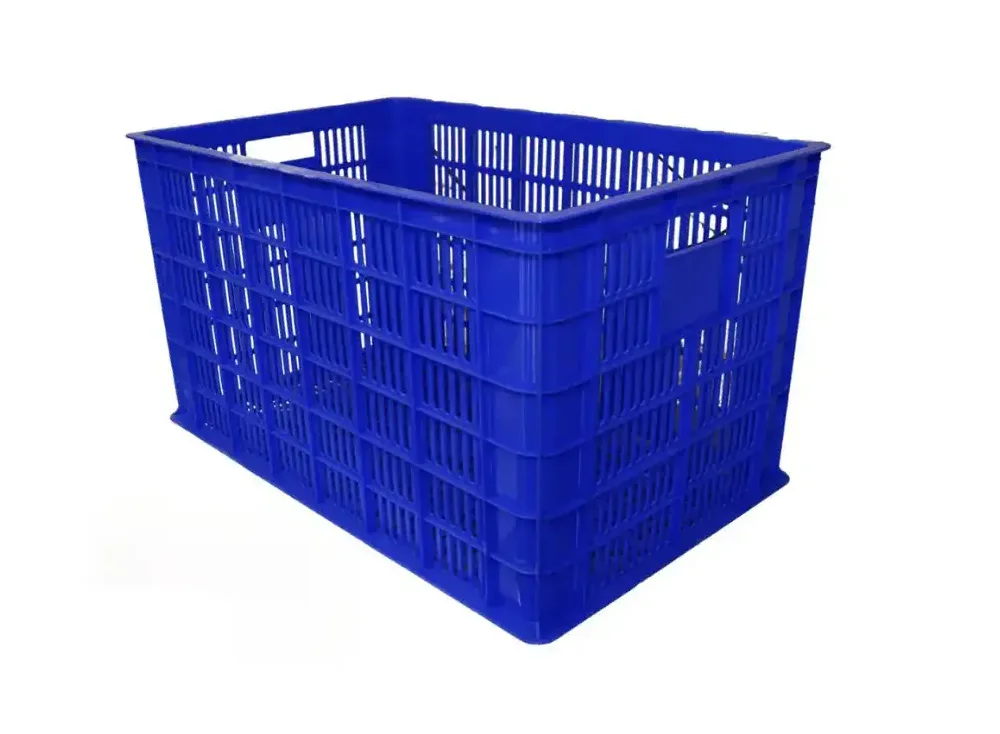
A blue plastic crate is a rectangular open-sided plastic crate with slatted walls and base and ventilation openings, used to hold, stack and transport goods in warehouses, wholesale markets and primary processing workshops. According to ICD Vietnam’s product pages, the open-sided range is made from virgin PP combined with HDPE: PP gives a rigid body that holds its shape when stacked, and HDPE makes the crate flexible and impact-resistant.
Depending on region and trade, this product is also called an open plastic bin, open plastic tray, industrial plastic basket or plastic “ket”. Within the industrial plastic bin family, the open-sided crate differs from the others in wall type and use:
2. Blue plastic crate sizes from ICD Vietnam
The most common size is the 610 x 420 mm opening with six heights of 100, 150, 190, 250, 310 and 390 mm; larger sizes are 780 x 500 x 430 mm, 850 x 630 x 525 mm and 1030 x 670 x 540 mm. Crates are moulded in existing tooling, so the number of sizes is limited; for a custom size you usually need to order a large quantity to cover the cost of a new mould.
The table below summarises the 610 x 420 mm open-sided range according to ICD Vietnam’s product pages (checked in October 2026), sorted by height. A blank weight cell means the product page has not published it.
| Height code | Outside dimensions (mm) | Common model code | Weight | Suggested use |
|---|---|---|---|---|
| 1T | 610 x 420 x 100 | HS010 | About 0.9 kg | Drying trays, seedling trays, flat goods |
| 1T5 | 610 x 420 x 150 | HS008 | Leafy vegetables and seafood that need a thin layer | |
| 1T9 | 610 x 420 x 190 | HS009 | About 1.3 kg | Bakery, processed food, small components |
| 2T5 | 610 x 420 x 250 | HS014 | About 1.6 kg | Vegetables, fruit, consumer goods |
| 3T1 | 610 x 420 x 310 | HS004 | About 2.2 kg | Farm produce, clothing, light bulky goods |
| 3T9 | 610 x 420 x 390 | HS005 | Light, high-volume goods, collecting goods inside the factory |
Blue is available in the 610 x 420 mm models at 100, 190, 250 and 310 mm high, alongside green, yellow and red; the 1T9 model also comes in purple, black and grey. For the 3T9 model, the product page does not currently state which colours are in stock, so ask before placing a large order.
Small blue crates and trays
Besides the 610 x 420 mm range, the small group includes the ICD HS002 plastic bin, 525x355x150 mm, an open-sided crate in PP and HDPE in blue, green or yellow, suitable for dividing small goods or as a fish or vegetable tray. For components and screws there is the ICD A6 component tray, 238x152x124 mm, weighing about 200 g, made from PP and HDPE, in 6 colours including blue; this tray sits on a shelf or stacks for sorting by part number.
Large blue crates
Large sizes are for light but bulky goods such as clothing, parcels and light supplies. The ICD-2726 jumbo plastic crate, 1030x670x540 mm is made from PP and HDPE and comes in blue, green, yellow and red; the 780 x 500 x 430 mm open-sided crate comes in the same four colours, and the 850 x 630 x 525 mm open-sided crate weighs about 6.5 kg. The 780 x 500 x 430 mm size also belongs to the lidded crate group for goods that need dust protection. The large HS015 shipper crate, 1186x886x668 mm, is currently listed as clearance stock on its product page, so quantities may be limited.
Some large sizes have a version fitted with wheels so they can be pushed when full; choosing wheels, calculating wheel load and the safe load for one person pushing are covered separately in the article on plastic crates with wheels and are not repeated here.
3. Why are plastic crates often blue?
Blue is chosen mostly for two reasons that have evidence behind them: it contrasts clearly with most foods, so broken pieces of plastic are easy to spot, and a bright, even colour from batch to batch is easier to achieve with virgin resin. A third reason is habit: many factories are used to blue in food areas and keep ordering the same colour to match their existing crates.
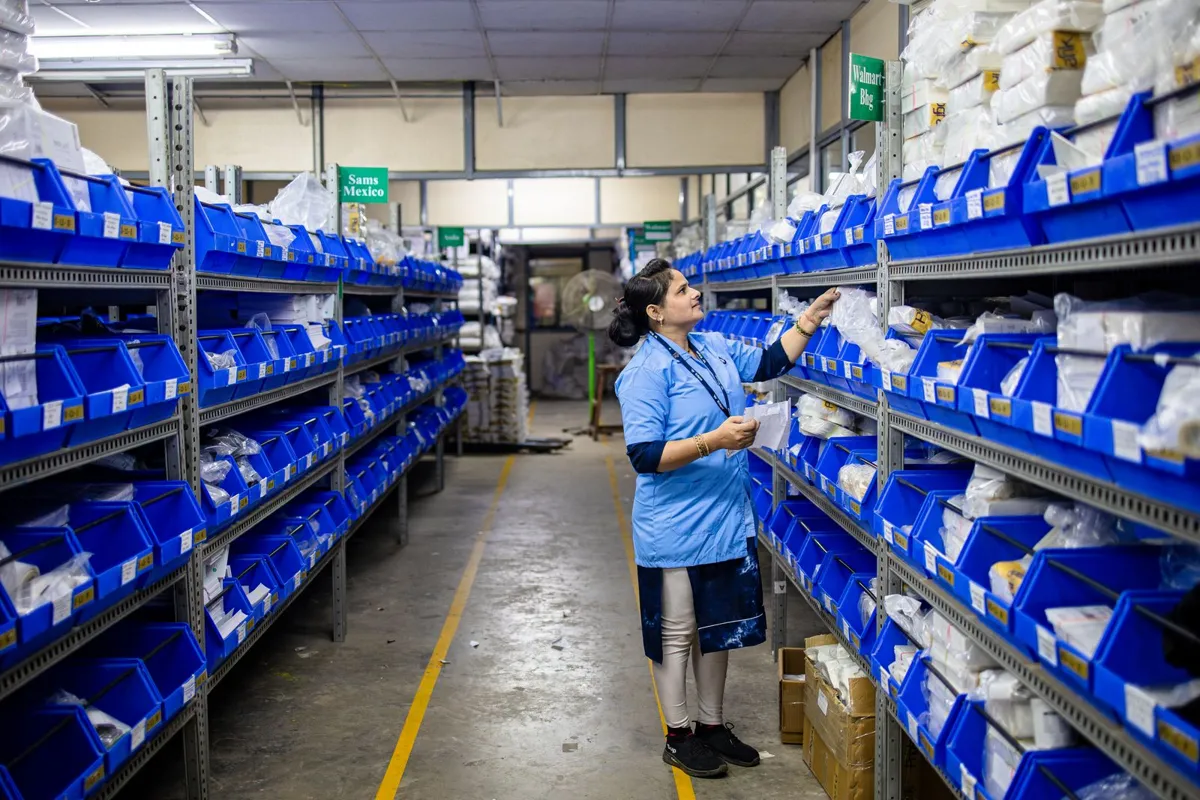
Easy to spot plastic fragments in food
According to a 2005 FoodNavigator report on research by the Georgia Tech Research Institute (GTRI, USA), blue has become the standard colour for plastic items in food processing plants, because very few foods are blue and workers on the line can easily recognise foreign objects. The institute’s test camera system at the time focused on blue and green objects, and in the laboratory could detect foreign fragments as small as 1.5 mm.
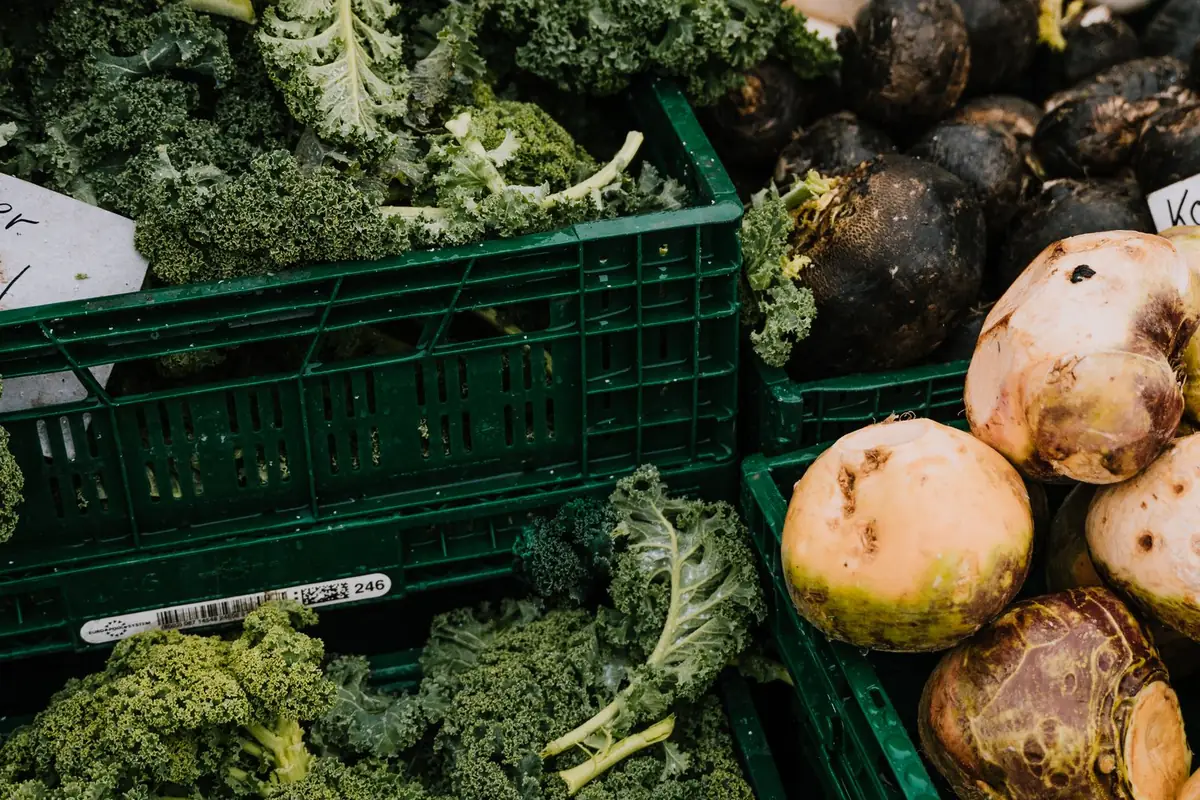
A bright, even colour goes with virgin resin
Virgin resin is naturally an opaque white, so it can be coloured a bright, even blue from batch to batch. Recycled plastic collected from many sources is usually a mix of colours and hard to turn into a fresh, uniform colour, so it is usually compounded to a dark colour, most commonly black. For a buyer, then, a bright, even blue is a useful indicator, but it does not replace asking the supplier exactly which plastic is used and what share is recycled.
Blue does not make a crate stronger by itself. Durability depends on the material, wall thickness and additives. HDPE and PP left in regular sunshine without a UV stabiliser will fade and gradually turn brittle, which is UV degradation of polyolefin plastics; crates used in outdoor staging yards should have UV-resistant additives or be kept under a roof. A few large ICD Vietnam models, such as the 780 x 500 x 430 mm crate with wheels and the 1030 x 670 x 540 mm crate, are listed on their product pages as containing a UV stabiliser.
4. Using crate colour to sort goods in a factory
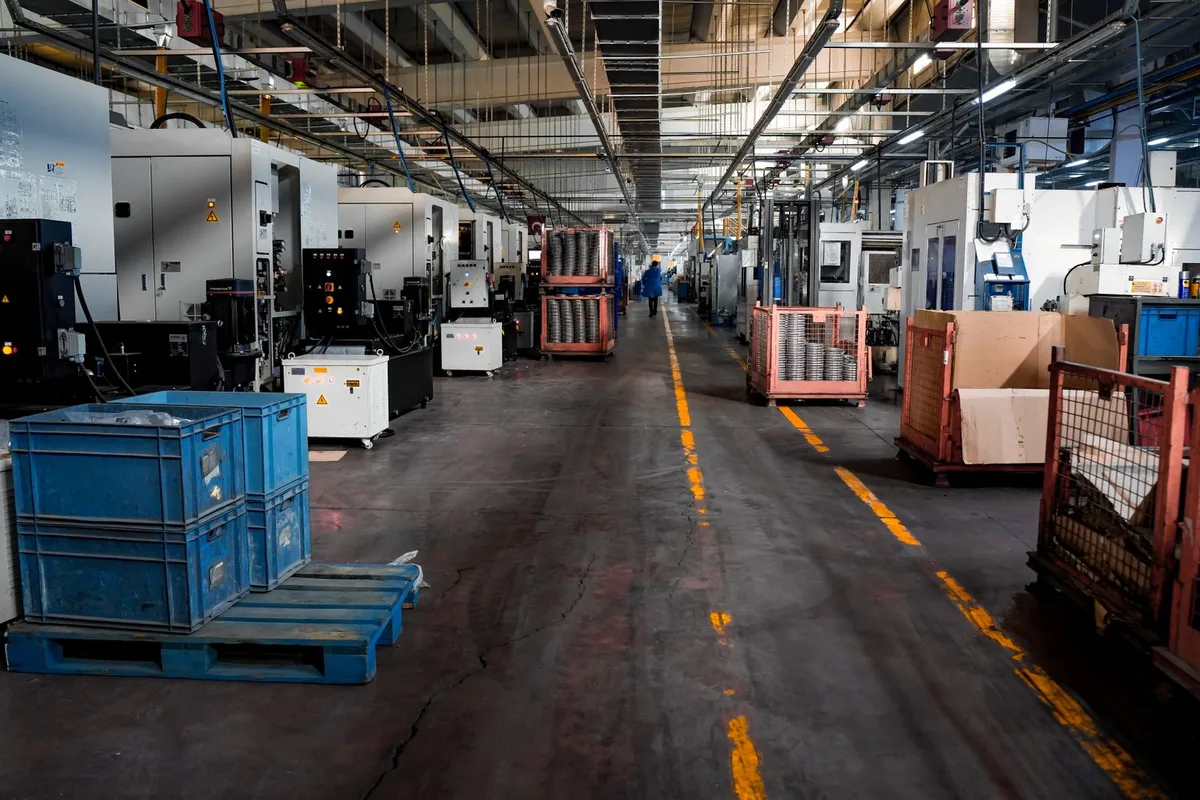
Many factories use crate colour as an internal convention to separate product flows, but there is no general standard dictating which colour goes with which goods; each business sets its own and writes it into its procedures. The US Food and Drug Administration (FDA) allergen control guidance recommends colour codes, tags or marks specific to bins and crates holding allergen-containing ingredients, which may assign one colour to each allergen group, while noting that the colour code must be clear and must not clash with other colour code systems already used in the plant.
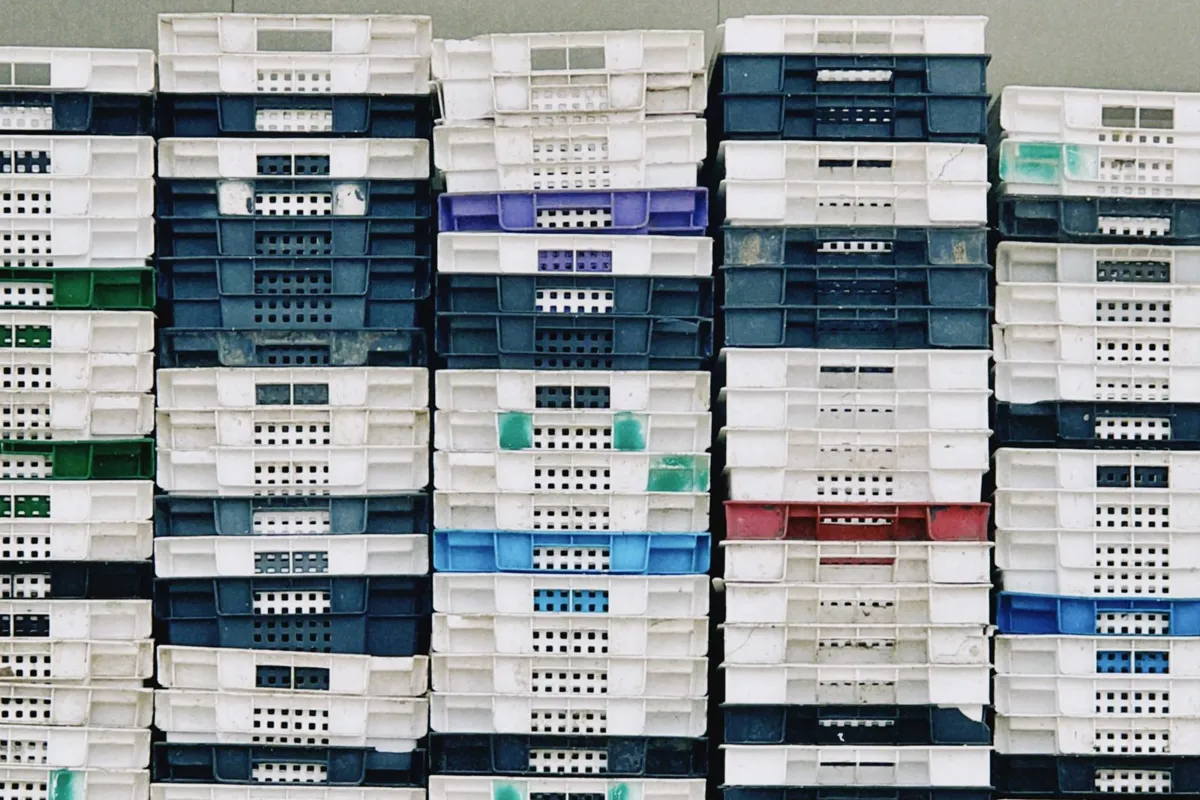
One example of a scheme a business can set for itself: blue for food products and clean areas; green for fresh produce and incoming materials; yellow for goods awaiting inspection; red for defective goods and scrap. This is only a suggestion, not a standard. When drawing up a scheme, choose colours from the list your supplier regularly keeps in stock (for ICD Vietnam’s 610 x 420 mm range that is blue, green, yellow and red) so later orders do not drift in colour, and post a colour chart in the receiving and production areas.
5. Why are black plastic crates and pallets usually recycled?
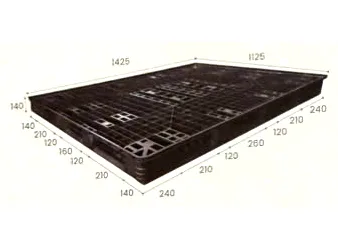
Black plastic crates and pallets are usually recycled because plastic collected from many sources has patchy colours, and compounding to black covers everything so the product is uniform in colour and lower in cost. For example, ICD Vietnam’s product page for the black plastic pallet, 1100 x 1300 x 120 mm, lists the material as recycled PP granules mixed with HDPE; this type suits warehouses and industrial goods that have no demanding appearance requirements.
The downside of black comes at the end of the product’s life. According to WRAP, the UK resources and recycling organisation, carbon black pigment strongly absorbs infrared light, so near-infrared (NIR) sorting machines at recycling facilities cannot detect black plastic. This is why black plastic products generally find it harder to enter the recycling stream than light-coloured plastic.
6. Virgin blue crates compared with recycled black crates
A virgin blue crate has an even colour, is durable and is easier to prove safe for food; a recycled black crate is cheaper and suits industrial goods that do not touch food directly. The table below summarises the differences to help you choose the right one:
| Criterion | Virgin-resin blue crate | Recycled-resin black crate |
|---|---|---|
| Material | New PP and HDPE granules, uniform composition | Plastic collected from many sources, compounded to black |
| Colour | Bright, even from batch to batch | Black, hides patchy colours |
| Durability, impact resistance | Consistent from batch to batch | Depends on the plastic source, may be uneven between batches |
| Holding food | Usable when it meets QCVN 12-1:2011/BYT | Should not touch food directly |
| Cost | Higher | Lower |
| Recycling at end of life | Can be sorted by NIR machines | Hard to sort because of carbon black |
For plastic utensils in direct contact with food, the regulation that applies in Vietnam is QCVN 12-1:2011/BYT from the Ministry of Health on the hygiene and safety of synthetic plastic packaging and utensils. Recycled plastic of unknown origin has difficulty proving compliance with this regulation, so food businesses usually choose light-coloured crates made from virgin resin.
7. Choosing the right blue plastic crate
Settle three parameters before ordering: height according to the goods, wall type open or solid, and colour and material according to whether the goods touch food. When you send a request, state the opening size, height code, wall type and colour, for example open-sided 610 x 420, 2T5, blue, with the quantity; if you need a printed logo, card holders or dividers, tell us as well so we can advise.
Frequently asked questions
What else is a blue plastic crate called?
It is also called an open plastic bin, open plastic tray, industrial plastic basket or plastic “ket”: a rectangular plastic bin with slatted walls, used to hold and transport goods.
What material is a blue plastic crate made from?
According to ICD Vietnam’s product pages, the open-sided range is made from virgin PP combined with HDPE. PP gives the crate a rigid body that holds its shape when stacked; HDPE makes it flexible and impact-resistant.
Why does the food industry often use blue plastic crates?
Because very few foods are blue, broken plastic or blue foreign objects that fall into the goods are easy to see; GTRI reported that blue has become the standard colour for plastic items in food plants. A bright, even blue is also easier to achieve with virgin resin.
Is a blue plastic crate more durable than other colours?
No. Colour does not decide durability; durability depends on the material, wall thickness and UV additive. Virgin blue crates are usually more consistent in quality than recycled black crates, but red, yellow and green crates of the same virgin range have comparable durability.
Which crate is the blue 610x420x390 plastic crate?
It is the open-sided crate with height code 3T9 (common model code HS005), outside dimensions 610 x 420 x 390 mm, the tallest in the 610 x 420 mm opening range. It suits light but high-volume goods such as farm produce, clothing and packaging, and stacks accurately with the 1T9, 2T5 and 3T1 crates of the same range.
What do the codes 1T5, 2T5, 3T1 on an open plastic crate mean?
They are the crate height in “tac” (10 cm): 1T5 is 150 mm high, 2T5 is 250 mm, 3T1 is 310 mm. These codes usually go with the 610 x 420 mm opening, so when ordering you only need to state the height code, wall type and colour.
Can blue plastic crates be used for food?
Yes, if the crate is made from virgin PP or HDPE and meets QCVN 12-1:2011/BYT on the hygiene and safety of plastic utensils in contact with food. Wash the crate before first use and do not share crates used for food with those used for chemicals or industrial goods.
How long is the warranty on ICD Vietnam plastic crates?
ICD Vietnam plastic bins and crates carry a 12-month warranty for manufacturer faults, counted from the date on the invoice or delivery note, under the warranty and repair policy on the website.
Contact us about blue plastic crates
ICD VIETNAM INDUSTRIAL MANUFACTURING CO., LTD
For advice on crate size, colour and quantity for your goods, contact ICD Vietnam through the website icdvietnam.com.vn or the channels below; ICD Vietnam plastic bins and crates carry a 12-month warranty.
- Northern Vietnam hotline: 0983 797 186 / 090 345 9186 / 090 5859 186.
- Southern Vietnam: 098 6784 186.
- Email: sales@icdvietnam.com.vn.
- Zalo: Chat with ICD Vietnam on Zalo.
References
- FoodNavigator, Researchers field test new plastic detector (2005): GTRI, blue in food plants, 1.5 mm foreign objects.
- WRAP, Black plastic packaging hub: carbon black and NIR sorting machines.
- Wikipedia, UV degradation: UV degradation of polyolefin plastics.
- FDA, Hazard Analysis and Risk-Based Preventive Controls for Human Food, Appendix 9: Allergen Cross-Contact Prevention: colour coding of bins and crates holding allergens.
- Ministry of Health, QCVN 12-1:2011/BYT, National technical regulation on hygiene and safety of synthetic plastic packaging and utensils in direct contact with food.
- ICD Vietnam product pages: 610 x 420 mm open-sided range, open-sided 780 x 500 x 430, 850 x 630 x 525, 1030 x 670 x 540, 1186 x 886 x 668 mm, A6 tray, black plastic pallet 1100 x 1300 x 120 mm (size, weight, material, colour), checked October 2026.
- ICD Vietnam, warranty and repair policy: plastic bins and crates carry a 12-month warranty.