
Table of Contents
- What is a plastic crate with wheels?
- Plastic crates with 5 wheels from ICD Vietnam
- Choosing crate wheels by floor type
- How to calculate wheel load for a plastic crate
- How many kilograms can one person safely push on a crate with wheels?
- Frequently asked questions
- What is the maximum weight a plastic crate with wheels can carry?
- Which wheels will not scratch an epoxy floor?
- When do I need locking wheels?
- How does a five-wheel crate differ from a crate with more wheels?
- How much does a 780 x 500 x 430 mm plastic crate with wheels hold?
- Should I choose an open or a solid crate with wheels?
- How long is the warranty on ICD Vietnam plastic crates with wheels?
- Contact us about plastic crates with wheels
- References
Reviewed and updated by ICD - Week 43/2026
The most common plastic crate with wheels measures 780 x 500 x 430 mm and carries 5 wheels (4 at the corners, 1 in the middle). The body weighs 3.3 kg for the open-wall version and 4.1 kg for the solid-wall version, wheels not included, and is made from PP and HDPE. These crates collect and push goods around warehouses, garment workshops and post offices without lifting; choose by wall style (open or solid), by a wheel type that suits the floor, and by the total weight you will load.
Wheels turn an ordinary plastic crate into a container that doubles as a means of transport. This guide compares the three five-wheel crates that ICD Vietnam makes, and helps you choose the wall style, pick wheels by floor type, size the wheel load using the rules of industrial wheel manufacturers, and know how much each crate can safely carry so that one person can push it all shift.
What is a plastic crate with wheels?
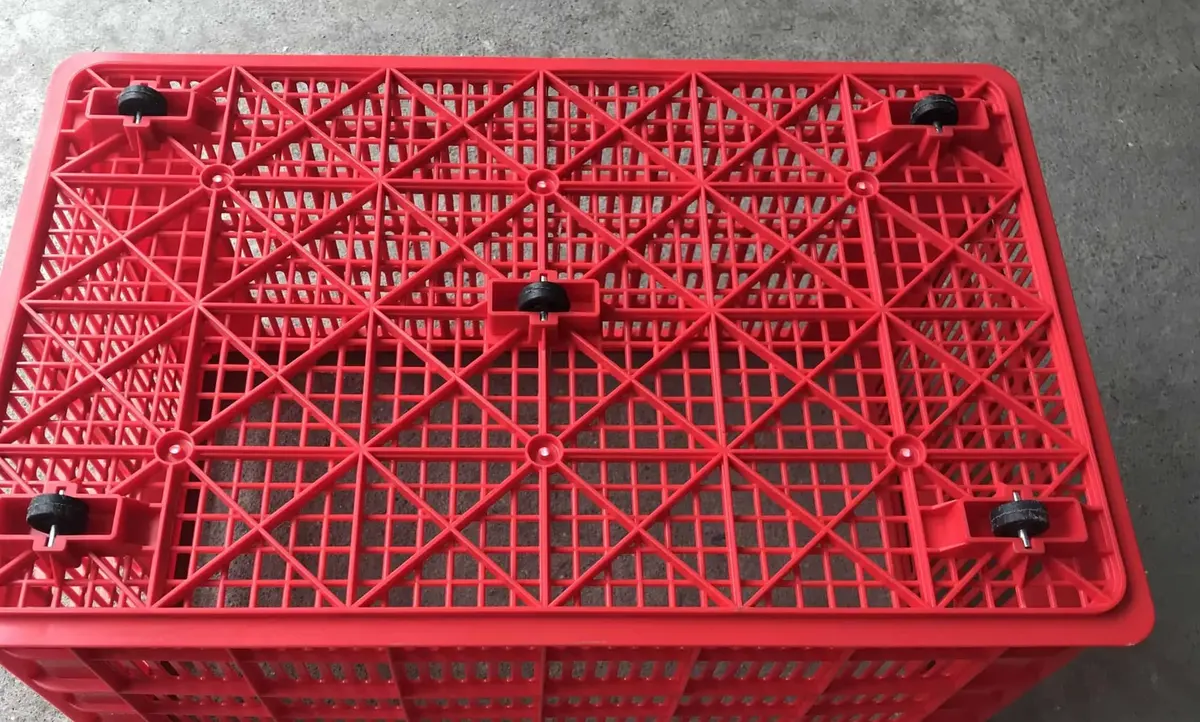
A plastic crate with wheels is a PP or HDPE crate with wheels fitted under the base, so goods can be pushed straight along without a trolley or hand carrying. Unlike an ordinary crate that has to sit on a trolley, the goods are loaded once where they arise and pushed to the packing area, the counting area or the truck, which cuts the number of times a crate is lifted and set down.
Compared with ordinary crates plus a trolley, a crate with wheels needs no separate trolley parking and removes most of the lifting at each stage. In return it needs a reasonably flat floor with few steps, and when crates are stacked, locking wheels are needed to stop them drifting; an ordinary flat-base crate still stacks more easily and suits static storage with little movement. That is why crates with wheels are used most in post offices, garment workshops, produce preparation areas and warehouses feeding production lines, where goods pass through many stations in a day.
Plastic crates with 5 wheels from ICD Vietnam
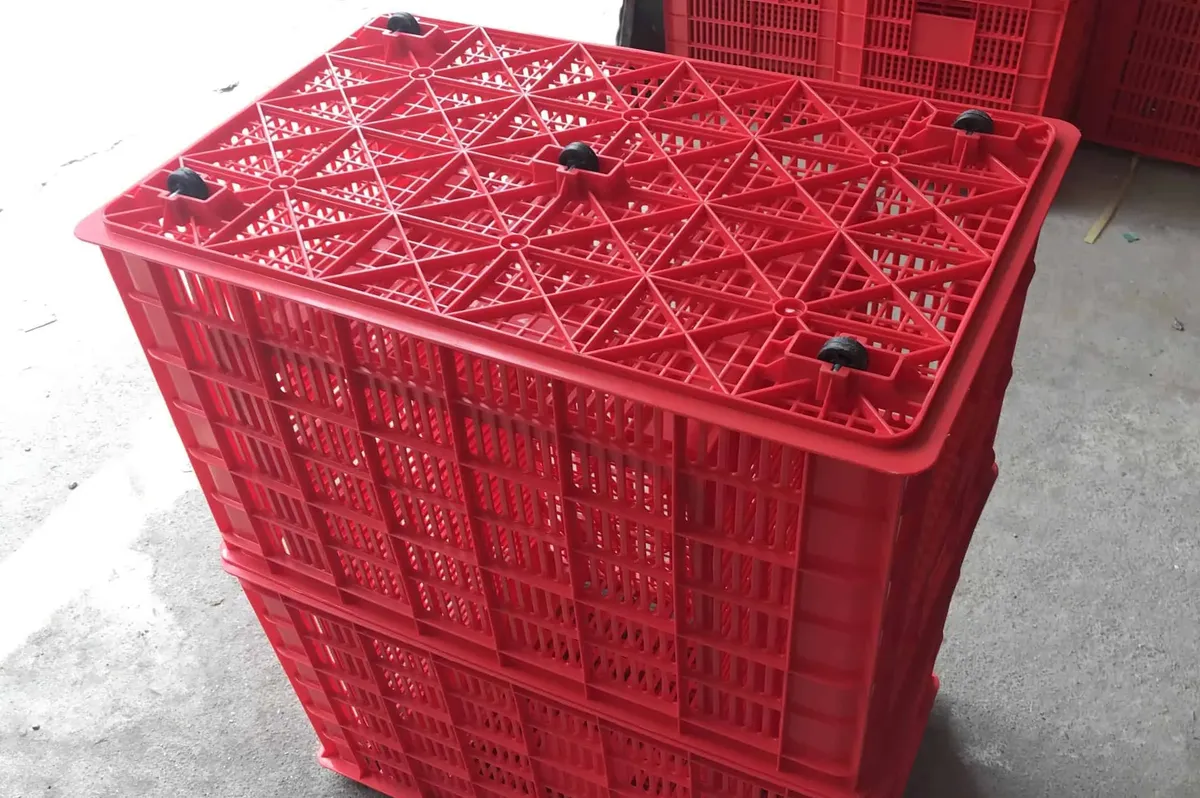
ICD Vietnam currently offers three five-wheel crate codes with the same outer size of 780 x 500 x 430 mm, differing in wall style, body weight and colour; there is also a large 1030 x 670 x 540 mm plastic crate fitted with wheels for bulky goods. The specifications below come from ICD Vietnam’s product pages (October 2026).
1. ICD HS004-5B express-delivery plastic crate
The ICD HS004-5B express-delivery crate has an open slatted body and weighs 3.3 kg (+/- 5%). It is made from PP and HDPE and comes in four colours (blue, green, yellow and red), with optional logo printing, card holders, dividers or lids. The plastic contains a UV-resistant additive so it fades less outdoors, which suits couriers and freight handlers who gather goods in yards. Why blue is the usual choice and how to use colour to separate flows of goods are covered in the article on blue plastic crates.
2. Open-wall crate with 5 wheels
The ICD-SH5BX open five-wheel crate has an open diagonal-slat body and weighs 3.3 kg without wheels, in blue. The open walls let goods breathe, prevent water from collecting and make the contents easy to see when counting; this type suits vegetables, fruit, agricultural produce, garments and large items in warehouses and yards.
3. Solid-wall crate with 5 wheels
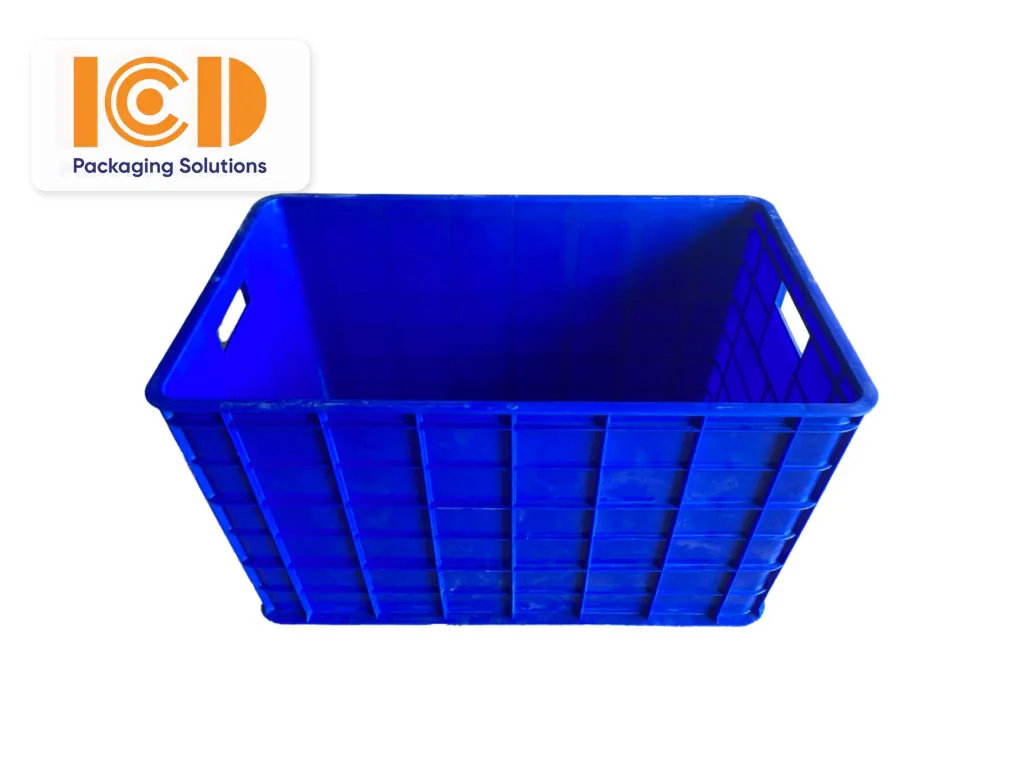
The ICD HS026-5B solid five-wheel crate has closed walls and weighs 4.1 kg without wheels, in blue. The closed walls keep out dust and water and hold small items, components and documents, which suits electronics plants, spare-parts stores and goods that must stay clean while in circulation.
| Product code | Wall style | Outer size | Body weight | Available colours |
|---|---|---|---|---|
| ICD HS004-5B (express-delivery crate) | Open, slatted | 780 x 500 x 430 mm | 3.3 kg (+/- 5%) | Blue, green, yellow, red |
| ICD-SH5BX (open five-wheel crate) | Open, diagonal slats | 780 x 500 x 430 mm | 3.3 kg, wheels not included | Blue |
| ICD HS026-5B (solid five-wheel crate) | Closed | 780 x 500 x 430 mm | 4.1 kg, wheels not included | Blue |
The solid crate body is about 0.8 kg heavier than the open one because closed walls use more plastic; in return it holds small goods and blocks dust and water, while the open crate is light and airy and suits produce and clothing. Guidance on choosing containers for garments and fabric goods in warehouses is in the article on containers for storing clothes. The product pages for these codes do not yet publish a load rating, so when you order, state the maximum weight you plan to put in each crate and we will advise the right code and wheel type.
Other types of crates with wheels on the market
Besides the 780 x 500 mm size, the market also offers large solid-wall bodies with more wheels to spread the load over more points, and multipurpose crates with 360-degree swivel wheels for supermarkets and warehouses with narrow aisles. The larger the body, the more wheels it needs to keep the base from sagging, but the crate also becomes heavier and harder to manoeuvre in tight aisles. ICD Vietnam’s large 1030 x 670 x 540 mm plastic crate belongs to this large-body group, used for garments and light bulky goods in post offices and logistics warehouses. When goods need a closed lid but still have to be pushed around the warehouse, see the large lidded plastic container with wheels.
CLICK NOW to see other PLASTIC CRATES.
Choosing crate wheels by floor type
Flat concrete and tile floors suit hard plastic wheels; epoxy floors, high-end ceramic tile or cold stores should use rubber or PU wheels to run quietly and leave no marks; stacking positions need at least 2 locking wheels. The wrong wheel wears out the crate’s wheel mounts quickly, makes noise or scratches the floor, so match the floor before you confirm a plastic crate with wheels.
| Wheel type | Suitable floor | Noise | Pros and cons |
|---|---|---|---|
| Hard plastic PA/PP | Flat concrete, tile, hard floors | Cao | Cheap, wear-resistant, rolls easily; noisy and scratches epoxy floors |
| Cao su TPR | Epoxy, tile, easily scratched floors | Low | Quiet, does not scratch the floor, good grip; wears faster than hard plastic |
| PU (polyurethane) | Epoxy, cold stores, clean floors | Very low | Quiet, leaves no marks; higher price |
| Locking (brake) wheel | Any floor, stacking positions | Depends on wheel type | Holds still when stopped and stops drifting when stacked; slower to operate |
| Swivel wheel without lock | Narrow aisles, constant movement | Depends on wheel type | Moves freely in every direction; cannot hold position and drifts easily |
Every industrial wheel has a rated load published by the wheel manufacturer, printed in the catalogue or on the wheel body; that is the number to calculate with, not an estimate from the wheel size. On rough floors, floor joints or door thresholds, a larger wheel rolls over more easily and takes less effort to push. On a five-wheel crate the 4 corner wheels carry the main load, and the middle wheel supports the base so it does not sag under heavy goods:
How to calculate wheel load for a plastic crate
Each wheel’s rated load must be at least the total weight (crate plus goods) divided by the number of wheels minus 1. This is the rule given by Colson Group, an industrial wheel manufacturer, for a 4-wheel cart with corner wheels: because floors are never perfectly flat, there will be moments when one wheel carries almost no load, so the other three must carry the whole weight.
For example, a 4-corner-wheel crate carrying a total of 90 kg needs each wheel rated for at least 90 / 3 = 30 kg. Colson notes that this rule is written for a cart with 4 wheels at the corners; other layouts share the load differently. For a five-wheel crate, we recommend calculating cautiously as if there were only 4 corner wheels (that is, also dividing by 3) and treating the middle wheel as a reserve that supports the base. On rough floors, slopes, impacts or when pushing continuously all shift, choose wheels with a rated load higher than the minimum.
The three most common mistakes are using hard plastic wheels on epoxy floors (scratches, marks, noise), overloading until the wheel mounts crack and the axles break, and not locking the wheels when crates are stacked so the stack drifts and spills goods. The wheel mount is the weakest point of the crate; when loading close to the limit, inspect the mounts and axles regularly and replace worn or misaligned wheels before they crack the base.
How many kilograms can one person safely push on a crate with wheels?
According to the RAPP push-pull assessment tool from the UK Health and Safety Executive (HSE), pushing goods on wheeled equipment with a total load under 50 kg is rated as low risk; 50 to 100 kg is medium, 100 to 200 kg is high and over 200 kg is very high. The pushing distance of each trip is also scored: 10 m or less is low, 10-30 m is medium and over 30 m is high.
This is why crates with wheels help noticeably in post offices and garment workshops. When lifting by hand, the lifting equation of the US National Institute for Occupational Safety and Health (NIOSH) sets 23 kg as the maximum load even in ideal lifting conditions, and it decreases as you bend, twist or lift away from the body. Pushing on wheels allows a much larger load to be moved with less effort, provided the wheels and the floor are suitable.

HSE gives reference forces of about 20 kg for men and 15 kg for women when starting and stopping, and about 10 kg for men and 7 kg for women while pushing, stressing that these are reference levels, not approved limits. The force needed rises when wheels are misaligned or poorly maintained, on soft or rough floors and on slopes; a slope over 5 degrees counts as an obstacle on the pushing route.
- Keep each crate under 50 kg if one person pushes many trips in a shift.
- Clear cables and high thresholds from the route and avoid slopes over 5 degrees.
- Remove hair, thread and tape wound round the wheel axles and replace worn or misaligned wheels.
You can use the tool below: enter the number of wheels, the rated load per wheel (from the catalogue or the wheel body) and the weight of the crate plus goods, to check whether the set of wheels is strong enough under the divide-by-(wheels minus 1) rule and to see the pushing risk level on the HSE load scale.
Frequently asked questions
What is the maximum weight a plastic crate with wheels can carry?
It depends on the wheel’s rated load and the crate body. Each wheel’s rating must be at least the total weight divided by the number of wheels minus 1; for a five-wheel crate calculate as for 4 corner wheels, that is, divide by 3. ICD Vietnam’s five-wheel crate codes do not publish a load rating on their product pages, so state the weight you plan to load when ordering to get advice.
Which wheels will not scratch an epoxy floor?
TPR rubber wheels and PU wheels are quiet, grip well and leave no marks on epoxy floors, cold stores or high-end ceramic tile. Avoid hard PA/PP plastic wheels on these floors because they scratch and make noise.
When do I need locking wheels?
Use locking wheels when stacking crates, when a crate must be held in place at a workstation, or on a gentle slope to stop it drifting. Aim for at least 2 locking wheels on each crate.
How does a five-wheel crate differ from a crate with more wheels?
A five-wheel crate has 4 wheels at the corners and 1 in the middle of the base, common in the 780 x 500 mm size. Crates with more wheels are generally used for large bodies, spreading the load over more points so the base sags less, but they are heavier and cost more.
How much does a 780 x 500 x 430 mm plastic crate with wheels hold?
The outer envelope volume is about 168 litres; real capacity is smaller because of the wall and base thickness. By weight, keep the total load per crate under 50 kg if one person pushes many trips in a shift; this is a low risk level on the HSE push-pull assessment scale.
Should I choose an open or a solid crate with wheels?
Choose the open crate for vegetables, fruit and clothing that need airflow and drainage, with a lighter body (3.3 kg). Choose the solid crate for components, small items that could fall through, or goods that must stay free of dust and water, with a heavier body (4.1 kg).
How long is the warranty on ICD Vietnam plastic crates with wheels?
ICD Vietnam plastic crates carry a 12-month warranty against manufacturing defects, counted from the date on the invoice or delivery note, under the warranty and repair policy published on the website.
Contact us about plastic crates with wheels
ICD Vietnam Industrial Manufacturing Co., Ltd
For advice on wall style, crate code and quantity based on your goods, floor and real pushing distance, send us your details; ICD Vietnam plastic crates carry a 12-month warranty.
- Northern Vietnam hotline: 0983 797 186 / 090 345 9186 / 090 5859 186.
- Southern Vietnam: 098 6784 186.
- Email: sales@icdvietnam.com.vn.
- Zalo: Chat with ICD Vietnam on Zalo.
References
- HSE (Health and Safety Executive, UK), Risk assessment of pushing and pulling (RAPP) tool, INDG478: load scale, pushing distance, slope (linked in the safe pushing section).
- HSE, Doing a push/pull risk assessment: reference forces for starting and sustaining a push.
- NIOSH (CDC, USA), Applications Manual for the Revised NIOSH Lifting Equation, publication 94-110 (linked in the safe pushing section).
- Colson Group, How to Calculate Caster Load Capacity: the rule of dividing total load by the number of wheels minus 1 (linked in the wheel load section).
- ICD Vietnam product pages: ICD HS004-5B, ICD-SH5BX, ICD HS026-5B (size, weight, material, colour), October 2026.
- ICD Vietnam, warranty and repair policy: plastic crates carry a 12-month warranty.