
Table of Contents
- How does a composite container differ from an HDPE or PP container?
- When are HDPE and PP enough, and when do you need composite?
- Choosing the composite base resin by chemical
- Wall structure of a three-layer composite tank
- Composite, stainless steel, HDPE or rubber-lined steel?
- Where are composite containers and tanks used?
- How to choose a composite workshop and accept a tank
- Placing tanks and moving chemical containers safely
- Frequently asked questions
- How is a composite container different from an ordinary plastic container?
- What are the advantages of composite FRP material?
- What should I look for when choosing a composite tank manufacturer?
- Can an HDPE container hold hydrochloric acid (HCl)?
- Can composite containers be used for raising fish or growing plants?
- How do composite tanks and HDPE plastic tanks differ?
- How do I know a composite container has deteriorated?
- Does ICD Vietnam sell composite containers?
- Contact us for advice
- References
Reviewed and updated by ICD - Week 43/2026
A composite (FRP) tank or container is a vessel made from a thermoset resin (polyester, vinyl ester or epoxy) reinforced with glass fibre. Choose composite when you need a large fixed tank, operating temperatures above roughly 60 °C, or solvents such as toluene and xylene. Common acids and alkalis at room temperature, packed in drums or carboys under 220 litres, are usually handled well enough by virgin HDPE or PP containers.
Composite chemical tanks that meet a recognised standard are usually built to ASTM D3299 (filament winding) or ASTM D4097 (hand lay-up). The wall has three layers: an inner corrosion barrier, a filament-wound structural layer and an outer UV-resistant layer. A composite plastic container is therefore not an ordinary plastic bin but a storage vessel designed for one specific chemical, concentration and temperature.
I am Le Van Thang and I have worked at ICD Vietnam since 2011. One thing needs to be clear from the start: ICD Vietnam supplies HDPE and PP plastic containers and pallets, and we do not manufacture or sell composite tanks. This article exists because customers buying chemical containers keep asking the same question: can my chemical go in an HDPE container, or do I need a composite tank? The answer below is based on the chemical resistance tables of the resin manufacturers and the ASTM standards for storage tanks.
How does a composite container differ from an HDPE or PP container?
The core difference is the base resin. HDPE and PP containers use a thermoplastic that is melted and moulded, while composite uses a thermoset resin cured together with glass fibre. The result is stiffer, more heat-resistant and can be built as tanks of tens of cubic metres to your drawing.
Industrial HDPE or PP containers are injection moulded, blow moulded or rotationally moulded, so their size is limited by the tooling that already exists, and their price is low in large quantities. A composite container is built one at a time: a laminator or a filament-winding machine lays glass fibre soaked in base resin (usually polyester, vinyl ester or epoxy) over a mould, the resin cures, and only then is the part removed. Thanks to the reinforcing fibre, a composite wall carries load and impact well and deforms little when hot. Because the base resin can be chosen, the same tank design can be adjusted to suit each chemical.
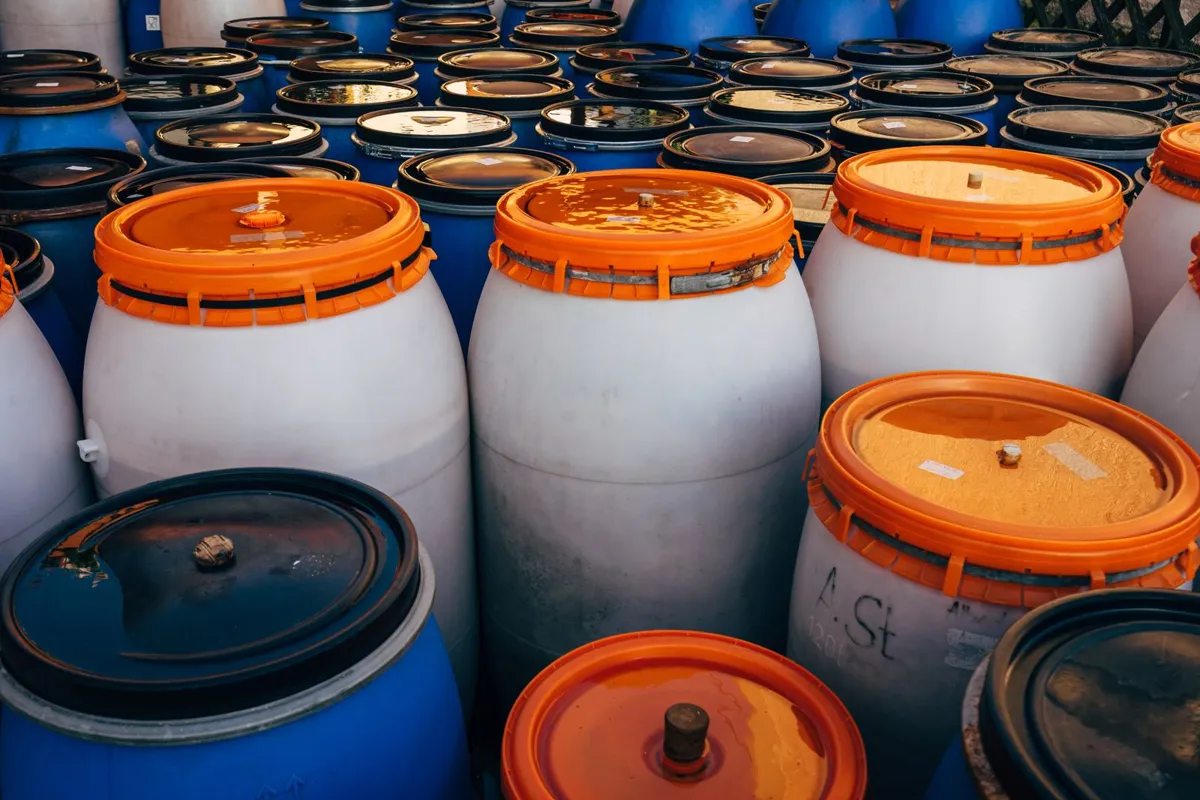
The flip side is that, precisely because the base resin has to be matched to the chemical, no composite resists everything. INEOS Composites states plainly in the introduction to its vinyl ester resins that no single FRP resin can handle every kind of corrosion. Phrases such as “absolute chemical resistance” or “resists the strongest chemicals” are only true when the tank has been designed for that specific substance.
The three groups above are the most common reason a plant considers composite. With strong acids, steel and stainless steel corrode easily; with concentrated alkalis, the glass fibre itself is attacked, so the contact layer must use a synthetic veil; with mixed waste, the full composition must be declared so that the material can be chosen.
See also: Plastic container manufacturers
When are HDPE and PP enough, and when do you need composite?
HDPE and PP resist most dilute inorganic acids, alkalis and salts at room temperature, so for carboys, drums and returnable containers a thermoplastic is usually enough and cheaper. Composite becomes necessary at high temperatures, for very large fixed tanks, or when the chemical is an aromatic solvent or a concentrated acid that HDPE and PP cannot withstand.
The table below pulls together figures from three manufacturer and standards documents: the INEOS Olefins & Polymers HDPE chemical resistance guide (tested at 21 °C and 60 °C), the PP chemical resistance table in ISO/TR 10358 (20, 60 and 100 °C, unstressed), and the INEOS Composites Derakane resin selection guide for the widely used vinyl ester 411 (maximum recommended service temperature).
| Chemical | HDPE at 21 / 60 °C | PP at 20 / 60 / 100 °C | FRP vinyl ester (Derakane 411) |
|---|---|---|---|
| Hydrochloric acid 30% | Pass / Pass | Pass / Limited / Limited | Up to 65 °C |
| Sulphuric acid 50% | Pass / Pass | Pass / Limited / Limited | Up to 100 °C |
| Sulphuric acid 96% | Affected / Fail | Pass / Limited / Fail | Table covers only up to 80% (40 °C) |
| Nitric acid 30% | Pass / Pass | Pass / Fail / Fail | Up to 25 °C (30 - 35%) |
| Nitric acid 40 - 50% | Pass / Affected | Limited / Fail / Fail | Not recommended |
| Caustic soda NaOH 50% | Pass / Pass (concentrated) | Pass / Pass / Pass | Up to 80 °C, needs a synthetic veil |
| Hydrofluoric acid 40% | Pass / Pass | Pass / no data | Table covers only up to 20% (40 °C) |
| Toluene 100% | Fail / Fail | Limited / Fail / Fail | Up to 25 °C (grade 451: 50 °C) |
Reading the table reveals something many people do not expect: at room temperature, HDPE resists hydrochloric acid, hydrofluoric acid and concentrated caustic soda as well as or better than composite, while for nitric acid above 36% the Derakane 411 resin is not recommended at all. Composite genuinely pulls ahead in three cases: high operating temperatures (50% sulphuric acid up to 100 °C), aromatic solvents such as toluene and xylene that HDPE cannot take, and fixed tanks whose capacity or shape a thermoplastic mould cannot produce.
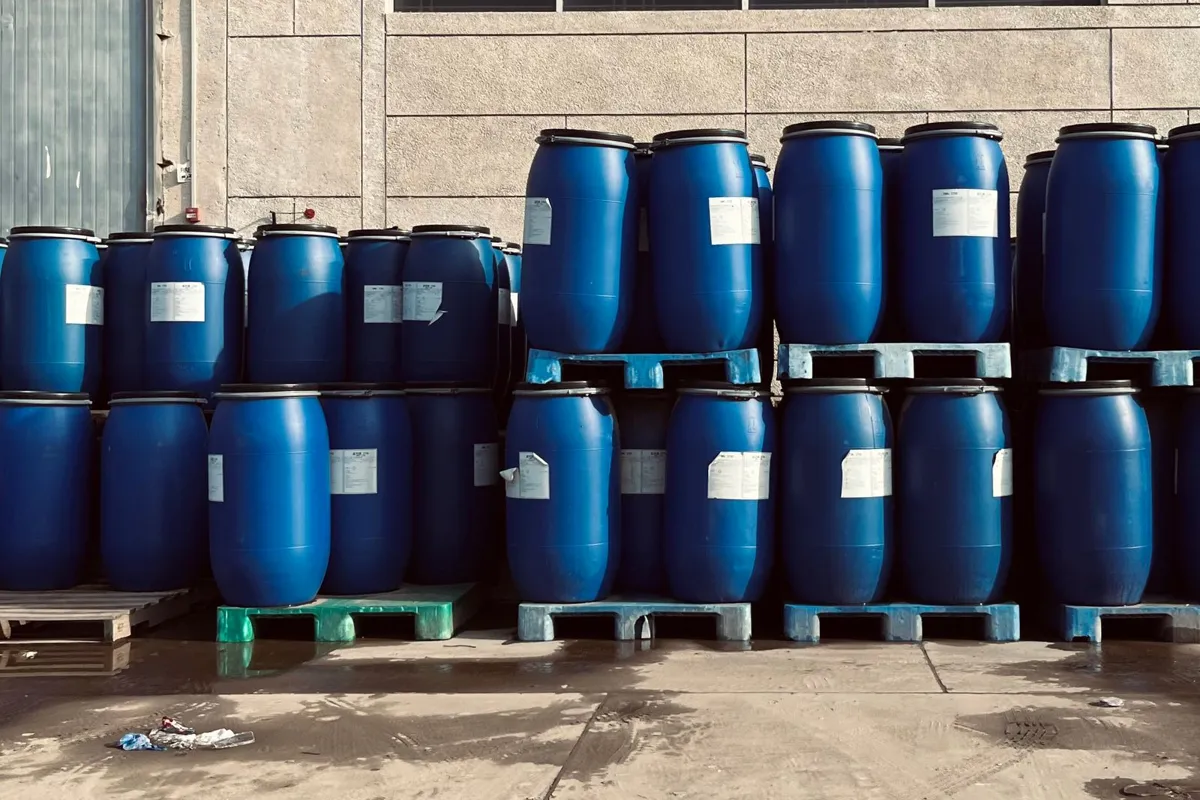
The standards also set a temperature limit. ASTM D1998, the standard for rotationally moulded upright polyethylene tanks of 1,900 litres and larger, applies only to tanks operating at atmospheric pressure at a continuous temperature below 66 °C (Type I) or 60 °C (Type II). Hotter chemicals, or extra loads such as agitator blades, are the point to consider a composite tank or another material. The sizes and acid resistance of large round polyethylene containers are covered separately in the article on large round HDPE plastic containers.
Two cautions when using the table. First, every manufacturer states that these are general chemical resistance ratings; permeation through the wall, stress cracking and container design are separate factors, so test in real conditions before long-term use. Second, a mixture of several substances can be more aggressive than any single one, so for mixed wastewater send the safety data sheet to the container or tank supplier. The specifications of common HDPE chemical containers are on the HDPE plastic chemical container page.
Choosing the composite base resin by chemical
The corrosion resistance of a composite tank is set by the base resin, not by the glass fibre: orthophthalic polyester is the weakest, isophthalic is better, vinyl ester is the common choice for acids, alkalis and oxidisers, and epoxy is used for special parts.
When requesting a quotation for a composite tank, a business should supply at least four items: the chemical name, the concentration, the maximum operating temperature and the capacity. The INEOS Composites technical questionnaire also asks about trace impurities, the temperature during upsets together with how long they last, and whether the substance is a liquid, gas or solid. Without this information the workshop can only quote a generic configuration, which easily leads to the wrong base resin.
Wall structure of a three-layer composite tank
A composite tank wall consists of a resin-rich corrosion barrier on the inside, a fibre-rich structural layer in the middle and a UV-protective layer on the outside. The innermost layer decides service life in contact with chemicals.
According to INEOS Composites guidance, the corrosion barrier is about 2.5 - 6.3 mm thick in total. Its outermost part is a resin-rich film 0.3 - 0.8 mm thick, about 95% resin, reinforced with one or two layers of veil; behind it is 2 - 6 mm of resin with chopped strand mat, roughly 20 - 30% glass. The inner surface must be free of air bubbles, pinholes and resin-starved areas, because these are paths for chemicals to soak into the fibre layer. The manufacturer also notes that service life is proportional to the thickness of the corrosion barrier, so this is a figure the buyer should have written on the drawing.
The structural layer carries the main load and contains more fibre, typically 40 - 50% glass and up to about 60% when the fibre is wound by machine. The outer layer uses resin with UV inhibitors or a gelcoat to protect tanks installed outdoors. The three layers are usually produced by two methods: the corrosion barrier is almost always laid by hand to control the amount of resin, while the structural layer of a large cylindrical shell is better made by a filament-winding machine.
When you receive a quotation, ask clearly which method was used for the shell and to which standard. Two tanks with the same capacity and colour can differ greatly in the thickness of each layer in a way the naked eye cannot tell.
Composite, stainless steel, HDPE or rubber-lined steel?
Composite is not the only choice for a chemical tank: 316 stainless steel handles heat well but performs poorly with chloride-bearing acids, HDPE is light and cheap but limited by the mould and by temperature, and rubber-lined steel depends on the lining. The table below compares the four materials quickly.
| Criterion | Composite FRP | 316 stainless steel | HDPE, PE plastic | Rubber-lined steel |
|---|---|---|---|---|
| Chloride-bearing acids (HCl) | Good with vinyl ester | Poor, prone to pitting | Good | Depends on the lining |
| Large capacity, built on site | Good | Good | Limited by the mould | Good |
| Weight | Light | Heavy | Light | Heavy |
| Heat resistance | Depends on the base resin | Good | Lower | Depends on the lining |
| Repair | Can be patched on site | Can be welded | Plastic welding possible | Difficult, must be re-lined |
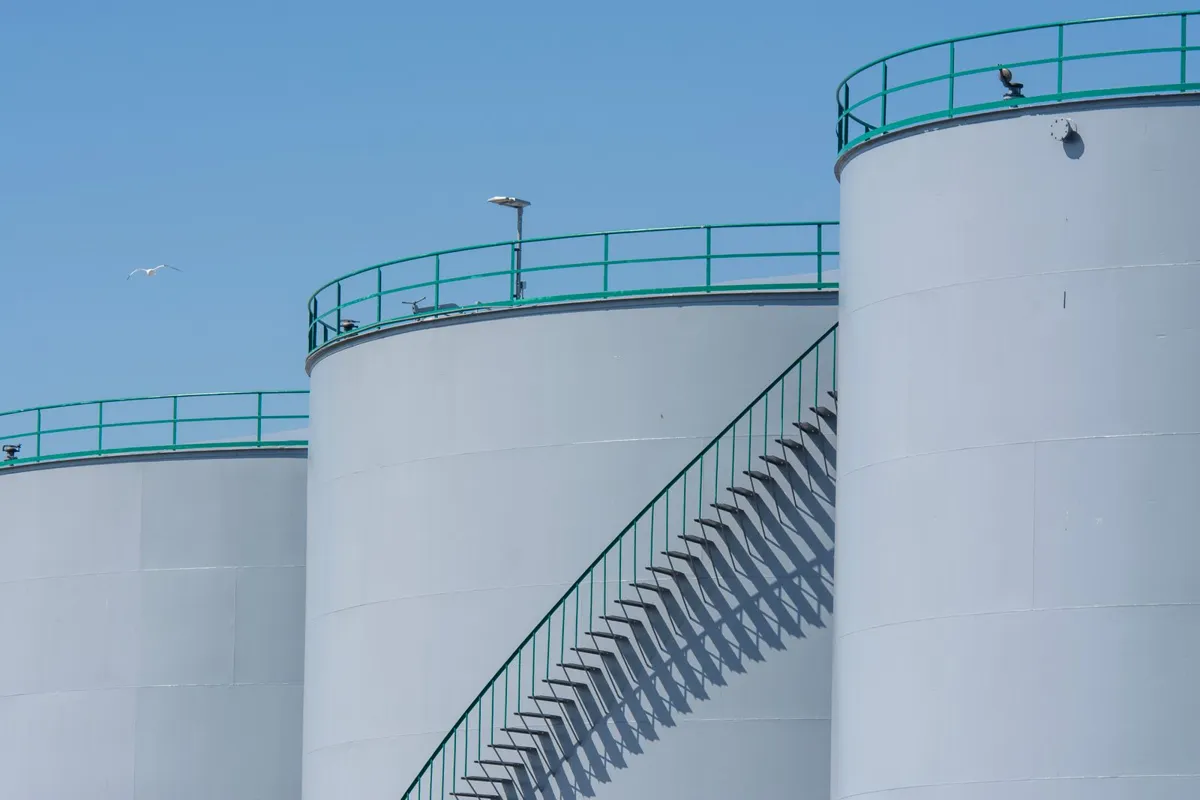
For small quantities packed in 30 to 220 litre carboys and drums for moving between workshops, virgin HDPE containers are usually more economical than a composite tank. Composite shows its advantage when you need a large fixed tank, a high operating temperature, or a chemical that HDPE cannot withstand. INEOS Composites also notes that FRP tanks are much lighter than metal and cheaper than rubber-lined steel or high-nickel alloys.
Where are composite containers and tanks used?
Composite tanks are used mainly in three groups: chemical and plating plants storing acids, alkalis and plating solutions; industrial wastewater treatment systems; and aquaculture, which needs light, rust-free tanks for salt water.
In chemical plants and plating workshops, composite tanks store hydrochloric acid, sulphuric acid, caustic soda and plating solutions, where an unlined steel tank would corrode quickly. At wastewater treatment plants, composite basins withstand complex chemical mixtures and are easy to build to the specific shape of each stage. In aquaculture, composite tanks and basins hold salt water and nurse shrimp fry because they are light and do not rust. All three cases share one requirement: the base resin must be chosen to suit the medium, as explained above.
How to choose a composite workshop and accept a tank
A trustworthy composite workshop should be able to show four things: equipment and experience with your specific chemical, transparent sourcing of base resin and fibre, the ability to design to your own parameters, and an inspection record before leaving the factory.
As someone who works in the industry, here is the checklist I would not skip when choosing a manufacturer:
Not every plastics workshop can make composite: a large tank shell needs a filament-winding machine to produce an even tank with no structural weak points. Buyers should ask for certificates of origin and quality (CO, CQ) for the base resin and glass fibre, because the base resin determines chemical resistance. The workshop also needs engineers who calculate wall thickness and stiffening ribs from capacity and load, rather than selling from a ready-made pattern.
The four items below are what a buyer can ask the workshop to carry out and to record in the acceptance report:
- Visual inspection of the inner surface: no bubbles, cracks or open pores exposing fibre; ASTM D2563 is the standard for classifying visual defects in glass-fibre-reinforced plastic parts.
- Measure the thickness of each layer and compare with the drawing, especially the corrosion barrier.
- Measure Barcol hardness (ASTM D2583) to confirm the resin has fully cured and meets the minimum value recommended by the resin maker.
- Fill-with-water leak test, checking the shell, flanges and joints before delivery.
Placing tanks and moving chemical containers safely
A fixed composite tank should sit on a flat foundation with a bund or spill tray around it; containers and drums that need to move should sit on a pallet whose dynamic load rating is greater than the weight of the container when full of chemical.
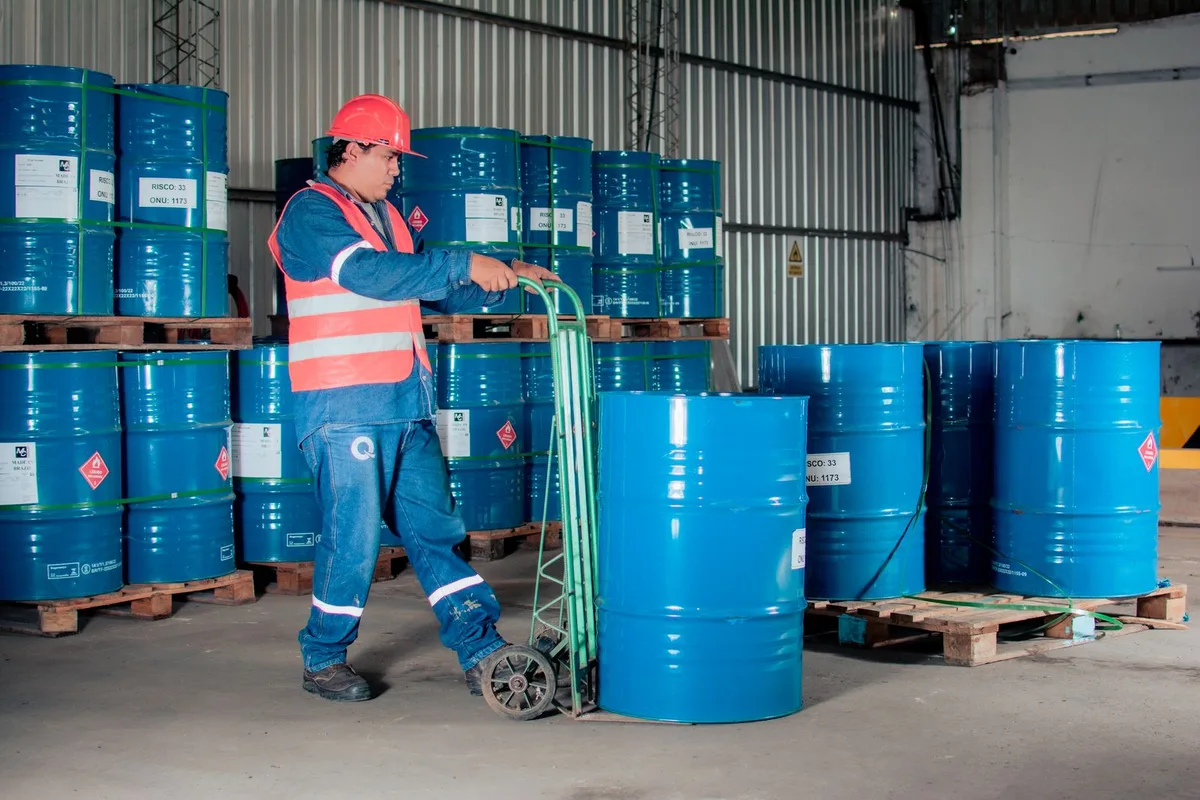
This is what ICD Vietnam does every day. A 220-litre drum of a solution heavier than water can exceed 250 kg, and four drums on one pallet make a tonne, so when choosing a pallet look at dynamic load, not only static load. A flat-bottomed upright composite tank needs a flat foundation, free of lumps of gravel and ridges, as the tank manufacturer’s installation requirements specify. The area around tanks and drums should have a bund or spill tray large enough to hold the contents of the largest tank, to contain any leak.
Frequently asked questions
How is a composite container different from an ordinary plastic container?
An ordinary plastic container is moulded from PP or HDPE, has a small capacity and a low price. A composite container is made from glass-fibre-reinforced thermoset resin, built one at a time, can reach large capacities to a drawing, and handles heat and some strong chemicals better when the right base resin is chosen.
What are the advantages of composite FRP material?
It is mechanically strong thanks to the reinforcing fibre, lighter than metal tanks, corrosion-resistant when the right base resin is chosen, its outer layer resists UV, and it can be repaired on site by patching. That is why FRP is widely used in the chemical, plating, wastewater and aquaculture industries.
What should I look for when choosing a composite tank manufacturer?
Ask whether the workshop has already built tanks for your type of chemical, and request the CO and CQ for the base resin and fibre, a drawing stating the thickness of each layer, the fabrication standard (ASTM D3299 or D4097), and an inspection record covering visual inspection, Barcol hardness and a water leak test before delivery.
Can an HDPE container hold hydrochloric acid (HCl)?
Yes. The INEOS HDPE chemical resistance guide rates HCl at 10%, 30% and 35% as acceptable at both 21 °C and 60 °C. For HCl, a virgin HDPE container is usually more economical than composite at small capacities; composite is worth considering when you need a very large fixed tank.
Can composite containers be used for raising fish or growing plants?
Yes. Composite containers and tanks are used to raise fish, nurse shrimp fry and grow plants because they are light, rust-free and tolerate salt water. For this purpose choose a new container with a smooth finished inner surface, and do not reuse one that previously held chemicals.
How do composite tanks and HDPE plastic tanks differ?
An HDPE tank is moulded from thermoplastic, is cheap, has a capacity limited by the mould, and under ASTM D1998 is rated only for continuous use below about 60 - 66 °C. A composite tank uses glass-fibre-reinforced thermoset resin and can be built to large capacities on request, with better heat and solvent resistance when the right base resin is chosen, at a higher price.
How do I know a composite container has deteriorated?
Check periodically for these signs: blistering or hairline cracks on the inner surface, exposed glass fibre, unusual discolouration, Barcol hardness falling compared with the acceptance reading, and seepage at flanges. If caught early, the corrosion barrier can be ground back and rebuilt on site.
Does ICD Vietnam sell composite containers?
No. ICD Vietnam supplies HDPE and PP plastic containers and pallets and does not manufacture or sell composite tanks. ICD Vietnam plastic containers carry a 12-month warranty under the warranty and repair policy published on the website.
Contact us for advice
If you need HDPE or PP plastic containers for chemicals, or pallets for drums and containers, please contact ICD Vietnam for advice on the right type for your chemical and load. For a fixed composite tank, work directly with a composite workshop using the criteria above.
ICD VIETNAM INDUSTRIAL MANUFACTURING CO., LTD
- Address: 3rd Floor, Thang Long A1 Building, Bau Hamlet, Thien Loc Commune (formerly Kim Chung, Dong Anh), Hanoi.
- Phone: 0983 797 186 / 090 345 9186 / 090 5859 186.
- Email: sales@icdvietnam.com.vn
ICD Vietnam plastic containers carry a 12-month warranty under the warranty and repair policy published on the website.
References
- ASTM International - ASTM D3299, Filament-Wound Glass-Fiber-Reinforced Thermoset Resin Corrosion-Resistant Tanks.
- ASTM International - ASTM D4097, Contact-Molded Glass-Fiber-Reinforced Thermoset Resin Corrosion-Resistant Tanks.
- ASTM International - ASTM D1998-21, Polyethylene Upright Storage Tanks (continuous service temperature range).
- ASTM International - ASTM D2583 (Barcol hardness) and ASTM D2563 (classification of visual defects in glass-fibre-reinforced plastic parts).
- ASME - BPVC Section X, Fiber-Reinforced Plastic Pressure Vessels.
- INEOS Olefins & Polymers USA - HDPE Chemical Resistance Guide (21 °C and 60 °C).
- INEOS Composites - Resin Selection Guide for Chemical Resistance, Derakane epoxy vinyl ester resins, and the Derakane Fabrication Guide (corrosion barrier construction).
- ISO/TR 10358 - Plastics pipes and fittings: combined chemical-resistance classification table (PP chemical resistance at 20, 60, 100 °C).
- Wikipedia - Fibre-reinforced plastic.