
Table of Contents
- The most common types of plastic water containers today
- ICD Vietnam water containers available
- What does the price of a plastic water container depend on?
- How many liters of water container should I buy?
- Calculate the floor load before placing a container up high
- Experience in choosing and using plastic water containers
- Cleaning water containers properly
- Where to buy plastic water containers?
- Frequently asked questions
- Should I choose a square or round plastic water container?
- Are cheap plastic water containers safe?
- How do I know a 1,000 liter IBC tank is good quality?
- How do I fit a tap to a plastic container without leaks?
- How much does a 1,000 liter plastic container weigh when full?
- How often should I clean the container and change the water?
- When is a 20 liter plastic container used?
- Should I use a blue container to resist the sun?
- Can a 500 liter container sit on a balcony?
- Contact us for advice on plastic water containers
- References
Plastic water containers come in three main forms: round drums of 100-220 liters, square tanks from 10 to 2,000 liters, and 1,000 liter IBC tanks in a steel cage (1200 x 1000 x 1155 mm). For drinking water, choose virgin HDPE with an opaque body and a tight lid; every 1,000 liters of water weigh about 1 ton, so the surface under the tank must carry the load.
I am Le Van Thang, and I have worked at ICD Vietnam since 2011. Customers asking to buy a water container usually start with capacity, but my three questions back are always: is the water for drinking or for irrigation, where will the container sit, and will it be in the sun? Answering those three lets you choose correctly among the types of plastic containers for water, from a 10 liter container on a kitchen counter to a 1000 liter IBC tank for a work site. This article goes through each form in turn, how to calculate capacity, how to work out floor load, how to choose material and how to clean.
The most common types of plastic water containers today
The three forms differ in how they carry water pressure, how they stack and how they are transported. The table below gives a quick comparison before we go into each type.
| Type | Common capacity | Advantages | Limitations | Suited to |
|---|---|---|---|---|
| Round drum | 100-220 liters | Carries water pressure evenly, easy to roll and transport | Takes floor area, hard to place side by side | Backup water, water filtration, wastewater |
| Square or rectangular tank | 10-2,000 liters | Fits against walls and into narrow corners, uses space well | Flat walls bulge easily on large tanks, needs a flat base | Households, balconies, warehouses |
| IBC tank | 1,000 liters | Steel cage protection, bottom drain valve, can be lifted by forklift | Bulky; the opaque white inner tank grows algae easily in the sun | Work sites, farms, factories |
Round plastic drums
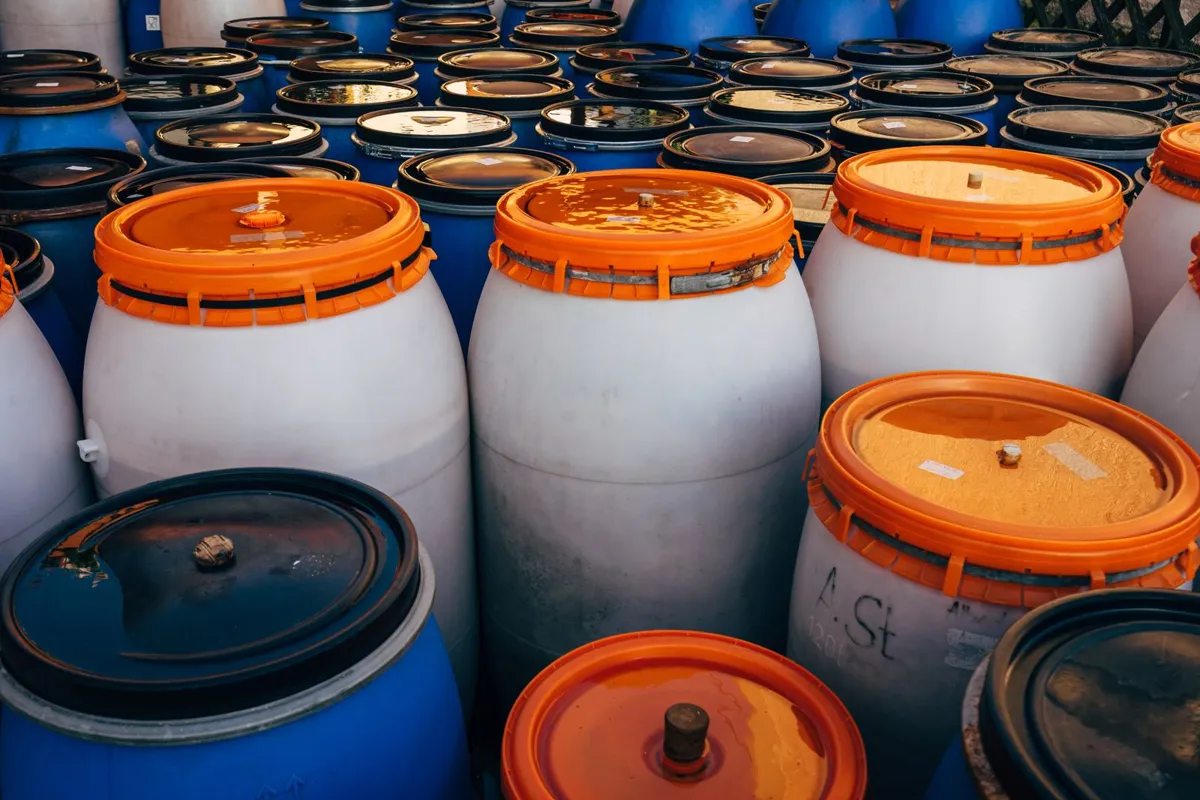
The plastic drum is the traditional form, usually blue, made of thick-walled HDPE. The 120, 160 and 220 liter sizes are often used for backup water, as a well water filter tank or to collect wastewater. The round body spreads water pressure evenly on the wall, so a drum bulges less than a square tank of the same capacity, and it can be tilted and rolled when it has to be moved with water still inside.
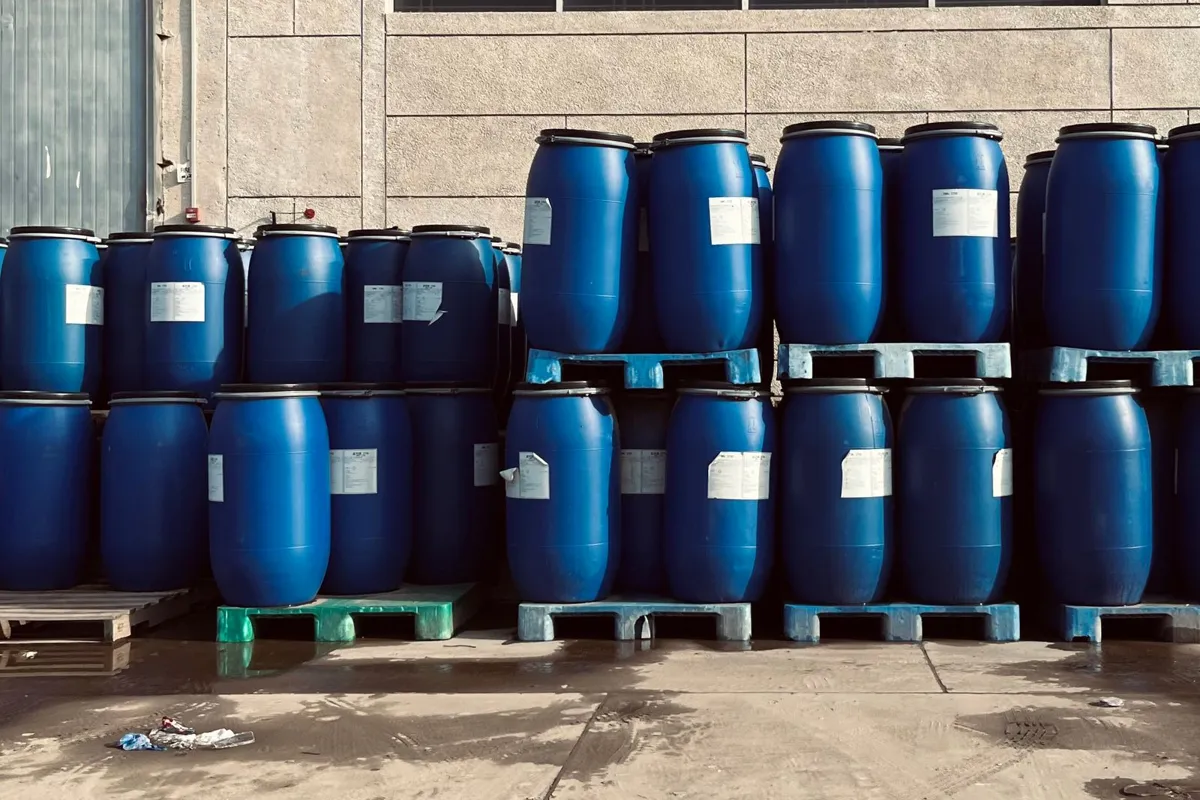
Drums have two types of opening. The fully open lid (with a clamp ring) is easy to clean inside and to scoop from, suited to a filter tank or irrigation water. The closed lid with two small threaded openings on top keeps out dust and insects and lets you pour without dipping a ladle, which suits storing household water better. The round container sizes from 100 liters up, wall thickness and how to choose a lid are compared in detail in the article on large round HDPE plastic containers.
Square and rectangular plastic tanks
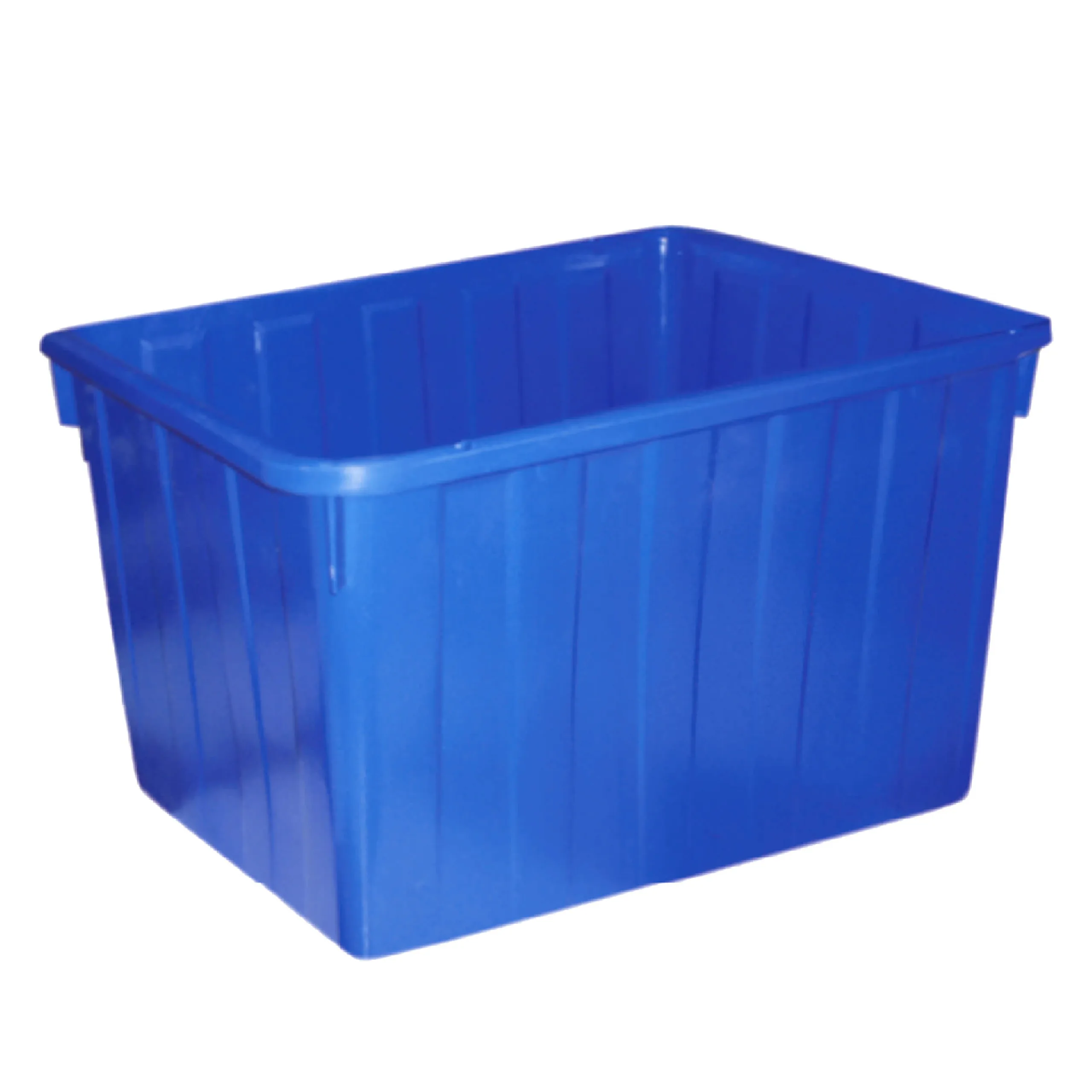
Square tanks are chosen because they use space well: they sit against a wall and fit into a balcony corner, under a staircase or a warehouse corner without leaving gaps like a round tank. The 100-200 liter sizes suit apartments and townhouses; sizes of 300-500 liters and up are common in backyards, farms and workshops. The weakness of flat walls is that they bulge when full, so the bigger the tank, the more it needs stiffening ribs and a perfectly flat base.
1,000 liter IBC tank
For work sites, livestock farms and production areas, the IBC tank is the familiar choice. A standard tank measures 1200 x 1000 x 1155 mm outside, with an HDPE inner tank in a steel cage, a base of steel or plastic pallet for forklift tines and a drain valve right at the bottom. The steel cage keeps the plastic inner tank from bulging and protects it from impact during handling, so the tank can be carried full of water on a truck, something a square tank of the same capacity cannot do.
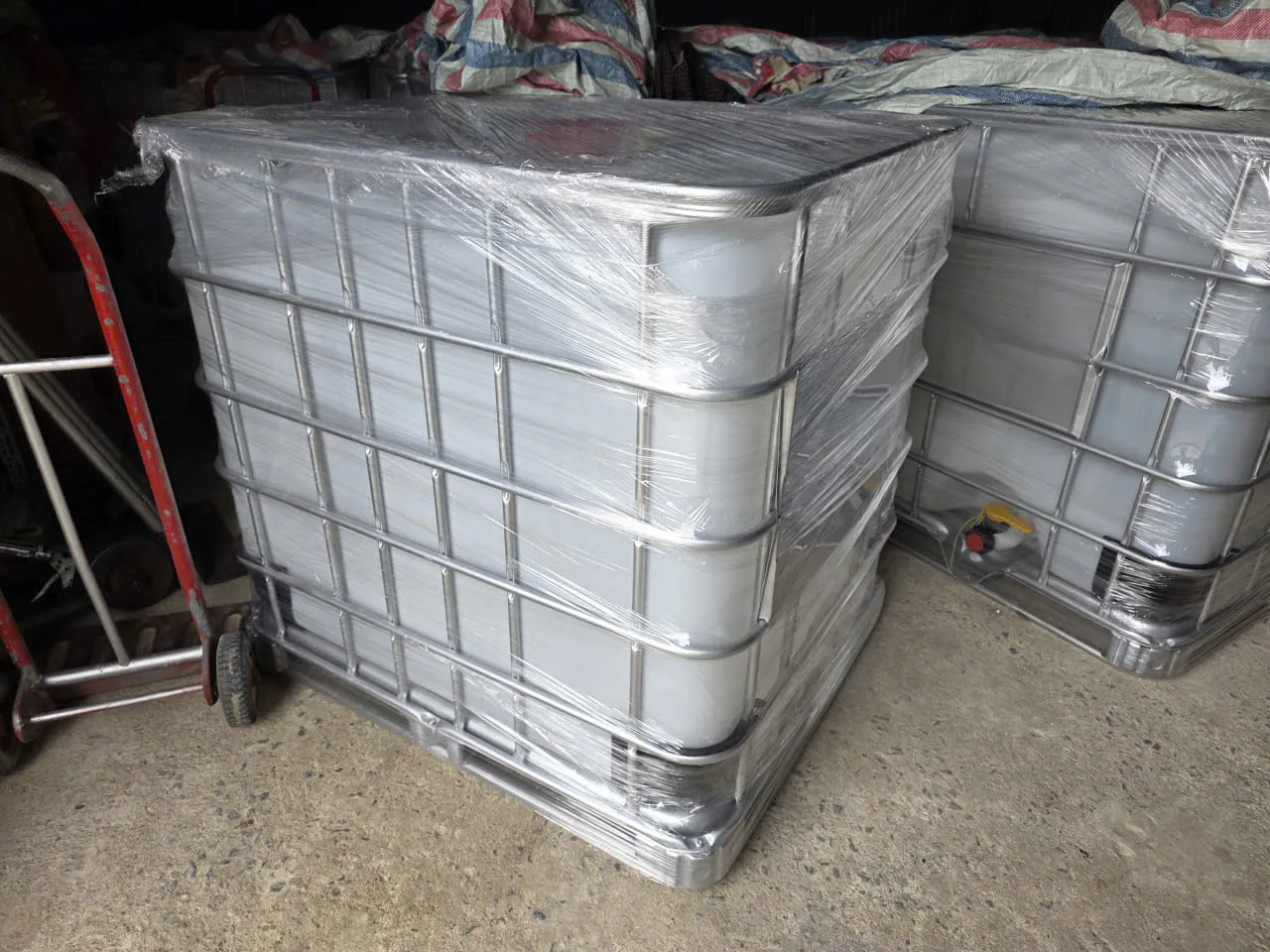
The question to ask most when buying an IBC tank is what the tank held before. A new tank with a virgin HDPE inner tank can be used for both drinking and irrigation water. A used tank that once held food (cooking oil, honey, sugar water) should only be used for drinking water when you know for sure what it held and it has been cleaned thoroughly. A tank that once held chemicals, solvents or oil must not be used for drinking water: according to the CDC guidance on safe water storage (US Centers for Disease Control and Prevention), do not use a container that once held toxic substances such as bleach, pesticides or petroleum products to hold water, because chemicals can leach into the water. If the tank is used, read the old label on the tank body and ask the seller for the safety data sheet of the substance it held.
ICD Vietnam water containers available
ICD Vietnam’s range of square plastic tanks is made of virgin PP or HDPE, in sizes of 10, 20, 50, 60, 100, 200, 300, 500 and 2,000 liters, plus a 1,000 liter IBC tank with a virgin HDPE inner tank. The external dimensions of the models most often asked about, taken from the product pages on 16 October 2026:

- 10 liter square container: 265 x 265 x 240 mm.
- 200 liter square container: 910 x 760 x 410 mm.
- 300 liter square container: 1120 x 910 x 410 mm.
- 500 liter square container: 1085 x 820 x 770 mm.
- 1,000 liter IBC tank: 1200 x 1000 x 1155 mm, steel or plastic pallet base; a UV-blocking inner tank version is available.
The 200 and 300 liter containers are only 410 mm tall, meaning a low, wide-bodied type that suits nursery tanks, wash tanks or irrigation water basins better than household storage indoors. This low shape is also a size often used to raise field crabs in plastic containers. The 500 liter container is 770 mm tall, more compact in floor area but putting more load on the floor, as the load calculation below shows. The external dimensions of the other models are in the table in the article on plastic crate dimensions.
What does the price of a plastic water container depend on?
There is no single price for plastic containers for water, because at the same capacity the price differs by four factors: wall thickness, resin type, accessories and order quantity. ICD Vietnam quotes by specific model and quantity, so when you ask for a price, send the capacity, purpose and quantity to get an exact figure rather than an estimated range.
For IBC tanks, price also depends on a steel or plastic pallet base and a standard or UV-blocking inner tank. For large square tanks, a tank with stiffening ribs and a tight lid usually costs more than a smooth-wall tank, but it is worth it if the tank must hold full water all year.
How many liters of water container should I buy?
Capacity should be calculated from the number of people and the number of days of reserve needed. According to the WHO document Domestic water quantity, service level and health, about 20 liters per person per day covers only the minimum need, while full use for drinking, bathing, laundry and sanitation is around 100 liters per person per day or more. The table below is calculated at 100 liters:
| Household | Daily use | 1 day of reserve | 3 days of reserve |
|---|---|---|---|
| 2 people | 200 liters | 200 liter container | 500 liter container + 100 liter container |
| 4 people | 400 liters | 500 liter container | 1,000 liter IBC tank + 200 liter container |
| 6 people | 600 liters | 1,000 liter IBC tank | 2 IBC tanks of 1,000 liters |
If you only store drinking and cooking water in case the supply is cut, the need is much lower. The CDC emergency water guidance counts a minimum of about 1 gallon (nearly 3.8 liters) per person per day for 3 days, so a family of 4 needs about 45 liters: two 20-25 liter containers or one 50-60 liter container is enough. Small containers also have the advantage of fast water changes, easy washing, and being liftable when full.
Calculate the floor load before placing a container up high
One liter of water weighs about 1 kg. What few people notice is that the floor load depends not only on capacity but also on the base area: the taller the container, the more kilograms it puts on each square meter. The chart below divides the weight of water by the external base area of the ICD models above, without the weight of the container itself:
base 0.69 m²
base 1.02 m²
base 0.89 m²
base 1.20 m²
The 500 liter container holds 2.5 times as much as the 200 liter container but puts nearly twice as much load on each square meter of floor, because the base is smaller while the water column is nearly twice as high. A full IBC tank puts about 830 kg on each square meter. When you place a large container on a balcony, rooftop or mezzanine, ask someone with structural expertise first; on the ground, set the container on a concrete pad or a flat support plate so the base does not settle unevenly and twist the container wall.
Experience in choosing and using plastic water containers
Three things decide whether a water container lasts and stays clean: a material that fits the purpose, a base that carries the load, and a body that does not let light through.
Material for drinking water
Drinking and cooking water need virgin plastic containers with no strange odor. In Vietnam, plastic packaging and utensils in direct contact with food must meet QCVN 12-1:2011/BYT of the Ministry of Health; for containers bought in bulk for drinking water, you can ask the seller for test reports under this standard. Recycled plastic is cheaper but the source of its resin is unclear, so use it only for irrigation water, wash water and wastewater.
Containers placed outdoors
An opaque, dark body has a second benefit: it blocks light, which limits algae growing in the water. The white translucent inner tank of an IBC left in the sun for a long time is where algae grows fastest, so if it must sit outdoors, choose the UV-blocking inner tank version or cover it with a dark tarp.
Fitting taps and drain valves
To fit a tap to a container, choose a thick-walled container so the drilled hole and the nut hold firmly. A container with a tap or valve fitted at the factory leaks less than one you drill yourself. If a drilled hole is leaking or the wall has cracked, see how to patch a punctured plastic bin before deciding to replace the container. On an IBC tank, the bottom drain valve is a lever valve with a cap that blocks the outlet; check the valve gasket on delivery and screw on the cap when not in use so dust does not collect at the valve mouth.

Cleaning water containers properly
A water container should be washed and disinfected before first use and periodically after that. The procedure below follows the CDC safe water storage guidance:
- Wash the inside of the container with soap and rinse it completely with clean water.
- Mix about 5 mL of unscented chlorine bleach (5-9% sodium hypochlorite) into 1 liter of water, shake or scrub so the solution touches every inner surface, leave it for at least 30 seconds and pour it out.
- Let the container air dry or rinse it with clean water, then fill it with water and close the lid tightly.
For water you pour in yourself as a reserve, the CDC emergency water guidance (How to Create an Emergency Water Supply) advises writing the storage date on the container, replacing the water about every 6 months, keeping the container in a cool place out of direct sun and away from gasoline and pesticides. A container used every day should be rinsed more often, especially an open-lid container or one placed outdoors.
Where to buy plastic water containers?
Buy from a place that states the material clearly (HDPE or PP, virgin or recycled), gives an invoice, has a warranty policy and lets you inspect the container on delivery. For bulk purchases for a farm or work site, deal directly with the manufacturer or distributor to get advice on the right model and a quote by quantity. ICD Vietnam plastic crates carry a 12-month warranty under the warranty and repair policy published on the website; ICD delivers and quotes per order.
Whether you need a 10 liter container for a small job or a 2,000 liter container for a farm, keep the same order of priority: the right material for the purpose, enough room and enough load capacity for the location, and only then the price.
Frequently asked questions
Should I choose a square or round plastic water container?
Round containers carry water pressure more evenly, last outdoors and can be rolled when moved. Square containers use space better, sit against walls and fit narrow corners such as balconies and small storerooms; large square containers need stiffening ribs and a flat base so the walls do not bulge.
Are cheap plastic water containers safe?
Cheap containers are usually made of recycled plastic and should only hold water for plants, wash water or wastewater. Do not use recycled containers of unknown resin source for drinking water; drinking water needs virgin HDPE or PP with an opaque body and a tight lid.
How do I know a 1,000 liter IBC tank is good quality?
A good tank has a rust-resistant galvanized steel cage, a drain valve that opens and closes smoothly without leaking, and an evenly colored opaque white HDPE inner tank with clear capacity marks on the body. The standard external size is 1200 x 1000 x 1155 mm. For a used tank, you need to know what it held before.
How do I fit a tap to a plastic container without leaks?
Prepare a tap with an external thread, two rubber gaskets and an internal-thread nut. Drill a hole that fits the tap thread, put one gasket on the outside and one on the inside of the container wall, then tighten the nut to press both gaskets against the wall, so water does not escape along the thread.
How much does a 1,000 liter plastic container weigh when full?
Water weighs about 1 kg per liter, so a full 1,000 liter tank weighs about 1 ton, plus the tank shell and steel cage. This load sits on a base of about 1.2 m², or about 830 kg per square meter, so place the tank only on firm ground, a concrete floor or a support that has been calculated to carry the load.
How often should I clean the container and change the water?
Wash and disinfect the container before first use and periodically after that. For water you store yourself for drinking and cooking, the CDC recommends replacing it about every 6 months, writing the storage date on the container and keeping it in a cool place out of direct sun.
When is a 20 liter plastic container used?
A 20 liter container suits storing drinking water, backup cooking water or taking on a picnic, because when full it weighs only about 20 kg and one person can lift it. Choose one with a tight threaded lid and a narrow mouth so you can pour without dipping your hand or a ladle into the container.
Should I use a blue container to resist the sun?
Blue does not by itself resist UV; sun resistance comes from the UV stabilizer additive in the resin. When buying a container for outdoors, ask whether it has a UV additive. An opaque, dark body helps block light and so limits algae in the water.
Can a 500 liter container sit on a balcony?
A full 500 liter square container puts about 560 kg on each square meter of base, nearly twice that of the low 200 liter container. Before placing it on a balcony or rooftop, ask someone with structural expertise; if the floor is weak, splitting into several smaller containers placed near the beams is safer than one large container.
Contact us for advice on plastic water containers
ICD Vietnam Industrial Manufacturing Co., Ltd.
To get advice on the right container, send ICD Vietnam the intended use (drinking water, household water, irrigation or wastewater), the capacity, where the container will sit and the quantity; we match a suitable model and quote by quantity.
- North Vietnam: 0983 797 186 / 090 345 9186 / 090 5859 186.
- South Vietnam: 098 6784 186.
- Email: sales@icdvietnam.com.vn.
- Zalo: Chat with ICD Vietnam on Zalo.
ICD Vietnam plastic crates carry a 12-month warranty under the warranty and repair policy published on the website.
References
- Choosing, cleaning and disinfecting water storage containers; not using containers that once held toxic substances: CDC, Safe Water Storage (linked in the IBC tank section).
- Emergency water quantity, 6-month replacement, container location: CDC, How to Create an Emergency Water Supply, a page on the same domain as the CDC link in the IBC tank section.
- The 20 liter and 100 liter per person per day levels: WHO, Domestic water quantity, service level and health, second edition, 2020 (linked in the capacity section).
- Hygiene and safety requirements for plastic packaging and utensils in contact with food: Ministry of Health, QCVN 12-1:2011/BYT (linked in the material section).
- Dimensions and material of square containers and the 1,000 liter IBC tank: ICD Vietnam product pages, checked on 16 October 2026; floor loads are calculated from these dimensions.