
Table of Contents
- What is a plastic crate? Definition and basic features
- How do solid and open plastic crates differ?
- Should you choose PP or HDPE plastic crates?
- What is the standard size of an industrial plastic crate?
- Plastic crate types by lid and special features
- Plastic crate applications by industry
- 5 common mistakes when choosing plastic crates
- How to read plastic crate specifications
- Frequently asked questions
- Which is more durable, PP or HDPE plastic crates?
- How many years do plastic crates last?
- Can I order plastic crates in a custom size?
- How do lidded and lidless plastic crates differ?
- How do you tell virgin plastic crates from recycled ones?
- What is a plastic crate called in English?
- What is the HS code for plastic crates?
- How many 600 x 400 mm crates fit on a 1200 x 1000 mm pallet?
- Conclusion and contacting ICD Vietnam
- References
Reviewed and updated by ICD - Week 43/2026
A plastic crate is an industrial container moulded from virgin PP or HDPE, mainly by injection moulding, used to hold, protect and move goods. There are two main groups: solid crates (closed-wall) and open crates (mesh baskets); the common base size is 600 x 400 mm and its sub-multiples 400 x 300 and 300 x 200 mm, which fit 1200 x 800 and 1200 x 1000 mm pallets.
I am Le Van Thang, and I have worked at ICD Vietnam since 2011. After more than fifteen years advising factories and warehouses on crates and pallets, I have seen many businesses buy plastic crates by feel: buy it if it is cheap, pick it if it is big. The usual results are crates that crack early, do not fit the pallet, cannot carry the load when stacked high, or recycled-plastic crates used for food. This article goes through the definition, crate types, materials, sizes and the common selection mistakes, in the same order I ask customers when advising them.
What is a plastic crate? Definition and basic features
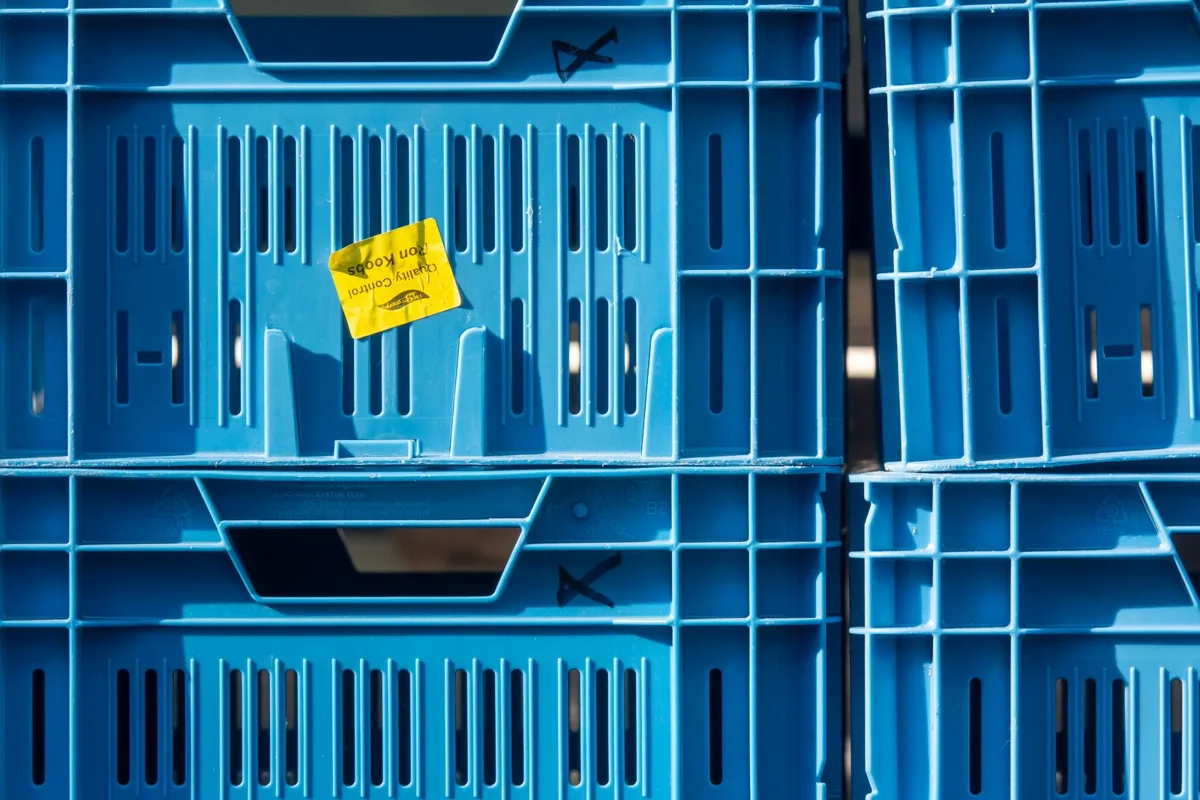
A plastic crate is an industrial container moulded in one piece from virgin thermoplastic resin, usually PP or HDPE, used to hold, stack and move goods in factories, warehouses and on trucks. In southern Vietnam it is often called “song nhua” (plastic crate). Most crates are made by injection moulding: molten plastic is injected into a metal mould, so crates of the same code have uniform dimensions and stack tightly on each other.
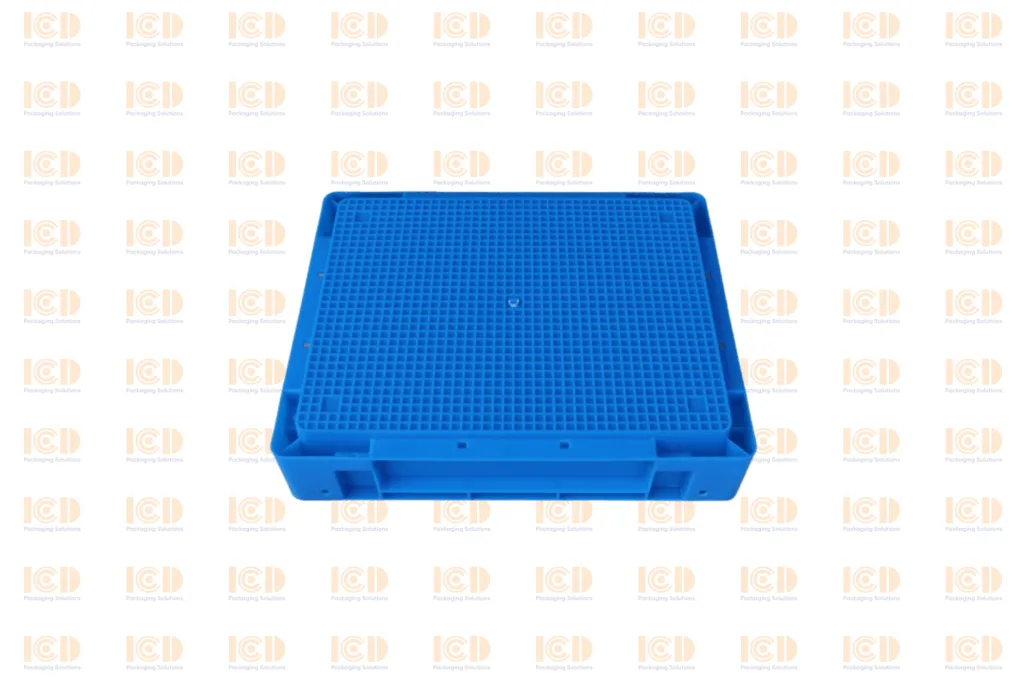
When reading foreign catalogues or filing customs declarations, the same item goes by many names. Solid crates are usually written as plastic container, solid box or tote box; open crates (mesh baskets) are plastic crate or mesh crate; crates with a loose lid or hinged lid are lidded storage box or attached lid container; crates that fold flat when empty are foldable crate or collapsible crate. On a customs declaration this group falls under the description boxes, cases, crates of plastic, HS subheading 3923.10, and the 8-digit code most often seen is 3923.10.90 (other).
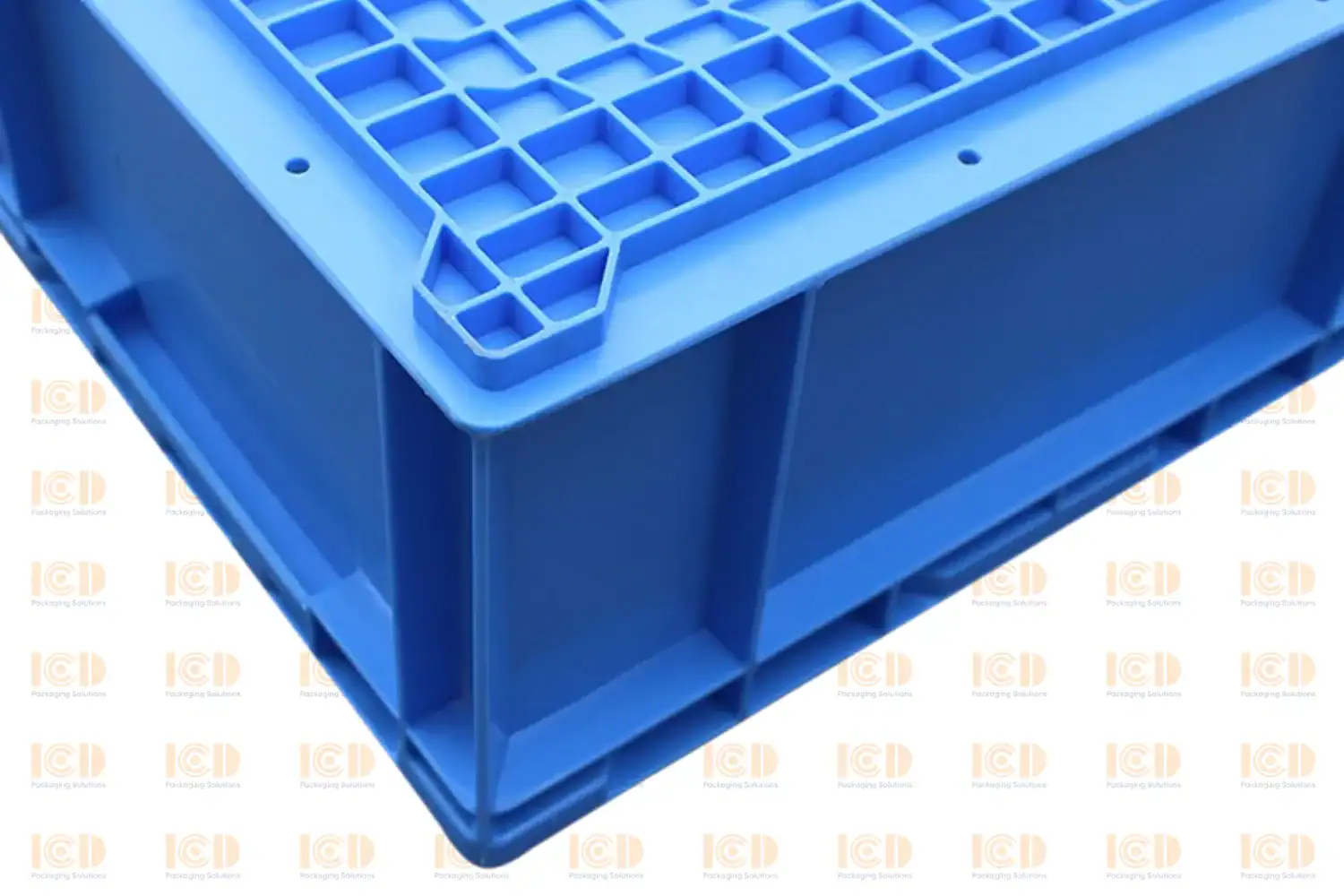
Industrial plastic crates must be separated right away from household plastic boxes sold in supermarkets. Industrial crates have thick walls, ribbed bases and stacking rims, and are made to carry heavy goods every day in factories, cold stores and production lines; household boxes only suit light items kept indoors. As for raw material, a crate meant for long use should be made of 100% virgin resin, that is, plastic that has not been used before. Recycled plastic is cheaper but its composition is hard to control, it turns brittle and cracks under heavy use, and it should not go where a crate touches food or medicine directly.
How do solid and open plastic crates differ?
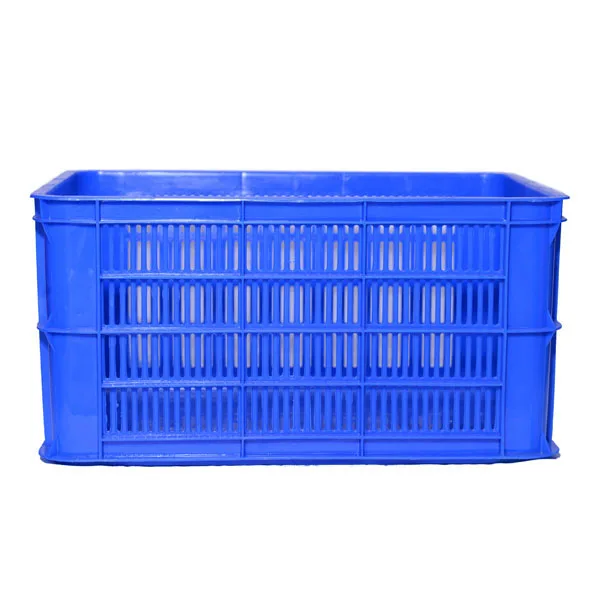
A solid crate has a closed base and walls and holds small items, grains and powders; an open crate has ventilation holes in the walls and base, draining water and letting air through. This is the most important classification when buying, because it decides which goods and environments the crate suits.
Solid plastic crates (closed-wall, solid container)
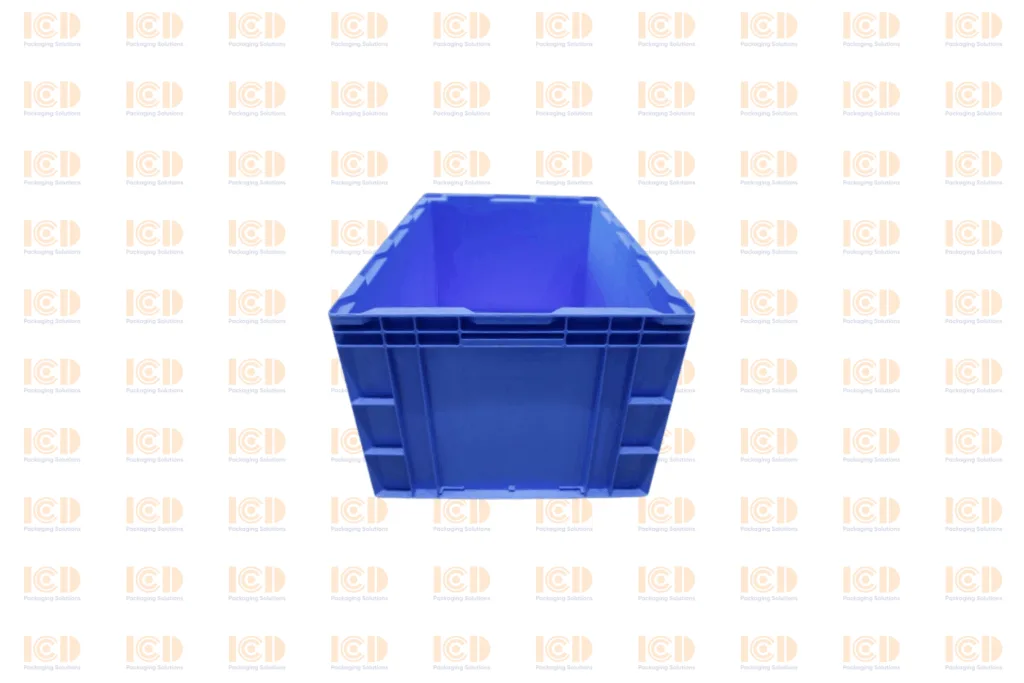
A solid crate has a base and four walls in one piece, with no holes. Goods do not spill, dust has trouble getting in, and with a lid it can even hold granular materials or liquids. At the same size, a solid crate is usually stiffer than an open one. It is the type seen most in electronics plants, automotive assembly and logistics warehouses: holding electronic components, mechanical parts, packaged food and anything that needs dust protection.
Open plastic crates (mesh baskets)
An open crate, or plastic basket, has mesh-style walls and base. Air circulates through the load, water drains quickly when washing, and an empty crate is lighter than a solid one of the same size because the mesh cells use less plastic. That is why in harvesting farm produce, vegetables and fruit, and in seafood processing, open crates are almost the default choice: goods are not steamed, and the crate is easy to spray clean after every shift.
Should you choose PP or HDPE plastic crates?
Choose PP when the crate must be stiff and light and has to be washed in hot water or steam-sterilised, such as component crates and food crates; choose HDPE when the crate is used in a cold store, holds water or chemicals, or is a large-capacity crate or tank. This is the question business customers ask me most. Both are good plastics, just good for different jobs, so a wrong choice means either the crate fails early or you spend money you did not need to.
| Criterion | PP (Polypropylene) | HDPE (High-Density PE) |
|---|---|---|
| Stiffness | High, stiffer | Medium, more flexible |
| Heat resistance | Melts at about 160-166 °C, withstands steam sterilisation | Melts at about 132 °C, withstands only 120 °C briefly |
| Impact resistance | Poor at low temperature, brittle below 0 °C | Better, especially at low temperature |
| Chemical resistance | Good with oils and greases, most organic solvents, acids and non-oxidising bases | Good with many solvents, slightly better than PP in chemical durability |
| Density | 0.895 - 0.93 g/cm³, the lightest commodity plastic | 0.93 - 0.97 g/cm³ |
| Plastic code | Triangle number 5 | Triangle number 2 |
| Suited to | Components, food, hot environments | Large crates, water, chemicals, cold stores |
The figures in the table are properties of the base material, compiled from the PP and HDPE sources in the references; a real crate also depends on additives, wall thickness and rib design. Many crate models on the market, including part of ICD Vietnam’s crate range, list the material as PP blended with HDPE to balance PP’s stiffness with HDPE’s toughness.
A simple selection rule: choose PP for crates used in electronics plants, food workshops that need hot washing, and high-temperature environments. Choose HDPE for large crates above 100 litres, crates holding liquids or chemicals, or crates used in freezer stores. If you are still unsure, send me the type of goods, the store temperature and how the crates are moved, and I will advise specifically.
What is the standard size of an industrial plastic crate?
The most common base size is 600 x 400 mm with its sub-multiples 400 x 300 and 300 x 200 mm; in Vietnam the 610 x 420 mm crate line is also very common. The mistake I see most is businesses buying crates without testing them on the pallets and racks they already use, so the crates sit crooked, overhang the edge, lose capacity and tip over when the truck moves.
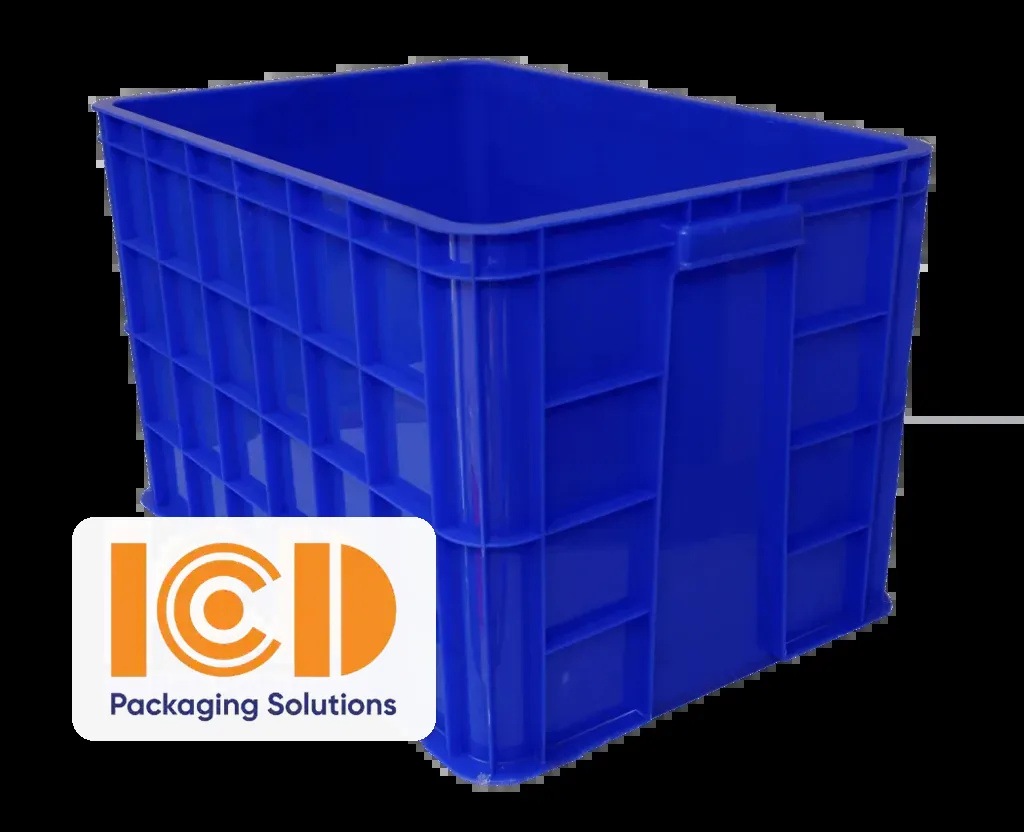
This size system is not the private convention of any one manufacturer. The ISO 3394:2012 standard sets the dimensions of rigid transport packaging on a 600 x 400 mm module (with two further modules, 600 x 500 and 550 x 366 mm), matching the 1200 x 800, 1200 x 1000 and 1100 x 1100 mm pallet sizes. The EU crate line in the ICD Vietnam catalogue follows this system, with base sizes of 400 x 300, 600 x 400, 800 x 600 and 1200 x 600 mm; the 600 x 400 mm size alone comes in several heights such as 147, 230, 280 and 340 mm. The full table of external sizes and inner cavity of each code is in the article on plastic crate dimensions.
The 610 x 420 mm crate line goes by height instead, and this is where newcomers often get confused. ICD Vietnam’s 610 x 420 mm solid crate comes in heights of 100, 150, 190, 250, 310 and 390 mm; in southern Vietnam these sizes are called by T-codes 1T5, 1T9, 2T5, 3T1 and 3T9, meaning heights of 1 tac 5 (150 mm), 1 tac 9 (190 mm) and so on. Once you know how to read the code, you can compare quotes between suppliers much faster.
| Crate base size (mm) | Pallet 1200 x 800 | Pallet 1200 x 1000 | Notes |
|---|---|---|---|
| 600 x 400 | 4 crates per layer | 5 crates per layer | 1000 pallet: 3 crates turned lengthways + 2 crosswise |
| 400 x 300 | 8 crates per layer | 10 crates per layer | 1000 pallet: 2 rows of 3 crates + 1 row of 4 |
| 300 x 200 | 16 crates per layer | 20 crates per layer | Fully packed, no gaps |
| 610 x 420 | 2 crates per layer (spare edge) | 4 crates per layer, overhanging 10 mm at each end | 1100 x 1100 pallet: 4 crates in a pinwheel pattern (610 + 420 = 1030 mm) |
The number of crates per layer was calculated by ICD Vietnam from external dimensions, without tolerance or wall taper. The table shows that the 610 x 420 mm crate, a very common line in Vietnam, stacks best on a 1100 x 1100 mm pallet; if your warehouse uses 1200 x 1000 mm pallets, crates on the 600 x 400 mm module give more stable loads in transit.
Plastic crate types by lid and special features
By feature, plastic crates fall into five common groups: lidded crates, crates with wheels, folding crates, anti-static ESD crates and Danpla plastic crates. Knowing these groups in advance helps you pick the right crate from the start, instead of buying an ordinary crate and then hunting for accessories to add.
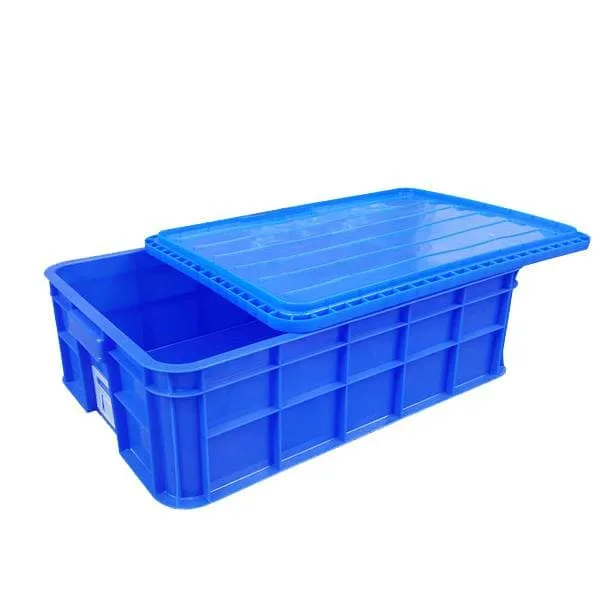
Lidded plastic crates use a loose lid or a hinged lid to keep out dust, moisture and insects, and make crate stacks steadier. This type is common in cold stores, food and pharmaceuticals. A lidded crate is heavier and costs more than a lidless crate of the same kind, so it is worth using only when the goods really need covering. Fresh produce that needs both ventilation and a dust barrier on long hauls can use a lidded plastic basket.
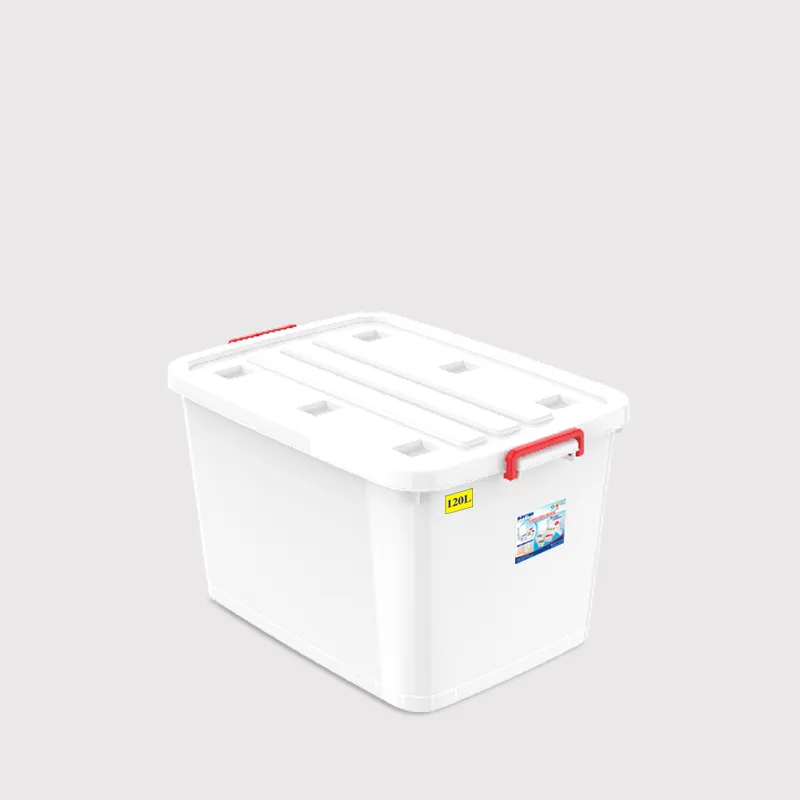
Plastic crates with wheels have swivel wheels under the base so they can be pushed by hand in warehouses and workshops without a forklift. ICD Vietnam’s catalogue has solid crates and open baskets of 780 x 500 x 430 mm with 5 wheels, often used in parcel sorting areas.
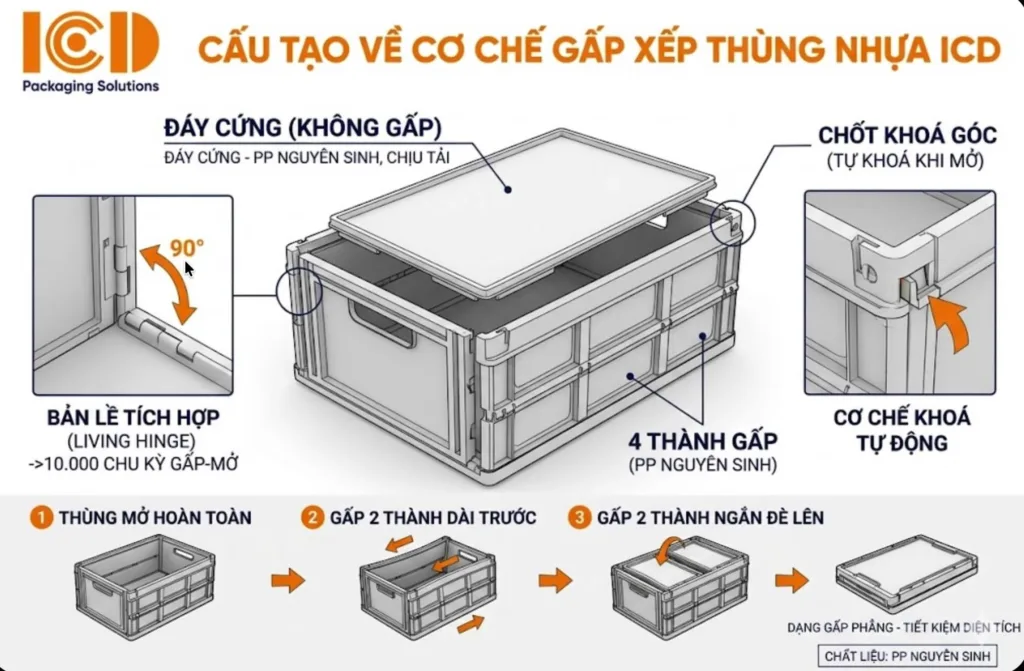
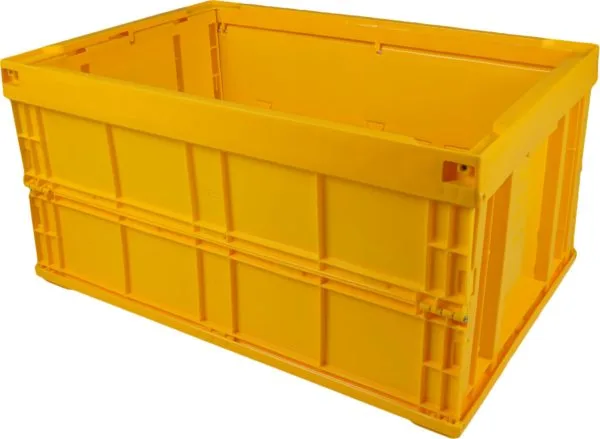
Folding plastic crates have a rigid base and four walls that fold on hinges, collapsing flat when empty. According to product specifications, ICD Vietnam’s folding crates cut volume by about 70 to 80% when folded, a real benefit when empty crates must be hauled back.
Anti-static (ESD) plastic crates are made of PP blended with conductive carbon additive, so static electricity drains away instead of building up and discharging into components. In electronics assembly areas that run a static-control programme, packaging and containers for sensitive components are classified under IEC 61340-5-3, so the crates usually have to be ESD type.
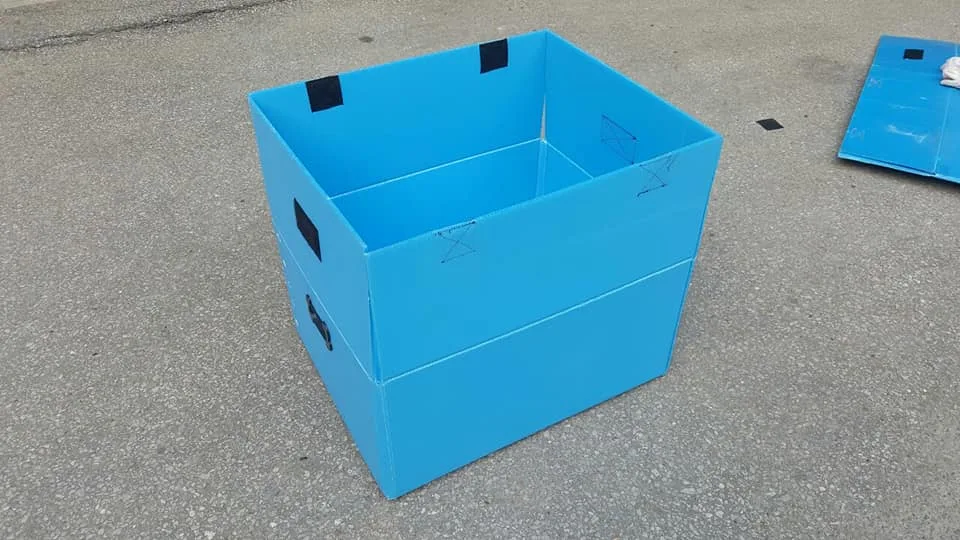
Danpla plastic crates are not injection-moulded crates. They are cut and folded from hollow PP sheet, like a corrugated board sheet but made of plastic, so they are lighter and can be made to custom sizes without a mould. Danpla also comes in an anti-static version for the electronics industry.
Plastic crate applications by industry
Each industry picks crates differently in size, material and hygiene requirements; there is no single type for everyone. Below is how I usually advise customers in the industries that use crates most in Vietnam.
Logistics and warehousing should prefer solid plastic crates in 600 x 400 mm or 610 x 420 mm to match pallets, with stacking rims and non-slip bases. Korean-style logistics crates in the EU line are chosen by many warehouses because of their flat walls and flat bases that run smoothly on automatic conveyors.
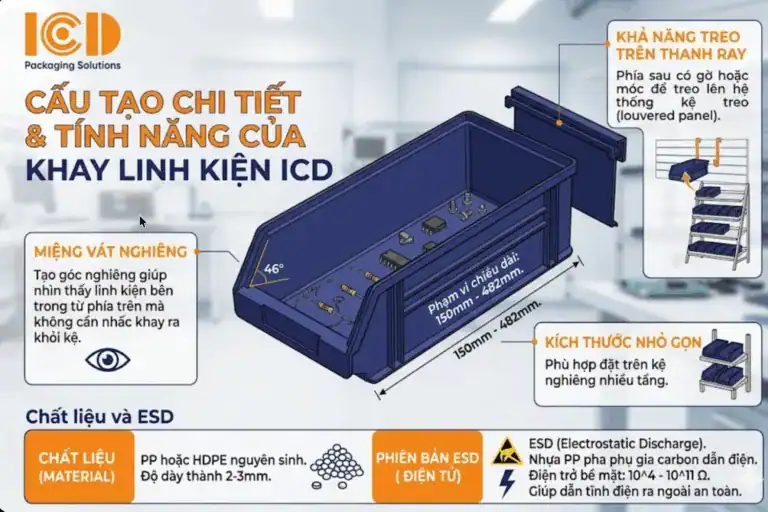
Electronics uses virgin PP crates, which can be fitted with divider walls to sort small components. In board assembly and semiconductor areas, use ESD anti-static plastic trays to avoid component damage from static discharge.
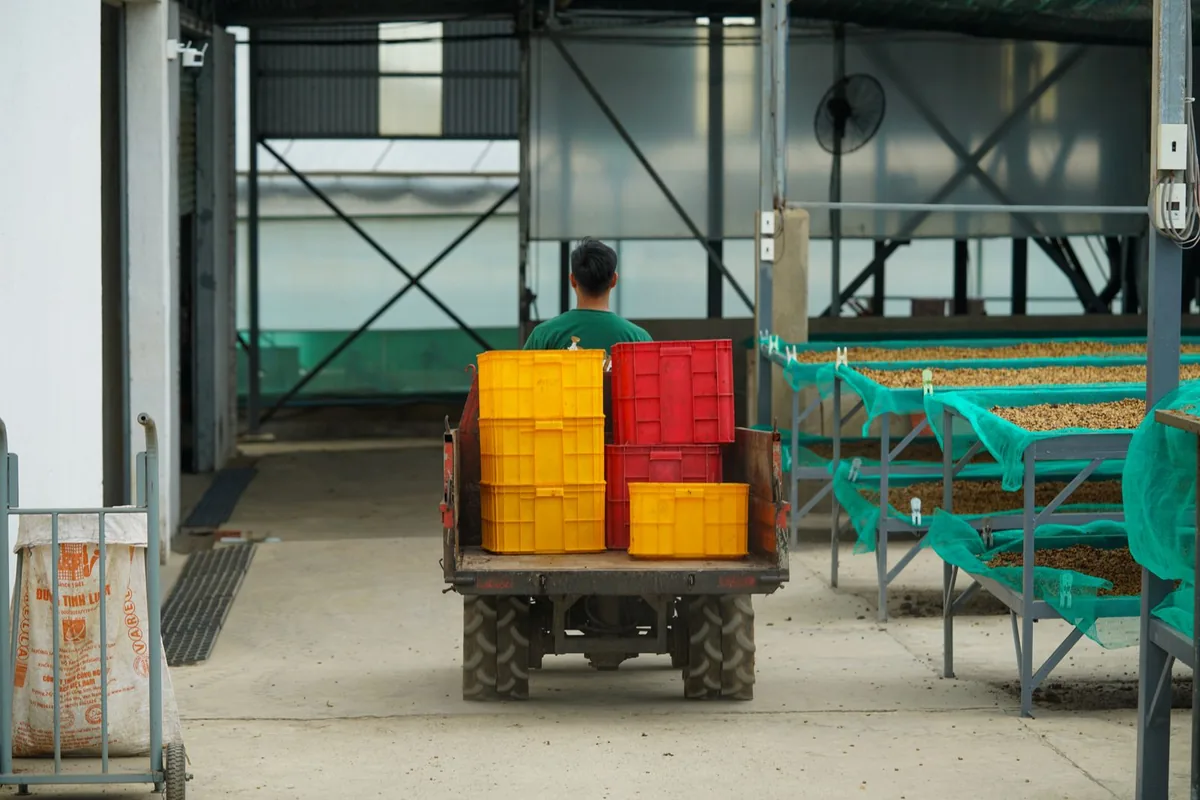
Agriculture and food should prefer open plastic crates (baskets) so vegetables are not steamed or bruised. HACCP hygiene principles require containers that are easy to clean, with no crevices to hide dirt. In Vietnam, crates in direct contact with food must meet QCVN 12-1:2011/BYT on synthetic-plastic packaging and utensils, and belong to the group of food containers that must be self-declared under Article 4 of Decree 15/2018/ND-CP.
Aquaculture needs large-capacity HDPE crates and tanks that resist brine, disinfectant chemicals and temperature swings, for example the 5,000-litre fish-rearing plastic tank in the ICD Vietnam catalogue. Chemicals and pharmaceuticals need virgin HDPE with no recycled plastic, with migration test results when holding sensitive products; for volatile chemicals, ask closely about the sealed lid design before buying.
5 common mistakes when choosing plastic crates
The five most common mistakes are choosing by price instead of specification, not testing the fit with the pallet, using open crates for goods that need to be sealed, ignoring the stacking load, and using recycled plastic for food. I gathered them from customers who came back because the crates they bought before could not be used.
1. Choosing by price instead of specification
Cheap crates usually use recycled plastic or low-grade virgin plastic with thin walls. After a while of heavy use, the crate turns brittle and cracks at the corners. The cost of replacing crates early is usually higher than the difference paid to buy good crates from the start.
2. Not checking the fit with the pallet
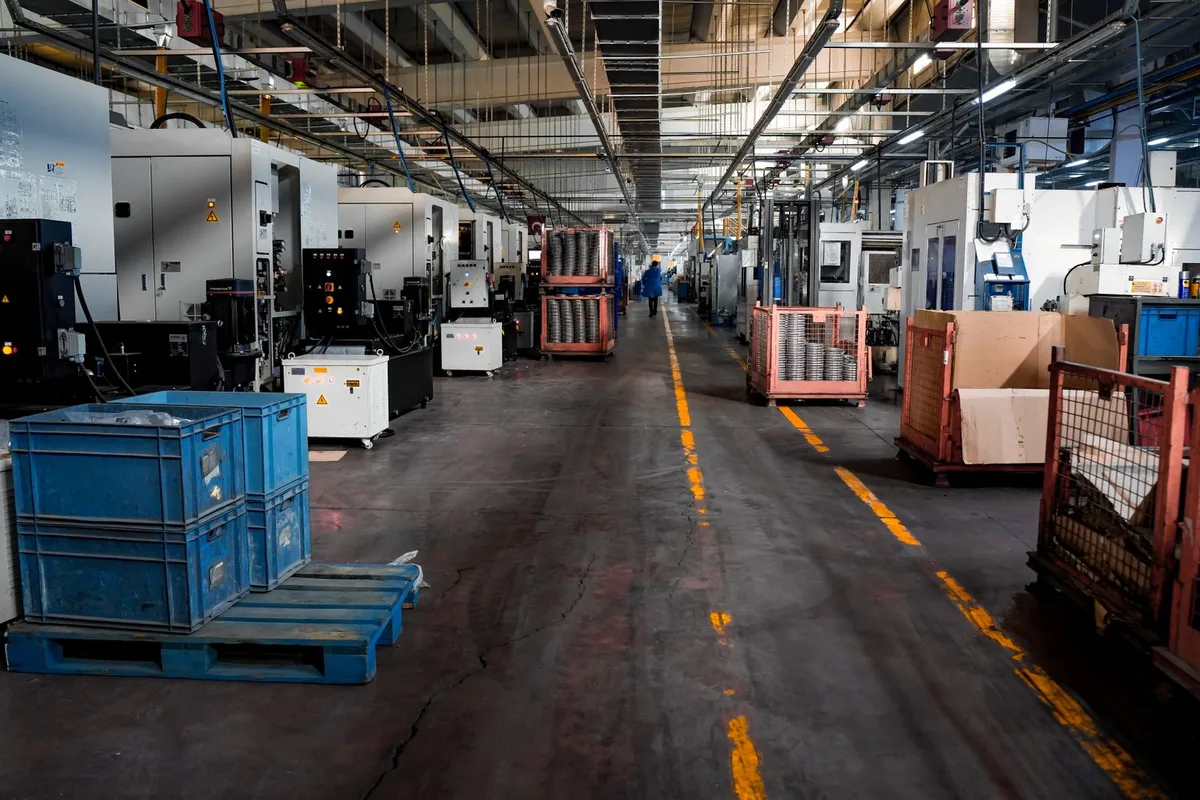
Buy 500 x 350 mm crates to stack on a 1200 x 1000 mm pallet and the pallet surface is not covered, so the load shifts in transit. Before buying, check whether the number of crates times the crate length or width roughly equals the pallet side; a difference of just a few millimetres is fine.
3. Buying open crates for goods that need to be sealed
Open crates are lighter and cheaper, but they do not suit small items, powders or goods that need dust protection. I once met a customer who bought open baskets for small electronic components and only after stacking saw the components fall through the mesh holes. Small goods need a solid closed-wall crate.
4. Not accounting for the stacking load
A crate that holds 50 kg inside may not withstand four or five full crates stacked on top while the truck is moving. So ask the supplier for the stacking load separately, not just the capacity of a single crate.
5. Using recycled plastic in the food industry
This is the most serious mistake. Recycled plastic can carry heavy metals and additives of unknown origin from earlier use. If vegetables, seafood or processed food touch the crate directly, use a virgin plastic crate and ask the supplier for documents showing the right crate code meets QCVN 12-1:2011/BYT.
How to read plastic crate specifications
The six specifications to read in a catalogue are external dimensions, internal dimensions, load (capacity and stacking), empty weight, material and applicable standard. Not every number printed in a catalogue matters equally; these are the ones I always compare when putting models side by side:
- External dimensions (L x W x H) to work out the fit with pallets and racks.
- Internal dimensions to work out real holding volume.
- Capacity load and stacking load, two completely different numbers.
- Empty weight, which affects transport cost and the effort of handling.
- Material: PP or HDPE, virgin or recycled, and whether the colour additives are safe.
- Standards and accompanying documents for the industry of use.
On standards, ISO 9001 certification, if a supplier has it, certifies only the factory’s quality management system, not each crate code. Crates for food in Vietnam need documents meeting QCVN 12-1:2011/BYT and a product self-declaration; goods exported to the US may be required to use plastic that meets FDA 21 CFR 177.1520 on olefin polymers.
Frequently asked questions
Which is more durable, PP or HDPE plastic crates?
There is no absolute answer because durability depends on the environment of use. PP is stiffer and more heat-resistant, withstands steam sterilisation, and suits hot environments and food crates that need hot washing. HDPE is tougher, takes impact well at low temperature, and suits cold stores, large-capacity crates and chemicals. In an ordinary warehouse, both are durable if they are virgin plastic.
How many years do plastic crates last?
Lifespan depends on plastic quality, load, sun exposure and cleaning chemicals, so there is no single figure. Recycled crates, crates often exposed to UV without UV-resistant additives, or washed with unsuitable chemicals, degrade faster. Replace a crate when you see cracks at the corners, a cloudy whitish colour, or a crate that turns brittle on a light knock. ICD Vietnam plastic crates carry a 12-month warranty under the company’s warranty policy.
Can I order plastic crates in a custom size?
Yes, but an injection-moulded crate needs its own mould, and the mould cost is high, so it makes sense only when the order quantity is large enough to amortise it. For small quantities, pick the nearest standard size, or use a Danpla crate cut to size. ICD Vietnam advises on a suitable standard size and quotes specifically from a drawing.
How do lidded and lidless plastic crates differ?
A lidded crate keeps out dust, moisture and insects and makes stacks steadier, but is heavier and costs more than a lidless crate of the same kind. Use lidded crates for goods sensitive to dust and moisture, food, pharmaceuticals and electronic components; use lidless crates for rough goods, produce that needs ventilation, and stored goods that rarely move.
How do you tell virgin plastic crates from recycled ones?
A virgin crate has an even colour, a smooth glossy surface, no odd specks or colour streaks, and rings clearly when tapped lightly. A recycled crate usually has a dull, uneven colour, may be speckled with black or brown, has a slightly matt surface and sounds duller when tapped. The surest way is to ask for the raw material documents and check the plastic code under the base: PP is triangle number 5, HDPE is triangle number 2.
What is a plastic crate called in English?
An open plastic crate is usually called a plastic crate; a solid plastic crate is a plastic container, solid box or tote box; a crate with a lid is a lidded storage box. On customs documents this group falls under the description boxes, cases, crates of plastic (HS 3923.10).
What is the HS code for plastic crates?
Plastic crates used to hold and transport goods usually fall under subheading 3923.10 (boxes, cases, crates and similar articles of plastics), 8-digit code 3923.10.90, other. The exact code is determined by customs from the actual goods; a business may request an advance ruling on the code. How to look up the code for each type of crate and tray is explained in the article on plastic crate HS codes.
How many 600 x 400 mm crates fit on a 1200 x 1000 mm pallet?
Each layer holds 5 crates: 3 crates turned lengthways (the 400 mm side running along the 1200 mm direction) and 2 crosswise in the remaining space, covering the pallet fully. On a 1200 x 800 mm pallet, each layer holds 4 crates.
Conclusion and contacting ICD Vietnam
Choosing the right plastic crate from the start saves a good deal of cost over the long run. Four core points to remember: use virgin PP or HDPE to suit the environment; choose a size that fits your existing pallets and racks; choose a solid or open crate by type of goods; and ask for the stacking load, not just the capacity.
ICD Vietnam’s industrial plastic crate range now has more than 100 codes, from component trays, solid crates and open baskets to folding crates and large-capacity crates, delivered nationwide with VAT invoices. If you need advice on crate type, size and quantity for a specific need, the ICD Vietnam team helps free of charge.
- North: 0983 797 186 / 090 345 9186 / 090 5859 186.
- South: 098 6784 186.
- Email: sales@icdvietnam.com.vn.
- Zalo: 090 345 9186.
References
- PP properties (density, melting point, brittle below 0 °C): Wikipedia, Polypropylene.
- HDPE material characteristics: British Plastics Federation (BPF).
- Transport packaging dimension module: ISO 3394:2012.
- Plastic packaging and utensils in direct contact with food: QCVN 12-1:2011/BYT.
- Self-declaration of food containers: Decree 15/2018/ND-CP.
- Packaging for static-sensitive components: IEC 61340-5-3.
- Olefin polymers in contact with food in the United States: FDA 21 CFR 177.1520.
- HS classification of plastic component crates, 3923.10.90: customs policy answer on LuatVietnam; MFN import tariff schedule under Decree 26/2023/ND-CP.