
Table of Contents
- What levels of custom plastic container are there?
- What is changing a container’s colour to match your brand for?
- Which way of putting a logo on a plastic container should you choose?
- Label cards, dividers and lids: customisation without a new mould
- When do you really need a dedicated plastic container mould?
- How do you order custom plastic containers at ICD Vietnam?
- Frequently asked questions
- What does making custom plastic containers cover?
- What minimum quantity is needed to order logo printing on plastic containers?
- How long does logo printing on plastic containers take?
- Can dividers be made to custom sizes?
- What are container label cards used for?
- When should you make a new plastic container mould?
- How long does it take to make a new plastic container mould?
- Who owns a custom-made mould?
- Is a logo printed on a plastic container durable?
- Contact ICD Vietnam
- References
Reviewed and updated by ICD - Week 43/2026
A custom plastic container is one ordered to differ from the standard version in colour, logo, accessories or size. For most businesses, changing the colour, printing a logo, adding label cards and inserting dividers on an existing container is enough; only when no model fits the goods and the volume is large enough to amortise the mould should you consider a dedicated mould.
Standard plastic containers are priced by model, delivered quickly and work with existing pallets, racks and conveyors. I have worked with warehouse and factory customers since 2011, and most of the “make us our own container” requests I receive end up solved by an existing model plus a colour, a logo or dividers. This article helps you work out which level you need, what information to prepare, and when a dedicated mould is really worth the money.
What levels of custom plastic container are there?
There are four levels with rising cost and lead time: changing the colour, printing a logo, adding accessories and making a new mould. The first three use existing moulds so there is no mould cost; the fourth changes the shape of the container itself, so a mould must be made from scratch.
When a new request comes in, the first question to ask is: what is wrong with the standard container? If it is only that the colour does not match the brand, or containers get mixed up between departments, that is a level 1 and 2 matter. If goods shift and knock against each other inside the container, that is a matter for dividers. Only when the goods’ size or the pallet pattern fits no model do you need to think about a mould.
| Customisation level | New mould needed? | What changes | Suitable when |
|---|---|---|---|
| 1. Colour change | No | Colour masterbatch matched to the brand colour on an existing mould | You want matching colours, or to tell areas, shifts or customers apart |
| 2. Logo or company name printing | No | Screen printing, decals or labels on the container wall | You need identification and to prevent containers getting lost in circulation |
| 3. Adding accessories | Usually not | Dividers, loose lids, label cards, handles | Fragile goods, need for compartments, lot code labelling or a sealed lid |
| 4. New mould | Yes | Own dimensions, rib structure, handles, lid | Standard containers do not fit the goods and the volume is large enough to amortise the mould |
What is changing a container’s colour to match your brand for?
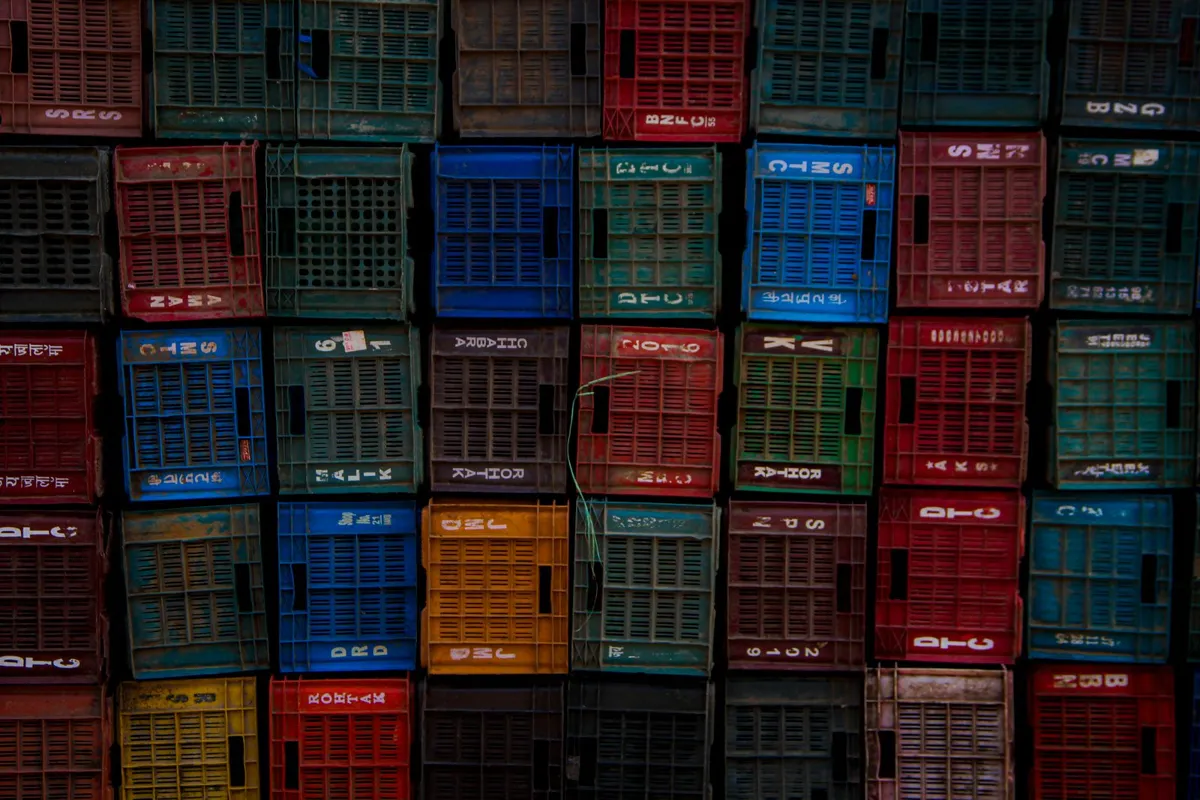
Changing colour lets you recognise your own containers, or which area or customer they belong to, by eye alone without reading a label. The colour is mixed from masterbatch at moulding time on an existing mould, so the container body does not change in size, load capacity or stackability.
For example, if an organisation’s main colour is blue, producing plastic containers in a matching blue strengthens the company image in customers’ memory. In the warehouse, colour is also a sorting tool: blue containers for accepted goods, red containers for faulty goods awaiting handling, white containers for the food area. The reason the food industry favours blue baskets is also tied to this kind of classification. Some ICD Vietnam container product pages state that custom colours are made to the Pantone palette, so when ordering send a Pantone code instead of describing it in words, because everyone’s “blue” is a different colour.
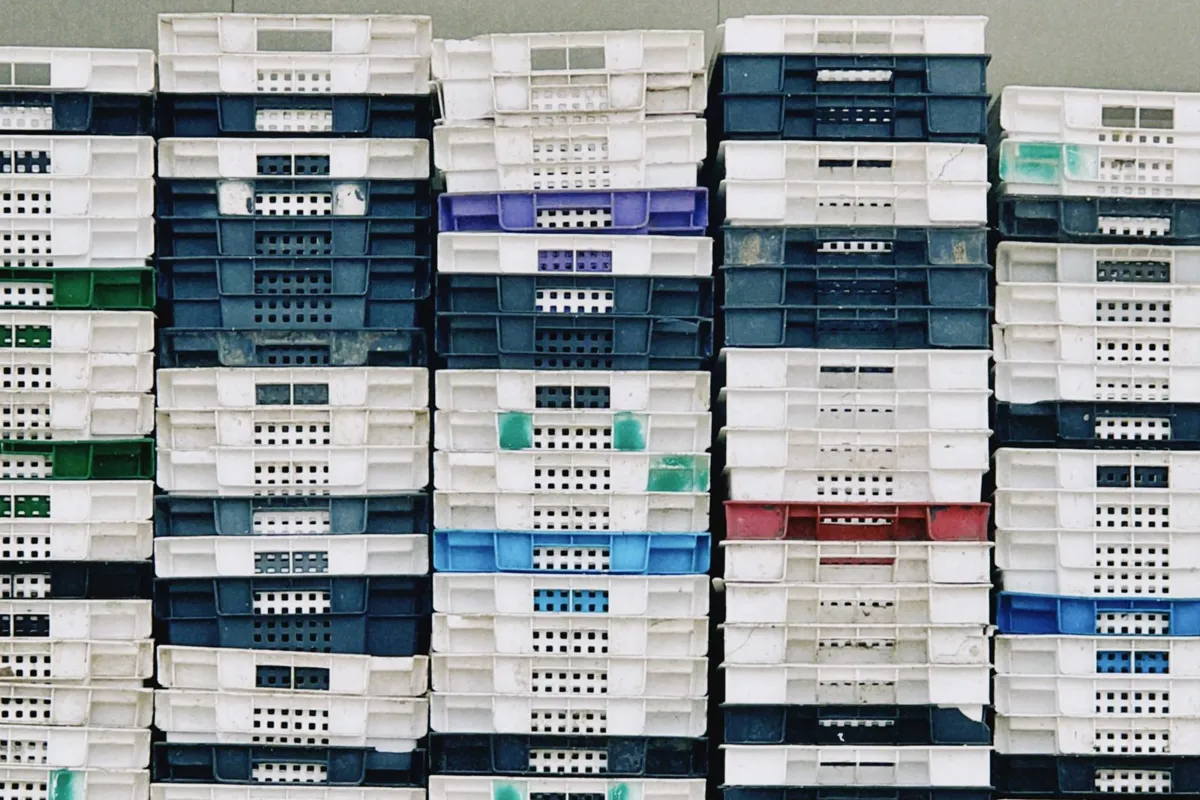
There are two points to note. First, a custom colour means a separate production run, so it always comes with a minimum quantity; at ICD Vietnam this is 50 pieces, the same as a logo printing order. Second, light colours and white show dirt easily, while dark colours hide marks better in a yard; if the containers will be outdoors for long, ask about UV-resistant additives so the colour does not fade quickly.
Which way of putting a logo on a plastic container should you choose?
For existing containers, the most common way is screen printing on the container wall; engraved lettering in the mould and in-mould labelling are only possible with a dedicated mould. How to order logo printing on plastic containers and plastic pallets at ICD Vietnam has its own guide. The logo should go on the face that is easy to see once containers are stacked, usually the two narrow end faces.
A logo can be put on the container in four ways, differing in durability and cost:
| Logo method | Durability | Advantage | Note |
|---|---|---|---|
| Raised or recessed lettering engraved in the mould | Permanent, does not peel | No effort to print each container | Only possible with a dedicated mould; changing the content means altering the mould |
| Screen printing on the container wall | Good if the surface is treated before printing | Low cost, easy to change the content | Each print colour is a separate pass |
| In-mould labelling (IML) | High, the label is integral with the container body | Can print many colours and images | Needs a mould and equipment to apply labels |
| Decals, stickers | Lower, tend to peel when washed | Fast, flexible, small quantities | Suited to management codes and temporary labels |
Screen printing pushes ink through a mesh frame that has been blocked out except for the logo, one frame and one pass for each colour. That is why a logo of one or two colours, with clear lines and no gradients, is the best fit for plastic containers. PP and HDPE plastic have surfaces that ink struggles to grip, so printers usually treat the surface before printing so the ink does not flake off when the containers are washed.
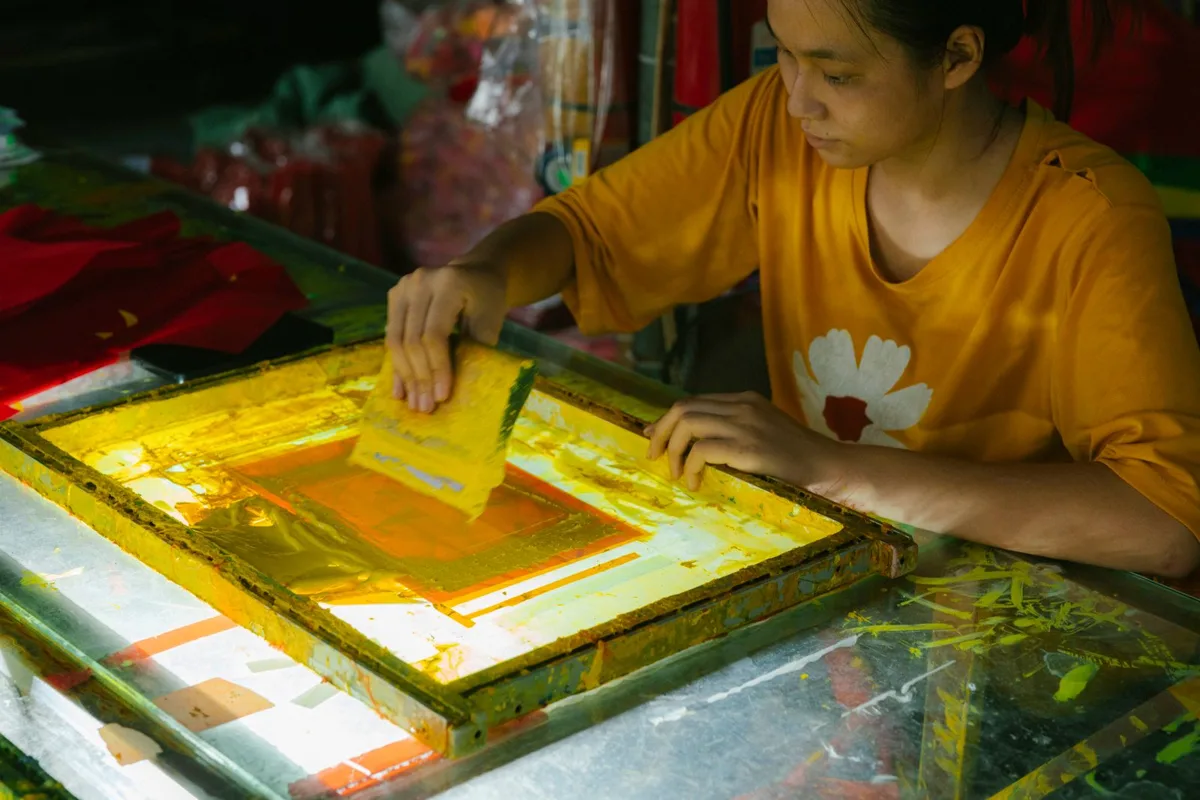
When sending a printing request, prepare the logo file as a vector (AI, PDF, SVG), the colour codes, the size you want and the face to be printed. ICD Vietnam takes logo printing orders with a uniform minimum quantity of 50 pieces per model. For container lids in particular, the product page states a delivery time of 15 - 20 working days for logo printing orders. The printing option and delivery time for the model you choose should be confirmed when you ask for a quote.
Label cards, dividers and lids: customisation without a new mould
These are customisations fitted to an existing container, solving goods management and protection without touching the container body. On many product pages, ICD Vietnam states support for logo printing, label cards and dividers made to order for large-quantity orders.
Label cards slotted on the outside of the container wall
A card is a PP plastic sheet that slots into the groove on the container wall, used to record the lot code, product code, product name or expiry date so goods ship out in first-in, first-out order without opening the container. According to ICD’s container label card page, the card is made to fit each container model individually, can be bought separately for replacement or extra supply, and printing of lot codes and logos is accepted for orders from 50 cards. Because cards are not shared between sizes, confirm the exact container model before ordering.
Dividers that split the interior into compartments
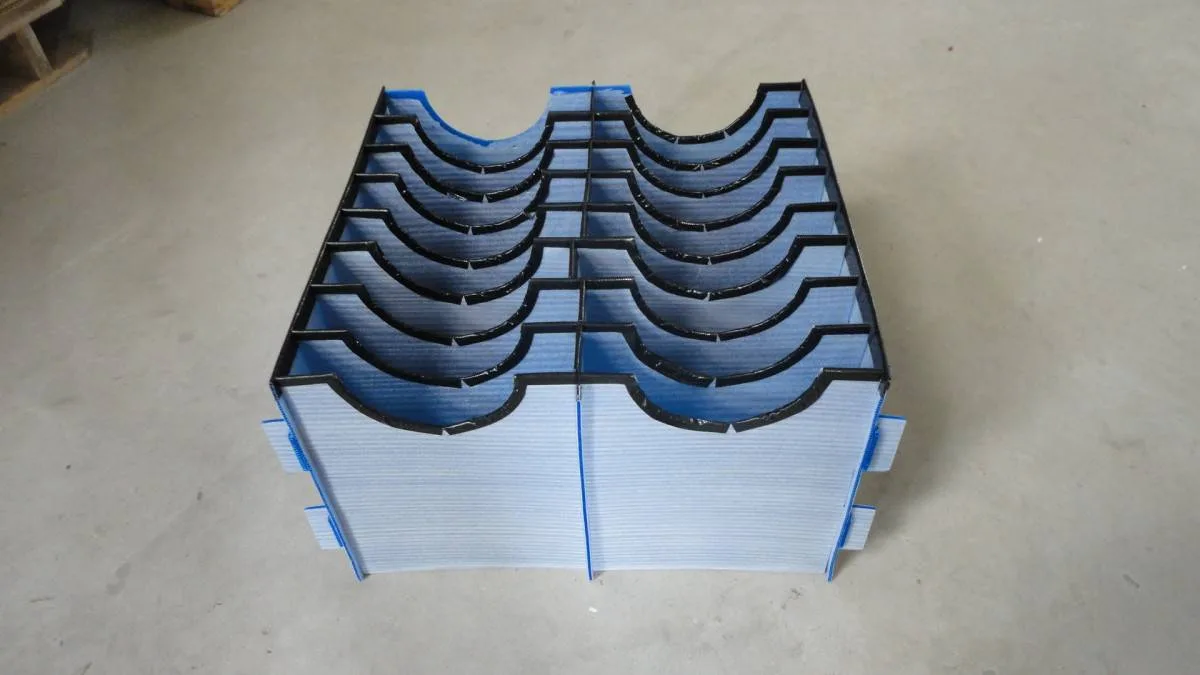
Dividers split the container interior into separate cells so components, bottles or machined parts do not knock against each other. Dividers are usually made from Danpla plastic sheet, cut and recessed to the shape of the part. To order, you only need to give the container model and the cell size you want; for parts of unusual shape, send a photo or drawing so the divider is recessed in the right places.
Loose lids and handles
A loose lid keeps dust out and lets containers full of goods stack more firmly; the lid must match the model because the opening size differs for every model. The options above are available on many lines: solid-wall containers and empty containers, antistatic containers, containers with lids, and Danpla containers in standard and antistatic types. For folding containers, the product page also lists an option to fit handles.
When do you really need a dedicated plastic container mould?
Only make a dedicated mould when no standard container fits the size of the goods or the pallet pattern, and the volume is large enough to spread the mould cost over each container. An injection mould is a precision-machined steel block that makes up most of the upfront investment of the whole project. How the mould and machine produce a container is explained in the article on injection moulding technology for plastic containers.
The section below is a general description of how plastic container mould projects usually go, to help you know what to ask the company taking the job, not a commitment of any specific supplier’s service.
A new mould project usually goes through five steps: fixing the requirements, 3D design, machining the mould and trial moulding, mass production, then finishing. The mould-making step takes the most time and cost, and the trial samples from the real mould are the most important milestone for you to approve.
At the design step, five factors decide whether the container can be moulded stably and whether the mould has to be complicated:
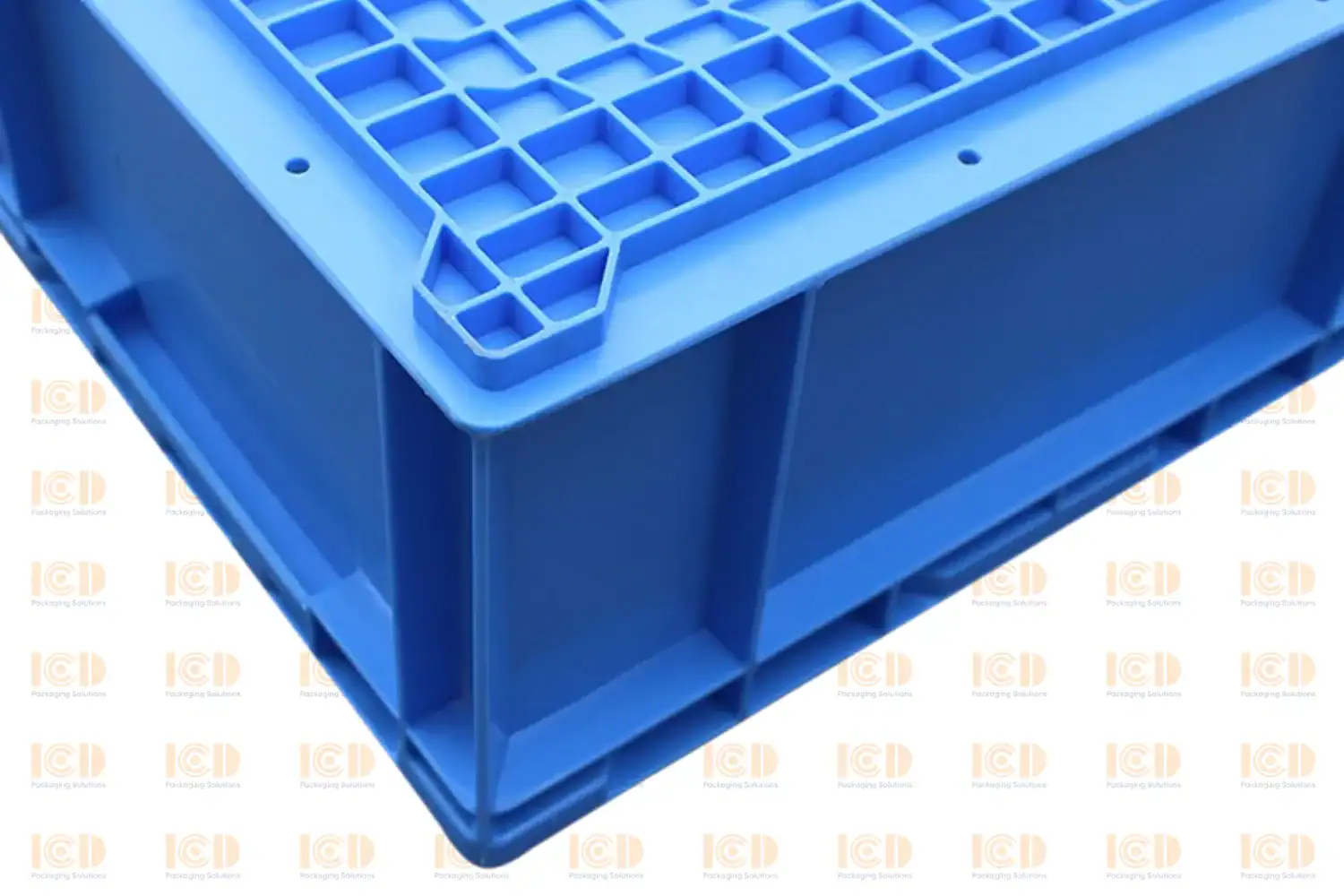
On dimensions, the ISO 3394 standard sets rigid shipping package sizes based on the modules 600 x 400, 600 x 500 and 550 x 366 mm, matching four ISO pallet sizes (1200 x 1000, 1200 x 800, 1219 x 1016 and 1100 x 1100 mm). For example, 4 containers with a 600 x 400 mm base cover one layer of a 1200 x 800 mm pallet exactly. Designing a new container to this module makes pallet loading and container loading tidy and keeps it compatible with standard containers.
Before mass moulding, ask for trial samples from the real mould and check: outside and inside dimensions, flatness of the container rim, stackability when full, colour against the brand colour sample, and the position and sharpness of the logo. Only approve production once the sample passes. In parallel, the contract needs to state who owns the mould and who it may be used for.
How do you order custom plastic containers at ICD Vietnam?
You send your requirements by hotline or email, ICD confirms the container model, options and quantity and gives a quote, then delivers and takes payment under the purchasing policy published on the website. The more information you give at the start, the faster and closer the quote.
To get advice and a fast quote, have the following information ready:
The ordering steps under ICD Vietnam’s purchasing and payment guide:
- Call the hotline (08:00 - 17:00, except Sunday) or send an email with the container model, quantity, colour, logo file and divider cell size.
- ICD confirms the customisation option, the minimum for that model and gives a quote; orders placed on the website get a call back from staff to confirm.
- Confirm the order and pay by cash or bank transfer; ICD issues a VAT invoice for the order.
- Delivery follows the shipping policy; delivery time for logo-printed goods is quoted separately for each order.
ICD Vietnam plastic containers carry a 12-month warranty under the warranty and repair policy. Goods with a printed logo or custom colour are made to order, so approve the colour sample, logo position and logo size before producing the whole batch; for EU-type containers, the product page states that a sample can be sent for real-world checking before ordering large quantities.
Frequently asked questions
What does making custom plastic containers cover?
Four levels: changing the colour to match the brand, printing a logo or company name, adding accessories such as dividers, lids and label cards, and making a new mould when you need your own size or structure. The first three use existing moulds so there is no mould cost.
What minimum quantity is needed to order logo printing on plastic containers?
ICD Vietnam applies a uniform minimum of 50 pieces for custom colour or logo printing orders, covering containers, EU-type containers, container lids and container label cards. The option and delivery time are confirmed at the time of quoting.
How long does logo printing on plastic containers take?
The time is quoted per order. For container lids in particular, the ICD product page states delivery within 15 - 20 working days for logo printing orders.
Can dividers be made to custom sizes?
Yes. You give the container model and the cell size you want; dividers are usually made from Danpla plastic sheet and can be recessed to the shape of the part to hold goods in place during transport.
What are container label cards used for?
A card slots into the groove on the container wall to record the lot code, product code, product name or expiry date, helping goods ship in the right order without opening the container. Cards fit each model individually and can be bought separately.
When should you make a new plastic container mould?
When no standard container fits the size of the goods or the pallet pattern, and the total number of containers expected is large enough that the mould cost per container is still lower than the savings in warehouse space and damaged goods.
How long does it take to make a new plastic container mould?
The time depends on the size and complexity of the container: design, steel mould machining, trial moulding and mould adjustment usually take several weeks. Containers with cut-out handles, reverse latches or hinged lids need sliding cores and take longer than straight-walled ones.
Who owns a custom-made mould?
Mould ownership, where the mould is stored, maintenance cost and a commitment not to use the mould to produce for other parties should be stated clearly in the contract. A business investing in a mould should ask for a design confidentiality clause from the start.
Is a logo printed on a plastic container durable?
Durability depends on the method: a logo engraved in the mould and an in-mould label last the whole life of the container; screen printing is durable when the surface is treated before printing; decals peel easily if the container is often washed with hot water or chemicals.
Contact ICD Vietnam
ICD Vietnam Industrial Manufacturing Co., Ltd
Send the container model, quantity, colour, logo file or the cell size to be divided to get advice on the right customisation level and a quote:
- Hotline: 0983 797 186 / 090 345 9186.
- Email: sales@icdvietnam.com.vn.
ICD Vietnam plastic containers carry a 12-month warranty under the warranty and repair policy published on the website.
References
- ISO, ISO 3394:2012 Packaging: Dimensions of rigid rectangular packages: modules 600 x 400, 600 x 500, 550 x 366 mm.
- Wikipedia, Injection moulding: draft angle, sliding cores for undercut parts, mould cost, in-mould labelling.
- Wikipedia, Screen printing and Corona treatment: how screen printing works, surface treatment of polyolefin plastics before printing.
- ICD Vietnam: pages for plastic containers, lids, container label cards and dividers; Purchasing and payment guide; Shipping policy; Warranty and repair policy, cross-checked on 16 October 2026.