
Table of Contents
- Smooth or spiny softshell: choose the species before the tank
- Choosing the tank: by tank surface, not by litres
- Layout of water area, shallow area and basking spot
- Preventing turtles from biting each other in the tank
- Water, temperature and water changes in the tank
- Feed and feeding by temperature
- Common diseases and how to prevent them
- Slow growth: rearing time and harvest
- Frequently asked questions about raising softshell turtles in plastic tanks
- What stocking density is reasonable for raising turtles in plastic tanks?
- What plastic tank capacity should I choose for raising turtles?
- How long does it take to harvest turtles raised in plastic tanks?
- Do I need permission to raise spiny softshells?
- Do turtles raised in tanks need to bask?
- Why do turtles in a tank bite each other and how can it be limited?
- Is it better to raise turtles in a plastic tank, a cement tank or a tarpaulin tank?
- How do I raise newly hatched turtles at home?
- Do turtles need feeding in winter?
- Where can I buy plastic tanks for raising turtles?
- Contact ICD Vietnam to buy plastic tanks for raising turtles
- References
Reviewed and updated by ICD - Week 43/2026
Raising softshell turtles in plastic tanks needs a low, wide HDPE tank, divided into about 2/3 water with a sand layer so the turtles can bury themselves and 1/3 gently sloping shallow area where they climb out to bask and eat. The tank rim must stand well above the shallow area and carry a mesh lid, because softshell turtles are strong climbers. Stock sparsely (1 - 2 turtles per m² for beginners), stock only one size and separate males from females once the turtles reach about 0.6 kg to limit biting. The smooth softshell suits home trials; the spiny softshell is a Group IIB endangered, precious and rare species, so you must hold a farm registration code.
I am Le Van Thang and I have worked at ICD Vietnam since 2011. Customers who buy plastic containers to raise softshell turtles usually ask the same question: how many litres is enough. For turtles the better question is how wide the tank top is, where to put the shallow area and whether the tank can stop the turtles climbing out. Softshell turtles are air-breathing reptiles that need to come onto land to bask, bite each other often and grow much more slowly than fish, so the tank layout is very different from a fish-farming tank. How each fish species is handled is covered in the articles on raising catfish in plastic tanks and raising loach in plastic tanks.
This article focuses on those specific points: choosing the species, dividing water and shallow area, preventing escape, preventing biting, feeding by temperature and the legal rules for the spiny softshell. The technical figures come from the Da Nang Agricultural Extension Centre, the Hai Phong Agricultural Extension Centre, Ninh Binh fisheries extension and the Nghe An Aquatic Seed Centre. These documents were written for ponds and built tanks; where I convert them to tanks, I mark it clearly as an ICD suggestion.
Smooth or spiny softshell: choose the species before the tank
In Vietnam, farmers mainly raise the smooth softshell and the spiny softshell. The smooth softshell is easy to raise, survives well and its seed is cheap; the spiny softshell grows faster but is weaker, its seed is expensive and the species is on a managed list, so paperwork is required before raising it.
This description follows the technical document of the Da Nang Agricultural Extension Centre. The same document also notes a form of smooth softshell living in streams, called “nep suoi” by farmers, with a folded back like toad skin and a white belly, which hardly grows at all, so check the seed carefully when buying. A 2022 commercial-farming model in Tien Lang, monitored by the Hai Phong Agricultural Extension Centre, shows the difference between the two main species clearly:
| Item | Smooth softshell | Spiny softshell |
|---|---|---|
| Stocking size | 50 - 60 g each | 90 - 100 g each |
| Density | 2 per m² | 1.5 per m² |
| Rearing time | 16 months | 17 months |
| Harvest weight | 1.2 - 1.5 kg (average 1.3 kg) | 2.0 - 2.3 kg (average 2.2 kg) |
| Survival rate | 80% | 70% |
According to this model’s assessment, the spiny softshell grows faster but is weaker, so its survival rate is lower than the smooth softshell. The commercial spiny softshell procedure of the Nghe An Aquatic Seed Centre advises stocking even more sparsely, 1 - 3 per m², with seed of 80 - 100 g each from a clear source; under the same conditions, females grow faster than males. Spiny softshells raised for one year usually reach 0.8 - 1 kg each, and 2.5 - 3 kg after two years. For a household raising a few turtles in a tank as a trial, the smooth softshell is the lower-risk choice in both technique and paperwork.
Rules for raising the spiny softshell (updated October 2026)
Under Article 25 of Circular 27/2025/TT-BNNMT, organisations and individuals must be granted a farm registration code before raising the species. Appendix I of the Circular places the spiny softshell in the column of endangered, precious and rare forest animals (Group IIB), so under Article 26 the code is issued by the provincial Forest Protection authority (Forest Protection Sub-Department); the rule that moves the matter to fisheries law under clause 4 of Article 25 applies only to species classed as aquatic. The spiny softshell is also named in the List of aquatic species permitted for trade attached to Decree 37/2024/ND-CP, a list that concerns trading and does not replace the authority that issues the code. Within 3 working days of bringing the turtles home, the farm owner sends a notification on Form 08 with a copy of the seed origin documents to the local Forest Protection authority, or to the commune People’s Committee where there is no local Forest Protection office. The seed must come from a lawful source, the housing must suit the species and the owner must keep a farming logbook on Form 07. The application for the code is submitted to the provincial Forest Protection authority or the provincial fisheries authority depending on the case set out in Article 26.
To sell spiny softshells, Article 23 of the Circular only allows trading Group II specimens of captive-bred origin from the F1 generation onward at a registered farm. So when buying seed, ask the hatchery for its origin documents and farm code. The smooth softshell (Pelodiscus sinensis) is not listed in the CITES Appendices; even so, before raising large numbers for sale, you should ask the Forest Protection sub-department or the fisheries authority where the tank is placed about the procedure that applies locally. This section is reference information and does not replace the guidance of the regulator.
Choosing the tank: by tank surface, not by litres
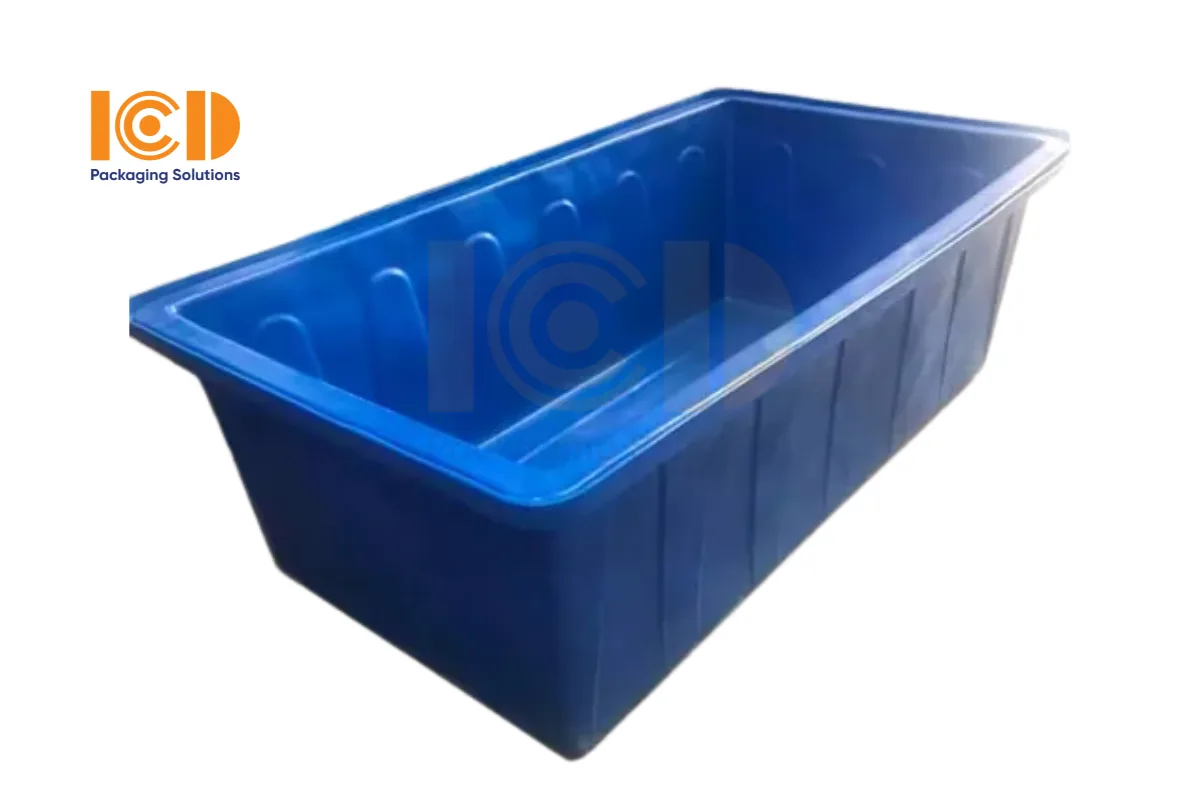
A turtle tank should be a virgin HDPE tank with thick walls, a flat base, low height and a wide top; when comparing tanks, compare surface area rather than capacity, because turtles need room to swim, to bury themselves and to climb out.
Virgin HDPE resists impact, does not turn brittle in cold weather and has no recycled additives leaching into the water; do not use a tank that once held chemicals. The tank wall must be well above the shallow area so turtles cannot climb out, so a tank that is too low will not do. A square or rectangular tank makes it easier to place the shallow area at one end than a round tank. On water depth, the Da Nang extension document keeps newly hatched turtles in small basins or tanks 20 - 25 cm deep and juveniles and breeders in ponds or tanks 0.8 - 1 m deep; Ninh Binh fisheries extension advises meat-turtle tanks larger than 10 m² and 0.6 - 1 m deep.
From this, plastic tanks fit best for the three uses below. To raise many meat turtles, use the widest tank possible, for example a square tank of 1,000 - 2,000 litres, or move to a built tank once the group grows.
Layout of water area, shallow area and basking spot
Every extension model leaves room for turtles to come onto land: a strip of ground between the bank and the water edge, steps, a ramp, or a bamboo or wooden raft floated in the middle of the pond. In a tank, this part is a shallow area taking about 1/3 of the tank surface, with a gentle slope down to the water.
The diagram below summarises the layout of the water area, shallow area, heat lamp and filter in one tank:
Softshell turtles are cold-blooded animals and must bask to warm their bodies. Place the tank where it gets morning sun but is shaded from the harsh midday sun, because the water in a small tank heats up very quickly and above 35 °C turtles stop eating. If the tank is indoors or under a metal roof with no sun, ICD’s suggestion is to use a heat lamp shining down on the shallow area to create a warm spot; the extension documents describe only outdoor basking and give no lamp specifications. The tank should also stand in a quiet place with little traffic from people and pets, because softshell turtles are shy and dive and hide at any noise or shadow of a person, and may stop eating.
Ninh Binh fisheries extension warns that you must guard against turtles escaping, especially on days of heavy rain and strong wind and just after stocking; the Da Nang document notes that turtles often climb onto the bank at night. For a tank, check the mesh lid and lock after every rainy night. Field crabs also escape easily, so a field crab tank also needs a tightly closed mesh lid.
How many turtles can one tank hold?
The number of turtles you can stock depends on the tank’s surface area, not on litres. The Da Nang document advises seed of 100 - 200 g at 10 - 15 per m² and above 200 g at 5 - 7 per m²; Ninh Binh gives seed of 50 - 100 g at 10 - 15 per m² and 200 g at 4 - 7 per m². New households should stock 1 - 2 per m² and increase gradually; the spiny softshell under the Nghe An procedure is 1 - 3 per m². These are densities for ponds and tanks with regular water changes; in a small tank take the low end. Enter the tank’s inner dimensions for an estimate:
Preventing turtles from biting each other in the tank
Biting is the biggest cause of loss when raising turtles at high density. The Da Nang extension document describes turtles as attacking one another, especially when they meet an injured, bleeding animal and the others gather to bite it; when hungry, larger turtles readily eat smaller ones. In spring and summer turtles eat heavily and chase and bite each other fiercely; at feeding they fight over food and carry it away to eat alone. Young turtles die in large numbers at 7 - 15 days old and 1 - 3 months old, partly from crowding and bite wounds.
In the Tien Lang model, to reach a high survival rate, farmers separate male and female turtles once they reach 0.6 kg or more each, to avoid biting that leads to infected wounds. For tank rearing, the similar approach is to split into two tanks when the turtles start chasing and biting, while keeping enough sand on the base and shallow area so a chased animal has somewhere to hide.
Water, temperature and water changes in the tank
Water in a tank gets dirty many times faster than in a pond because turtles eat fresh food, produce a lot of waste and the water volume is small. In ponds, the Da Nang document advises changing 1/4 - 1/3 of the water at least every 5 days; the Tien Lang model keeps pH at 7 - 8.5 and changes 30 - 50% of the water when quality is poor; the Nghe An spiny softshell procedure changes 20 - 50% of the water daily in summer. For tanks, ICD’s suggestion is to change 30 - 50% of the water every 2 - 3 days and remove uneaten food about 30 minutes after each meal.
If you use tap water, the Da Nang document advises storing it in a separate tank for a few days to remove chlorine before adding it to the rearing tank; well water must not carry a lot of iron rust. When changing water, let it flow in slowly and quietly, because strongly disturbed turtles become frightened and stop eating for several days. An external filter drawing water from the water area helps stretch the time between changes, but it does not replace removing uneaten food every day.
Feed and feeding by temperature
Softshell turtles mainly eat animal food: shrimp, small fish, fish, crab, snails, clams and earthworms. The Da Nang document advises feeding 1 - 2 times a day in the early morning and evening, at 3 - 6% of turtle body weight, and adjusting the ration by water temperature as follows:
| Water temperature | Daily feed amount | Turtle condition |
|---|---|---|
| Above 30 °C | About 10% of body weight | Eating heavily; above 35 °C eating little or not at all |
| 25 - 29 °C | 7 - 8% of body weight | Fastest growth |
| 20 - 25 °C | 4 - 5% of body weight | Eating moderately |
| Below 20 °C | Very little | Reduced activity |
| 10 - 12 °C and below | Stop feeding | Buried to overwinter |
The Tien Lang model feeds 80% floating fish pellets and 20% trash fish or silver carp, washed and minced, twice a day with more in the evening meal, at 3 - 5% of turtle body weight depending on the stage. Pellets give the farmer a controllable feed source and keep the water cleaner. Ninh Binh and Nghe An advise prepared feed with 40 - 43% protein or more. The Da Nang document calculates that 16 - 18 kg of fresh feed is needed for each 1 kg of turtle weight gain, so farmers often raise their own earthworms or release apple snails to secure a food source.
Common diseases and how to prevent them
Most diseases of tank-raised turtles come from dirty water, spoiled feed and bite wounds. The Da Nang document names three common diseases: swollen neck (red swollen neck, red pimples on the belly, cloudy white eyes, hard to treat), white spot (white mottled marks on the shell and belly, ulcerated shell edge) and saprolegnia (white cotton-like fungus growing on injured skin).
- Stock healthy, same-size, unscratched seed; set aside any animal still carrying a yolk sac under the belly because it is easily infected.
- Keep the water clean, remove uneaten food daily and never feed spoiled food.
- Move sick animals to a separate tank, change all the water and wash the tank if many animals share the disease.
- Do not buy turtles caught by hook or electrofishing as seed because they are easily injured, paralysed and die.
Slow growth: rearing time and harvest
Softshell turtles grow much more slowly than fish, especially in the north where they almost stop growing in winter. According to the Da Nang document, from hatching to 2 months old turtles gain only about 10 g a month; stocked at 100 g each they reach 0.4 - 0.5 kg after 1 year, and stocked at 0.5 kg each they reach 0.9 - 1.2 kg each after 1 year. In Tien Lang, smooth softshells stocked at 50 - 60 g take 16 months to reach 1.2 - 1.5 kg.
The period of strongest growth in the northern provinces is from April to November, and turtles need full feeding in this stage. In summer turtles die easily when kept out of water for long; the Da Nang document records that 3 days out of water can already kill them, so avoid harvesting and transporting over long distances in hot months. When harvesting, drain some of the water and handle gently so the turtles are not scratched.
Frequently asked questions about raising softshell turtles in plastic tanks
What stocking density is reasonable for raising turtles in plastic tanks?
Count by the tank’s surface area. Beginners should stock 1 - 2 per m², spiny softshells 1 - 3 per m². Ponds and tanks with regular water changes can hold seed of 50 - 200 g at 10 - 15 per m² and turtles above 200 g at 4 - 7 per m², but in a small tank take the low end because the water area takes only about 2/3 of the tank surface.
What plastic tank capacity should I choose for raising turtles?
Choose by tank surface rather than capacity. To trial a few meat turtles, use a square or rectangular tank with a wide top of about 1,000 - 2,000 litres; smaller tanks suit rearing hatchlings or isolating sick animals. The tank wall must be well above the shallow area and carry a mesh lid.
How long does it take to harvest turtles raised in plastic tanks?
Usually more than a year. Stocked at 100 g each, turtles reach about 0.4 - 0.5 kg after 1 year; stocked at 0.5 kg each, they reach 0.9 - 1.2 kg after 1 year. The pond model in Tien Lang raised smooth softshells for 16 months to reach 1.2 - 1.5 kg each.
Do I need permission to raise spiny softshells?
Yes. The spiny softshell is in Group IIB of the List of endangered, precious and rare species under Circular 27/2025/TT-BNNMT and in CITES Appendix II. The farmer must be granted a farm registration code by the Forest Protection Sub-Department before raising, the seed must come from a lawful source, the local Forest Protection authority must be notified within 3 working days of bringing the turtles home and a logbook must be kept.
Do turtles raised in tanks need to bask?
Yes. Softshell turtles are cold-blooded and need to come onto land to bask and warm their bodies; extension models all leave a shallow area or float a raft for turtles to bask on. An outdoor tank should get morning sun and shade from harsh midday sun; an indoor tank can use a heat lamp shining on the shallow area.
Why do turtles in a tank bite each other and how can it be limited?
Turtles fight over food, chase and bite each other in spring and summer and often gather to bite an injured animal; when hungry larger turtles even eat smaller ones. Limit it by stocking one size, stocking sparsely, spreading feed over several points, separating injured animals at once and separating males and females when the turtles reach about 0.6 kg.
Is it better to raise turtles in a plastic tank, a cement tank or a tarpaulin tank?
A cement or tarpaulin tank of 10 m² or more and 0.6 - 1 m deep suits raising large numbers. A plastic tank suits trials of a few animals, rearing small turtles or isolating sick animals: it is easy to clean, watertight and movable, but its small area means you must stock sparsely and change the water more often.
How do I raise newly hatched turtles at home?
According to Da Nang extension, from hatching to 15 days old keep turtles in a basin or small tank with water 20 - 25 cm deep, in a cool spot without direct sun, changing the water twice a day. Feed 3 meals a day (morning, noon and afternoon) with egg yolk, red worms or minced small fish.
Do turtles need feeding in winter?
When the water is below 20 °C turtles eat very little, and at about 10 - 12 °C and below they stop eating and bury themselves to overwinter. At this point cut feeding sharply or stop, keep the sand layer thick enough for the turtles to bury themselves, shield them from cold wind and resume feeding only when the water warms up.
Where can I buy plastic tanks for raising turtles?
Buy virgin HDPE tanks from a manufacturer that states the size and material clearly. ICD Vietnam makes square and round plastic containers in many sizes with a 12-month warranty; contact us using the details at the end of the article for advice on tank size by the number of turtles you plan to raise.
Contact ICD Vietnam to buy plastic tanks for raising turtles
ICD Vietnam Industrial Manufacturing Co., Ltd
For advice on tank size by the number of turtles you plan to raise and where to place the tank, please contact:
- North: 0983 797 186 / 090 345 9186 / 090 5859 186.
- South: 098 6784 186.
- Email: sales@icdvietnam.com.vn.
- Zalo: Chat on Zalo with ICD Vietnam.
ICD Vietnam plastic containers carry a 12-month warranty under the warranty and repair policy published on the website.
References
- Da Nang Agricultural Extension Centre, Softshell turtle farming techniques (in Vietnamese): classification, behaviour, density, feed by temperature, telling sexes apart, diseases.
- Hai Phong Agricultural Extension Centre, Assessment of the commercial smooth and spiny softshell farming model (Tien Lang, 2022 - 2023, in Vietnamese).
- Ninh Binh fisheries extension, Guide to raising meat softshell turtles (2024, in Vietnamese).
- Nghe An Aquatic Seed Centre, Technical procedure for commercial spiny softshell farming (in Vietnamese).
- Ministry of Agriculture and Environment, Circular 27/2025/TT-BNNMT on management of endangered, precious and rare species, farming of common forest animals and CITES implementation (effective 1 July 2025, in Vietnamese); the original includes Article 25, Article 26 and Appendix I: Circular text, Appendix I species list (read on 17 October 2026).
- Government, List of aquatic species permitted for trade in Vietnam attached to Decree 37/2024/ND-CP (version posted on the Can Tho city data portal, section IV lists the spiny softshell; read on 17 October 2026).
- Legal Library, Decree 42/2026/ND-CP: list of documents that ceased to be in force, including Decree 06/2019/ND-CP and 84/2021/ND-CP.
- CITES, Notification to the Parties No. 2013/022: addition of Palea steindachneri to Appendix II, effective 12 June 2013.