
Table of Contents
- Why are round tanks used for liquids instead of rectangular ones?
- Large round plastic tank sizes by capacity
- Which technology makes round plastic tanks: injection, blow or rotational moulding?
- What are large round HDPE plastic tanks used for?
- How do you tell virgin HDPE from recycled tanks?
- 3 common mistakes when buying round HDPE tanks
- How do you place round tanks in a warehouse and move them safely?
- How to choose a large round HDPE tank quickly
- Frequently asked questions about large round HDPE plastic tanks
- How much does a 200L round HDPE tank cost?
- Can round HDPE tanks be used for food and drinking water?
- How long does a round HDPE tank last outdoors?
- How do a 1000L tank and a 1000L water storage tank differ?
- Can acids be held in an HDPE tank?
- What are the dimensions of a 1000-litre round plastic tank?
- Can round HDPE tanks hold hot water?
- Can large round plastic tanks be stacked?
- What warranty do ICD Vietnam plastic tanks have?
- Contact for advice on ICD Vietnam round plastic tanks
- References
Reviewed and updated by ICD - Week 43/2026
A large round HDPE plastic tank is a cylindrical or flared-mouth container, with a common capacity of 200 to 3,000 litres, used to hold water, chemicals and for aquaculture. Choosing right means weighing four points: real dimensions (mouth, base, height), the moulding technology, virgin or recycled plastic, and the load when full, because 1,000 litres of water already weighs 1 tonne.
I am Le Van Thang, and I have worked at ICD Vietnam since 2011. When customers call to ask about large round tanks, the first question is usually “how much is a 1,000-litre tank”, but the question I ask back is always “what will you hold in it, and where will it sit”. Two tanks both called 1,000 litres can differ: one has a low flared mouth only 79 cm high, another has nearly straight walls 1.1 m high; some are injection-moulded, some blow-moulded, some rotationally moulded. Choose the wrong type and the tank still holds water, but it may crack under chemicals, sink into an upper floor, or not fit through the warehouse door.
This article follows the order in which I advise: why liquids are better held in round tanks, a table of real dimensions by capacity, how to tell moulding technologies, virgin and recycled plastic apart, how far acids can be held, then the common mistakes in installation and transport.
Why are round tanks used for liquids instead of rectangular ones?
Round tanks are used for liquids because the curved wall spreads pressure evenly around the circumference with no corners concentrating stress, so at the same wall thickness it carries load better than a rectangular tank. When full, the liquid pushes outward in every direction. In a rectangular tank the flat faces bulge and force concentrates at the corners and edges; in a round tank the force spreads across the whole circumference, so a thinner wall still holds its shape. That is why drums, chemical storage tanks and nursery tanks are mostly round.
You can check this with a simple calculation. Water pressure at the bottom of a tank 1.1 m high is only about 10.8 kPa (0.11 bar). For a tank 1.2 m in diameter with a 6 mm wall, the hoop stress from the formula σ = p x r / t is about 1.1 MPa, less than 3% of the 38 MPa short-term tensile strength of HDPE. Manufacturers still make walls thicker than the calculation, because plastic creeps (deforms slowly) under continuous load over many years, takes knocks in transport and weakens as temperature rises.
A notable drawback of round tanks is that they take up space. Packed side by side in straight rows, each tank occupies a square whose side equals its diameter, and the empty part is 1 - π/4, about 21.5% of the floor area. A warehouse that needs dense storage should allow for this waste when laying out, or consider square tanks for dry goods.
Large round plastic tank sizes by capacity
A 200-litre flared-mouth tank typically has a mouth of about 76 cm, a base of 60 cm and a height of 59 cm; a 1,000-litre tank has a mouth of about 146 cm, a base of 118 cm and a height of 79 cm. The table below gathers common sizes from the catalogues published by several domestic manufacturers (cross-checked on 16 October 2026). The last column is the geometric volume I recalculated with the truncated-cone formula, so you can see how closely the measurements match the nominal capacity.
| Nominal capacity | Mouth | Base | Height | Geometric volume |
|---|---|---|---|---|
| 200 litres | Ø76 cm | Ø60 cm | 59 cm | about 215 litres |
| 250 litres | Ø87 cm | Ø65 cm | 60 cm | about 275 litres |
| 350 litres | Ø97 cm | Ø75 cm | 68 cm | about 395 litres |
| 400 litres | Ø127 cm | Ø110 cm | 43 cm | about 475 litres |
| 500 litres | Ø108 cm | Ø82 cm | 77 cm | about 550 litres |
| 750 litres | Ø128 cm | Ø102 cm | 77 cm | about 805 litres |
| 1,000 litres | Ø146 cm | Ø118 cm | 79 cm | about 1,085 litres |
| 1,500 litres | Ø172 cm | Ø144 cm | 82 cm | about 1,610 litres |
| 2,000 litres | Ø194 cm | Ø165 cm | 84 cm | about 2,130 litres |
| 3,000 litres | Ø229 cm | Ø200 cm | 87 cm | about 3,150 litres |
Two things can be read from the table. First, geometric volume is always about 5 to 20% larger than nominal, because nominal capacity counts up to a safe fill level, leaving headroom so it does not spill when moved. Second, the same capacity range can look very different: a 400-litre tank is only 43 cm high but 127 cm across the mouth, suited to a shallow nursery tank, while a 500-litre tank is 77 cm high with a 108 cm mouth. Besides the flared-mouth type there is a tall-wall version, for example the 1,100-litre size with a mouth of about 129 cm, a base of 109 cm and a height of 110 cm, which takes less floor. Sizes can differ by a few centimetres between makers, so always ask for all three measurements before deciding.
For a flared-mouth tank, work out the placement from the mouth diameter, not the base. A wide mouth makes cleaning inside easier, but increases the floor area occupied compared with a straight-wall tank. All are called large round plastic tanks, but the market has three shapes that differ in use: the flared-mouth tank (mouth wider than base) nests when empty, saving transport and storage space; the straight-wall drum has reinforcing ribs and a sealed lid, suited to transport; the upright tank is fixed in place, with a bottom drain valve and an inspection lid. Flared-mouth tanks nested for a long time can jam tight; how to separate them without cracking the wall is in the article on separating two stuck plastic bins.
Because every manufacturer’s dimensions differ, the surest way is to calculate the volume from the real measurements yourself. A flared-mouth tank is a truncated cone, and its volume is V = π x h / 12 x (D² + D x d + d²), where D is the mouth diameter, d is the base diameter and h is the height (in metres, multiply the result by 1,000 for litres). For example, a tank with a 1.46 m mouth, a 1.18 m base and a height of 0.79 m has a geometric volume of about 1,085 litres, matching the size usually sold as a 1,000-litre tank.
The tool below does that calculation for you: enter the three real measurements and the liquid density, and it returns the geometric volume, the amount to fill (about 90%), the liquid mass and the load per square metre of floor under the tank base.
Which technology makes round plastic tanks: injection, blow or rotational moulding?
Large round plastic tanks are made by three technologies: injection moulding for open-top tanks with loose lids, blow moulding for drums and hollow-body jerrycans, and rotational moulding for tanks and large tubs with one-piece walls. Each technology leaves visible marks on the body and decides what the tank suits holding. Many buyers tell only “blow” from “rotational” and miss injection moulding, though most lidded round tanks of a few tens to a few hundred litres in supply markets are injection-moulded.
Injection moulding: open-top tanks, uniform dimensions
Molten plastic is injected into a closed mould under high pressure and then cooled. An injection-moulded tank has very consistent dimensions between batches, ribbed walls for stiffness, and a sharp mouth and lid rim. The tell-tale signs are a small injection point (usually in the middle of the base) and even ribs around the body. Moulds are expensive and large injection machines are limited, so injection moulding is common for tanks and buckets of small and medium capacity.
Blow moulding: drums and hollow-body jerrycans
A hot plastic tube (parison) is clamped in the mould and then inflated with compressed air to press against the mould wall. This is how closed hollow bodies are made, so the sealed two-bung plastic drums of 200 to 220 litres are mostly blow-moulded from high-molecular-weight HDPE. A blow-moulded tank has no weld line, but it has a mould seam running along the body and a pinch-off area at the base; wall thickness depends on how well the machine controls the parison and can be uneven between mouth, body and base.
Rotational moulding: large tanks and tubs
Plastic powder is put in a mould that is heated while rotating slowly about two axes so the powder coats the wall evenly, then cooled while still rotating. The product is one piece with no seam, a relatively even wall and almost no residual stress, so it suits tanks and vessels from a few hundred to a few thousand litres. The moulding cycle is slow and each mould makes fewer products than injection or blow moulding, so the price is usually higher at the same capacity. For long-term chemical storage or a tank above 1,000 litres, rotational moulding is the safer choice; if you are unsure how a tank was made, ask the supplier directly.
What are large round HDPE plastic tanks used for?
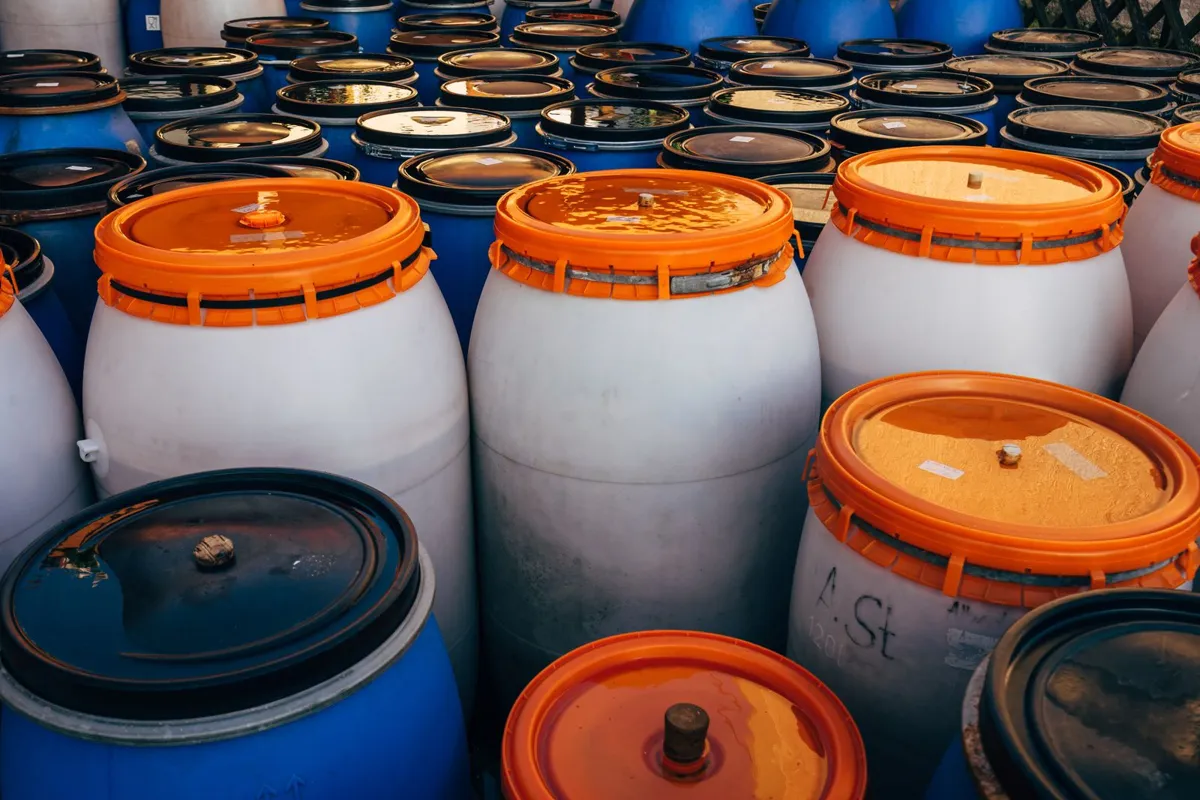
Large round HDPE tanks are used most in four groups of work: aquaculture, holding and mixing chemicals, holding clean water or treating wastewater, and agriculture. Each group needs a different capacity and tank type.
In aquaculture, round tanks of 350 to 2,000 litres serve as shrimp nursery tanks, indoor fish-rearing tanks or water treatment tanks before water is fed to the pond. The round base makes the water swirl and gathers waste at the centre of the base for siphoning. Tanks for aquaculture need virgin plastic, not recycled stock of unknown origin; blue or black is usually chosen to limit light and reduce algae growth. How to choose capacity, stocking density and tank type for each species is in the article on plastic tanks for fish farming.
For industrial chemicals, HDPE tanks are used for storage and mixing in textile dyeing, electroplating, paper making and metal surface treatment. HDPE resists dilute acids, alkalis, inorganic salts and alcohol well, but does not suit some organic solvents such as MEK and toluene, or concentrated oxidising acids, so check the compatibility table before use (see the acid section below). For solvents or working tanks above about 60 °C, the alternative is a composite FRP tank.
In clean water and wastewater, rotationally moulded tanks of 1,000 to 3,000 litres are placed at pump stations, in small wastewater treatment systems or as equalisation tanks. Compared with a built tank, a plastic tank installs faster, can be relocated, does not leak and needs no waterproof paint. In agriculture, tanks of 500 to 1,000 litres are used to compost organic fertiliser, hold fertiliser solution or serve as household biogas tanks. If placed outdoors, choose a tank with UV-resistant additive, because HDPE without it turns brittle in the sun over time.
How do you tell virgin HDPE from recycled tanks?
Virgin HDPE has an even colour, no odd smell, a smooth surface and material documents; recycled HDPE is usually cheaper but streaky, smelly and should not be used for food, drinking water or aquaculture without test results. At the same capacity, round tank prices on the market differ quite widely, and most of the difference comes from the resin. Virgin plastic gives a durable tank with controlled composition; recycled plastic has weaker mechanical properties and you do not know in advance what it once held.
Four signs I usually show customers to check when receiving goods:
- Look at colour: virgin stock is opaque white or one even colour; recycled stock often has streaks, dull specks, a yellowish or greyish cast.
- Smell: virgin stock has no smell or only a light plastic smell when new; recycled stock often smells burnt or chemical.
- Touch the surface: virgin stock is smooth and even; recycled stock is usually slightly rough and looks uneven on close inspection.
- Ask for documents: request a material certificate or test results if the tank is used for food, drinking water or aquaculture.
These four signs help weed out poor stock quickly, but do not replace documents. For a tank holding food or drinking water, the documents to ask for are test results under the safety regulation for plastic packaging in contact with food.
3 common mistakes when buying round HDPE tanks
The three mistakes I see most are choosing a capacity without calculating the floor load, using the wrong type of tank for chemicals, and forgetting the accessory budget. All three can be avoided if you know them in advance.
Mistake 1: choosing capacity by feel, without calculating the floor load
A 1,000-litre tank full of water weighs 1 tonne, not counting the tank itself. If the tank base is about 1 m in diameter, the load on the floor is about 1.27 tonnes per square metre, equal to 12.5 kN/m². That is about 8 times the normal service load of 1.5 kN/m² that TCVN 2737 sets for residential floors. So do not put a large tank full of water on an upper floor or rooftop before a structural engineer has checked it; even a thin cement base on the ground should be reviewed.
Mistake 2: using a thin-wall blow-moulded tank for concentrated chemicals
A thin-wall blow-moulded tank with no UN mark tends to fail at the mould seam and the pinch-off area when holding high-density chemicals (above 1.2) or when placed outdoors with repeated thermal expansion. For long-term chemical storage, choose a drum with the right UN packing group mark, or a thick-wall rotationally moulded tank, even though it costs more.
Mistake 3: leaving accessories out of the budget
A large round tank usually needs a bottom drain valve (ball or butterfly valve), a stand or steel frame if the ground is not flat, stainless or HDPE connecting pipe, and a lid if dust and insects must be kept out. Accessory costs can be significant compared with the price of the tank, so ask for a full-set quote from the start instead of asking only the tank price.
How do you place round tanks in a warehouse and move them safely?
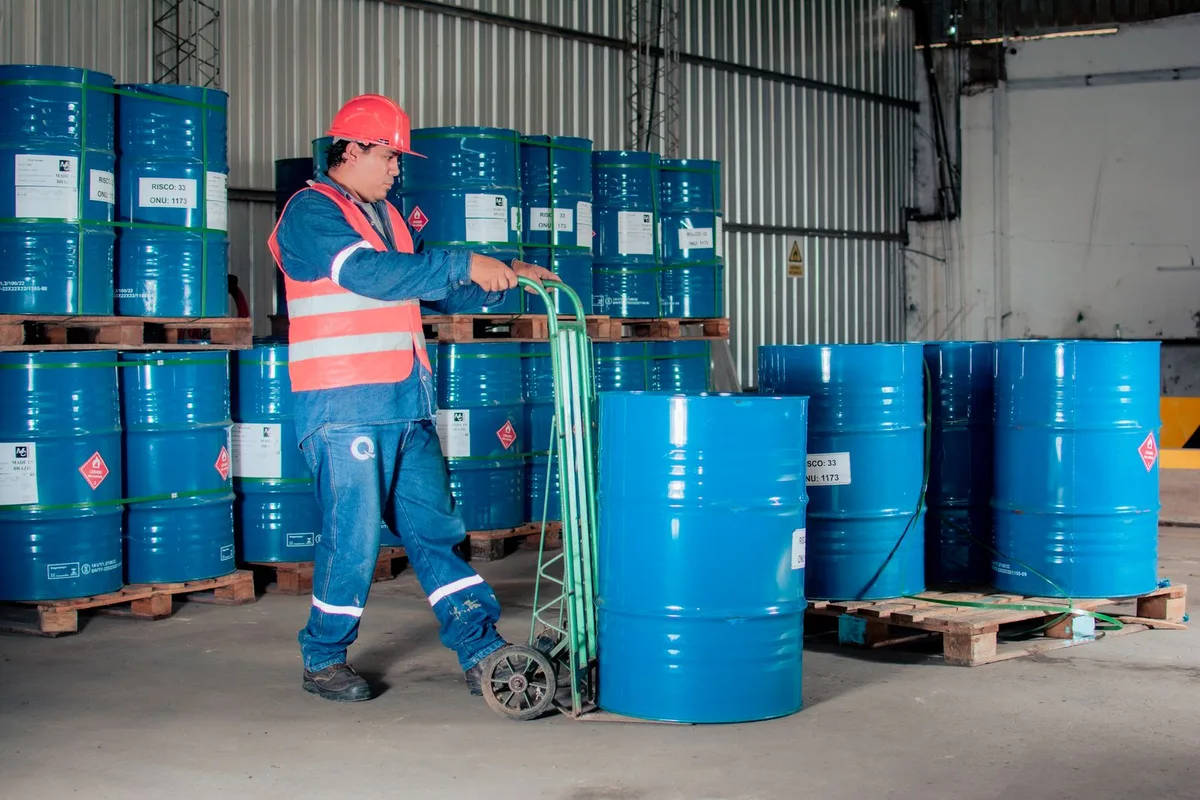
A large round tank should sit on a pallet strong enough for forklift handling, and must be strapped and chocked when carried on a truck because round tanks roll easily. These tanks are usually fixed in place, but when a workshop expands or changes layout they still have to be moved; from 500 litres up, even an empty tank is hard to manoeuvre by hand and needs a forklift or hand pallet truck with a suitable holding hook.
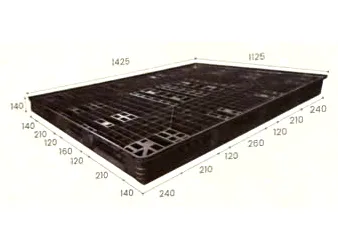
For a warehouse that must arrange many 200L-500L tanks, putting them on plastic warehouse pallets makes forklift movement easier and leaves a clear gap underneath for checking leaks. Choose a pallet with a suitable load rating: a 200-litre tank full of a chemical of density 1.3 already holds about 260 kg of liquid, plus the weight of the tank.
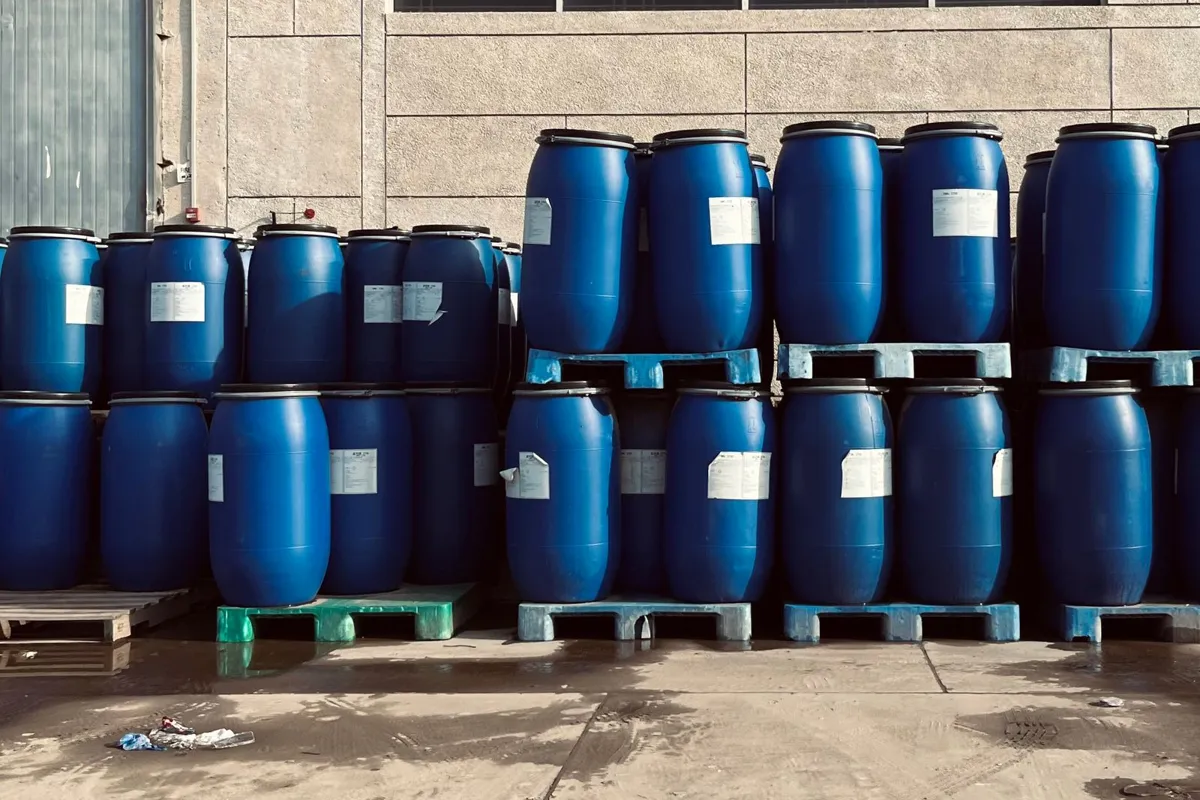
When transporting large HDPE tanks by truck, secure them with straps and stretch-wrap around the group of tanks to prevent knocks and shifting. Round tanks tend to roll if not properly secured; the most common accident is not using chocks or lashing incorrectly.
How to choose a large round HDPE tank quickly
Choose quickly with the five questions below, in order; once answered, you have enough data for a supplier to quote the right type of tank.
- What will it hold, at what concentration and temperature, to look up the chemical compatibility table.
- Is the substance dangerous goods that must be transported; if so, you need a UN-marked drum.
- Is it for food, drinking water or aquaculture; if so, you need virgin plastic and a test certificate under QCVN 12-1:2011/BYT.
- Where will it sit, what floor load can it take, how wide is the warehouse door, to choose a flared-mouth or tall-wall type.
- Will it stay outdoors; if so, you need a UV-resistant additive.
Frequently asked questions about large round HDPE plastic tanks
How much does a 200L round HDPE tank cost?
The price of a 200-litre round HDPE tank varies with plastic quality (virgin or recycled, with or without UV additive), moulding technology, accessories and order quantity. A rotationally moulded tank usually costs more than a blow-moulded or injection-moulded one of the same capacity. Contact ICD Vietnam for a quote for your specific need.
Can round HDPE tanks be used for food and drinking water?
Yes, if it is a virgin HDPE tank with test results that meet QCVN 12-1:2011/BYT on plastic packaging and utensils in direct contact with food. HDPE is plastic number 2, also permitted for food contact in the United States under 21 CFR 177.1520. Recycled tanks of unknown origin should be used only to hold technical water or non-edible supplies.
How long does a round HDPE tank last outdoors?
Outdoor life depends mainly on UV-resistant additive, wall thickness and strength of sunlight, so there is no single figure. A tank with UV additive withstands years of sun and rain with less brittleness and fading; a tank without it should sit under a roof or be covered with a tarpaulin. Ask the manufacturer whether the tank is marked “UV stabilized” or “UV resistant”.
How do a 1000L tank and a 1000L water storage tank differ?
The two names usually refer to the same product group: “tank” (bon) is often used for the fixed type with a bottom drain valve, an inspection lid and a vent; “tub or barrel” (thung) is often used for the flared-mouth type with a loose lid that can be moved around. The more significant difference is in shape: a flared-mouth tank is low and wide, an upright tank is tall and takes little floor.
Can acids be held in an HDPE tank?
Yes for many acids, but it depends on concentration and temperature. According to the HDPE chemical resistance chart of the resin maker INEOS, at about 21 degrees C HDPE is rated resistant to sulfuric acid up to 70%, hydrochloric acid 35% and nitric acid up to 70%; at 60 degrees C, sulfuric acid above 50% and nitric acid above 30% start to attack it. Nitric acid 95-98% and solvents such as MEK and toluene cannot be used.
| Chemical (concentration) | About 21 degrees C | About 60 degrees C |
|---|---|---|
| Sulfuric acid 0-50% | Resistant | Resistant |
| Sulfuric acid 70% | Resistant | Partly attacked |
| Sulfuric acid 96-98% | Partly attacked | Not resistant |
| Hydrochloric acid 35% | Resistant | Resistant |
| Nitric acid 0-30% | Resistant | Resistant |
| Nitric acid 30-70% | Resistant | Partly attacked |
| Nitric acid 95-98% | Not resistant | Not resistant |
| Chromic acid 10-50% | Resistant | Partly attacked |
| Acetic acid 80-100% | Resistant | Partly attacked |
| MEK, toluene | Not resistant | Not resistant |
The table above summarises the INEOS HDPE chemical resistance guide, tested without mechanical stress. For each specific chemical, especially mixtures, high concentrations or high temperatures, ask the tank supplier to confirm in writing before use.
What are the dimensions of a 1000-litre round plastic tank?
It depends on the shape. A common 1,000-litre flared-mouth tank has a mouth of about 146 cm, a base of 118 cm and a height of 79 cm; the tall-wall 1,100-litre version has a mouth of about 129 cm, a base of 109 cm and a height of 110 cm. Measure the real size and recalculate the volume with the truncated-cone formula before installing.
Can round HDPE tanks hold hot water?
They can hold warm water, but do not pour in boiling water or very hot liquids. HDPE melts at about 132 degrees C, withstands only about 120 degrees C briefly and cannot take steam sterilisation; when hot, the tank wall softens and deforms easily under the water load.
Can large round plastic tanks be stacked?
Flared-mouth tanks nest inside each other when empty, cutting volume when hauling and storing. When full, open-top round tanks should not be stacked; sealed drums may be stacked only to the number of tiers the manufacturer allows.
What warranty do ICD Vietnam plastic tanks have?
ICD Vietnam plastic tanks carry a 12-month warranty under the warranty and repair policy published on the website icdvietnam.com.vn.
Contact for advice on ICD Vietnam round plastic tanks
ICD Viet Nam Industrial Production Company Limited
ICD Vietnam supplies round HDPE plastic tanks, 5,000-litre fish-rearing tanks and large-capacity plastic tanks to businesses nationwide, with VAT invoices and free technical advice on capacity and accessories. Send us the type of liquid, the capacity and where the tank will sit to receive a quote:
- North: 0983 797 186 / 090 345 9186 / 090 5859 186.
- South: 098 6784 186.
- Email: sales@icdvietnam.com.vn.
- Zalo: 090 345 9186.
ICD Vietnam plastic tanks carry a 12-month warranty under the warranty and repair policy published on the website.
References
- Density, 38 MPa tensile strength, melting point and short-term heat resistance of HDPE: Wikipedia, High-density polyethylene; principles of blow moulding and rotational moulding: Wikipedia, Blow molding and Rotational molding.
- HDPE chemical resistance chart at 70 and 140 degrees F: INEOS Olefins & Polymers USA, HDPE Chemical Resistance Guide.
- Material characteristics of HDPE (high-density polyethylene): British Plastics Federation (BPF).
- Packaging codes 1H1, 1H2 and packing groups X, Y, Z: UNECE, UN Recommendations on the Transport of Dangerous Goods, Model Regulations.
- Polyolefin plastics in contact with food: U.S. FDA, 21 CFR 177.1520 Olefin polymers.
- Migration test requirements for PE and PP plastic packaging and utensils: Ministry of Health, QCVN 12-1:2011/BYT (Circular 34/2011/TT-BYT).
- Residential floor service load: TCVN 2737, Loads and actions.
- Round tank sizes by capacity: catalogues published by domestic plastic tank manufacturers, cross-checked on 16 October 2026.