Mục lục
Summary:
- PA plastic (Polyamide) can be sterilized using UV radiation or steam autoclave, but both methods carry certain risks to material durability.
- UV rays easily cause PA plastic to age, become brittle, and yellow due to polymer chain scission.
- Meanwhile, steaming at high temperatures can cause PA plastic to absorb moisture, leading to dimensional expansion and reduced mechanical hardness.
- For stringent requirements such as in the medical field, sterilization using Ethylene Oxide (EO) gas or Gamma irradiation is considered the more optimal choice to protect the plastic structure.
1. Which sterilization method is compatible with PA plastic?
In the field of plastics engineering, choosing a sterilization method depends heavily on the physicochemical properties of the material. For PA plastic, the answer for the two most common methods is as follows:
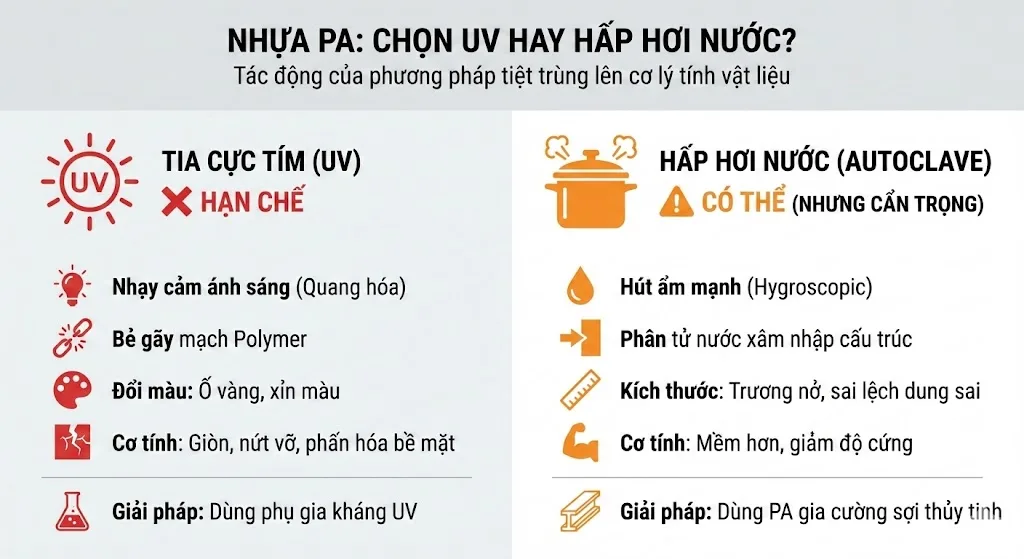
- UV sterilization: Possible but very limited. Polyamide plastic has poor UV resistance by nature. If exposed to high intensity or periodic UV irradiation frequently, the molecular structure of the plastic will be gradually destroyed from the surface inward, causing components to age quickly, lose their gloss, and become brittle.
- Steam sterilization (Autoclave): Possible but the number of sterilization cycles must be limited. PA plastic has fairly good heat resistance, with a melting point much higher than the standard autoclaving temperature (121 degrees C). However, the biggest barrier is PA plastic’s very strong moisture absorption property. Continuous steaming in a saturated steam environment will cause the plastic to absorb water, resulting in slight dimensional expansion and degradation of its original mechanical properties.
2. How does UV radiation damage PA plastic?
UV rays carry very high radiation energy. When directed onto PA plastic, they stimulate chemical reactions that break long polymer chains into shorter segments. This process is called photodegradation or light-induced aging.
The most noticeable physical consequences include:
- Discoloration: PA plastic components that were naturally white or transparent will gradually turn to dull yellow and then brownish. This causes serious aesthetic damage, especially for equipment that requires a high level of cleanliness.
- Brittleness and cracking: Tiny cracks will appear on the plastic surface that are sometimes difficult to see with the naked eye. When touched, you may feel a thin layer of powder-like dust on your hand - this is the surface chalking phenomenon. At this point, the impact resistance of the PA plastic has been significantly reduced, and components may break even under minor external force.
Note: If the process requires frequent use of UV lamps, manufacturers need to use PA plastic with added UV stabilizer additives or light stabilizer additives to extend the product’s service life.
3. Is steam sterilization (Autoclave) safer than UV for PA plastic?
Compared to UV radiation, steam autoclaving is considered less chemically damaging to the molecular structure but causes geometric and mechanical property changes instead.
- Advantages: Unlike UV which breaks polymer bonds, the steam temperature in an autoclave typically ranges from 121 degrees C to 134 degrees C. Meanwhile, the melting points of common PA plastic grades such as PA6 or PA66 are both above 220 degrees C. Therefore, the plastic will not deform due to melting during autoclaving.
- Disadvantages: Polyamide is an extremely moisture-sensitive plastic. The saturated steam environment combined with high pressure in the autoclave forces water molecules into the gaps within the plastic’s molecular structure. This causes two major problems:
- First, dimensional inaccuracy: Machine parts requiring precision down to the micrometer will expand, making assembly difficult or causing machine jamming after sterilization.
- Second, reduced hardness: PA plastic after absorbing moisture will become more flexible and less rigid compared to its original dry state.
4. The most optimal sterilization method for PA plastic
To completely overcome the disadvantages of UV and steam, in industries with high standards such as medical devices and precision equipment manufacturing, the following two methods are top priorities:
- Ethylene Oxide Gas (EO Gas): This is the gold standard for instruments made from PA plastic. The process takes place at low temperatures, uses no water, and involves no high-energy radiation. EO gas permeates through gaps to eliminate microorganisms without altering any mechanical or physical properties of the PA plastic material.
- Gamma Irradiation (Low dose): This method uses gamma rays for sterilization. The advantage is extremely high effectiveness and the ability to sterilize large quantities of components simultaneously. However, the dosage must be controlled at a low level because excessive irradiation can still cause plastic aging similar to UV radiation, albeit at a milder level.
References
- Scientific research (PubMed/NIH): Effect of UV surface irradiation on the properties of Polyamide
- International report (ResearchGate): UV Degradation of industrial plastics PA6 and PA66