
Mục lục
Rubber wood - once considered a by-product after latex harvesting - has become the dominant raw material in furniture and export pallet manufacturing thanks to modern impregnation and kiln-drying technology. This article examines the vacuum pressure impregnation process and steam kiln-drying method used at ICD, explaining why properly treated rubber wood achieves superior durability, complete pest resistance and dimensional stability in any weather condition.
Why rubber wood must go through heat treatment
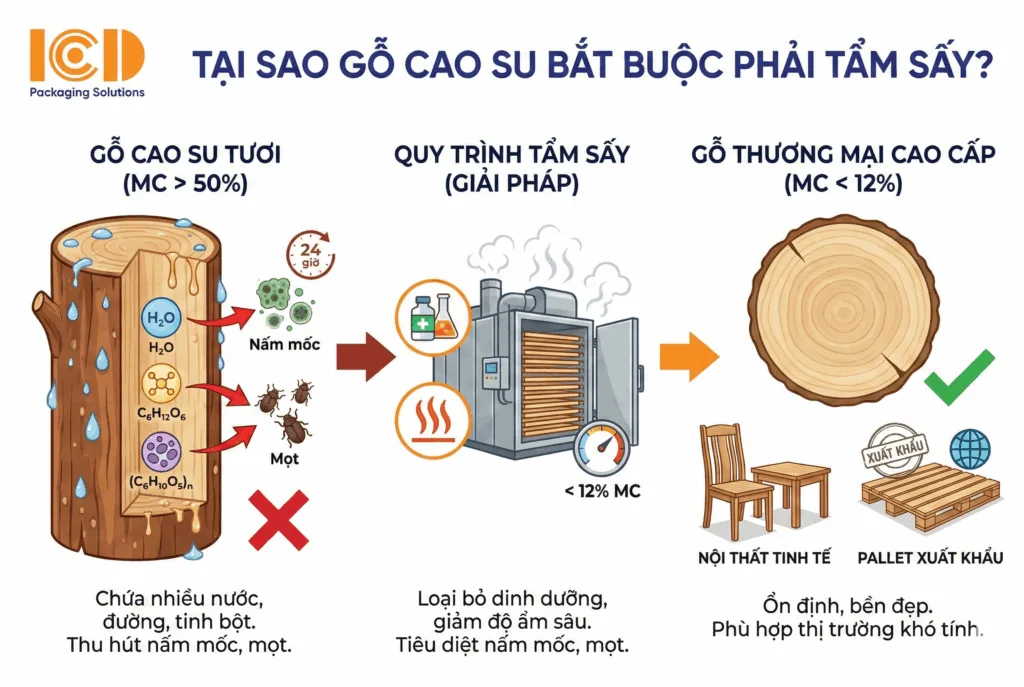
Unlike natural forest timbers with dense grain and high natural resin content, rubber wood has distinctive biological characteristics. Fresh-cut rubber wood contains large amounts of water, sugars and starch within the grain. These nutrients are an ideal food source for blue-stain fungi and wood-boring beetles, which can attack within 24 hours of felling.
If not treated immediately, the wood will blacken, decay and lose its usable value. Impregnation and drying is therefore not merely a manufacturing step - it is the transformation that converts raw timber into premium commercial lumber. The primary target of the process is to bring the wood moisture content (MC) below 12%, stabilising the grain structure and making it suitable for producing fine furniture and export pallets destined for demanding markets.
Step-by-step rubber wood treatment process at the factory
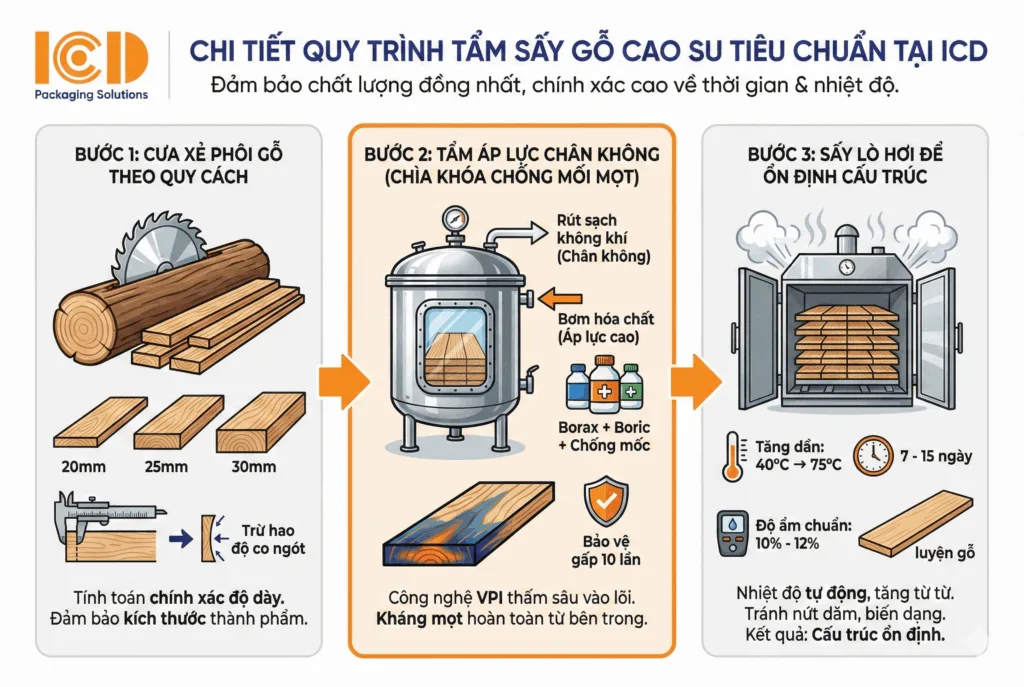
To achieve consistent wood quality, ICD follows a strict technical sequence that demands precise control of both time and temperature at every stage.
Step 1: Sawing timber blanks to specification
Once logs arrive at the mill they are debarked and sawn into rough blanks. Depending on the order, the timber is cut to common thicknesses of 20 mm, 25 mm or 30 mm. Calculating the sawing thickness is critical because an allowance must be built in for shrinkage during drying so that the finished dimensions are accurate.
Step 2: Vacuum pressure impregnation - the key to pest resistance
This is the most important stage and the one that sets the durability of ICD rubber wood apart. Rather than simply spraying preservative onto the surface by hand, ICD uses a dedicated stainless-steel impregnation vessel to carry out Vacuum Pressure Impregnation (VPI).
The timber is loaded into the vessel and all air inside the wood cells is evacuated under vacuum. A preservative solution - a combination of Borax and Boric acid compounds together with an anti-mould agent - is then pumped into the vessel under high pressure. The pressure drives the chemicals deep through the capillaries into the core of every board. This method delivers protection approximately 10 times greater than conventional surface treatments, ensuring complete internal pest resistance throughout the wood.
Step 3: Steam kiln-drying to stabilise the structure
After impregnation the timber is stacked in a dedicated steam kiln. This is the conditioning stage and it requires patience. Drying time typically runs from 7 to 15 days depending on the blank thickness.
Kiln temperature is controlled automatically, rising gradually from 40 degrees C to 75 degrees C. The slow temperature increase allows moisture to migrate evenly from the core to the surface. Forcing the temperature too high too quickly causes surface checking (cracking) or distortion. On exiting the kiln the timber reaches a moisture content of 10% to 12%, meeting export quality standards.
Quality standards for treated rubber wood
A rubber wood board is considered to meet specification when it satisfies all of the following criteria:
Moisture content: Consistently maintained at 8% to 12%. This range keeps the wood stable - it will not shrink or swell as ambient conditions change.
Colour: After drying the wood must retain its characteristic pale yellow colour, with a clean surface free of blue-stain or chemical residue discolouration.
Mechanical properties: The wood becomes noticeably harder and stiffer. A quick field test: tap the board lightly - a clear, resonant sound means the wood is dry through to the core and meets quality requirements.
Why choose ICD kiln-dried rubber wood?
ICD does not just supply wood - we supply confidence. With a pressure impregnation vessel system and high-capacity kiln banks, every batch that leaves the factory is closely controlled.
For the rubber wood pallet range in particular, ICD guarantees that 100% of products pass through the full impregnation and drying process. This completely eliminates the risk of mould developing inside a sealed container during long export voyages, protecting the reputation of your goods.
Conclusion
The quality of a furniture product or a pallet starts with the quality of each individual board. Do not compromise on initial cost by buying rubber wood that has only been sun-dried or given a superficial kiln pass. The consequence is a product that warps, decays and is destroyed by insects within a short period of use. Industrial impregnation and kiln-drying is the best warranty for the long-term durability of any product or structure.
Related articles
| What is rubber wood? Properties and applications | Does rubber wood get termites and insects? | Rubber wood pallet: specs and pricing |
1. Why does rubber wood need to be impregnated and kiln-dried?
Fresh-cut rubber wood is rich in sugars, starch and water - ideal nutrients for fungi and wood-boring insects. Without treatment the wood blackens and decays within hours of felling. Impregnation and drying locks out pests and reduces moisture content to below 12%, making the wood stable and commercially viable.
2. What chemicals are used in rubber wood impregnation?
The standard preservative solution combines Borax and Boric acid compounds (low toxicity, widely accepted for export timber) with an anti-mould agent. The mixture is forced under pressure through the entire cross-section of the board, not just the surface.
3. How long does the kiln-drying process take?
Typically 7 to 15 days depending on the blank thickness. Temperature rises gradually from 40 degrees C to 75 degrees C. Faster drying at high initial temperature causes surface checking and warping, so the slow ramp is essential.
4. What moisture content should treated rubber wood reach?
The target on exiting the kiln is 10% to 12% MC. For long-term storage or high-humidity environments, boards held at 8% to 12% are most dimensionally stable and least prone to warping or swelling.
5. How can I tell whether rubber wood has been properly dried?
Tap the board lightly. Properly dried wood produces a clear, resonant sound. A dull thud indicates residual moisture. Colour should be pale yellow throughout, with no blue-stain patches or discolouration from chemical residue.
6. Is impregnated rubber wood safe for food-adjacent applications?
Borax and Boric acid compounds are low-toxicity preservatives approved for use in many countries for timber that may come into indirect contact with goods. For direct food-contact applications, confirm the preservative specification with ICD before ordering.
7. Does ICD’s rubber wood pallet include the full impregnation and drying process?
Yes. ICD guarantees that 100% of rubber wood pallets undergo the complete vacuum pressure impregnation and steam kiln-drying process. This eliminates mould risk during long sealed-container export voyages.
Contact ICD Vietnam
Hotline: 0983 797 186 / 090 345 9186 / 090 5859 186
Email: sales@icdvietnam.com.vn | Zalo: Chat Zalo