
Mục lục
- 1. Full taxonomy of rubber wood (Hevea brasiliensis)
- 2. Role of the scientific name Hevea brasiliensis in export documentation
- 3. Biological characteristics of Hevea brasiliensis that affect pallet quality
- 4. How ICD Vietnam supports businesses
- 5. Conclusion
- Related articles
- Frequently asked questions about rubber wood scientific name
- Contact ICD Vietnam
The scientific name of rubber wood is Hevea brasiliensis, belonging to the family Euphorbiaceae. In pallet and timber exports, using the correct name Hevea brasiliensis on the phytosanitary certificate and timber declaration is a legal requirement to prove the wood originates from a lawful plantation. This prevents shipments from being caught by CITES controls and smooths access to markets that demand green certification, such as the EU and Japan.
1. Full taxonomy of rubber wood (Hevea brasiliensis)
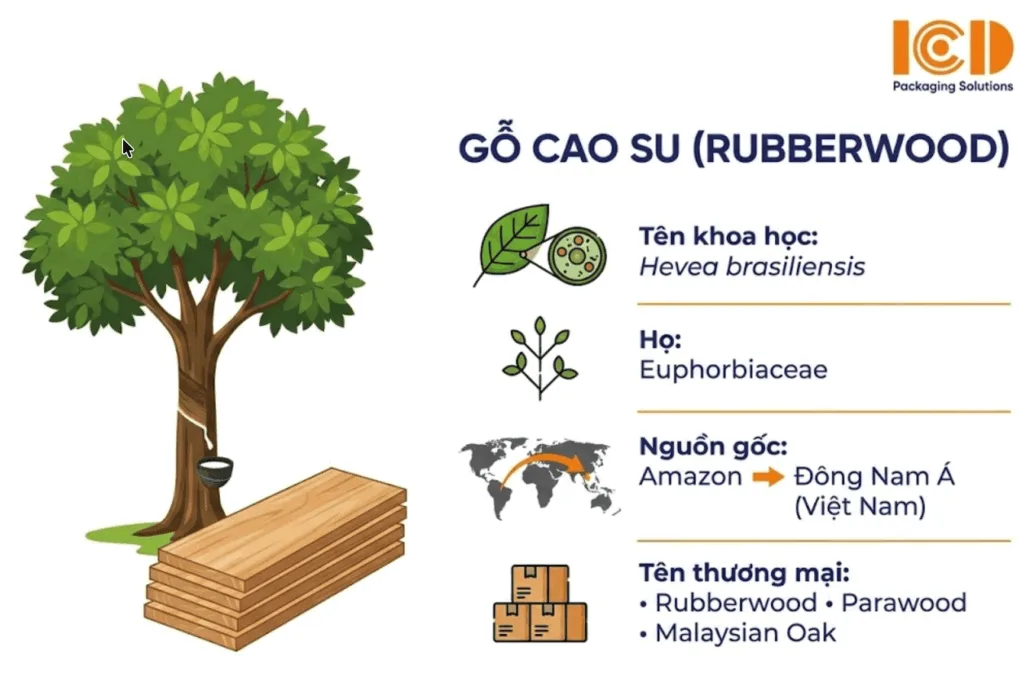
The rubber tree originated in the Amazonian rainforest of South America but has long become a key industrial crop across Southeast Asia, especially Vietnam.
| Classification level | Name |
|---|---|
| Scientific name | Hevea brasiliensis |
| Family | Euphorbiaceae (Spurge family) |
| Common trade name (English) | Rubberwood, Parawood, Malaysian Oak |
| Origin | Amazon basin (South America); now cultivated across Southeast Asia |
In international trade contracts, rubber wood is commonly called Rubberwood, Parawood, or sometimes Malaysian Oak to highlight its durability and attractive grain, which resembles oak.
2. Role of the scientific name Hevea brasiliensis in export documentation
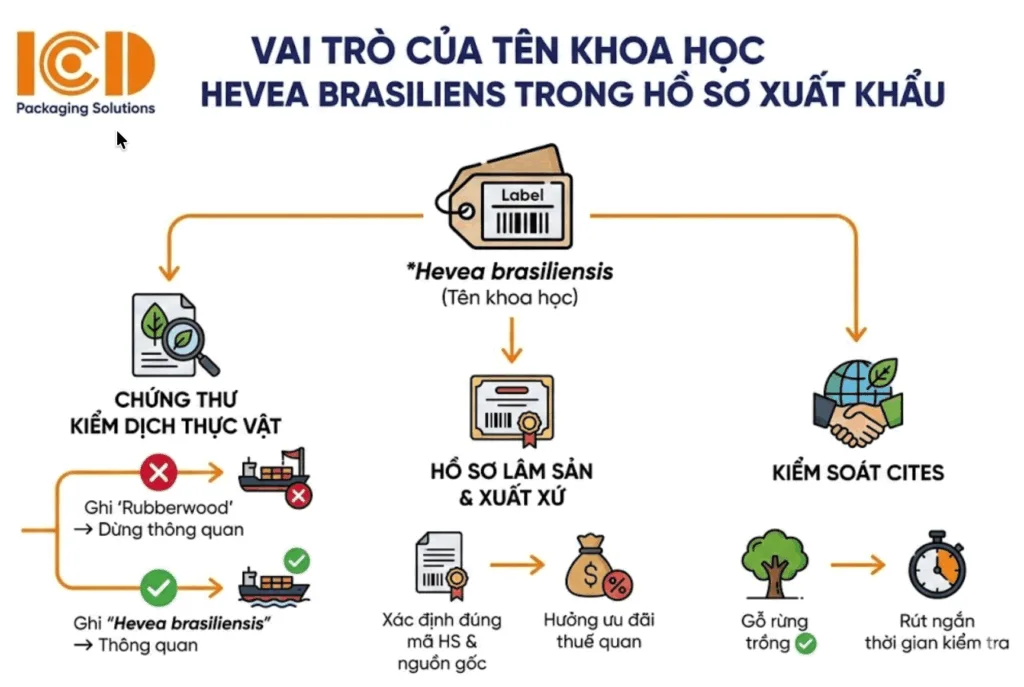
For export documentation staff, the scientific name is not merely a biological term - it is mandatory legal information required on several key documents.
| Document | Requirement | Risk if omitted |
|---|---|---|
| Phytosanitary Certificate | Scientific name of species must be stated | Shipment held at destination; customs clearance delayed |
| Timber declaration / forest product list | Hevea brasiliensis identifies the HS code and origin | Loss of FTA preferential tariff rates |
| CITES control check | Correct species name confirms the wood is plantation-grown, not protected | Inspection delays; possible seizure if species is ambiguous |
Phytosanitary Certificate: Quarantine authorities always require the scientific species name. Listing only the English trade name “Rubberwood” is considered incomplete and may result in the pallet shipment being stopped at the importing country’s port, because the exact plant species cannot be confirmed.
Timber declaration and certificate of origin: Stating Hevea brasiliensis explicitly allows authorities to match the correct HS code and verify the wood’s origin. This is critical for businesses to benefit from preferential tariff rates under free trade agreements.
CITES compliance: Rubber wood is harvested after the latex production cycle ends, so it is classified as plantation timber. Using the exact scientific name confirms the shipment does not fall under CITES-protected species, shortening inspection time and reducing the risk of seizure.
3. Biological characteristics of Hevea brasiliensis that affect pallet quality
Understanding the nature of the wood helps businesses plan the right treatment and preservation before export.
High starch content in wood fibres: Because the rubber tree produces latex, the wood naturally contains relatively high levels of starch and sugar. These are a preferred food source for termites, borers, and mould. This is exactly why sawn rubber wood or rubber wood pallets must be heat-treated or chemically treated to the international fumigation standard ISPM 15 before export, in order to ensure durability.
Sustainability and eco-label advantages: Rubber wood is considered an environmentally friendly timber because it is a by-product of trees that have finished their latex-producing cycle. Instead of being burned - releasing emissions - the trunks are processed into wood products. This characteristic makes wooden pallets made from rubber wood easy to certify under Eco-label schemes, creating a significant advantage when exporting to markets with strict environmental requirements.
4. How ICD Vietnam supports businesses
ICD Vietnam does not only supply quality pallets - it also works alongside businesses to ensure the legal completeness of each shipment.
Rubber wood pallets with transparent documentation: Every pallet order at ICD comes with a timber declaration clearly stating the scientific name Hevea brasiliensis, guaranteeing the absolute legal compliance of the wood’s origin.
International-standard treatment: ICD performs fumigation and issues certificates to ISPM 15 standard, ensuring pallets are free of bacteria and mould and ready for long ocean freight journeys.
Documentation advisory: ICD’s team of specialists supports customers in correctly declaring the scientific name and HS code on customs declarations to optimise clearance, minimising errors that generate additional costs.
5. Conclusion
Rubber wood (Hevea brasiliensis) is an important raw material underpinning Vietnam’s timber export position. Understanding the scientific name and its associated regulations not only protects shipments from legal risk but also builds credibility with international partners through professional, complete documentation in every file.
Related articles
| Rubber wood: overview, quality and pricing | HS code for rubber wood - export tariff schedule | Does rubber wood get termites or borers? |
Frequently asked questions about rubber wood scientific name
1. What is the scientific name of rubber wood?
The scientific name is Hevea brasiliensis, belonging to the family Euphorbiaceae. This is the name recognised globally in biological research and international trade.
2. What are the common English trade names for rubber wood?
Rubber wood is sold internationally as Rubberwood, Parawood, or sometimes Malaysian Oak. Of these, Rubberwood is the most widely used in export contracts and technical specifications.
3. Why must the scientific name appear on a phytosanitary certificate?
Quarantine authorities require the scientific species name to confirm the exact plant being imported. Using only the trade name Rubberwood is considered incomplete and can cause shipments to be held at the destination port pending clarification.
4. Is rubber wood protected under CITES?
No. Hevea brasiliensis is plantation timber harvested after the latex cycle ends. It is not listed under CITES. Stating the correct scientific name on export documents confirms this and avoids unnecessary inspection delays.
5. Why must rubber wood pallets be treated to ISPM 15?
Rubber wood naturally contains high levels of starch and sugar in its fibres, which attract termites and mould. ISPM 15 heat or chemical treatment eliminates these risks and is a mandatory requirement for wooden packaging entering most countries.
6. Does using the scientific name help with FTA tariff preferences?
Yes. Stating Hevea brasiliensis on the timber declaration allows authorities to verify the wood’s origin and match the correct HS code, which is required for a shipment to qualify for preferential tariff rates under free trade agreements.
7. Is rubber wood considered an eco-friendly material?
Yes. Rubber wood is a plantation by-product: trees are felled only after the latex cycle ends, so the timber uses material that would otherwise be burned. This allows rubber wood pallets to qualify for Eco-label and green certification schemes valued in EU and Japanese markets.
Contact ICD Vietnam
Hotline: 0983 797 186 / 090 345 9186 / 090 5859 186
Email: sales@icdvietnam.com.vn | Zalo: Chat Zalo