
Mục lục
- 1. Rubber wood HS codes and export tax rates
- 2. Why the correct HS code directly affects your profit margin
- 3. Customs procedures and timber origin documents required
- 4. Notes for exporters using rubber wood pallets as packaging
- 5. Complete rubber wood export solution from ICD Vietnam
- Related articles
- Frequently asked questions about rubber wood HS codes
- Contact ICD Vietnam
Rubber wood HS codes fall into two main groups: sawn timber (codes 4407.29.96 and 4407.29.97) subject to a 25% export tax, and finished wooden pallets (code 4415.20.00) enjoying a 0% export tax. To clear customs smoothly, exporters must prepare a verified timber origin declaration, a phytosanitary certificate, and an ISPM 15-compliant fumigation mark for any wooden packaging. Knowing the correct code and the documents it requires saves money and keeps shipments moving.
1. Rubber wood HS codes and export tax rates
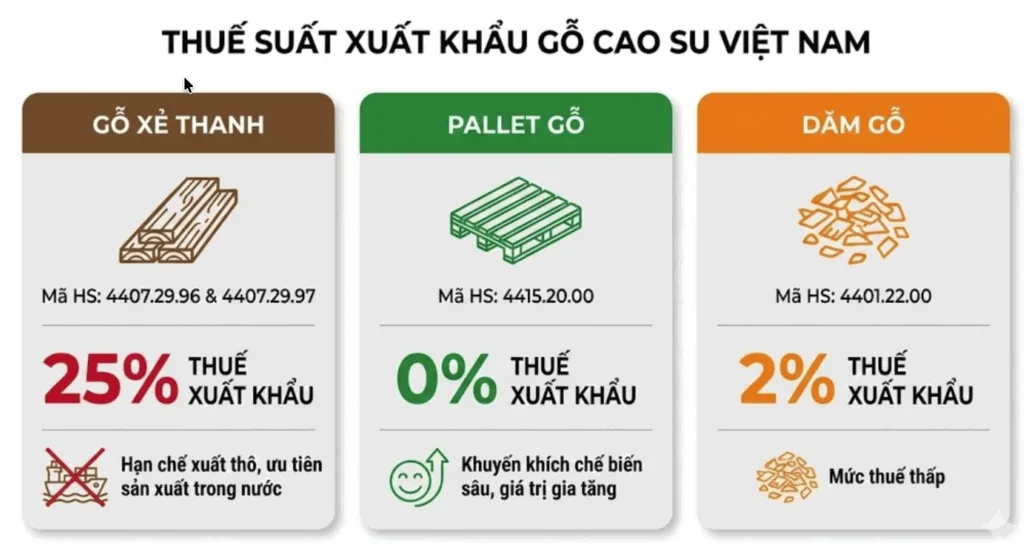
If you need the exact figures for tariff classification and duty calculation, these are the key codes:
| Product type | HS code | Export tax rate |
|---|---|---|
| Sawn rubber wood - planed, sanded or end-jointed | 4407.29.96 | 25% |
| Sawn rubber wood - other | 4407.29.97 | 25% |
| Rubber wood pallets (finished product) | 4415.20.00 | 0% |
| Rubber wood chips | 4401.22.00 | 2% |
The 25% rate on sawn timber is intentionally high - it is designed to discourage the export of raw material and to keep the supply available for domestic manufacturing. Finished pallets are classified under Chapter 44 heading 4415, which covers wooden packaging, and attract 0% because they represent a value-added product.
2. Why the correct HS code directly affects your profit margin
Misclassifying rubber wood is one of the most common mistakes that leads to legal and financial problems for exporters.
- Avoiding penalties: Customs authorities scrutinise timber exports closely to prevent tax fraud and illegal logging. Declaring sawn timber under a lower-duty code can result in back-payment of duties, heavy administrative fines, and suspension of export rights.
- Legitimate tax optimisation: Many businesses are unaware of the clear boundary between sawn timber and a finished pallet. By manufacturing to pallet specifications and classifying the product under code 4415, a company can move legally from a 25% rate to 0%, saving hundreds of millions of Vietnamese dong on a large shipment.
3. Customs procedures and timber origin documents required
Timber origin regulations are tightening in line with international green standards. Three documents are essential:
- Timber origin declaration: This is mandatory. The exporter must hold a verified timber product list confirmed by the local forest protection authority or commune government representative (the format depends on whether the wood is from a plantation or a household garden). Without this document, goods cannot clear customs.
- Phytosanitary certificate: Rubber wood is a plant-based product, so a phytosanitary certificate is required to confirm no bacteria or fungi will be introduced to the destination country. This inspection should be arranged in parallel with loading to save time.
- Fumigation to international standards: For rubber wood pallets, an ISPM 15-compliant fumigation mark is a mandatory entry requirement. The mark must be clear and legible, show the correct code of the treatment provider, and be accompanied by a fumigation certificate in the shipping document set.
4. Notes for exporters using rubber wood pallets as packaging
If your company does not trade in timber but exports goods (such as electronics or food) packed on rubber wood pallets, two points apply:
First, you do not need to declare a separate HS code for the pallets if they are functioning purely as protective packaging for the main cargo.
Second, the pallets must be heat-treated or chemically fumigated and stamped with an internationally recognised mark. Many cases arise where the main cargo passes inspection but an entire shipment is turned back because the accompanying pallets carry no fumigation mark or the mark has faded.
5. Complete rubber wood export solution from ICD Vietnam
ICD Vietnam understands the difficulties businesses face when classifying HS codes and handling timber documentation, and offers a comprehensive solution for rubber wood products.
ICD manufactures rubber wood pallets to the technical specifications that qualify for classification under heading 4415 with a 0% tax rate. ICD also supports customers in completing the full document set - from the timber origin declaration and phytosanitary certificate to ISPM 15-compliant fumigation. With extensive experience in timber export compliance, ICD helps your goods clear customs quickly, safely, and at the lowest possible cost.
Related articles
| Rubber wood: properties, grades and applications | What is ISPM 15? Fumigation standard for wooden packaging | Rubber wood pallet: specs, price and availability |
Frequently asked questions about rubber wood HS codes
1. What is the HS code for rubber wood pallets?
Rubber wood pallets are classified under HS code 4415.20.00. This heading covers wooden crates, boxes, cases, drums and similar wooden packaging, and finished pallets fall within it. The export tax rate is 0%.
2. What export tax applies to sawn rubber wood?
Sawn rubber wood is classified under HS codes 4407.29.96 (planed, sanded or end-jointed) and 4407.29.97 (other). The export tax rate on both codes is 25%, maintained at a high level to discourage the export of raw timber.
3. Can I reduce export tax by converting sawn wood to pallets?
Yes, and it is entirely legal. Rubber wood manufactured to pallet specifications and classified under code 4415.20.00 is subject to 0% export tax. The key is that the product must genuinely meet the technical definition of a pallet - not just be marketed as one.
4. What documents are required to export rubber wood?
Three core documents are required: a timber origin declaration verified by the local forest protection authority, a phytosanitary certificate confirming the wood is free from pests and pathogens, and an ISPM 15-compliant fumigation certificate with a clear mark on the wood or pallet.
5. Is fumigation required when rubber wood pallets are used as packaging only?
Yes. Even when the pallets are used only as protective packaging for another cargo, they must still carry an ISPM 15-compliant fumigation mark. Many shipments have been turned back at destination ports because the main cargo was compliant but the accompanying pallets lacked a valid fumigation mark.
6. What is the HS code for rubber wood chips?
Rubber wood chips are classified under HS code 4401.22.00 with an export tax rate of 2%.
Contact ICD Vietnam
Hotline: 0983 797 186 / 090 345 9186 / 090 5859 186
Email: sales@icdvietnam.com.vn | Zalo: Chat Zalo