
Mục lục
In Vietnam’s logistics sector, rubber wood and pine wood together account for around 90% of all pallet timber used. Choosing the right species is not just about protecting cargo - it is a direct cost-optimisation decision. Rubber wood leads on domestic price and load capacity, making it the standard choice for heavy sea-freight loads. Pine wood, lighter by 20-30% and cleaner in appearance, is the preferred option for air-freight exports and display-ready shipments.
1. Detailed technical comparison
To compare the two species objectively, the table below maps each against the key metrics that matter for industrial packaging.
| Criterion | Rubber Wood | Imported Pine Wood |
|---|---|---|
| Hardness | High - dense grain, excellent impact resistance | Low - softwood, can dent under heavy impact |
| Density | 600-650 kg per cubic metre | 450-500 kg per cubic metre |
| Static load capacity | 2,000-3,000 kg | 1,000-1,500 kg |
| Price | Lower - abundant domestic supply | Higher - import logistics and duties apply |
| Mold resistance | Good when kiln-dried to standard | Poor - highly susceptible to blue mold in humid conditions |
| Appearance | Natural cream tone, subdued grain | Clear grain, bright colour, suitable for display |
2. When should businesses prioritise rubber wood pallets?
Rubber wood has long been regarded as the benchmark load-bearing pallet timber in southern Vietnam. Its tightly interlocked grain and natural elasticity - a direct result of the latex-producing tree’s growth structure - deliver advantages that pine cannot match under demanding conditions.
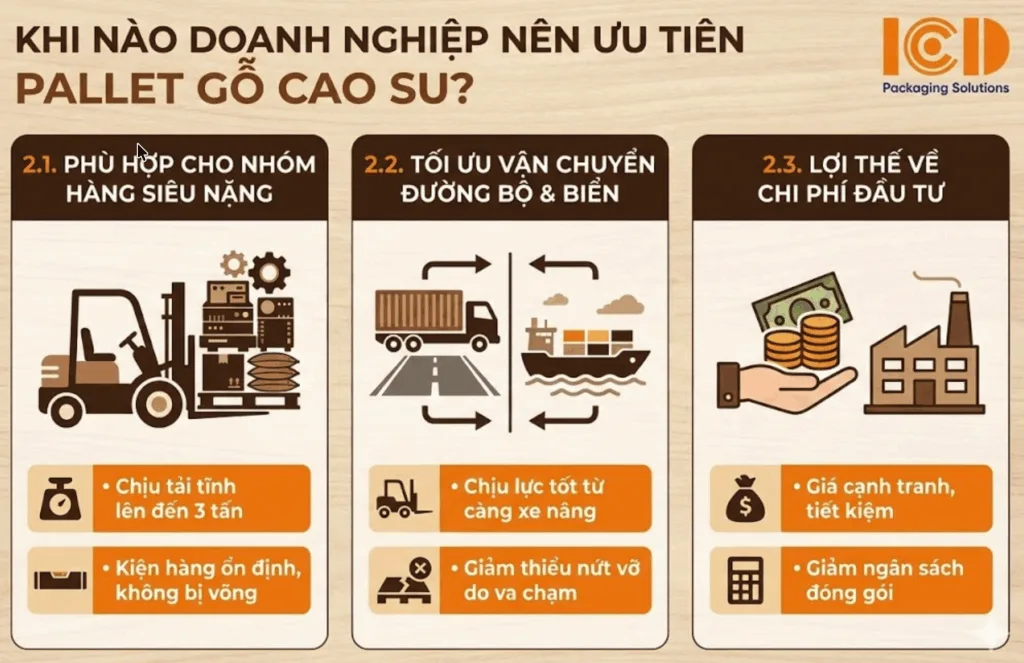
2.1. Best fit for very heavy goods
For cargo such as machinery, mechanical components, ceramic tiles, or bagged goods like cement and rice, rubber wood pallets are the irreplaceable choice. A static load capacity of up to 3 tonnes keeps the load stable without sagging or broken slats during extended warehouse storage.
2.2. Optimised for road and sea freight
On long-distance container or ocean freight runs, pallets must absorb repeated forklift impacts and the constant motion of transit. Rubber wood’s natural elasticity minimises cracking on sudden impact, giving businesses confidence when cargo must pass through multiple warehouses and transfer points.
2.3. Cost advantage
Thanks to extensive rubber plantations in Binh Duong, Dong Nai, and the Central Highlands, rubber wood pallet prices remain highly competitive. Businesses switching from imported pallet timber to rubber wood can save hundreds of millions of Vietnamese dong per year on packaging budgets when ordering at volume.
3. The strengths of pine wood pallets in modern logistics
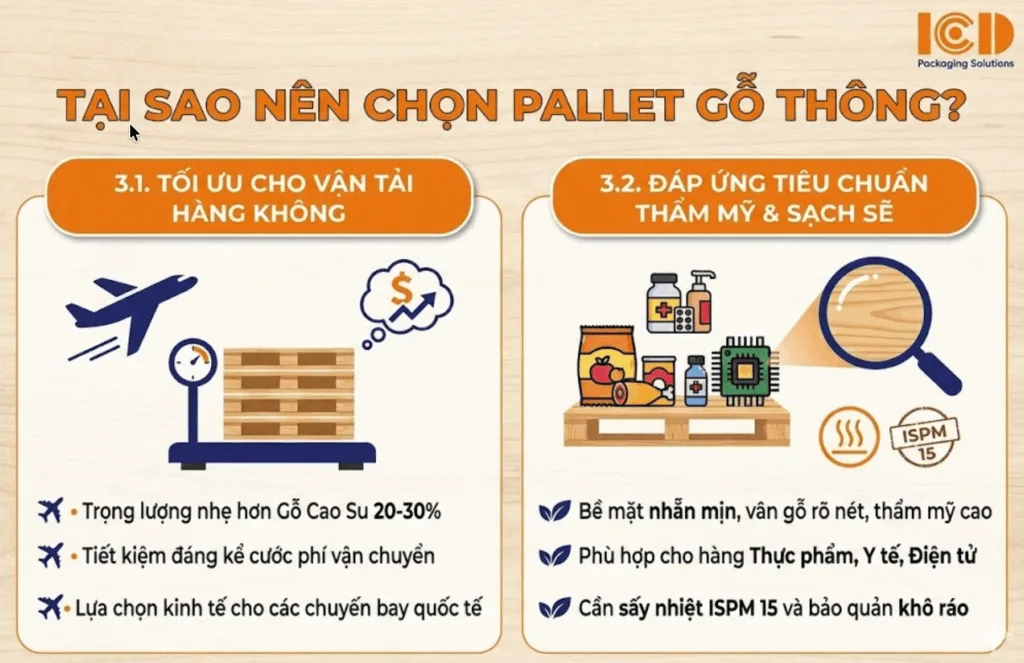
Despite its higher price and lower hardness, pine wood holds a firm position in specialist export segments because of its distinct physical properties.
3.1. The preferred choice for air-freight exports
In air freight, every kilogram translates directly into cost. Pine wood is 20-30% lighter than rubber wood. Using pine pallets meaningfully reduces total shipment weight, and the freight savings on a single air shipment typically exceed the difference in pallet price by a wide margin - making pine the most economical option for international air cargo.
3.2. Meeting aesthetic and cleanliness standards
Industries such as food, healthcare, and electronics demand high cleanliness and visual appeal. Pine wood’s smooth surface, clear grain, and low knot count make it a preferred choice for display pallets in supermarkets and electronics retail centres. One important note: pine is highly moisture-sensitive and must be heat-treated to ISPM 15 standard and stored in dry conditions to prevent blue mold.
4. Selection guidance from ICD Vietnam specialists
Comparing rubber wood and pine wood is not about finding which species is universally superior - it is about identifying which delivers the highest economic return for your specific business model.
If your warehouse is in a southern industrial hub and goods move primarily by domestic road or sea freight, rubber wood pallets are the first choice. ICD Vietnam’s proximity to the raw material source means we can offer the most competitive prices with fast lead times.
Conversely, if you are preparing a high-value consignment for export to Europe or the United States by air, investing in pine wood pallets is worthwhile. Their lighter weight can cut tens of USD in freight cost per package.
ICD Vietnam supplies both product lines with professional heat-treatment processes. Our core strength, however, remains in carefully selected rubber wood pallets - kiln-dried to international standard - helping businesses protect their cargo while optimising cash flow.
Related articles
| What is rubber wood? Is it good? Price and applications | Rubber wood vs oak wood comparison | Is rubber wood good? Real-world evaluation |
Frequently asked questions about rubber wood vs pine wood pallets
1. Which is more durable - rubber wood or pine wood for pallets?
Rubber wood is harder and more durable. Its grain density is 600-650 kg/m3 versus 450-500 kg/m3 for pine, and its static load capacity (2,000-3,000 kg) is roughly double that of pine (1,000-1,500 kg). For heavy cargo and long-term warehouse storage, rubber wood clearly outperforms pine.
2. Is rubber wood or pine wood cheaper for pallets?
Rubber wood pallets are generally cheaper in the Vietnamese market because raw material comes from domestic plantations in Binh Duong, Dong Nai, and the Central Highlands, keeping supply costs low. Pine must be imported and carries additional logistics and import duty costs.
3. Which wood is better for air-freight exports?
Pine wood is the better choice for air freight. Being 20-30% lighter than rubber wood, pine pallets reduce total shipment weight significantly. In air cargo, where every kilogram is billed, the freight saving typically exceeds the higher cost of the pallet itself.
4. Which wood is more susceptible to mold?
Pine wood is much more susceptible to blue mold in humid conditions. Rubber wood resists mold well when kiln-dried to the correct standard. Both species must be heat-treated to ISPM 15 for phytosanitary compliance on international shipments.
5. Can ICD Vietnam supply both rubber wood and pine wood pallets?
Yes. ICD Vietnam supplies both product lines with professional heat-treatment processes certified to international standards. Our core strength is in rubber wood pallets; pine wood pallets are available for customers with specific air-freight or display requirements.
Contact ICD Vietnam
Hotline: 0983 797 186 / 090 345 9186 / 090 5859 186
Email: sales@icdvietnam.com.vn | Zalo: Chat Zalo