
Table of Contents
- 1. What Is Tram Wood?
- 2. Characteristics, Pros and Cons of Tram Wood
- 3. Uses of Tram Wood in Daily Life
- 4. Tram Wood Prices and How Tram Wood Pallet Prices Are Worked Out
- 5. Is Tram Wood Good? Comparing Tram Wood with Other Woods
- 6. Tram Wood for Pallets: What to Note
- Frequently Asked Questions
- Does tram wood carry load well in pallets?
- Do tram wood pallets get termites and borers?
- Do tram wood pallets from ICD Vietnam come with a warranty?
- Which is better, tram wood or pine?
- Are acacia wood and tram wood the same?
- Is tram heartwood good?
- What moisture must dried sawn tram wood reach when building pallets?
- What are the disadvantages of tram wood?
- Should you choose tram wood pallets?
- Is tram wood water resistant?
- Contact ICD Vietnam
- References
Reviewed and updated by ICD - Week 43/2026
Tram wood (golden-flowered tram, that is Acacia auriculiformis) is a good plantation wood for load-bearing pallets and everyday wood products: dense wood with a bending strength of about 87 - 101 MPa according to Universiti Putra Malaysia research and TCVN 12619-2:2019, equal to or slightly above Acacia mangium and radiata pine. The weak points are sapwood that termites and borers attack easily, boards that tend to crack when sawn, and wood that must be dried before building.
The question “is tram wood good” usually comes from two kinds of customers: people choosing furniture and companies that need pallets for warehouses and export cargo. This article takes a materials viewpoint: what tram wood is, which group it belongs to, what the measured mechanical figures are, how it compares with Acacia mangium, pine and rubber wood, and what to note when using it for pallets. Figures in the article come from PROSEA, TCVN 12619-2:2019 and the studies listed at the end.
1. What Is Tram Wood?
Tram wood in the pallet and furniture trade is the wood of the golden-flowered tram tree, also called keo la tram (Acacia auriculiformis), a legume-family acacia widely planted in Vietnam. The name is easily confused with the cajuput and tram cu trees (genus Melaleuca, myrtle family), planted mainly for essential oil or as piles.
This confusion directly affects how wood quality is judged. A research report by the Vietnamese Academy of Forest Sciences on tram cu wood (Melaleuca) found small-diameter trees with crooked trunks and very high shrinkage (tangential shrinkage up to 23.2%), so the authors recommended not using tram cu wood as sawn timber. Claims like “tram wood has essential oil so it resists termites” refer to the myrtle-family tram tree, not the Acacia auriculiformis wood used for pallets. In this article, “tram wood” means Acacia auriculiformis only.
1.1 Origin and growth traits
According to PROSEA, Acacia auriculiformis is native to northern Australia (Cape York Peninsula, Northern Territory), southwest Papua New Guinea and Indonesia, was introduced to plantations about 50 years ago and is now widely planted in the tropics, including Vietnam. The tree tolerates poor soil and grows fast: in favourable conditions it reaches 6 - 12 m after 3 years of planting.
A mature tree can reach 30 m, with a branch-free trunk up to 12 m and a diameter up to 50 cm, but planted trees are usually smaller and often have crooked, heavily branched trunks; only selected strains give straight stems. The trunk size is why tram wood suits short parts such as boards and pallet slats rather than long beams.
1.2 Which group is tram wood?
Under TCVN 12619-2:2019 (classification of wood by physical and mechanical properties), Acacia auriculiformis belongs to Group IV, with a reference density of 0.59 g/cm³, a compression strength parallel to grain of 46 MPa and a static bending strength of 101 MPa; the standard rates its natural durability as poor. The 8-group table in Decision 2198-CNR of 1977 does not name this species, so when you see tram wood placed in “Group VI” or “Group VII” somewhere, ask what the classification is based on.
1.3 Physical and mechanical properties of tram wood
PROSEA describes yellow sapwood, light brown to dark reddish brown heartwood, and heartwood making up over 70% of trunk volume. Density varies widely, 490 - 840 kg/m³ at 15% moisture, depending on tree age and planting region. The wood is easy to work and polishes well but boards tend to crack when sawn. The table below gathers the main figures from three sources for comparison.
| Property | Tram wood (Acacia auriculiformis) | Source |
|---|---|---|
| Density | 490 - 840 kg/m³ at 15% moisture | PROSEA |
| Density (reference sample) | 0.59 g/cm³ | TCVN 12619-2:2019 |
| Compression strength parallel to grain | 46 MPa | TCVN 12619-2:2019 |
| Static bending strength | 101 MPa | TCVN 12619-2:2019 |
| Modulus of elasticity | 6,960 MPa | Universiti Putra Malaysia (UPM) |
| Natural durability | Heartwood fairly durable; TCVN rates it poor | PROSEA; TCVN 12619-2:2019 |
A 2026 study on second-generation plantations, published in the Journal of the Korean Wood Science and Technology, measured the bending strength of 4-year-old Acacia auriculiformis at 74.9 to 88.6 MPa, lower than the 101 MPa reference value in TCVN 12619-2:2019.
These figures vary with tree age, planting region and sample moisture, so use them for relative comparison among woods, not as a substitute for real pallet load testing.
2. Characteristics, Pros and Cons of Tram Wood
Tram wood is good in density, firmness and reasonable cost; it is limited by the natural durability of its sapwood, a tendency to crack when sawn and the size of the trunk.
2.1 Advantages of tram wood
The biggest advantage of tram wood is density and bending strength. A study by Sahri and colleagues (1998, Universiti Putra Malaysia) measured Acacia auriculiformis at a specific gravity of 0.56, a bending strength of 86.9 MPa and a modulus of elasticity of 6,960 MPa, against Acacia mangium at 0.40, 62.2 MPa and 5,828 MPa. Pallet slats from denser wood sag less under the same load. PROSEA rates the heartwood as fairly durable, and also records that the wood has some termite resistance in tests.
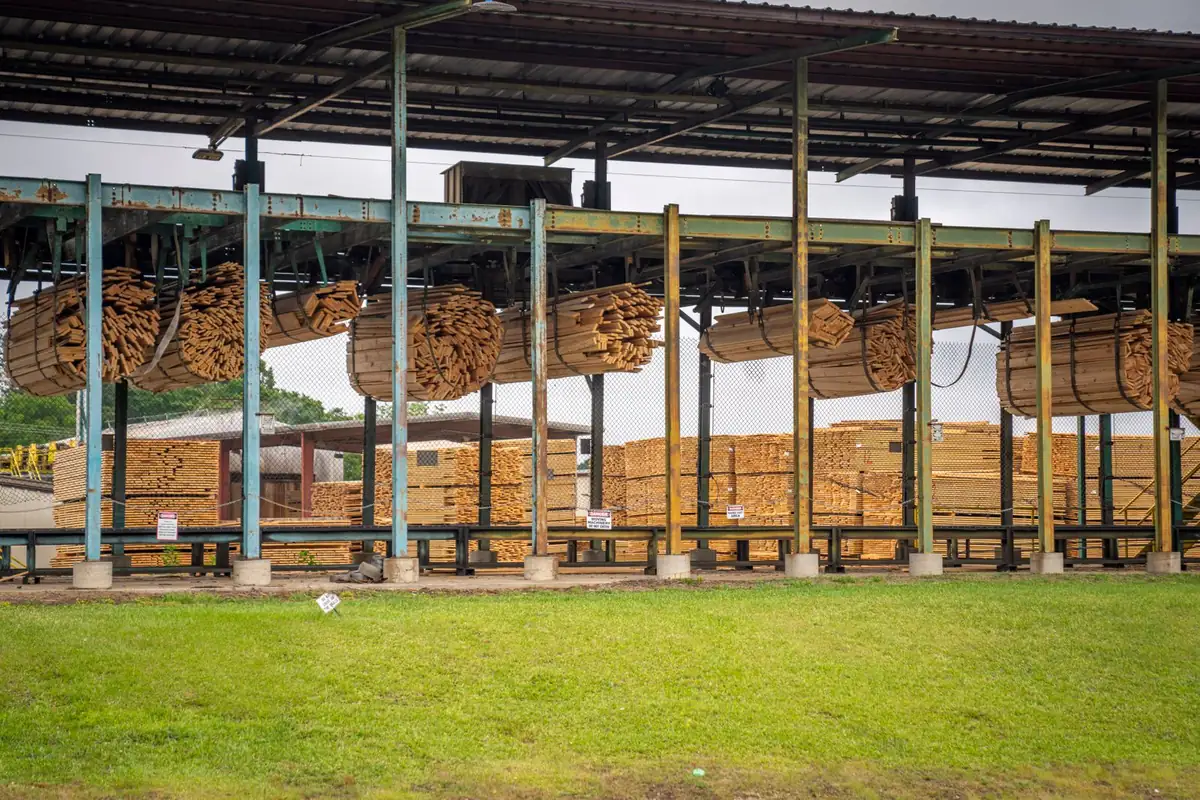
The second advantage is supply. Acacia auriculiformis is a familiar plantation species in Vietnam and grows fast, so the wood is available all year in board and slat sizes suited to pallets. Its pale colour and clear grain are also why it is used for ordinary furniture.
2.2 Disadvantages of tram wood
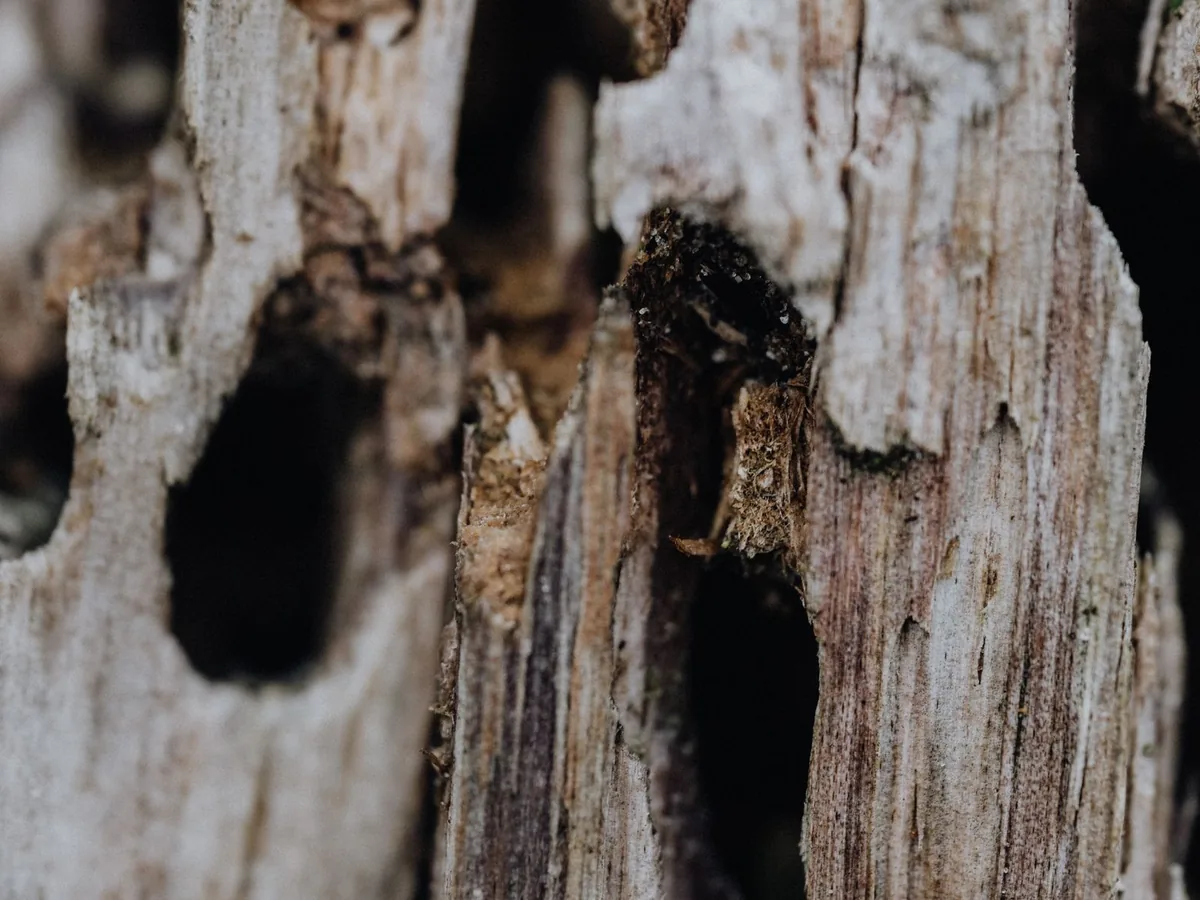
The first disadvantage is natural durability: TCVN 12619-2:2019 rates Acacia auriculiformis as poor, and the yellow outer sapwood is easily attacked by termites, borers and mould if the wood is damp or not preserved. Second, boards crack easily when sawn; the wood is harder than pine, so nailing close to the slat end also cracks it, and pilot drilling or sensible nail spacing is needed. Third, planted trunks are usually small and crooked, so it is hard to get long, wide boards without knots.
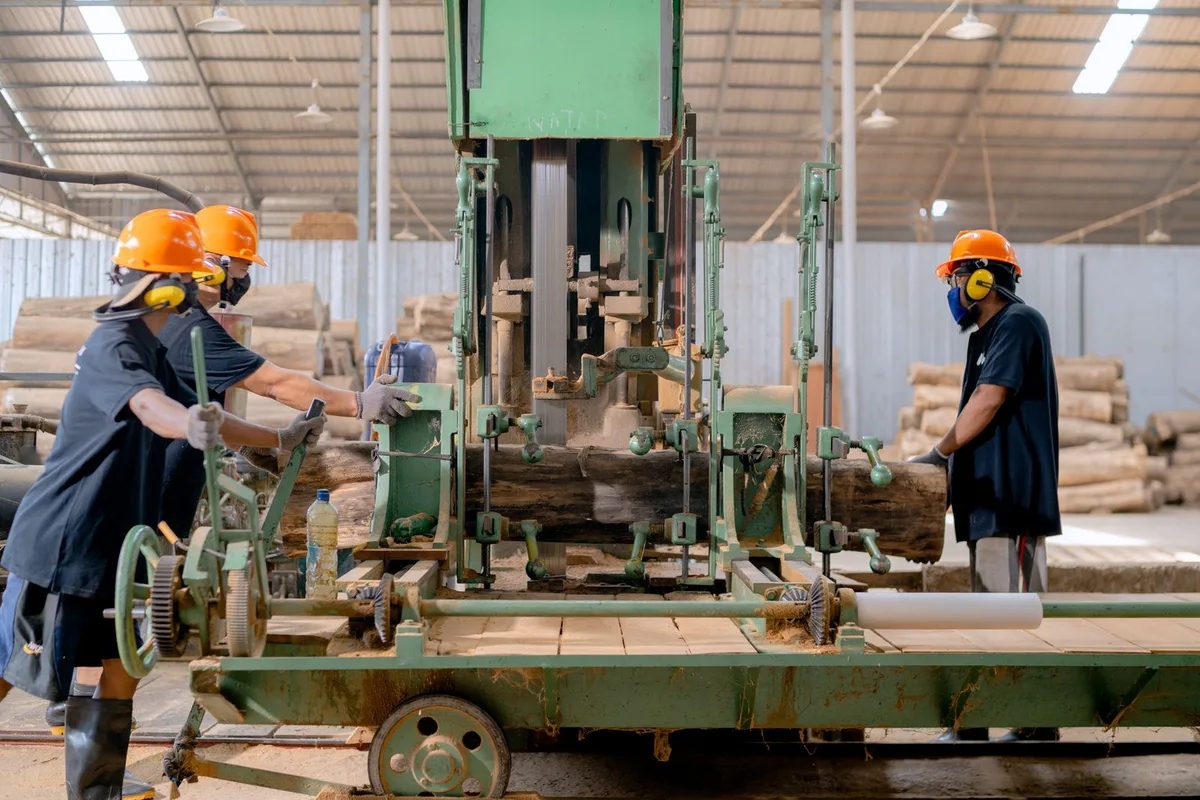
Beyond these three, there are four smaller limits. Tram wood is heavy: specific gravity 0.56 against 0.40 for Acacia mangium in the same Universiti Putra Malaysia study, so pallets take more effort to handle and raise freight when cargo is charged by weight; in return, the same density gives good load capacity and stability. Large timber is scarcer: a survey by the Vietnamese Academy of Forest Sciences on 7-year-old forests in Quang Tri found that only 1 in 10 Acacia auriculiformis trees exceeded 17 cm in diameter, against 5 in 10 for Acacia mangium, while round logs of 17-18 cm and up for joinery sell for far more than chip wood.
Supply is also less plentiful than other acacias. According to Dr Tran Lam Dong, Director of the Silviculture Research Institute (Vietnam National University of Forestry), writing in Lao Dong newspaper in 2022, Acacia mangium and hybrid acacia are the two common acacias in plantations, while Acacia auriculiformis covers less area; hybrid acacia also yields 1.5-2 times the wood volume at 7-8 years compared with Acacia mangium and Acacia auriculiformis according to the Vietnamese Academy of Forest Sciences. The colour is uneven because of reddish brown heartwood and yellow sapwood: for furniture, glued-panel makers grade the board face, with grade AA the most uniform in colour; for pallets, uneven colour does not affect load capacity. Finally, tram wood is harder than Acacia mangium but still softer than very heavy woods such as ironwood and cam xe, so the pallet surface still scratches and dents when forklift tines rub it repeatedly.
3. Uses of Tram Wood in Daily Life
Tram wood is used mostly for pallets, furniture and light building materials; according to PROSEA, Acacia auriculiformis is also a source of paper raw material, firewood and high-quality charcoal.
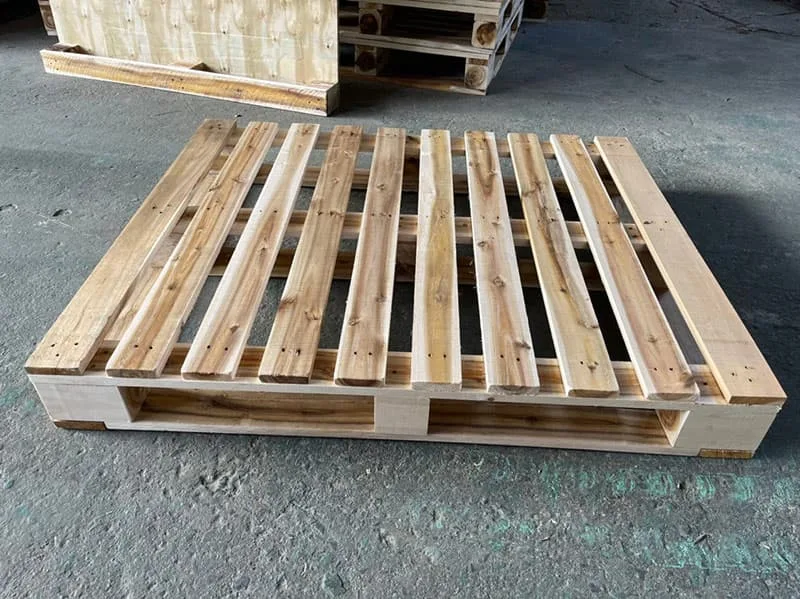
In making wooden pallets, tram wood is usually used for the deck boards, bearers and blocks of heavy cargo or recirculating pallets, where its density and nail-holding come into play. In furniture, dried tram wood is used for tables, chairs, cabinets, beds and glued panels; in construction, it goes into light parts such as floor boards and sub-frames. Small wood and branch tips are used for paper chips, firewood and charcoal.
4. Tram Wood Prices and How Tram Wood Pallet Prices Are Worked Out
The price of a tram wood pallet depends mainly on the volume of wood per pallet (size, board thickness, number of legs), the level of wood treatment and the order quantity.
Tram wood pallet prices are usually worked out on the formula:
Wooden pallet price = Wood volume + Nailing labour + Transport + Additional services
In this formula, wood volume is the largest part: the bigger the pallet, the thicker the boards and the more legs, the more wood it uses. Nailing labour depends on the number of joints and the nail type, while transport depends on quantity and delivery distance. Additional services include heat treatment and the IPPC mark for export pallets, or building to a custom drawing. Because these factors differ with each order, the price of tram wood pallets at ICD Vietnam is Contact for a quote; send the size, load and quantity so we can quote the exact specification.
5. Is Tram Wood Good? Comparing Tram Wood with Other Woods
Tram wood is equal to or slightly above Acacia mangium in density and bending strength, and equal to or slightly above radiata pine and rubber wood; in return, it is heavier and harder to work than softwood.
| Wood | Bending strength (MOR) | Data source |
|---|---|---|
| Tram wood (Acacia auriculiformis) | 86.9 MPa; 101 MPa | UPM; TCVN 12619-2:2019 |
| Radiata pine | 79.2 MPa | The Wood Database |
| Rubber wood | 71.9 MPa | The Wood Database |
| Acacia mangium | 62.2 MPa; 99 MPa | UPM; TCVN 12619-2:2019 |
Figures come from sources measured by different methods (The Wood Database for pine and rubber wood), so they only reflect the relative ranking among woods.
Read the table with care. Under TCVN 12619-2:2019, the bending strength of Acacia auriculiformis (101 MPa) and Acacia mangium (99 MPa) is almost the same. The Universiti Putra Malaysia study shows a bigger gap (86.9 against 62.2 MPa), but the authors themselves concluded that the difference in bending strength between the two species is not statistically significant at the 95% confidence level. So saying tram wood is “clearly stronger” than Acacia mangium goes too far; the clearer difference is that tram wood is denser and heavier.
Against radiata pine (79.2 MPa) and rubber wood (71.9 MPa) per The Wood Database, tram wood has slightly higher bending strength, but pine is light, easy to nail and has imported wood in uniform sizes. For pallets, the difference among these woods is usually smaller than the difference from design: board thickness, number of slats, number of legs and drying quality are what decide load.
6. Tram Wood for Pallets: What to Note
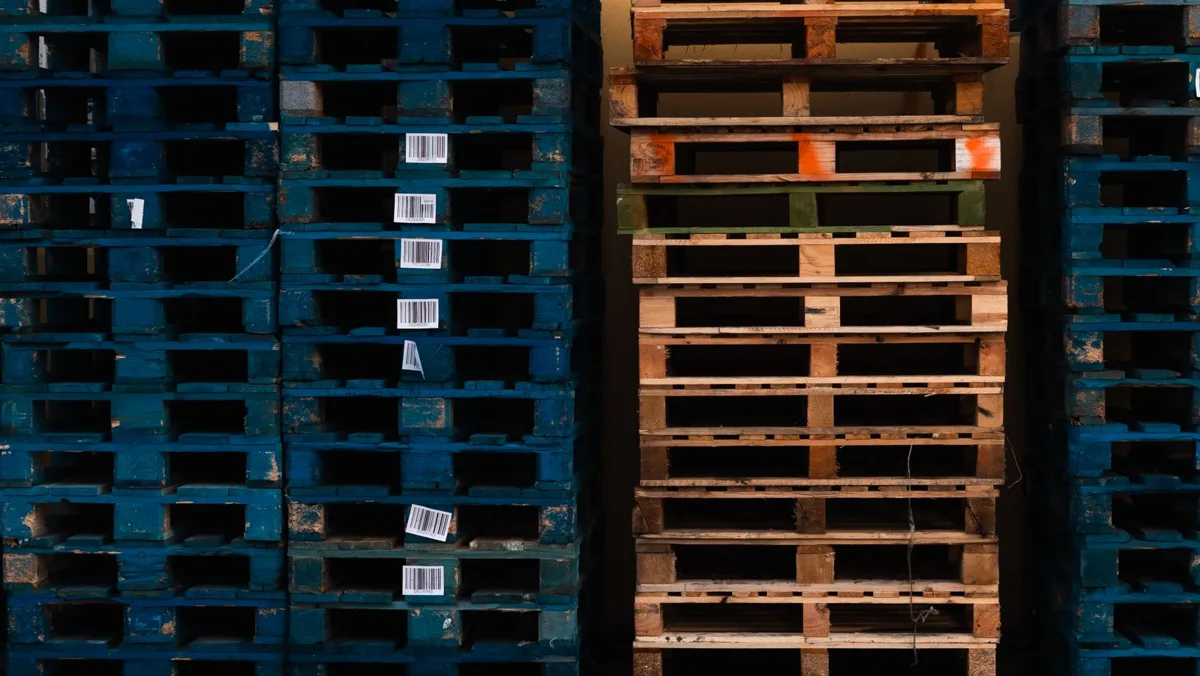
Tram wood makes good pallets when dried to the right moisture, with heartwood-rich boards chosen for load-bearing parts and nailed with the right technique. The Wood Handbook of the US Forest Products Laboratory (USDA FPL) says drying wood to 20% moisture or below and keeping it dry is how to prevent decay fungi; wood that is still damp when built shrinks, making the pallet deck uneven and nail joints gradually loose.
Most of the disadvantages of tram wood can be overcome in wood selection, drying and treatment; only the heavy weight is an inherent trait to account for when choosing pallets.
| Disadvantage | Cause | How to overcome when building pallets |
|---|---|---|
| Termites, borers and mould | Sapwood is easily attacked by insects and fungi while damp | Dry the wood, preserve it, keep pallets dry; ISPM 15 heat treatment only kills organisms already in the wood |
| Cracking when sawn | Wood trait, growth stress inside the trunk | Reject slats cracked at the ends, dry on the proper schedule, nail well away from slat ends |
| Hard to get long boards | Crooked trunk, many branches | Use for common pallet sizes and short slats; select long bearers separately |
| Heavy weight | High density | Prefer for heavy cargo, domestic warehouses and sea freight; choose lighter wood for air cargo |
| Uneven colour | Reddish brown heartwood, yellow sapwood | Does not affect pallet function; only matters for display goods |
A common misunderstanding is that a heat-treated pallet no longer has termite problems. ISPM 15 heat treatment only kills pests already in the wood, for quarantine of export cargo, and is not long-term preservation.
For export pallets, ICD Vietnam builds pallets to the customer’s specification, after which the pallets are treated and stamped with the IPPC mark under ISPM 15 through a licensed provider. If the cargo goes to the EU, note that the EU has banned the use of methyl bromide inside the bloc since 2010 but still accepts imported pallets treated by heat (HT) or methyl bromide (MB) fumigation correctly under ISPM 15; pallets carrying the EPAL mark may only be heat treated.
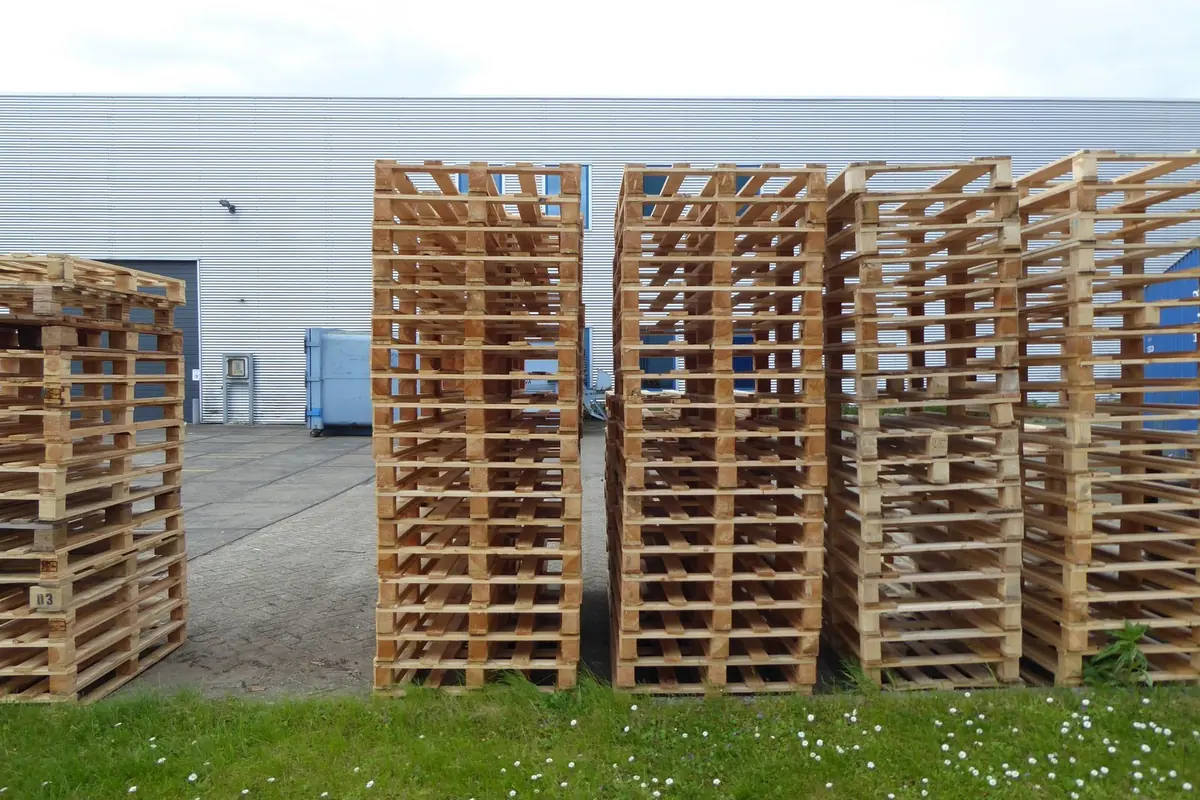
In short, choose tram wood pallets when cargo is heavy, stacked, circulating many times in a warehouse or going by sea; for export cargo, pallets must be treated and stamped with the IPPC mark under ISPM 15. One-way pallets for light cargo do not need tram wood, and lighter Acacia mangium pallets are enough; for air cargo charged by weight, lighter pine is the better priority. When using them, inspect pallets on receipt (no borer holes, no cracks at slat ends and blocks), store them in a dry ventilated place, raise them off the floor and never exceed the published load of the pallet model.
When buying tram wood pallets, ask three things: wood moisture after drying, the published load of the pallet model and the IPPC mark under ISPM 15 for export cargo. These three answers matter more than the name of the wood.
Frequently Asked Questions
Does tram wood carry load well in pallets?
Yes. Acacia auriculiformis has a reference density of 0.59 g/cm³ and a bending strength of 101 MPa under TCVN 12619-2:2019, so slats sag little and hold nails firmly. Even so, a pallet’s load depends heavily on design (board thickness, number of slats, number of legs) and wood moisture, so choose by the published load specification of each pallet model.
Do tram wood pallets get termites and borers?
They can, especially the yellow sapwood when the wood is damp. PROSEA rates the heartwood as fairly durable, but TCVN 12619-2:2019 rates the natural durability of Acacia auriculiformis as poor. ISPM 15 heat treatment only kills organisms already in the wood; to limit termites and borers long term, keep pallets dry or treat them with preservative.
Do tram wood pallets from ICD Vietnam come with a warranty?
Wooden pallets carry no warranty. ICD Vietnam accepts returns within 7 days and advises on choosing a specification by load before ordering. Hotline: 0983 797 186.
Which is better, tram wood or pine?
For load-bearing pallets, tram wood is denser and harder, with a bending strength equal to or slightly above radiata pine (79.2 MPa per The Wood Database). Pine is lighter, easier to nail and uniform in size, suiting light cargo or cargo charged by weight. Which is better depends on cargo weight and how the pallet is used.
Are acacia wood and tram wood the same?
The tram wood used for pallets is itself a kind of acacia: Acacia auriculiformis. When people say “acacia wood” they usually mean Acacia mangium or the hybrid between Acacia mangium and Acacia auriculiformis. Under TCVN 12619-2:2019, the bending strength of Acacia auriculiformis and Acacia mangium is nearly equal, but Acacia auriculiformis wood is denser and heavier.
Is tram heartwood good?
Yes. Tram heartwood is light brown to reddish brown, makes up over 70% of the trunk volume and is rated fairly durable by PROSEA, so it is more durable than the yellow outer sapwood. Boards rich in heartwood suit blocks and bearers of pallets.
What moisture must dried sawn tram wood reach when building pallets?
It should be dried to 20% or below. According to the Wood Handbook of the USDA Forest Products Laboratory, wood dried to this level and kept dry prevents decay fungi; wood still damp when built tends to shrink and warp, loosening nail joints.
What are the disadvantages of tram wood?
Tram wood (Acacia auriculiformis) has these main disadvantages: sapwood prone to termites and borers if not dried and treated; boards that crack easily when sawn; crooked trunks that make long boards hard to get; wood heavier than Acacia mangium; and uneven colour between heartwood and sapwood. Most of these can be overcome in wood selection, drying and treatment.
Should you choose tram wood pallets?
Choose them when cargo is heavy, pallets circulate many times or go by sea, provided the wood is dried, treated and carries the IPPC mark for export. One-way pallets for light cargo or air cargo do not need tram wood; Acacia mangium or lighter pine pallets are enough.
Is tram wood water resistant?
Tram wood is not a long-term water-resistant wood. Pallets soaked with water or kept damp for a long time easily get mould, change colour and lose durability. Use dried pallets, avoid leaving them in the rain and let pallets dry fully before loading again.
Contact ICD Vietnam
For advice on choosing tram wood, acacia or pine pallets by cargo load and transport route, contact ICD Vietnam. We have a production workshop, a Hanoi warehouse and a southern workshop; price: contact for a quote.
- North: 0983 797 186 / 090 345 9186 / 090 5859 186.
- South: 098 6784 186; southern workshop: 551/212 Le Van Khuong Street, Tan Thoi Hiep Ward, District 12.
- Zalo: Chat on Zalo. Email: sales@icdvietnam.com.vn.
References
- Acacia auriculiformis (origin, growth, heartwood, density): PROSEA, Pl@ntUse.
- TCVN 12619-2:2019 Wood, Classification, Part 2: By physical and mechanical properties, issued by the Ministry of Science and Technology.
- Sahri et al. (1998), Physical and mechanical properties of Acacia mangium and Acacia auriculiformis from different provenances, Pertanika J. Trop. Agric. Sci. 21(2): Universiti Putra Malaysia.
- Tram cu wood (Melaleuca): Vietnamese Academy of Forest Sciences, research report on integrated use of tram wood.
- Radiata Pine, Rubberwood: The Wood Database.
- Moisture and wood decay: USDA Forest Products Laboratory, Wood Handbook, chapter 14.
- ISPM 15 and the explanatory material on ISPM 15: IPPC, FAO.
- Evaluation of the physical and mechanical properties of Acacia auriculiformis wood from second generation plantation: Journal of the Korean Wood Science and Technology, 2026.
- Characteristics of Acacia mangium, Acacia auriculiformis and hybrid acacia in Dong Ha, Quang Tri; hybrid acacia planting techniques: Vietnamese Academy of Forest Sciences.
- Risk of a shortage of large timber for export (2022): Lao Dong newspaper.