Table of Contents
- What Is Rubber Wood?
- Is Rubber Wood Good? Pros and Cons
- Rubber Wood Compared with Pine, Oak and Acacia
- Is Rubber Wood Toxic, and How Long Does It Last?
- Common Types of Rubber Wood Board
- Uses of Rubber Wood and Making Pallets
- Rubber Wood Board Specifications and Quotations
- Frequently Asked Questions
- What is rubber wood?
- Which group is rubber wood in?
- What are the main advantages of rubber wood?
- Does rubber wood absorb water?
- Can rubber wood be used for export pallets?
- What is FSC rubber wood?
- How many kilograms per cubic metre does rubber wood weigh?
- How much heavier is a rubber wood pallet than a pine pallet?
- Is a rubber wood chopping board good?
- Is jointed rubber wood good?
- Contact ICD Vietnam
- References
Reviewed and updated by ICD - Week 43/2026
Rubber wood is timber taken from the trunk of the rubber tree (Hevea brasiliensis) once the tree has finished its latex-producing cycle, usually at 25-30 years old. Dry wood averages about 595 kg/m³ and is usually classed as group VII (the light wood group) in Vietnam. It is easy to work and reasonably priced but has poor natural durability, so it must be chemically treated and kiln dried before it is used for furniture or pallets.
I am Le Van Thang, and I have been making pallets at ICD Vietnam since 2011. Rubber wood is the species customers ask about most after pine and acacia, and the question is almost always the same: is it good, does it get weevils, can it go on export shipments. My short answer is that whether rubber wood is good depends on treatment and drying, not on the name. This article goes through the nature of the wood, its measured properties, pros and cons, the types of jointed boards, and finally using rubber wood for pallets.
What Is Rubber Wood?
Rubber wood is natural timber harvested from the trunk of the rubber tree after the tree has finished producing latex. It is plantation wood, not natural forest wood. Plantations usually fell the trees at 25-30 years, when latex yield is already very low, and replant with a new generation. Before chemical treatment against fungi and insects became available around the 1980s, exhausted rubber trees were usually burned rather than processed into timber.
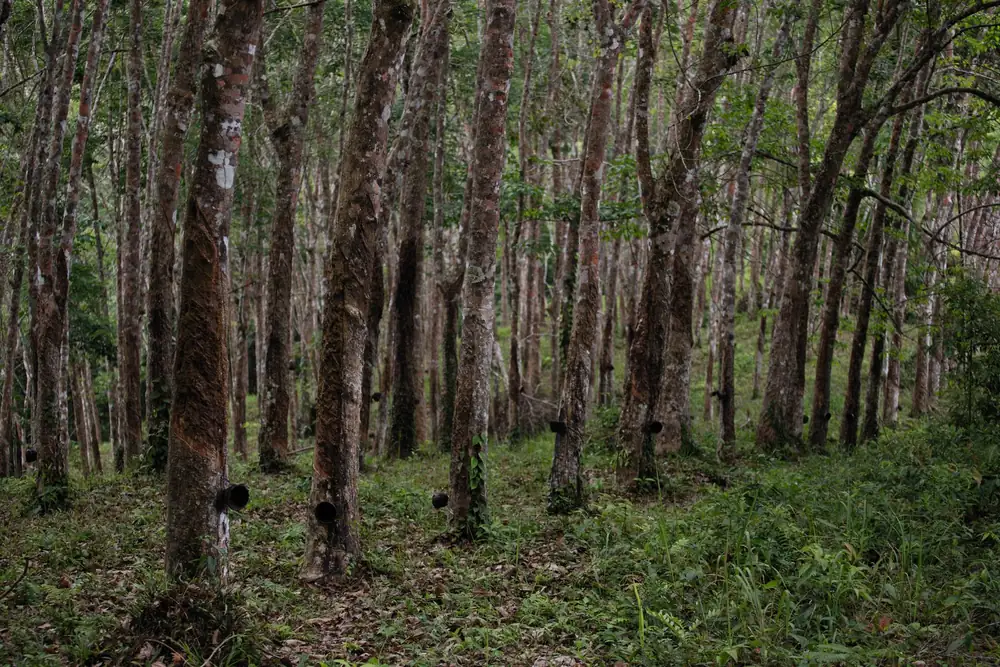
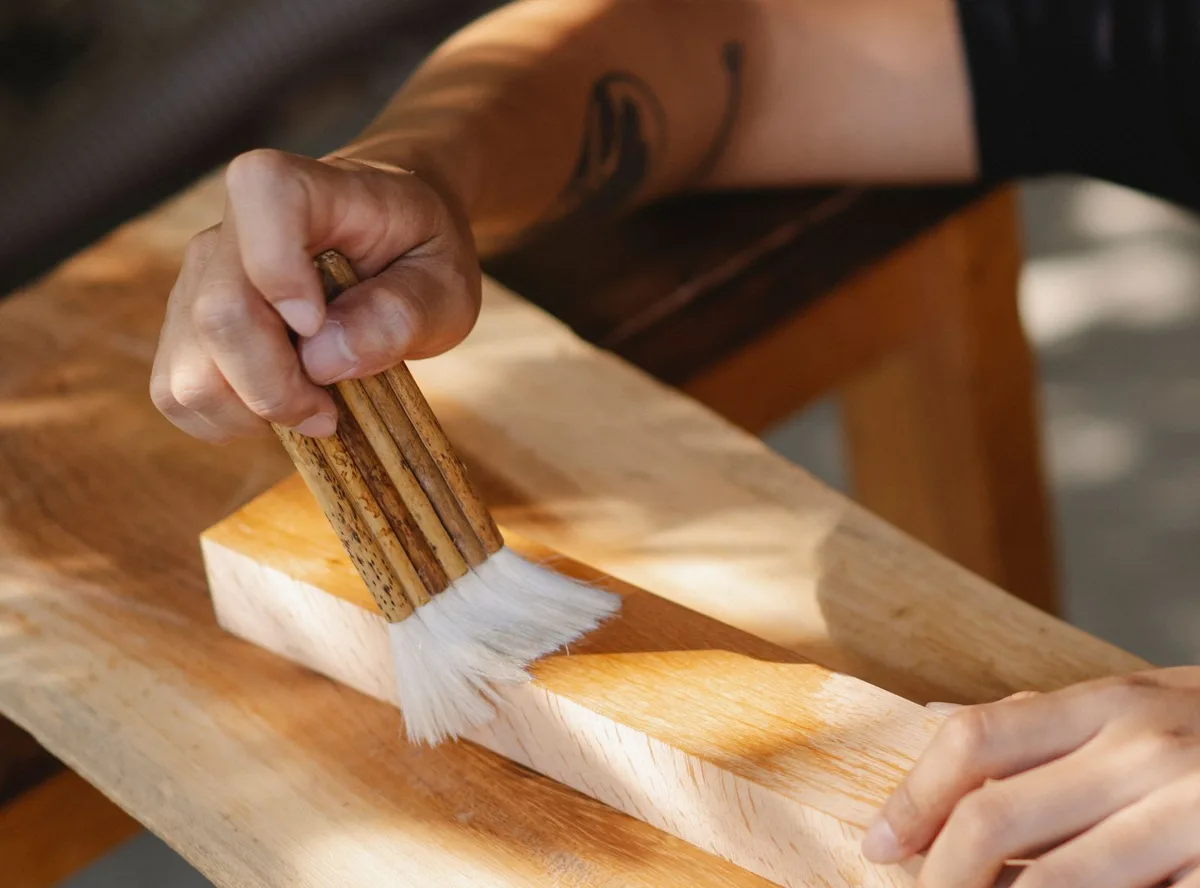
In Vietnam, rubber wood is usually placed in group VII of the wood classification table, the light wood group. This is easy to misread, because botanically the rubber tree is still a broadleaf species, so foreign sources call its timber a hardwood. The wood is pale yellow to pinkish brown with a fairly dense grain and takes paint well, so it is easily finished in cream, white or glossy PU colours.
Domestic supply is plentiful. According to the Vietnam Rubber Association, in 2024 the country had about 909.3 thousand ha of rubber, of which 734.8 thousand ha were being tapped. In 2025 the association estimated export turnover of rubber wood and rubber wood products at more than USD 3.1 billion. Each batch of trees cleared is a new batch of raw material for sawmills, board-jointing plants and pallet workshops.
The mechanical properties below follow The Wood Database, with what they mean when the wood is used for furniture or pallets:
| Property | Value | What it means in use |
|---|---|---|
| Density (dry) | 595 kg/m³ | Medium density, much lighter than premium hardwoods |
| Janka hardness | 4,280 N | Medium impact resistance, dents easily under a hard knock |
| Bending strength (MOR) | 71.9 MPa | Enough for table tops and pallet boards under ordinary loads |
| Modulus of elasticity (MOE) | 9.07 GPa | Medium stiffness under bending |
| Crushing strength parallel to grain | 42.1 MPa | Suitable for pallet legs and blocks |
| Volumetric shrinkage | 7.5% (tangential 5.1%, radial 2.3%) | Warps easily if not dried to a proper schedule |
| Natural durability | Poor, prone to staining fungi and insects | Must be treated and dried before use |
Is Rubber Wood Good? Pros and Cons
The answer to whether rubber wood is good depends on one condition: whether the wood has been treated and dried properly. When it meets that condition, rubber wood is an economical choice for indoor furniture and pallets.
- +Easy to work. Takes glue, nails and paint well, and is easy to joint into large panels
- +Light colour, easy to match. Pale yellow to pinkish brown, looks good natural or painted
- +Reasonable price. Much cheaper than oak or cherry for the same use
- +Plantation timber. Makes use of trees that have finished their latex cycle
- -Poor natural durability. Untreated wood stains with fungi and gets weevils because it holds a lot of starch and sugar
- -Warps if dried wrongly. Volumetric shrinkage of 7.5% requires a proper drying schedule
- -Medium hardness. Not as hard as rosewood, red ironwood or ebony; dents under a hard knock
- -Not suited to outdoors. Sun and rain wash out the preservative and the wood degrades quickly
One common misunderstanding online is that rubber wood is “tough and elastic” because the tree produces rubber. The Wood Database states plainly that the name comes only from the tree being grown on plantations for latex; the wood is no more elastic than other hardwoods of similar density. The claim that “rubber wood resists water well” is also wrong: untreated wood contains a lot of starch and sugar, so it is very prone to staining fungi and weevils.
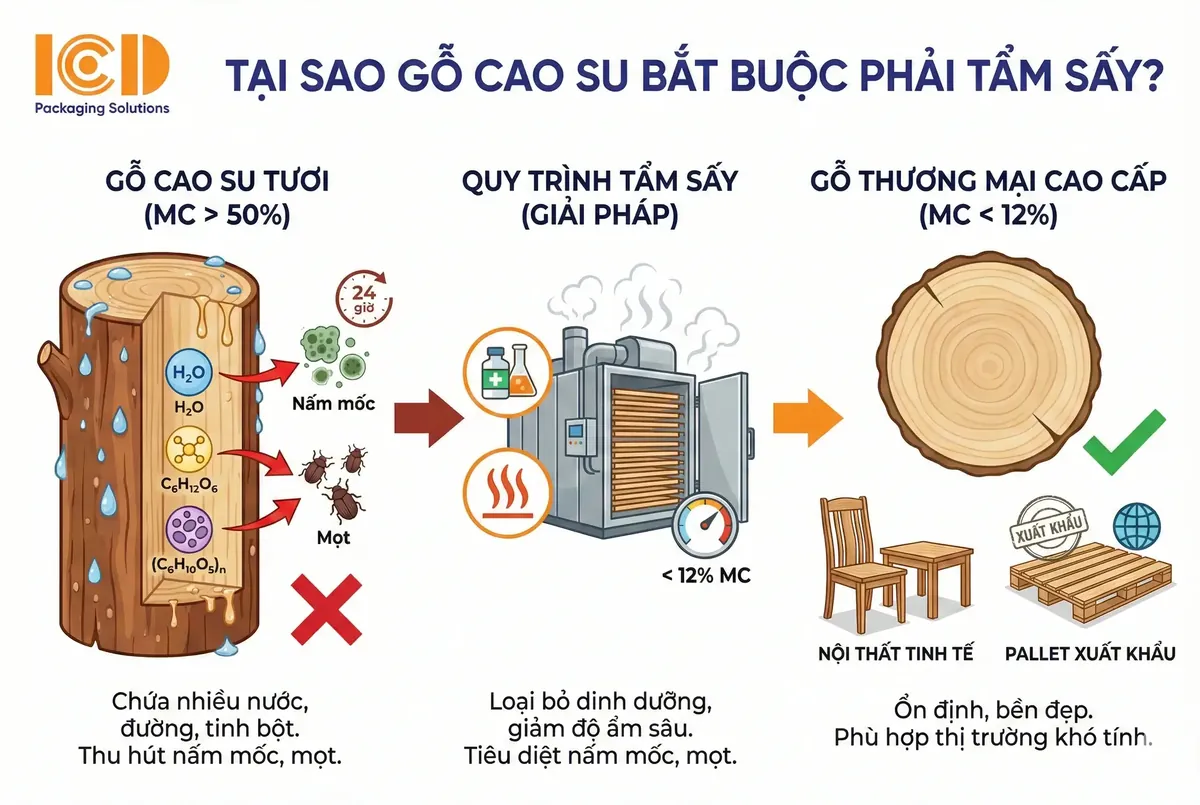
The common method is pressure treatment with a boron-based solution right after sawing so the chemical diffuses into the wood, followed by kiln drying to bring the moisture down. When buying blanks, boards or rubber wood pallets, ask clearly whether the wood has been treated and dried, and if possible ask to see the actual moisture readings for the lot.
Besides moisture readings, you can also check by eye: a board with grey-green streaks, a sour smell or tiny weevil holes is a sign the lot has not been properly treated. The Wood Database classes rubber wood as prone to rot, to staining by fungi and to insect attack, so these signs should be rejected at the point of receiving the blanks.
Rubber Wood Compared with Pine, Oak and Acacia
Rubber wood has a harder surface than radiata pine but falls short of red oak in both hardness and bending strength. The table below uses The Wood Database figures at 12% moisture so the three species are compared on the same basis.
| Property (12% moisture) | Rubber wood | Radiata pine | Red oak |
|---|---|---|---|
| Density | 595 kg/m³ | 515 kg/m³ | 700 kg/m³ |
| Janka hardness | 4,280 N | 3,150 N | 5,430 N |
| Bending strength (MOR) | 71.9 MPa | 79.2 MPa | 99.2 MPa |
On these figures red oak is about 27% harder than rubber wood, while rubber wood is about 36% harder than radiata pine. In the other direction, radiata pine is slightly stronger in bending than rubber wood, but its volumetric shrinkage when dried is as high as 10.7%, against 7.5% for rubber wood, so rubber wood holds its dimensions better after drying. The surface of rubber wood is still softer than oak and scratches easily under sharp objects, which is why rubber wood furniture is usually finished with PU lacquer to protect the surface.
Compared with acacia (Acacia mangium, hybrid acacia and Acacia auriculiformis, the last often called yellow-flower melaleuca in Vietnam), rubber wood has a smoother, more even-coloured surface that takes paint very well, so a natural or walnut finish both look good; acacia usually has an uneven grain and a darker colour. When customers ask which to choose, I usually suggest by purpose: indoor furniture on a moderate budget, or pallets that need a smooth deck, call for rubber wood; premium furniture needing a clear grain and a hard surface calls for oak; and tables, chairs or pallets left outdoors in direct sun and rain are not a fit for rubber wood, because the wood rots quickly once the preservative is washed out.
Is Rubber Wood Toxic, and How Long Does It Last?
Rubber wood is not classed as a toxic wood. According to The Wood Database, besides the general risk of wood dust from sawing and sanding, people allergic to natural rubber latex may react on contact, mainly with bare wood that has not been finished. Finished furniture carries a lower risk.
On lifespan, articles online give very different figures, from 3-5 years up to 20 years, without saying how they were measured. I give no figure, because lifespan depends mainly on the quality of treatment and drying, the surface finish and the environment of use. Rubber wood furniture kept indoors, away from standing water and direct sun, and wiped dry as soon as water is spilled, lasts a long time. The place to check regularly is the paint on edges, borders and the feet of tables and chairs, because exposed wood is where moisture and weevils get in first.
Common Types of Rubber Wood Board
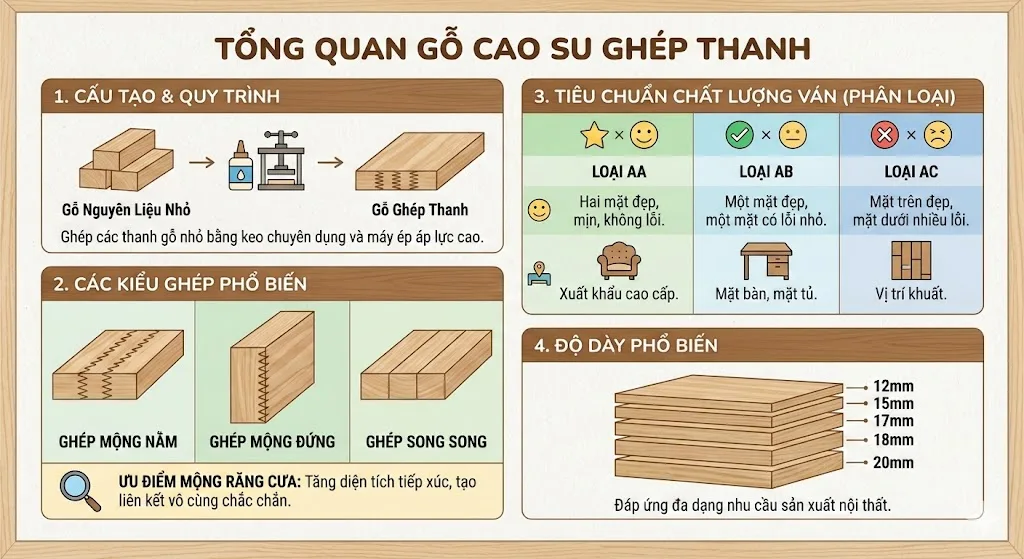
On the market, rubber wood is mostly sold as finger-jointed or edge-glued board, because rubber tree trunks are small and hard to saw into wide boards. Small pieces are glued with a dedicated adhesive in a high-pressure press, using flat joints, vertical joints or parallel jointing; finger joints increase the contact area and so make a stronger bond.
Boards are graded by the quality of the two faces. AA board has both faces smooth with no black knots and is used for premium export products where both faces show. AB board has a good top face and a bottom face with small knots or light colour flaws, suited to table tops and cabinet tops. AC board has more flaws on the bottom face, so it is usually used for cabinet backs, underlay and hidden positions. Common board thicknesses are 12, 15, 17, 18 and 20 mm.
The weakness of jointed board is not the grain but the glue lines. If the board is soaked or kept in a damp place for long, the joints can come apart and open gaps. For kitchen shelves or cabinets near water, ask for thorough sealing of the board edges with a primer, and choose board bonded with glue rated E1 or better for indoor use.
Uses of Rubber Wood and Making Pallets
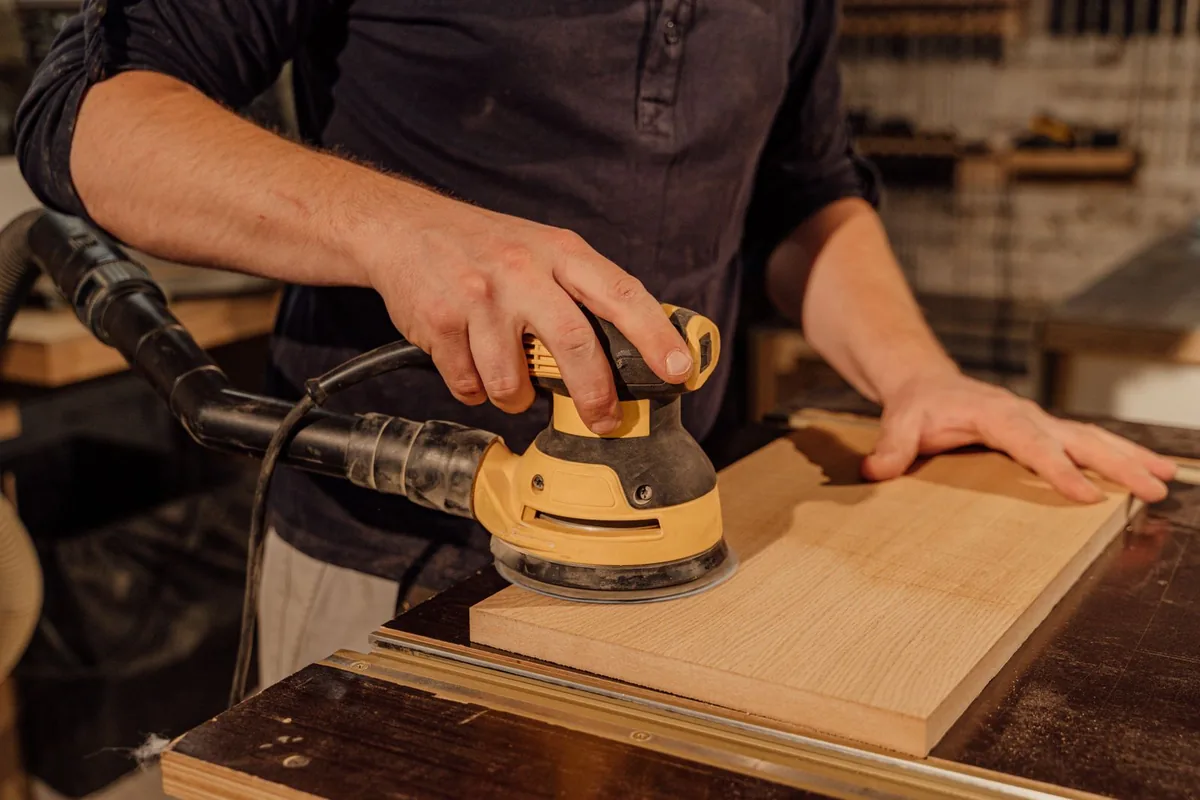
Rubber wood is used most for indoor furniture and for packaging that supports goods. At home that means dining tables, beds, wardrobes and TV stands, since the light colour makes a space look larger; in offices, desks, bookshelves and filing cabinets; there is also jointed flooring once the wood has been treated, dried and surface coated. Wooden pallets are the fourth area, where rubber wood is sawn into boards and blocks for both domestic and export cargo.
Kitchenware such as chopping boards and knife blocks is another common use listed by The Wood Database. Because the wood moulds easily, a rubber wood chopping board should be washed, wiped dry and kept somewhere airy after each use, never soaked.
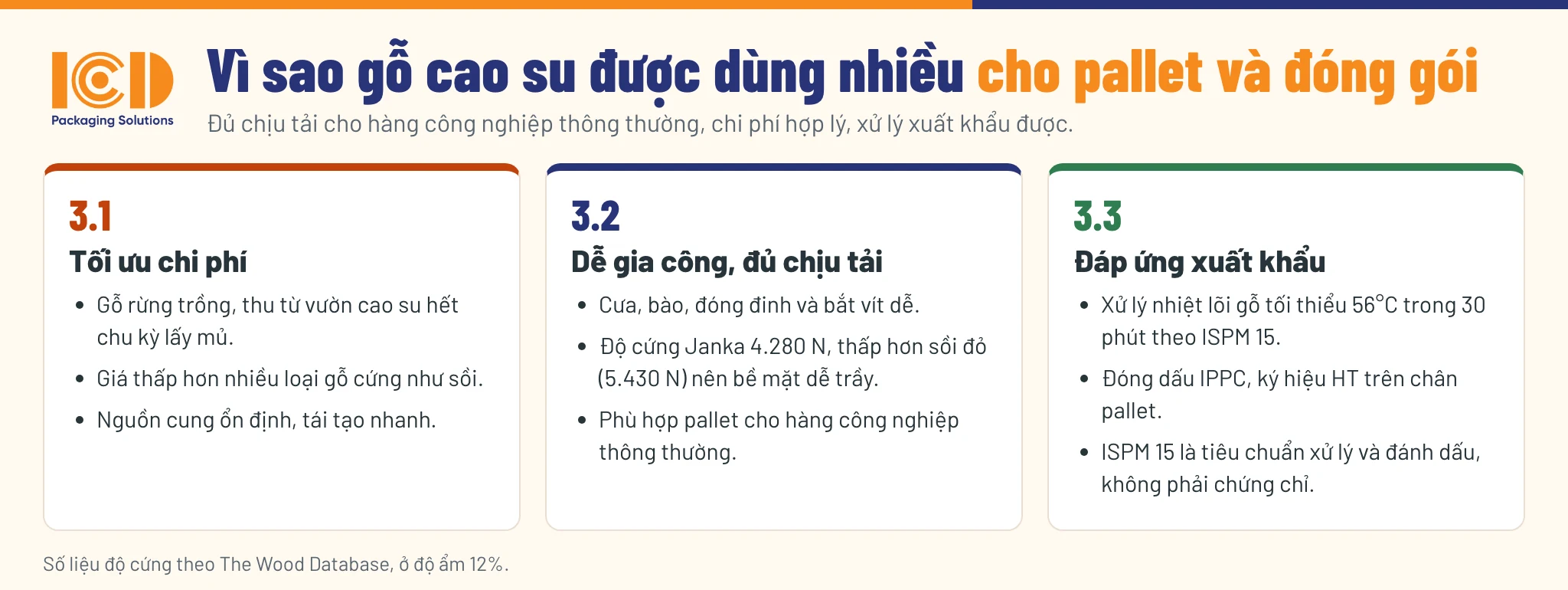
Rubber wood can be used for pallets, provided the wood has been treated against fungi and weevils and dried to a stable moisture level. With a density of about 595 kg/m³ and crushing strength of 42.1 MPa parallel to the grain, the wood is rigid enough for boards and blocks under ordinary loads. The point that most needs control is moisture: wood that is under-dried or kept in a damp place will grow surface mould, which stains cartons and food packaging placed on it.

Pallets for domestic use only need wood that has been treated against weevils and dried, with a careful check for mould, protruding nails and cracked boards before delivery. A pallet travelling with export cargo adds another requirement: the wood must be treated under the ISPM 15 standard of the International Plant Protection Convention (IPPC), most commonly heat treatment bringing the wood core to at least 56 °C for 30 continuous minutes, and then marked with the IPPC stamp.
In my experience, the most common problem with rubber wood pallets is not hardness but storage after treatment. A pallet that has been dried and marked but is left outdoors in the rain, or stacked on damp ground for a few weeks, can still go mouldy again before the container is loaded. So for export cargo I advise customers to schedule pallet delivery close to the loading date, store them under cover and off the floor, and state the moisture requirement in the purchase order if the overseas buyer has one.
Two more points customers often ask about when choosing rubber wood pallets are the surface and the weight. Rubber wood is smooth with few splinters, so it suits goods that scratch easily such as garments or finished furniture. On weight, you can estimate from density: rubber wood is about 595 kg/m³ and radiata pine about 515 kg/m³, so it is about 15% heavier for the same volume of wood. A pallet using 0.04 m³ of wood weighs about 24 kg in rubber wood and about 21 kg in pine, before counting nails and moisture. For air freight charged by weight, this difference should be allowed for in advance.
The load capacity of a rubber wood pallet depends on its size, board thickness and leg structure, so each model has its own specification; you can look at ICD Vietnam’s rubber wood pallet models before sending a quote request. When a pallet reaches the end of its life, rubber wood holds nails well and is easy to take apart and reuse for shelves or simple items.
Rubber Wood Board Specifications and Quotations
The price of jointed rubber wood board depends mainly on thickness and face grade: at the same size of 1200 x 2400 mm, the thicker the board and the better the face (AA versus AB), the higher the price. Prices also move with raw timber prices, order quantity and delivery area, so ICD Vietnam quotes per order. The table below lists common specifications to make it easier to ask for a price.
| Product type | Thickness (mm) | Size (mm) | Reference price (VND per sheet) |
|---|---|---|---|
| AA jointed board | 12 | 1200 x 2400 | Contact for a quote |
| AA jointed board | 15 | 1200 x 2400 | Contact for a quote |
| AA jointed board | 17 | 1200 x 2400 | Contact for a quote |
| AA jointed board | 18 | 1200 x 2400 | Contact for a quote |
| AB jointed board | 18 | 1200 x 2400 | Contact for a quote |
Raw unjointed blanks are usually priced per cubic metre and move with the raw rubber wood market. For rubber wood pallets, price also depends on size, leg type, load capacity and whether ISPM 15 treatment is needed.
Frequently Asked Questions
What is rubber wood?
It is natural timber harvested from the trunk of the rubber tree (Hevea brasiliensis) after the tree has finished its latex cycle, usually at 25-30 years old. It is plantation wood, not natural forest wood.
Which group is rubber wood in?
Rubber wood is usually placed in group VII of the Vietnamese wood classification table, the light group, easy to work. Botanically it is still a hardwood (a broadleaf tree); its resistance to moisture depends on treatment and drying.
What are the main advantages of rubber wood?
Easy to work, takes glue and paint well, light colour that is easy to match, reasonable price, and it comes from plantations, making use of trees that have finished their latex cycle.
Does rubber wood absorb water?
Yes, like other natural woods, and it has no natural resistance to decay. Once treated, dried and painted, the wood withstands indoor humidity, but it should not be used outdoors because rain washes out the preservative. For pallets in damp warehouses or cold stores, choose plastic pallets.
Can rubber wood be used for export pallets?
Yes, if the wood has been treated and dried and the pallet is treated under ISPM 15 (HT heat treatment, wood core at least 56 °C for 30 minutes, or fumigation) and then marked with the IPPC stamp on at least two opposite sides. Keep the pallet dry until the loading date.
What is FSC rubber wood?
It is rubber wood certified by the Forest Stewardship Council (FSC), confirming that the wood comes from forest managed to FSC standards and that the chain of custody is controlled from forest to finished product.
How many kilograms per cubic metre does rubber wood weigh?
According to The Wood Database, dry rubber wood weighs about 595 kg/m³ on average. Freshly sawn green wood is considerably heavier because it still holds a lot of water.
How much heavier is a rubber wood pallet than a pine pallet?
For the same volume of wood, a rubber wood pallet is about 15% heavier, because rubber wood is about 595 kg/m³ against 515 kg/m³ for radiata pine according to The Wood Database. A pallet using 0.04 m³ of wood weighs about 24 kg in rubber wood and about 21 kg in pine.
Is a rubber wood chopping board good?
It works well if the board is made from treated wood and kept dry after washing. With a Janka hardness of about 4,280 N the wood resists deep cuts reasonably well, but it is among the woods that mould easily, so it should not be soaked or left damp for long.
Is jointed rubber wood good?
Jointed rubber wood is good for furniture because it limits warping and makes use of small pieces. The weakness is in the glue lines: used in a damp place for long, the joints can open. Choose board bonded with glue rated E1 or better for indoor items.
Contact ICD Vietnam
ICD Vietnam supplies rubber wood, pine, acacia and pressed wood pallets in standard sizes or to drawing; pallets for export cargo are treated and marked with the IPPC stamp under ISPM 15. Prices are quoted by quantity and specification.
- North: 0983 797 186 / 090 345 9186 / 090 5859 186.
- South: 098 6784 186.
- Email: sales@icdvietnam.com.vn.
- Zalo: Chat with ICD Vietnam on Zalo.
- Fanpage: ICD Vietnam on Facebook.
References
- Harvest age, history of chemical treatment, limits for outdoor use: Wikipedia, Rubberwood.
- Mechanical properties, natural durability, allergy: The Wood Database, Rubberwood (Hevea brasiliensis).
- Comparison with radiata pine and red oak: The Wood Database, Radiata Pine (Pinus radiata) and Red Oak (Quercus rubra).
- Wood classification in Vietnam: TCVN 12619-2:2019 Wood - Classification - Part 2.
- Vietnam rubber area 2024: Vietnam Rubber Association, General Statistics 2024.
- Rubber wood exports 2025: Agricultural and Rural Development Information Centre, Vietnam’s rubber industry developing sustainably amid challenges.
- Treatment of wood packaging material: IPPC, ISPM 15.
- Forest management certification: Forest Stewardship Council (FSC).
- Characteristics of rubber trees used for timber: Vietnam Timber and Forest Product Association (VIFOREST).